

The short version
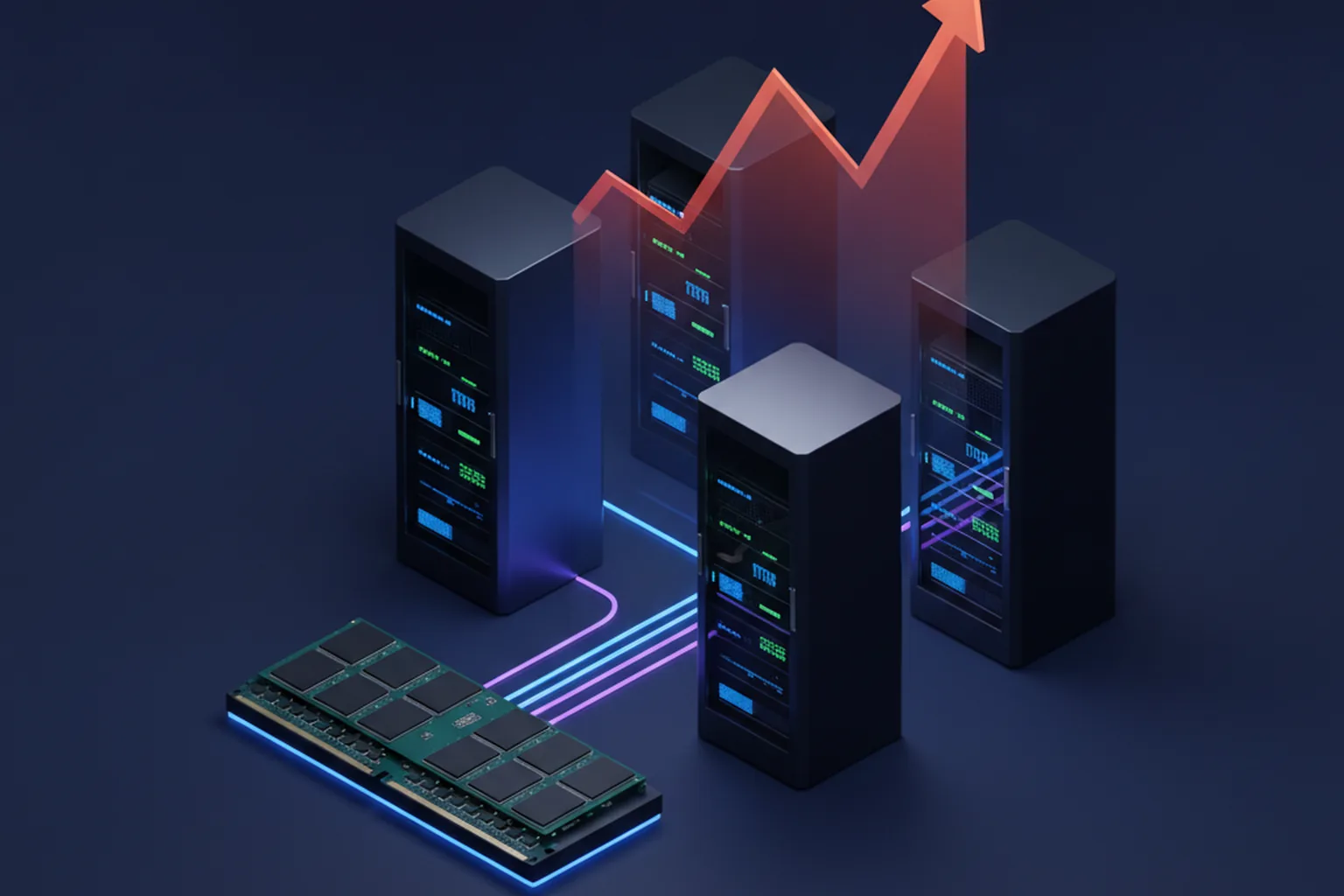
A worldwide shortage of memory chips, triggered by the AI data-center boom, is now pushing up the price of servers and cloud capacity. IEEE Spectrum reported DRAM prices rose 80–90% in a single quarter in early 2026, and Nvidia has since warned large customers that servers built on its Grace Blackwell and next-generation Vera Rubin chips will cost more than 15% more in many configurations, on systems shipped in early 2027. Analysts at TrendForce expect combined DRAM and NAND spending to climb roughly 98% year over year in 2026. None of this breaks your app today, but it changes the economics of running it — and the teams that manage their cloud infrastructure costs deliberately will feel it least.
What is actually happening
Two years of GPU scarcity taught most engineering leaders to watch accelerator supply. The tighter constraint in 2026 is the far more mundane component sitting next to the GPU: ordinary memory. IEEE Spectrum reported that DRAM prices jumped 80–90% in a single quarter earlier this year, and the pressure has continued through the third quarter of 2026 even as consumer demand cooled. The story is no longer a niche hardware headline — it is now showing up in the prices that server-builders and cloud providers quote.
The clearest signal came from the top of the market. According to reporting by Bloomberg, Nvidia has told major customers that servers built around its Grace Blackwell and next-generation Vera Rubin chips will cost more than 15% more in many configurations, with the increase attributed specifically to memory. The new prices are expected to take effect on systems shipped early in 2027, and the exact figure varies by accelerator generation and by how much memory each configuration carries. The notices are being passed along by the contract manufacturers that assemble servers for large operators including Microsoft, Google and Oracle — the companies that ultimately price the cloud capacity most teams rent.
This is not a one-vendor story. TrendForce expects combined DRAM and NAND flash spending to rise roughly 98% year over year in 2026 and another 50% in 2027, and analysts have flagged that memory is on track to consume a large and rising share of hyperscaler capital spending. When the input that goes into every server gets dramatically more expensive, the output — a virtual machine, a managed database, an AI inference endpoint — rarely stays flat for long.
Why AI made memory scarce
The mechanism is a supply reallocation, not a factory fire. Modern AI accelerators need enormous amounts of high-bandwidth memory (HBM), and HBM is far more profitable for memory makers than conventional DRAM. So manufacturers shifted wafer capacity toward HBM to feed the AI buildout, abruptly tightening the supply of the standard DRAM that ordinary servers, databases and applications depend on. IEEE Spectrum noted the HBM market alone is projected to grow from about $35 billion in 2025 toward $100 billion by 2028, and Micron's HBM share of DRAM revenue climbed from roughly 17% in 2023 to nearly half by 2025.
Demand made the squeeze worse. With thousands of new data centers planned or under construction worldwide, hyperscalers are buying memory at an unprecedented pace, and data centers now absorb a large majority of global memory output. The result is a classic shortage: soaring demand, deliberately constrained supply of the cheaper product, and lead times that stretch out for quarters. Industry executives have been blunt that meaningful new capacity will not come online until 2028 or later, which is why analysts at Gartner expect the crunch to persist at least through the first half of 2027 rather than easing this year.
How it reaches your cloud bill
Component inflation does not stay in the data center; it flows downstream. When a memory-heavy server costs 15% more to build, that cost eventually shows up in the on-demand rate, the reserved-instance price or the managed-service margin. Reporting through 2026 has already noted quiet, targeted increases — for example, higher prices on some AI-oriented capacity offerings — and providers have more room to raise memory-intensive SKUs than commodity compute. The workloads most exposed are the memory-hungry ones: large in-memory caches, analytics and vector databases, high-RAM application tiers, and AI inference that keeps big models resident.
The uncomfortable part is timing. Because much of the price pressure lands on systems shipping into 2027, the teams renewing multi-year commitments or planning next year's infrastructure budget right now are making decisions against a moving target. That makes this a planning story more than an incident: the practical response is not to panic-migrate today, but to build the cost visibility and architectural flexibility that let you absorb increases without a fire drill. Modern FinOps practice and thoughtful cloud and DevOps engineering exist precisely for markets like this one.
What it means for US & EU software teams
If you run production software on the major clouds, the first move is visibility, not migration. Most teams over-provision memory — instances sized for a worst case that rarely arrives — and that slack is now expensive. Put cost per workload and memory utilization on a dashboard, then right-size against real usage. In a glut, wasted RAM is a rounding error; in a shortage that could see memory prices stay elevated into 2027, it is a recurring tax you are choosing to pay.
The second move is to reduce how much memory your workloads actually need. Autoscaling that releases idle capacity, caching that avoids recomputation, tiered storage that keeps only hot data in RAM, and right-sized model-serving that does not pin oversized models in memory all cut your exposure to per-gigabyte price moves. For AI-heavy stacks, disciplined AI, ML and data engineering — batching inference, quantizing models, and separating hot from cold workloads — often does more for the bill than chasing a cheaper instance type.
The third move is optionality. Keep the freedom to move workloads to a different instance family, region or provider when pricing shifts, and review reserved-capacity and savings-plan commitments before you renew rather than after. For EU teams, that same portability doubles as resilience: being able to relocate a workload without a rewrite makes both a price shock and a data-residency requirement easier to satisfy. The honest caveat is that no architecture makes memory cheap — but good engineering decides whether a 15% component increase becomes a 15% budget increase or something much smaller.
How to protect your infrastructure budget
- Right-size before you renew. Match instance memory to real utilization, not to a worst case — over-provisioned RAM is now a recurring cost, not a rounding error.
- Make cost per workload visible. Put memory utilization and dollars-per-workload on a dashboard so an expensive tier is obvious and defensible to fix.
- Cut idle memory. Use autoscaling, caching and tiered storage so you are not paying to keep cold data and oversized headroom resident in RAM.
- Tune AI workloads. Batch and quantize inference, and avoid pinning oversized models in memory — inference is where memory cost compounds fastest.
- Review commitments carefully. Re-examine reserved instances and savings plans before renewal, given that pricing is moving into 2027.
- Stay portable. Keep at least one tested fallback instance family, region or provider so a price move is a config change, not a migration project.
- Budget for elevated prices. Plan next year assuming memory stays expensive at least into the first half of 2027 rather than betting on a quick reversal.
Frequently asked questions
Why are cloud and server prices rising in 2026?
A severe shortage of memory chips is the main driver. AI data-center buildouts have pulled DRAM manufacturing capacity toward high-bandwidth memory (HBM) for AI accelerators, tightening supply of conventional DRAM. IEEE Spectrum reported DRAM prices rose 80 to 90 percent in a single quarter in early 2026, and Nvidia has warned major customers of price increases above 15 percent on next-generation servers because of memory costs.
How much are Nvidia AI servers going up?
According to reporting by Bloomberg, Nvidia has told large customers that servers built around its Grace Blackwell and next-generation Vera Rubin chips will cost more than 15 percent more in many configurations, with the increases taking effect on systems shipped early in 2027. The exact figure varies by accelerator generation and how much memory each configuration includes. Contract server-builders that supply operators such as Microsoft, Google and Oracle have been passing the notices along.
When will memory prices come back down?
Analysts do not expect near-term relief. Gartner has projected the crunch will persist at least through the first half of 2027, and industry executives have said meaningful new fab capacity will not arrive until 2028 or later. TrendForce expects combined DRAM and NAND spending to rise roughly 98 percent year over year in 2026 and another 50 percent in 2027, so teams should budget for elevated prices rather than a quick reversal.
What should software teams do about it?
Treat memory as a budget line you actively manage. Right-size instances instead of over-provisioning RAM, use FinOps practices to track cost per workload, add autoscaling and caching to cut idle memory, review reserved-capacity and savings-plan commitments before renewal, and keep your architecture portable so you can move workloads to cheaper instance families or regions when pricing shifts.
Sources
IEEE Spectrum — AI Boom Fuels DRAM Shortage and Price Surge (February 2026)
Tom's Hardware — Nvidia reportedly warns biggest customers of 15% price hikes on AI servers as memory costs soar (August 2026)
SDxCentral — AI infrastructure costs set to explode as memory prices reshape budgets (August 27, 2026)