Monolith fatigue
Magento and Salesforce Commerce Cloud monoliths slow releases to a crawl. We carve out hot paths and move to composable.

GDPR PCI DSS AI-native
YuSMP Group builds revenue-grade storefronts, B2B portals and multi-vendor marketplaces on Shopify Plus, Adobe Commerce, commercetools and custom headless stacks. Our MACH-aligned teams ship Core Web Vitals-passing experiences with PCI DSS-capable checkout flows, GDPR-aligned data handling and SOC 2 Type II controls in progress — engineered for US and EU retail teams that need conversion, scale and audit-ready compliance from day one.

We deliver end-to-end ecommerce engineering across D2C storefronts, B2B and B2B2C portals, multi-vendor marketplaces and large-scale replatforming programs. Our engineers work natively in Shopify Plus, Adobe Commerce (Magento), commercetools, BigCommerce and custom headless builds on Next.js, Remix and Hydrogen — connected to ERP, PIM, OMS, CRM and tax engines through API-first integration. With 80+ senior engineers in Yerevan, CET hours overlapping US East Coast 9 AM–1 PM, and 120+ delivered projects at NPS 71, we run discovery, build, replatform, optimize and support as one accountable team. Explore how we deliver this through our Shopify Plus development service.
Challenges
Magento and Salesforce Commerce Cloud monoliths slow releases to a crawl. We carve out hot paths and move to composable.
Third-party cookies are gone. Personalization needs first-party data pipelines and consented identity, or it breaks.
VAT/OSS/IOSS (EU) + state sales tax, economic nexus, Marketplace Facilitator (US Wayfair-era rules) pile up. We integrate calculation engines (Avalara, TaxJar, Vertex) and reconcile cleanly across both regions.
Online, store, app and partner channels see different stock and prices. Unified inventory and pricing fix the customer trust issue.
Conversion lives in search and merchandising. We deploy vector and lexical hybrid search and tune for revenue, not recall.
Black Friday breaks fragile checkout flows. We harden with chaos drills, autoscaling and queue-based order intake.
Solutions
Composable stacks with commerce, CMS, search, CDP and PIM behind a unified storefront.
Multi-vendor platforms with onboarding, KYC, payouts and DSA-aligned trust and safety.
OMS, click-and-collect, store fulfilment and unified inventory across channels.
Account hierarchies, contract pricing, quotes, approvals and punch-out integrations.
Recurring billing, dunning, customer portals and growth analytics for direct-to-consumer brands.
Personalization, generative product copy and visual search tuned for US & EU first-party data.
Stack
TypeScript, React, Next.js, Node.js, commercetools, Shopify, Magento, BigCommerce, Algolia, Elasticsearch, Stripe, Adyen, PostgreSQL, GraphQL, Kafka, Kubernetes, AWS, Vercel.
Compliance
GDPR-aligned · ISO 27001 ready · SOC 2 Type II in progress · HIPAA-capable · CCPA-acknowledged
On an ecommerce platform these are vertical challenges — checkout scope, consent-driven personalization, multi-jurisdiction tax. For the deep implementation how-to we point you to the dedicated service pages: PCI DSS compliant software development, GDPR compliance consulting and SOC 2 readiness.
Integrations
A storefront is only as good as the systems behind it. We connect the commerce engine to the payment, tax, catalog, fulfilment and channel systems retail teams actually run, through API-first integration on custom software and web platform builds.
Stripe, Adyen, PayPal/Braintree and local acquirers, plus Apple Pay and Google Pay — tokenized so PCI DSS scope stays with the processor.
Avalara, TaxJar and Vertex for US state sales tax and economic nexus, plus EU VAT/OSS/IOSS calculation and per-country invoicing.
SAP, Microsoft Dynamics, NetSuite and 1C via middleware; order management, WMS and carrier integrations for unified stock and shipping.
Akeneo, inRiver and headless CMS behind the storefront, so one product-information backbone feeds every channel and locale.
Algolia and Elasticsearch for hybrid search and merchandising; consented first-party CDP pipelines with server-side tagging after the cookie sunset.
Amazon, eBay and Walmart listing and order sync, plus seller onboarding, KYC and payouts for DSA-aligned multi-vendor platforms.
Process
We run discovery, build, replatform, optimize and support as one accountable team — with conversion and Core Web Vitals deltas on every release, not just velocity.
We map catalog shape, traffic peaks and the ERP/PIM/tax landscape, then choose platform vs headless and define the composable target architecture.
Monoliths are carved along hot paths and migrated incrementally, keeping revenue stable — no big-bang cutover.
Storefront, checkout and back-office ship on custom builds with PCI-scoped payments, tax engines and OMS wired in through API-first integration.
Before Black Friday we run chaos drills, autoscaling and queue-based order intake on cloud & DevOps so peak day is boring on purpose.
Post-launch we tune search, merchandising and conversion against first-party data, with SLA-backed support and continuous Core Web Vitals monitoring.
Cases
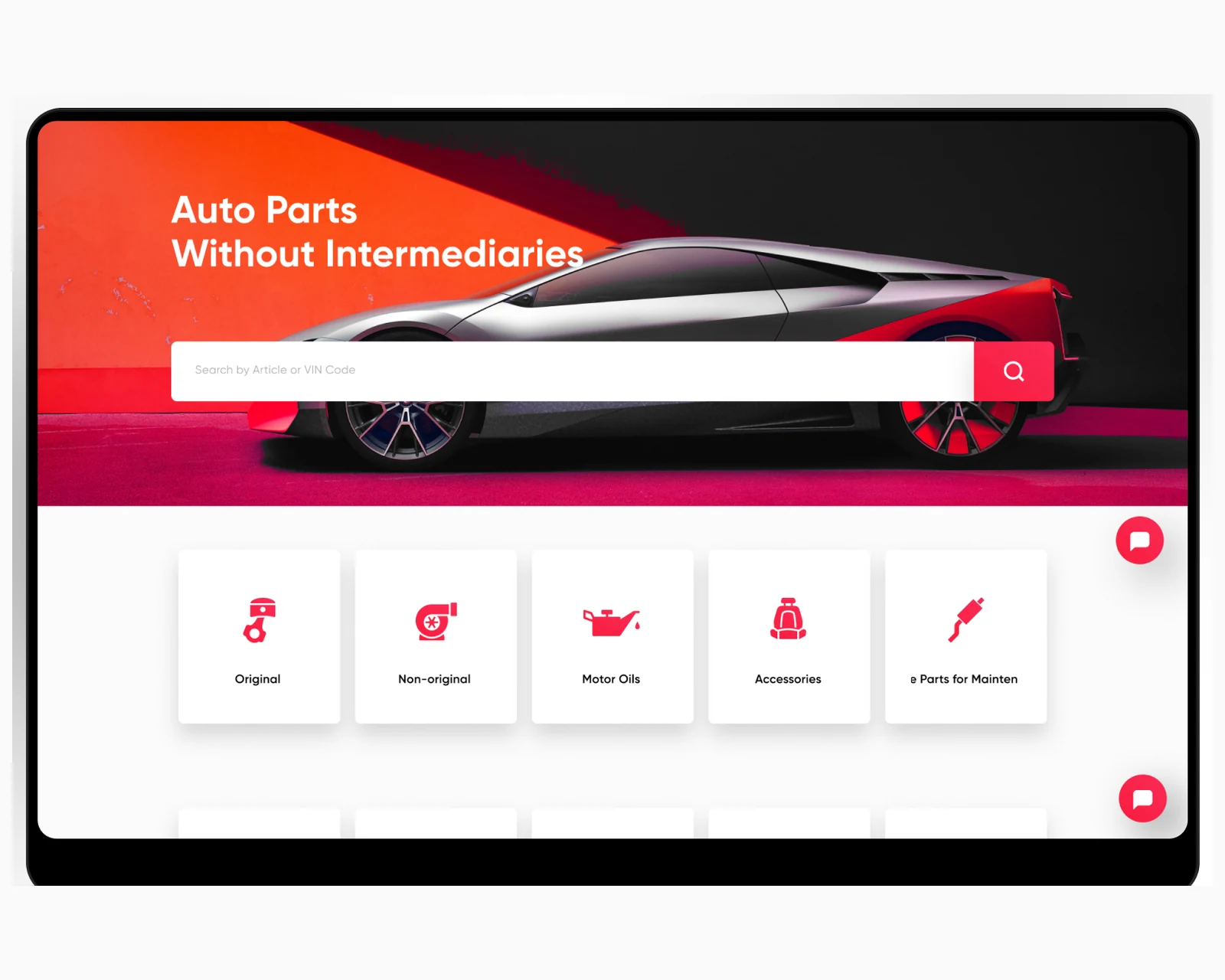
Laravel + React auto-parts storefront with real-time 1C ERP inventory sync — fitment search, card payments, personal account, US & EU launch.
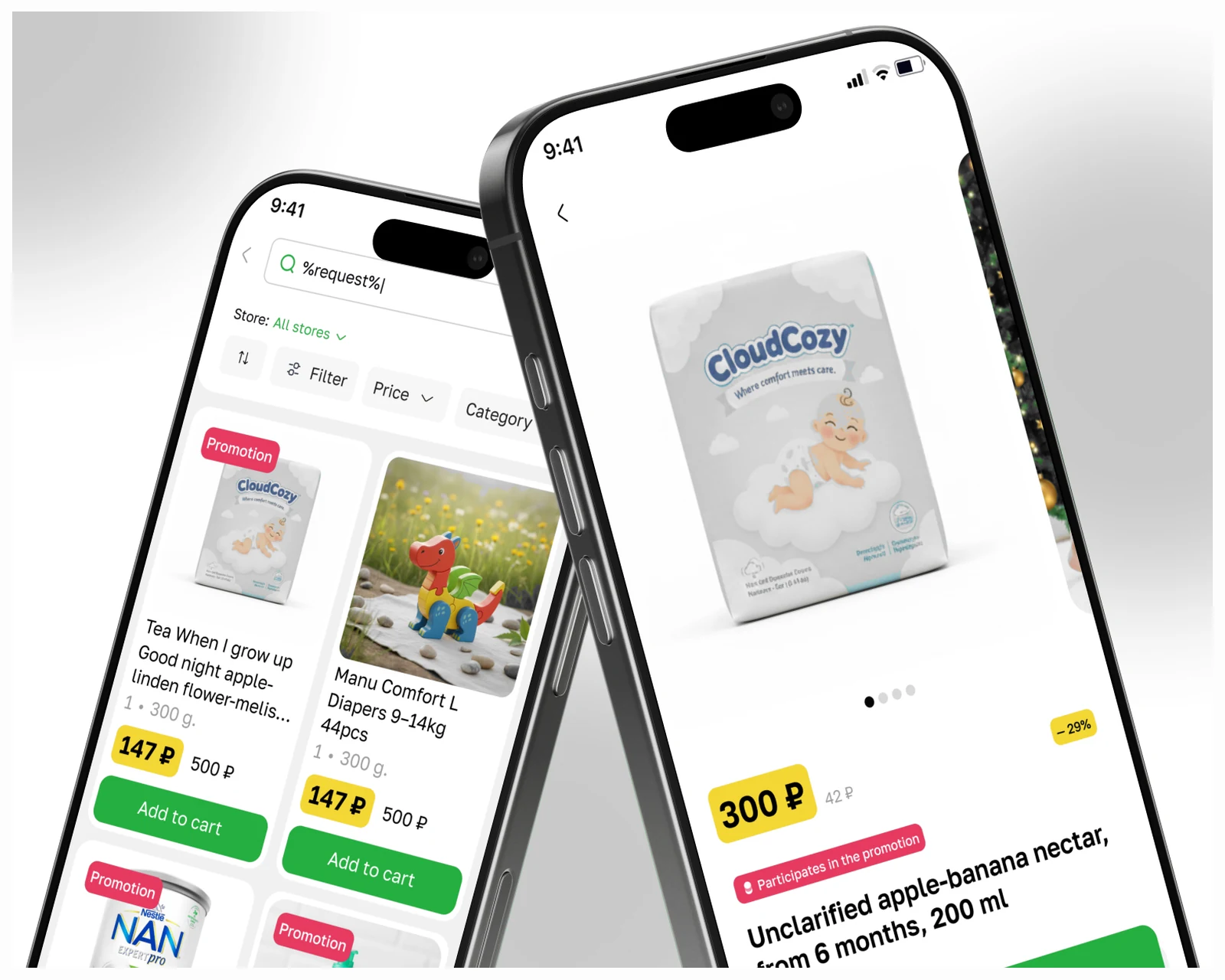
Local marketplace mobile app for an offline children's-goods chain — flexible catalog, two-tap checkout, online/offline stock sync.
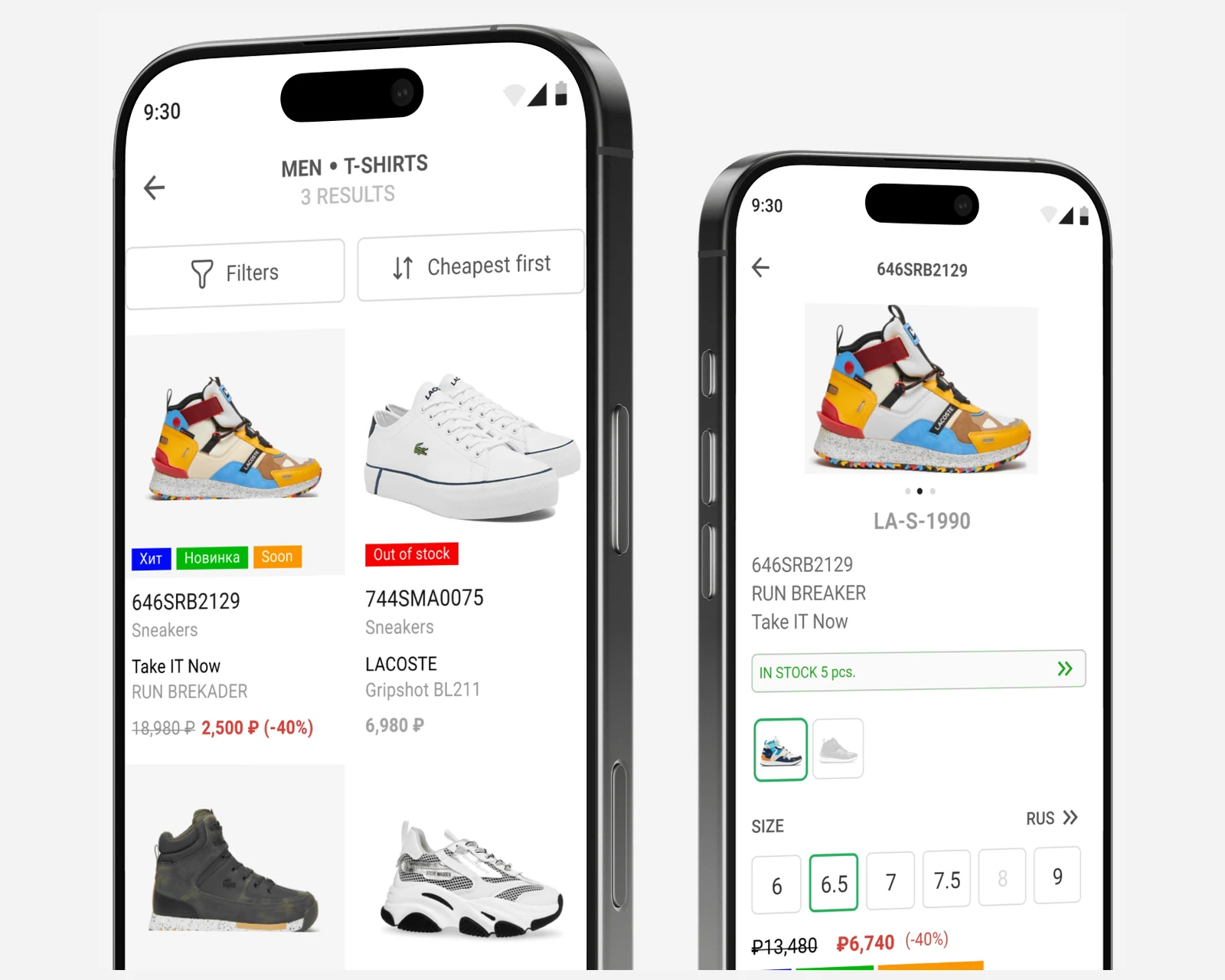
Retail POS companion app for a multi-brand boutique chain — ElasticSearch cross-store inventory search, 1C-system integration.
Why YuSMP
We don't lock you into one platform. We compose what fits your catalog and traffic shape.
Every release ships with conversion and Core Web Vitals deltas, not just velocity charts.
We rehearse Black Friday with chaos drills so your real one is boring on purpose.
Retail apps need to be fast and fault-tolerant with real-time inventory sync to offline stores. YuSMP built native Swift and Kotlin apps with ElasticSearch search, 1C ERP integration, and a two-tap checkout our customers genuinely love.
B2B commerce for a polymer products brand means complex product configurators, dealer pricing tiers, and order workflows that non-technical buyers must navigate. YuSMP built a platform our dealers adopted without a single training session. Order volumes through the portal doubled in year one.
FAQ
Yes. We split monolithic storefronts into composable commerce: a commerce engine, CMS, search and CDP behind a unified storefront, with phased migration to keep revenue stable.
We integrate VAT calculation services, support OSS and IOSS schemes, and reconcile invoices per country with proper tax codes and B2B reverse charge.
We integrate Avalara, TaxJar or Vertex for US state sales tax, track post-Wayfair economic nexus thresholds per state, and implement Marketplace Facilitator Act collection-and-remittance flows so the platform collects on behalf of third-party sellers.
We implement consent management, server-side tagging, first-party data pipelines and DSR/right-to-know/opt-out automation so personalization stays GDPR-aligned (EU) and CCPA-acknowledged (US) after the cookie sunset.
Yes. We model account hierarchies, contract pricing, quotes and approvals on top of standard B2C catalogs, with a shared product information backbone.
We build seller onboarding, KYC, content moderation and trader transparency aligned with the Digital Services Act and Omnibus Directive.
Shopify Plus makes economic sense up to approximately $100M GMV for B2C brands where speed-to-market, third-party app ecosystem, and reduced infrastructure overhead outweigh the 0.15–0.25% transaction fee and platform customization limits. Custom commerce builds are justified when your business model requires capabilities Shopify cannot deliver: complex B2B pricing rules, multi-warehouse fulfillment logic, custom payment workflows, or deep ERP integration that Shopify's API architecture doesn't support efficiently. Migration costs from Shopify to custom typically run $200k–$500k+ — factor this into your platform decision early, as the cost of migration increases with the volume of customization, data, and integrations built on Shopify.
Headless commerce delivers superior Core Web Vitals performance (LCP under 1.5s vs 3–5s for Shopify Online Store), multi-channel deployment from a single API, and developer experience improvements that reduce time-to-market for new features. The trade-offs are real: initial development cost is 2–3x higher than a traditional storefront, and operational complexity requires dedicated front-end developers and DevOps resources. Headless makes business sense when performance directly affects conversion (a 1-second LCP improvement typically lifts conversion 2–5%), when you need a true native mobile app experience, or when you're deploying the same product catalog across multiple branded storefronts, markets, or channels. For single-channel D2C brands under $20M GMV, a well-optimized Shopify theme typically outperforms headless on a cost-adjusted basis.
Black Friday load testing should simulate 10–20x your typical peak traffic with realistic user behavior patterns (product browse, search, add-to-cart, checkout) rather than just homepage hits. Key engineering requirements: autoscaling that provisions new capacity in under 60 seconds (Kubernetes HPA with KEDA custom metrics), database read replicas for product catalog queries that don't hit the primary, Redis cache warming for product pages and inventory status that starts 4 hours before the sale, and circuit breakers that degrade gracefully under load (show cached prices rather than returning errors if the pricing service is overwhelmed). We recommend a dedicated load test infrastructure that mirrors production with realistic data volumes and runs 2 weeks before the sale event, giving time to resolve bottlenecks without the pressure of the live event.
Native mobile apps convert at 3x the rate of mobile web for returning customers who have the app installed, due to stored payment credentials, biometric checkout, push notification re-engagement, and faster load performance from cached app assets. However, apps require customer acquisition investment to drive installation — a mobile web session has zero friction. The optimal strategy for most e-commerce brands is progressive: a high-performance mobile web experience (PWA with service worker caching) captures first-time visitors and drives app install prompts, while the native app delivers the high-conversion experience for loyal returning customers. App investments make economic sense once you have 50,000+ monthly active buyers who repeat purchase regularly.
Algolia is the fastest path to high-quality e-commerce search: it is SaaS, requires no infrastructure management, delivers sub-10ms query response through its distributed search network, and provides a well-designed merchandising dashboard for non-technical teams to manage search ranking rules, synonyms, and promoted results. Elasticsearch (or OpenSearch) gives you full control over ranking algorithms, infrastructure costs that scale linearly rather than per-search-operation, and the ability to process complex aggregations that power faceted navigation on catalogs with millions of SKUs. Algolia is the right choice for most e-commerce teams up to $100M GMV; Elasticsearch becomes economically justified above that scale or when search requirements exceed Algolia's ranking flexibility. We implement both and provide a cost/capability analysis for your specific catalog size and query volume.
E-commerce technical SEO has distinct requirements beyond standard site optimization. Canonical tags are critical for handling URL parameter variants (faceted navigation, sorting, pagination) that create thousands of near-duplicate URLs Google won't index efficiently — implement canonical consolidation with rel=canonical and crawl budget management via robots.txt parameter rules. Product schema (schema.org/Product) with price, availability, review ratings, and GTIN/MPN identifiers enables rich results in Google Shopping and SERP features. Faceted navigation requires JavaScript-rendered or server-side filter states that Google can crawl without executing state-change JavaScript. Internal linking between category pages, subcategories, and products passes PageRank efficiently through the site hierarchy. Site speed is particularly important for e-commerce: Google's Core Web Vitals (LCP, INP, CLS) are confirmed ranking factors, and a 1-second improvement in LCP directly correlates with 5–10% conversion improvement.
From composable storefront architecture to subscription management and marketplace platforms, we cover the full spectrum of modern e-commerce engineering.
Headless commerce decouples the frontend presentation layer from the backend commerce engine, enabling faster page loads (Lighthouse 90+ scores), framework flexibility, and multi-channel content delivery from a single commerce API. We build Next.js storefronts on Shopify Storefront API and commercetools GraphQL API, implement content federation with Contentful or Sanity CMS, and configure edge-deployed storefronts on Cloudflare Pages or Vercel that serve product pages in under 200ms globally.
Composable architecture assembles the commerce stack from best-of-breed MACH (Microservices, API-first, Cloud-native, Headless) components, allowing each capability to be replaced independently as technology and business requirements evolve. We design composable commerce reference architectures for Shopify Plus, commercetools, Elastic Path, and BigCommerce backends, with a unified GraphQL API federation layer that presents a consistent interface to the frontend regardless of the backend commerce engine.
Multi-vendor marketplace platforms require significantly more technical complexity than single-seller stores: seller onboarding workflows, commission calculation engines, escrow payment systems with payout scheduling, and dispute resolution tooling. We build marketplace architectures with seller-specific sub-accounts, implement Stripe Connect or Adyen Platforms for marketplace payments and instant payouts, and design commission structures with tiered rates and promotional override capabilities.
Seller dashboards with real-time earnings visibility, inventory synchronization across the marketplace and seller's own channels, and performance analytics create the marketplace value proposition that drives seller adoption. We implement seller rating and review systems with verified purchase validation, fraud detection for fake review injection, and seller performance scoring that surfaces high-quality sellers in search rankings and category pages.
Native mobile apps convert at 3x higher rates than mobile web for returning customers due to stored payment methods, biometric authentication, and push notification re-engagement. We build native iOS/Android commerce apps with Apple Pay and Google Pay integration, implement intelligent cart abandonment push notification sequences using Braze or Klaviyo, and create ARKit/ARCore product visualization features that let customers preview products in their real environment before purchasing.
App-exclusive promotions, loyalty point tracking, and personalized home screen widgets create differentiated value that motivates mobile app installation over mobile web. We design mobile-first product discovery experiences with visual search (search by image), barcode scanning for in-store price comparison, and swipe-based product browsing interfaces that match the native interaction patterns of iOS and Android.
Personalization engines that serve the right product to the right customer at the right price are responsible for 35–40% of revenue at leading e-commerce companies. We build real-time recommendation systems using collaborative filtering on session behavior and purchase history, implement ML-based dynamic pricing models that optimize margin while maintaining conversion rate, and develop AI-powered merchandising automation that adjusts product ranking based on inventory levels, margin, and customer segment signals.
Real-time personalization requires feature stores (Feast) that serve pre-computed customer and item embeddings to inference APIs with sub-10ms latency, enabling recommendations that respond to the current browsing session rather than yesterday's batch-computed preferences. We implement A/B testing infrastructure for recommendation algorithm experiments, measuring incremental revenue lift rather than click-through rate as the primary success metric.
Unified commerce unifies the customer experience across every touchpoint by maintaining a single view of inventory, customer profile, and order history regardless of where the interaction occurs. We integrate cloud-based POS systems (Lightspeed, Square, Shopify POS) with e-commerce backends through real-time inventory sync APIs, build BOPIS (buy online, pick up in store) workflows with store-specific availability checks and pickup notification systems.
Clienteling tools give store associates access to customer purchase history, product affinities, and loyalty status during in-store interactions, enabling personalized service that replicates the online recommendation experience in physical retail. We integrate clienteling APIs with POS systems and CRM platforms (Salesforce, HubSpot), implement mobile associate apps for floor-walking customer engagement, and build endless aisle order capture for out-of-stock items that fulfill from the e-commerce warehouse.
D2C subscription programs deliver predictable recurring revenue but require sophisticated cancel-save flows, dunning management, and pause options that reduce involuntary churn. We integrate Recharge Payments and Ordergroove for subscription management on Shopify/BigCommerce, build retention analytics dashboards that track MRR, churn rate, and LTV cohorts by acquisition channel, and design tiered loyalty programs that increase purchase frequency through behavioral incentive mechanics.
Subscription box personalization uses ML models trained on subscriber preference surveys, return history, and rating data to curate monthly boxes that reduce return rates and increase perceived value. We build curation algorithm APIs that combine rule-based merchandising constraints (brand budget caps, category diversity requirements) with ML recommendations, and implement feedback loops that improve personalization accuracy with each subscription cycle.
In-depth guides on building and scaling online stores — sales tax, payments and platform choices.






Response within 1 business day. NDA on request.
Share a few details and a senior consultant will reply within one business day.