

TL;DR — ecommerce software development in one paragraph
Ecommerce software development builds online-selling platforms (a storefront, checkout, catalogue, order and inventory system) around how a brand or retailer actually sells. In 2026 a build runs roughly $20,000–$500,000+ and reaches a first launch in three to nine months. Most of that outcome hinges on one early decision: monolithic, headless or composable architecture. The other thing that makes or breaks it is PCI DSS 4.0 security and payment compliance, engineered in from sprint one rather than bolted on. Ship a working buy-flow first. Personalisation, channels and merchandising come later, in phases.
What is ecommerce software development?
Ecommerce software development is the work of designing, building, integrating and supporting online-selling platforms — ones tailored to how a specific brand, retailer or marketplace actually sells. A generic template store does the opposite. It forces your catalogue, pricing and fulfilment into its own mould. Custom work runs the other way: a development team maps how those workflows really run, builds the storefront and checkout around them, then wires the platform into the payment, ERP and shipping tools you already use, all while keeping it PCI DSS compliant. You end up with a purpose-built commerce system rather than a patchwork of plugins your operations have to work around.
Commerce products get judged on conversion and payment security at the same time, which puts this work at the specialised end of delivery. That's why it usually lands with a team offering dedicated ecommerce software development services rather than a generic dev shop. A capable partner covers the full arc: discovery and workflow mapping, architecture and the data model, storefront and checkout development, integration with your payment gateway, ERP and shipping carriers, then data migration and ongoing support. Payments carry more risk than any other part of the build, so it's worth reading our payment gateway integration guide alongside this one before you scope the checkout.
Types of ecommerce software you can build
There are six main types of ecommerce software: the direct-to-consumer storefront, the B2B commerce portal, the multi-vendor marketplace, the subscription-commerce platform, the point-of-sale and omnichannel layer, and the order and inventory management system. Most real products don't try to be all six. They pair a storefront with one or two of the others. A D2C storefront lives or dies on conversion. A B2B portal turns on negotiated pricing and approvals; a marketplace gathers many independent sellers under one roof; the OMS is the operational backbone sitting behind whichever front end you run. Here's what each type does, and who tends to build it.
| Type | What it does | Typical buyer |
|---|---|---|
| D2C storefront | Sells a brand's own catalogue directly to consumers with a conversion-focused checkout | Retail and consumer brands |
| B2B commerce portal | Handles negotiated pricing, quotes, approvals and reordering for business buyers | Manufacturers, wholesalers, distributors |
| Multi-vendor marketplace | Lists, sells and settles payments across many independent sellers | Marketplace startups and platforms |
| Subscription commerce | Manages recurring billing, plans, dunning and lifecycle for repeat orders | DTC subscription and replenishment brands |
| POS & omnichannel layer | Unifies online and in-store stock, orders and customer data across channels | Multi-store and hybrid retailers |
| Order & inventory (OMS) | Routes orders, tracks stock and drives fulfilment and returns | Operations-heavy sellers at scale |

Custom-built vs SaaS platforms: how do you actually choose?
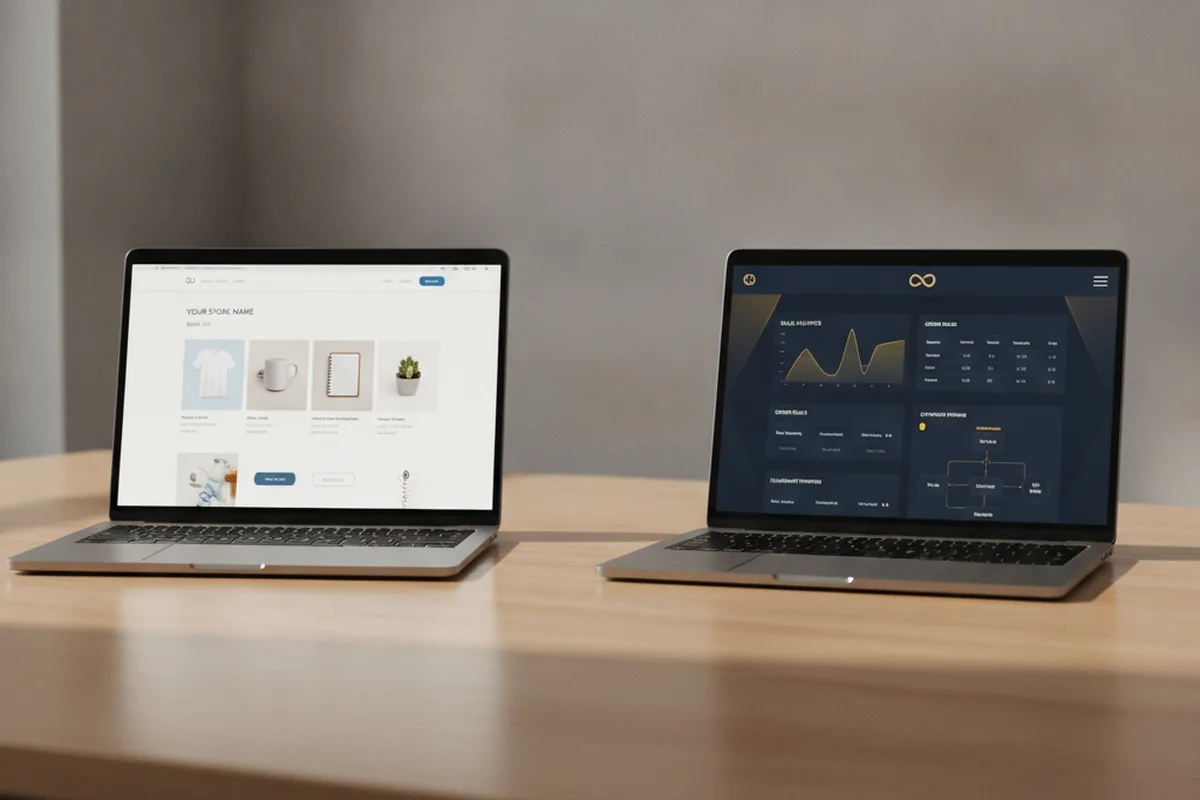
Before architecture, there's an earlier decision: build custom or buy a SaaS platform such as Shopify Plus, BigCommerce or Adobe Commerce. A SaaS platform gets a store live in weeks, costs less upfront, and ships with security and uptime handled for you — the trade-off is platform lock-in, per-transaction fees and a ceiling on how far you can bend checkout, pricing logic or integrations. Custom-built software costs more upfront and takes longer to launch, but there is no ceiling: catalogue rules, pricing logic, checkout flow and every integration are yours to shape, and you own the code and the data model outright.
| Factor | SaaS / off-the-shelf | Custom-built |
|---|---|---|
| Time to launch | Weeks | 2–9+ months |
| Upfront cost | Low ($0–$10k setup) | $20,000–$500,000+ |
| Ongoing fees | Subscription + per-transaction fees | Hosting + maintenance only |
| Flexibility | Bounded by the platform's data model and app marketplace | No ceiling — catalogue, checkout and integrations built to spec |
| Best fit | New stores, standard catalogues, revenue under ~$1M | Complex catalogues, negotiated pricing, deep ERP/CRM integration |
Three signals usually mean it's time to move off a SaaS platform: you're paying meaningful transaction fees on real volume, your catalogue or pricing rules don't fit the platform's data model without workarounds, or you need an integration — ERP, a specific payment flow, a loyalty system — that the platform's app marketplace can't cover cleanly. Below that threshold, a SaaS platform is the pragmatic call: a template store gets you selling sooner, and re-platforming later is a known, bounded cost. Above it, custom or headless commerce is what stops your operations from being bent to fit someone else's platform.
Monolithic vs headless vs composable: which architecture?
Architecture is the single most consequential decision in an ecommerce build, and the right answer tracks your revenue. Monolithic works for small stores. Headless earns its keep once a brand is growing, and composable is the enterprise play. Get this wrong and it hurts: 2026 platform analyses put the waste from a mistaken choice at $50,000–$500,000 in rework, before you count the ongoing infrastructure cost. So choose against your actual revenue, catalogue complexity and channel count, not against whatever is trending this quarter. The trade-offs look like this.
| Architecture | How it works | Best fit (2026) |
|---|---|---|
| Monolithic | Storefront, checkout and back office in one platform — fastest and cheapest to launch | Stores under ~$1M revenue, standard catalogues |
| Headless | Custom front end decoupled from the commerce engine via APIs; update one layer without the other | Growing brands ~$5M–$20M, custom UX needs |
| Composable (MACH) | Best-of-breed modules for catalogue, search, checkout and payments assembled via APIs | Enterprise scale, multi-brand or multi-region |
Composable commerce follows the MACH pattern (microservices, API-first, cloud-native and headless), and it's no longer a fringe choice. Forecasts have more than 60% of mid-sized and large retailers leaning on composable architectures by 2027, and around 64% of enterprises already run headless at scale. There's a catch, though. Flexibility is what composable sells you, and it charges for that in integration and orchestration work, which is why an enterprise MACH implementation commonly runs 9–12 months. Once you're serving many brands or regions from one codebase, the multi-tenant question surfaces early; our guide to building a multi-tenant SaaS architecture covers how to isolate each tenant's data safely.
Must-have features of modern ecommerce software in 2026
A plain catalogue-and-cart no longer clears the bar. In 2026 a store is expected to blend AI personalisation, fast APIs, omnichannel inventory and payment security, and shoppers and operators now treat the list below as table stakes. Scope each item as its own deliverable instead of assuming it comes for free. The realistic goal is a strong core of five to seven of these, done well, rather than a thin version of all seven.
- AI personalisation and search. Recommendations, ranking and semantic search tuned per shopper — personalised recommendations now drive roughly 31% of ecommerce revenue for many retailers.
- Frictionless, tokenised checkout. One-page and express checkout with wallets, and card data handled by a PCI-compliant gateway so it never touches your servers.
- Omnichannel inventory and orders. A single source of truth for stock and orders across web, app, marketplace and store.
- Headless content and merchandising. API-driven content and campaign tools so marketing can move without a developer.
- Integrations layer. Clean APIs to your ERP, payment gateway, shipping carriers, tax engine and CRM.
- Analytics and reporting. Conversion, cohort, margin and inventory dashboards built on a reporting-ready data model.
- Performance and mobile-first. A fast, Core Web Vitals-friendly, accessible (WCAG 2.2) experience — most 2026 traffic is mobile.
The ecommerce software development process
Ecommerce software gets built in phases, never in a single pass. The sequence below is roughly what a disciplined team follows, and it matters because each phase hands the next one a deliverable it depends on. One rule outranks the rest: launch a working buy-flow before you add advanced merchandising or extra channels. The core stages, in order:
- Discovery & workflow mapping. Document how catalogue, pricing, checkout, fulfilment and returns work today, agree the target flows, and define scope, channels and success metrics. Deliverable: a prioritised feature plan and requirements.
- Architecture & data model. Choose monolithic, headless or composable, design the catalogue, order, inventory and customer models, the integration approach and the payment-security model. Deliverable: an architecture the whole platform runs on.
- UX & conversion design. Design the storefront and checkout for conversion and accessibility (WCAG 2.2), because revenue depends on a buy-flow that works for everyone. Deliverable: validated, accessible flows for the first release.
- Agile build. Develop the core buy-flow first — browse, cart, checkout, pay, confirm — with the data model and PCI controls in place from day one. Deliverable: working features, integrated as they land.
- Integration. Connect the payment gateway, ERP, tax engine, shipping carriers and CRM via APIs. Deliverable: a connected store, not an island.
- QA, security & load testing. Test functionality, checkout security, accessibility and performance under peak-season traffic, then run user-acceptance testing. Deliverable: a signed-off, hardened build.
- Phased launch & support. Launch the core store, monitor conversion and errors, then add personalisation, channels and merchandising. Deliverable: a live store with a support and enhancement loop.

How much does ecommerce software development cost in 2026?
A 2026 build typically costs between $20,000 and $500,000 or more, with the range driven by architecture, feature depth, integrations and how complex your catalogue is. The number climbs steeply as you move from a monolithic store to headless and then composable. The bands below come from 2026 vendor and platform cost studies. Read them as planning ranges, not quotes.
| Build size | Typical 2026 cost | What it covers |
|---|---|---|
| MVP store | $20,000–$50,000 | Catalogue, cart, checkout, one payment method, one channel |
| Mid-complexity / headless | $50,000–$150,000 | Custom UX, ERP and tax integration, analytics, headless front end |
| Enterprise composable (MACH) | $150,000–$500,000+ | Microservices, multi-region, multi-brand, full compliance stack |
| AI personalisation / search | +~20–30% of build cost | Recommendation engine, semantic search, model integration |
| Annual maintenance | 15–25% of build cost / year | Support, updates, monitoring, peak-season readiness |
Architecture discipline is the biggest lever you have on cost. Match the build to your revenue and phase the advanced features, and you sidestep the overruns that come from over-engineering a small store or under-building an enterprise one. For a closer look at what actually drives the numbers, our custom software development cost breakdown applies the same estimation logic to commerce platforms.
Technology stack for ecommerce software
A modern ecommerce stack in 2026 leans toward an API-first, modular architecture rather than a single monolith, which is what lets a store absorb peak-season spikes and integrate cleanly. Which exact tools you pick matters far less than the overall shape: a shared commerce data model as the single source of truth, clean service boundaries, and a front end that's genuinely fast. A launchable store generally comes down to six architectural layers. Design for them up front and the build stops stalling at integration.
- Storefront / front end. A fast, SEO-friendly React or Next.js front end (headless) or a themed monolith storefront.
- Commerce engine. Catalogue, cart, pricing, promotions and checkout logic — the transactional core.
- Payments & tax. A tokenising payment gateway and a tax engine, so card data and nexus rules stay out of your code.
- Order & inventory. Order orchestration and a single stock source across channels, wired to fulfilment.
- Integrations layer. APIs to ERP, CRM, shipping carriers, search and content, with events for near-real-time sync.
- Analytics & data. A reporting-ready data layer feeding conversion, margin and inventory dashboards.
A common setup pairs a relational core such as PostgreSQL with a backend in Node.js, Python or Java, a React-based front end, and cloud hosting that uses containers and a CDN for peak-season scale. Managed engines run the gamut from monolithic SaaS to open-source headless stacks to enterprise MACH platforms. Which one fits depends on your revenue tier and how much of the stack you actually want to own. If mobile is a primary channel, budget the app layer separately using our guide to mobile app development cost.
Security & compliance: PCI DSS, PSD2 and privacy
Security and compliance gate every ecommerce build. Any store that touches card data has to meet PCI DSS, and since the PCI DSS 4.0 standard became mandatory in 2025, 2026 builds are held to it in full. The cleanest route is to keep card data out of your systems entirely by using a tokenising payment gateway, which shrinks your PCI scope to the smallest surface you can get away with. Selling into the EU or UK adds the GDPR and PSD2 strong customer authentication (SCA) on payments. US sellers, meanwhile, have to handle economic-nexus sales tax across states.
All of that is really an architecture problem. Tokenisation, consent flows, granular access control and full audit logging belong in the data model and the payment flow, not in a policy document nobody reads. Sales tax is the clearest example of something that has to be a build requirement rather than an afterthought, and our guide to ecommerce sales tax automation turns US nexus rules into concrete engineering requirements. Engineer all of this in from the first sprint. Retrofitting compliance after launch costs far more and can halt sales while you do it.
Ecommerce software trends shaping 2026
The defining trend of 2026 is that AI has stopped being a marketing badge and become expected infrastructure, while composable, API-driven commerce has shifted from the exception to the mainstream direction. Around 92% of US brands have adopted modular, API-driven systems. AI personalisation (recommendations, semantic search and dynamic merchandising) is quietly reshaping what buyers scope, and personalised recommendations already account for roughly 31% of revenue at many retailers. Headless and composable architecture, unified customer data and edge performance sit alongside AI now as baseline expectations, not differentiators.
For a custom build, the takeaway is simple: design for these capabilities from the start instead of stapling them on later. A recommendation engine built into your commerce data model behaves very differently from one wired to the edge of an already-finished store. If personalisation is on your roadmap, scope it as its own phase and pair it with our generative AI integration services, so the models draw on your real catalogue and order data while staying inside your compliance boundary. Marketplaces come with their own liquidity and settlement dynamics, which we cover in our guide to building an online marketplace.
Maintenance, scaling and post-launch optimisation
Launch is the start of the operational phase, not the finish line. A store that stays fast and correct needs ongoing monitoring for uptime, error rates and checkout conversion, security and dependency patching as PCI DSS, payment SDKs and frameworks update, and capacity planning ahead of peak-season traffic spikes such as Black Friday and Cyber Monday. Budget for it as a fixed cost, not an afterthought: annual maintenance typically runs 15–25% of the original build cost, covering support, monitoring, updates and peak-readiness testing, as shown in the cost table above.
- Monitoring & alerting. Uptime, error rates, payment-failure rates and checkout funnel conversion tracked in real time.
- Security patching. Framework, dependency and payment-gateway SDK updates applied on a schedule, not reactively.
- Load & peak-season testing. Capacity validated before high-traffic events, not discovered during them.
- Iterative optimisation. Conversion, page-speed and Core Web Vitals data feeding a prioritised backlog of fixes and enhancements.
How to choose an ecommerce software development company
Judge an ecommerce software development company on commerce domain fit, its integration and security track record, and its delivery model, not on the headline price. Ecommerce software touches payments and customer data, and the wrong partner turns out expensive in exactly the ways a cheap quote hides. Weigh these factors before you sign anything:
- Commerce experience. Ask for storefront, checkout and marketplace builds, not just generic software work — conversion and payments have their own patterns.
- Security evidence. Real PCI DSS and PSD2/SCA work, because payment security is where commerce projects most often stall.
- Architecture know-how. Demonstrated headless and composable (MACH) experience, and honesty about when a monolith is the right call.
- Integration depth. A track record wiring ERP, tax engines, payment gateways and shipping carriers via APIs.
- Phased delivery plan. A proposal that ships a working buy-flow first, not a single big-bang launch, and straight answers on who owns the code.
A reliable partner in the US or EU market will scope a discovery, an architecture decision and an MVP before quoting the whole platform. Anyone willing to price the entire system sight unseen is guessing, and the guess ends up on your invoice. If speed to a first release matters most, our MVP development checklist for founders shows how to define that first cut without cutting payment security.
Key takeaways
- Ecommerce software development builds a connected storefront, checkout, catalogue, order and inventory system around how you actually sell — not a template you have to bend your operations to fit.
- Decide build vs buy first: a SaaS platform launches in weeks and suits stores under ~$1M revenue; custom or headless removes the ceiling once transaction fees, catalogue complexity or integrations outgrow it.
- Architecture (monolithic, headless or composable/MACH) should track your revenue tier, not the current trend — a mismatched choice costs $50,000–$500,000 in rework.
- 2026 builds run roughly $20,000–$500,000+ and reach a first launch in three to nine months, with annual maintenance at 15–25% of build cost.
- PCI DSS 4.0, GDPR/PSD2 SCA and WCAG 2.2 accessibility have to be engineered in from sprint one; retrofitting them after launch costs far more and can halt sales.
- Ship a working buy-flow first. Personalisation, extra channels and advanced merchandising belong in later phases, not the first release.
FAQ
What is ecommerce software development?
Ecommerce software development is the design, build, integration and support work that produces online-selling platforms — a storefront, product catalogue, checkout, payment, order-management and inventory system — tailored to how a specific brand, retailer or marketplace actually sells. A development team models your catalogue, pricing, fulfilment and payment workflows, builds the platform around them, connects it to your ERP, payment gateway and shipping tools, and keeps it PCI DSS compliant. The output is a purpose-built commerce system rather than a generic template store you have to bend your operations to fit.
How much does ecommerce software development cost in 2026?
Ecommerce software development in 2026 typically costs between $20,000 and $500,000 or more, depending on architecture and complexity. A focused MVP store with catalogue, checkout and one payment method runs about $20,000–$50,000; a mid-complexity custom or headless build with custom UX, ERP integration and analytics costs roughly $50,000–$150,000; and an enterprise composable (MACH) platform with microservices, multi-region and full compliance starts near $150,000 and can exceed $500,000. Industry cost studies in 2026 put composable implementations at $15,000–$50,000 for small stores and $500,000+ at enterprise scale.
What is the difference between monolithic, headless and composable commerce?
Monolithic commerce bundles the storefront, checkout and back office into one platform — simplest and cheapest, and a good fit for stores under about $1M in revenue. Headless commerce decouples the front end from the commerce back end via APIs, so you can build a custom experience while keeping one commerce engine; it suits growing brands roughly in the $5M–$20M range. Composable commerce (the MACH pattern — microservices, API-first, cloud-native, headless) assembles best-of-breed modules for catalogue, search, checkout and payments via APIs, and is built for enterprise scale where flexibility outweighs the added integration cost.
How long does it take to build ecommerce software?
Most custom ecommerce builds reach a first launch in three to nine months, depending on architecture, integrations and catalogue complexity. A focused MVP store can go live in two to four months; a mid-complexity headless build with custom UX and ERP integration usually takes four to eight months; and an enterprise composable (MACH) platform with microservices and multi-region deployment often runs nine to twelve months. Phased delivery — launching a core buy-flow first and adding advanced merchandising, personalisation and channels later — is the dominant 2026 approach because it gets a revenue-generating store live sooner.
What compliance and security rules apply to ecommerce software?
Any store that handles card data must meet PCI DSS, and the current PCI DSS 4.0 standard became mandatory in 2025, so 2026 builds are held to it in full; the cleanest path is to keep card data out of your systems by using a tokenising payment gateway. Stores selling to the EU or UK must comply with the GDPR and with PSD2 strong customer authentication (SCA) on payments, and US sellers must handle economic-nexus sales tax across states. Accessibility (WCAG 2.2) is increasingly a legal requirement too. These obligations should be engineered in from the first sprint rather than retrofitted after launch.
How do I choose an ecommerce software development company?
Choose an ecommerce software development company on commerce domain fit, integration and security track record, and delivery model rather than price alone. Look for a team that has shipped storefronts, checkout and ERP or payment integrations before, can show real PCI DSS and PSD2/SCA work, understands headless and composable (MACH) architecture, and proposes a phased plan that launches a working buy-flow first. Ask who owns the code, how card and customer data are protected, and how they handle peak-season load — then prefer a partner that scopes an MVP and an architecture decision before quoting the whole platform.
Should I buy a SaaS ecommerce platform or build custom software?
Buy a SaaS platform such as Shopify Plus, BigCommerce or Adobe Commerce if you're launching a new store, run a standard catalogue and generate under roughly $1M in revenue — it's live in weeks, costs less upfront and comes with security and uptime handled for you. Build custom once you're paying meaningful transaction fees on real volume, your catalogue or pricing rules don't fit the platform's data model, or you need an integration the platform's app marketplace can't cover cleanly. Custom-built software costs more upfront and takes longer to launch, but removes the ceiling on flexibility and gives you full ownership of the code and data model.
Published 7 July 2026, last updated 25 September 2026. Cost, timeline and adoption figures are drawn from 2026 industry ecommerce and platform cost studies and vendor benchmarks and are cited as general planning guidance. The right platform type, architecture, feature set, stack, cost and timeline depend on your revenue, catalogue and compliance scope — treat this as a starting point, not a quote.