

The short version
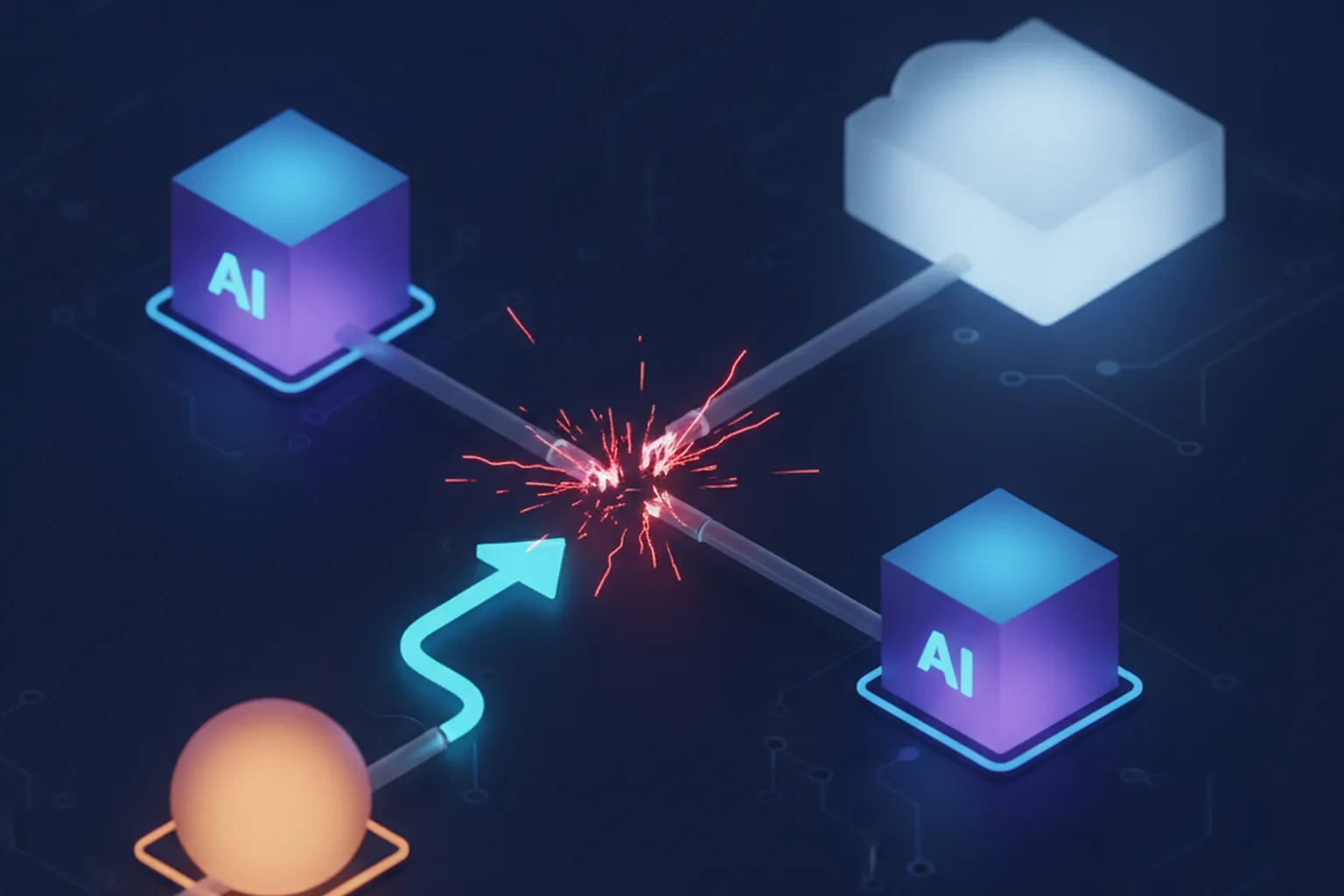
Three of the most-used AI chatbots — ChatGPT, Claude and Grok — went down within the same window on September 3, 2026, for about three hours, largely because of a Microsoft Azure East US regional failure. Downdetector logged more than 37,000 reports for ChatGPT alone. The lesson is not that any one vendor is unreliable; it is that concentration in a shared cloud makes correlated failure possible, and most products bolt on a single LLM with no fallback. If AI is on your critical path, treat provider outages as a design input — the same discipline we bring to integrating generative AI into products rather than an afterthought bolted on at the end.
What happened on September 3
On Thursday, September 3, 2026, users across the United States began reporting near-simultaneous failures of three major AI assistants. OpenAI's ChatGPT and its Codex coding tool started returning elevated error rates after what OpenAI described as a routing error. Anthropic's Claude was disrupted at the same time, with some models recovering faster than others. xAI's Grok also went dark. Having any one of these platforms stumble is routine; having all three falter in the same window is a notable anomaly.
The scale showed up on outage trackers. Downdetector logged more than 37,000 reports for ChatGPT, around 1,300 for Claude, and roughly 1,365 for Grok — the lopsided numbers reflecting ChatGPT's far larger user base. Reporting also noted a compounding effect: when ChatGPT went down, some users hopped to Claude and Grok, adding load to services that were themselves already struggling. The disruption lasted roughly three hours before the platforms were restored the same day.
For teams whose applications call these models through an API rather than a chat window, the event was more than an inconvenience. An outage of the underlying model provider means AI features quietly break in production — summaries fail to generate, agents stall mid-task, support copilots stop answering. That is exactly the failure mode you want designed around before it happens, and it is where AI, ML and data engineering choices about redundancy and fallbacks pay off.
Why one fault took down three models
The common thread in the reporting was Microsoft Azure. A regional failure inside Azure's East US footprint — a cloud backbone that supports several of the largest AI services — appears to have knocked out ChatGPT and Codex and contributed to Claude's disruption at the same time. When multiple independent AI companies run inference through the same cloud region, a single regional fault can surface as a coordinated-looking outage across otherwise unrelated products.
The picture was not perfectly uniform, and that nuance matters. xAI traced Grok's problem to an outage at its own data center in Memphis, not to Azure, which suggests the day was a mix of a shared-infrastructure event and at least one separate, coincidental failure. The takeaway holds either way: whether your dependency is a specific cloud region or a specific provider's own facility, a single point of concentration upstream can take your feature offline no matter how solid your own code is.
The concentration risk hiding in your stack
Most AI features are built on a chain of dependencies that is deeper than it looks. Your application calls a model API; that provider runs inference in a specific cloud region; that region sits in one provider's data centers. Each link is a potential single point of failure, and several of them are invisible from your own dashboards. You can have perfect uptime on your servers and still go dark because a cloud region three hops upstream had a bad morning.
This is the same lesson traditional infrastructure learned years ago — don't put all your load in one availability zone — now arriving in the AI layer. The difference is that model providers are newer, fewer, and more concentrated than the broader cloud market, and switching between them is not as simple as changing a connection string because prompts, APIs, and output formats differ. That friction is precisely why so many teams ship with one provider and no plan B, and why the September 3 outage is a useful, low-stakes prompt to fix it. Sound cloud and DevOps practice — redundancy, health checks, and tested failover — applies to the model tier just as it does to databases and message queues.
Patterns for LLM resilience
Making an AI feature survive a provider outage does not require exotic engineering — it requires applying well-understood reliability patterns to the model layer. The building blocks are familiar:
- A provider-agnostic gateway. Route model calls through an internal abstraction rather than calling one vendor's SDK directly. When the primary provider errors or times out, the gateway fails over to a secondary model. This is the single highest-leverage change, because it makes every other pattern possible.
- Redundancy across regions and providers. Where feasible, spread inference across more than one cloud region — and, for critical paths, more than one model vendor — so a single regional fault cannot take the whole feature down.
- Timeouts, retries and circuit breakers. Cap how long a call can hang, retry transient errors with exponential backoff, and trip a circuit breaker when a provider is clearly unhealthy so you fail fast instead of piling requests onto a dead endpoint.
- Caching and queuing. Serve cached results for repeated queries, and queue non-urgent work (batch summarization, enrichment) to process when the provider recovers rather than failing it outright.
- Graceful degradation. Decide what the product does with no model at all. A support copilot can fall back to search and a human handoff; a drafting tool can offer templates. A reduced but working experience beats an error screen.
The caveat worth stating plainly: a backup provider is only real if you have tested it and confirmed the output quality is acceptable. A failover path that silently produces worse answers — or that no one has exercised since it was written — is a false sense of security. Resilience is a property you verify with drills, not one you assume from an architecture diagram.
What it means for US & EU teams
For engineering leaders in the US and EU, the first move is to map the dependency honestly. Trace where each AI feature actually runs: which provider, which region, which single points of failure sit upstream that you do not currently monitor. Many teams discover their “AI strategy” is one API key and a default region, with no visibility into the layers underneath.
The second move is to right-size the response to the stakes. Not every feature needs multi-vendor redundancy; the effort should track the cost of downtime. A customer-facing assistant in a FinTech or HealthTech product, where an outage means lost transactions or a stalled clinical workflow, warrants full multi-provider failover and tested degradation. An internal tool used by a handful of staff may be fine with one provider, solid retries, and a clear fallback message. Match the investment to the impact rather than defaulting to maximum redundancy everywhere — the same judgement we apply when building production AI agents that have to keep working when a dependency doesn't.
The third move is organizational: treat model providers as vendors with SLAs, not as infrastructure that simply exists. Read the status-page history, understand the stated availability commitments, and set internal alerting on provider health so your on-call team learns about an outage from monitoring rather than from customers. The teams that came through September 3 calmly were the ones who had already asked, “what happens when this is down?” and answered it in code.
A resilience checklist for AI features
- Map the dependency chain. For each AI feature, document the provider, cloud region, and any upstream single points of failure. You cannot protect what you have not traced.
- Abstract the model endpoint. Call models through a provider-agnostic gateway so you can switch or fail over without a rewrite.
- Add a tested secondary provider for anything business-critical — and verify its output quality, don't just wire it up.
- Set timeouts, retries and circuit breakers so a slow or dead provider fails fast instead of dragging your app down with it.
- Cache and queue where you can, so repeated and non-urgent work survives a provider being offline.
- Design graceful degradation. Define the reduced-but-usable experience for when no model is available, and show users something better than an error.
- Monitor provider health and run drills. Alert on upstream status, and periodically exercise the failover path in a controlled test so you know it works before you need it.
Frequently asked questions
What happened in the September 3, 2026 AI outage?
On September 3, 2026, three of the most widely used AI chatbots — OpenAI's ChatGPT (and its Codex coding tool), Anthropic's Claude, and xAI's Grok — reported outages at roughly the same time, mostly affecting US users. Downdetector logged more than 37,000 reports for ChatGPT, around 1,300 for Claude, and roughly 1,365 for Grok. Services were disrupted for about three hours before being restored the same day.
What caused three AI services to fail at once?
Reporting pointed to a regional failure inside Microsoft Azure's East US infrastructure, the same cloud backbone that hosts several of the largest AI services. OpenAI cited a routing error; Anthropic's Claude was also affected. xAI, however, traced Grok's problem to an outage at its own data center in Memphis, so not every issue was Azure-related. The common thread is heavy reliance on shared, concentrated infrastructure, which turns one regional fault into a multi-service event.
How do you protect an application from an LLM provider outage?
The core pattern is to avoid a single point of failure. Route model calls through a provider-agnostic gateway so a request can fail over from one vendor to another; deploy across more than one cloud region or provider where feasible; add timeouts, retries with backoff, and circuit breakers; cache and queue non-urgent work; and design graceful degradation so the product stays usable in a reduced mode when the model is unavailable. Test these paths regularly rather than assuming they work.
Does multi-provider AI failover add cost and complexity?
Yes. Supporting more than one model provider means normalizing different APIs, prompts, and output formats, plus ongoing evaluation to keep quality consistent across vendors. That work is justified when the AI feature is business-critical or customer-facing and downtime carries real cost. For internal or non-critical tooling, a single provider with solid retries and graceful degradation may be enough. The decision should follow the impact of an outage, not default to maximum redundancy everywhere.
Sources
Axios — ChatGPT, Claude and Grok all simultaneously hit outages (September 3, 2026)
The Register — ChatGPT, Claude, and Grok all had outages at the same time (September 3, 2026)