

TL;DR — the secure SDLC in one paragraph
The secure software development life cycle (SSDLC) builds security into every phase of delivery instead of testing for it at the end. Design gets threat modelling. The build gets secure coding. SAST and DAST run in the pipeline, and production gets patched — with the NIST SSDF or OWASP SAMM usually setting the shape. Catch a vulnerability this early and it is still cheap to fix. Security stops being a final gate and becomes a property of the process.
What is the secure software development life cycle?
The secure software development life cycle (SSDLC) embeds security work into every phase of the software development life cycle: requirements, design, development, testing, deployment and maintenance. Nothing gets bolted onto the end. A standard SDLC tends to lean on a single penetration test before launch. A secure one hands every phase its own security activity and owner. You find and remove vulnerabilities while they are still cheap, rather than after they have shipped to production and into an attacker's reach.
This matters most where software carries real regulatory, financial or safety weight. That is why regulated enterprises building with our enterprise software development services treat the secure SDLC as a baseline, not an upgrade. Underneath, the process is still the ordinary life cycle. If you want the phases and deliverables first, our software development life cycle guide walks through them; here we layer the security activity onto each one. The industry shorthand for that layering is "shifting left": moving security work earlier, to the point where a fix is a code change instead of an incident.
Secure SDLC vs traditional SDLC: what changes?
What separates a traditional SDLC from a secure one is not a longer list of phases. It is a security activity added inside every phase you already run. A traditional life cycle surfaces security problems at the end, once they are structural and costly. A secure life cycle keeps surfacing them all the way through, while they are still cheap edits. The table below shows what changes, phase by phase.
| Phase | Traditional SDLC | Secure SDLC |
|---|---|---|
| Requirements | Functional requirements only | Security & privacy requirements captured alongside |
| Design | Architecture for features | Threat modelling and secure architecture |
| Development | Write working code | Secure coding standards, review, dependency scanning |
| Testing | Functional and QA testing | SAST, DAST, IAST and penetration testing |
| Deployment | Ship the release | Hardened config, secrets management, secure pipeline |
| Maintenance | Fix bugs on report | Vulnerability monitoring, patching SLAs, incident response |
What are the benefits of a secure SDLC?
The core benefit of a secure SDLC is economic. It moves security defects to the phase where they cost least to fix and are least likely to reach production. Fewer breaches, faster audits and shorter enterprise sales cycles all trace back to that one shift. Here are the concrete payoffs:
- Cheaper fixes. Catch a flaw in design and it is just a decision to revisit. Let the same flaw reach production and it is an incident. The widely cited IBM System Science Institute figures put the cost of fixing a defect after release at up to 100× the cost of fixing it during design. That gap is the whole economic case for shifting left.
- Fewer production vulnerabilities. Layer SAST, SCA and DAST in the pipeline and whole classes of flaw get caught before release, so fewer of them ever reach the software your users, and your attackers, actually touch.
- Faster audits and enterprise deals. A documented secure SDLC mapped to the NIST SSDF is the evidence that shortens SOC 2 and ISO 27001 audits and clears enterprise security reviews.
- Federal market access. Selling software to the US government requires self-attestation to SSDF practices. No secure SDLC, no attestation, no deal.
- Predictable delivery. Security work planned into each phase does not ambush a release the week before launch, so schedules and budgets hold.
- Breach costs keep climbing. IBM's 2026 Cost of a Data Breach Report puts the global average at $4.99 million, up 12% year-on-year, with AI-enabled attacks adding roughly $1 million to the average breach. A secure SDLC is one of the few controls that measurably lowers that number, because most of the cost sits in detection, escalation and business disruption — exactly what earlier detection prevents.
Security activity in each SSDLC phase
A secure SDLC gives each phase one clear security activity, and the point of that is coverage: no phase gets to pass its security problems downstream. The same rule holds across all six phases below. Name the activity, name the owner, and put a gate on it that the next phase depends on. These are the core secure software development life cycle processes, in order.
- Requirements — define security requirements. Capture security and privacy requirements as first-class items next to functional ones: authentication, authorisation, data classification, encryption, logging and the regulations in scope. Deliverable: a security requirements set that testing can later verify against.
- Design — threat modelling. Model how the system could be attacked before a line is written — trust boundaries, data flows, abuse cases — and design the mitigations in. Deliverable: a threat model and secure architecture decisions, including least-privilege access and data-protection choices.
- Development — secure coding. Enforce secure coding standards, peer review, and software composition analysis (SCA) so vulnerable dependencies are caught as they enter. Deliverable: reviewed, source-controlled code with a known, scanned dependency tree.
- Testing — security testing. Run static analysis (SAST), dynamic analysis (DAST), interactive testing (IAST) and, for higher-risk releases, penetration testing. Deliverable: a tested build and a triaged list of findings mapped to severity.
- Deployment — harden and automate. Ship through a secure pipeline with hardened configuration, managed secrets, signed artefacts and least-privilege infrastructure. Deliverable: a repeatable, gated release and a rollback plan.
- Maintenance — respond to vulnerabilities. Monitor for new vulnerabilities, patch to agreed SLAs, and run incident response when something slips through. Deliverable: a supported system with a live vulnerability-management loop.

Secure SDLC frameworks and standards in 2026
You do not have to invent a secure SDLC from scratch. Several established frameworks already define the practices, and most teams adopt one as a backbone. The dominant reference in 2026 is the NIST Secure Software Development Framework (SSDF, SP 800-218). OWASP SAMM and BSIMM add maturity models, and Microsoft's SDL remains a practical, prescriptive option. None of them compete; they complement. Pick one as your spine and borrow from the rest.
| Framework | What it is | Best used for |
|---|---|---|
| NIST SSDF (SP 800-218) | High-level practices in four groups: Prepare the Organization, Protect the Software, Produce Well-Secured Software, Respond to Vulnerabilities | A methodology-agnostic backbone; required for US federal self-attestation |
| OWASP SAMM | Software Assurance Maturity Model — measures maturity across governance, design, implementation, verification and operations | Assessing where you are and planning improvement in stages |
| BSIMM | A descriptive benchmark of what real firms actually do, refreshed from observed data | Comparing your programme against industry peers |
| Microsoft SDL | A prescriptive set of secure development practices and tools | Teams that want concrete, ready-to-adopt steps |
Start with the SSDF, because it anchors the others and increasingly drives compliance. Its four practice groups — PO, PS, PW and RV — describe outcomes rather than tools, so they map cleanly onto Agile sprints and DevOps pipelines alike. Version 1.1 is current. NIST published a draft version 1.2 (SP 800-218 Rev. 1) for public comment in December 2025, and a companion profile, SP 800-218A, extends the framework to generative-AI and dual-use foundation models. Treat the exact version numbers as a moving target; the four-group structure is the stable core.
Which security tools power each phase?
The right SSDLC tools are the ones wired into your pipeline so they run on every change. A shelf of scanners nobody opens does nothing. Each testing technique catches a different class of flaw, which is why mature programmes layer several instead of betting on one. The table maps the common tool categories to the phase where each does the most good.
| Tool category | Phase | What it catches |
|---|---|---|
| SAST (static analysis) | Development | Insecure code patterns in your own source, as it is written |
| SCA (software composition analysis) | Development | Known-vulnerable open-source dependencies and licence risk |
| DAST (dynamic analysis) | Testing | Runtime flaws in the running application, from the outside in |
| IAST (interactive analysis) | Testing | Vulnerabilities observed from inside the app during tests |
| Secrets & IaC scanning | Deployment | Leaked credentials and misconfigured infrastructure |
| Vulnerability management | Maintenance | New CVEs in shipped software, tracked to a patch SLA |
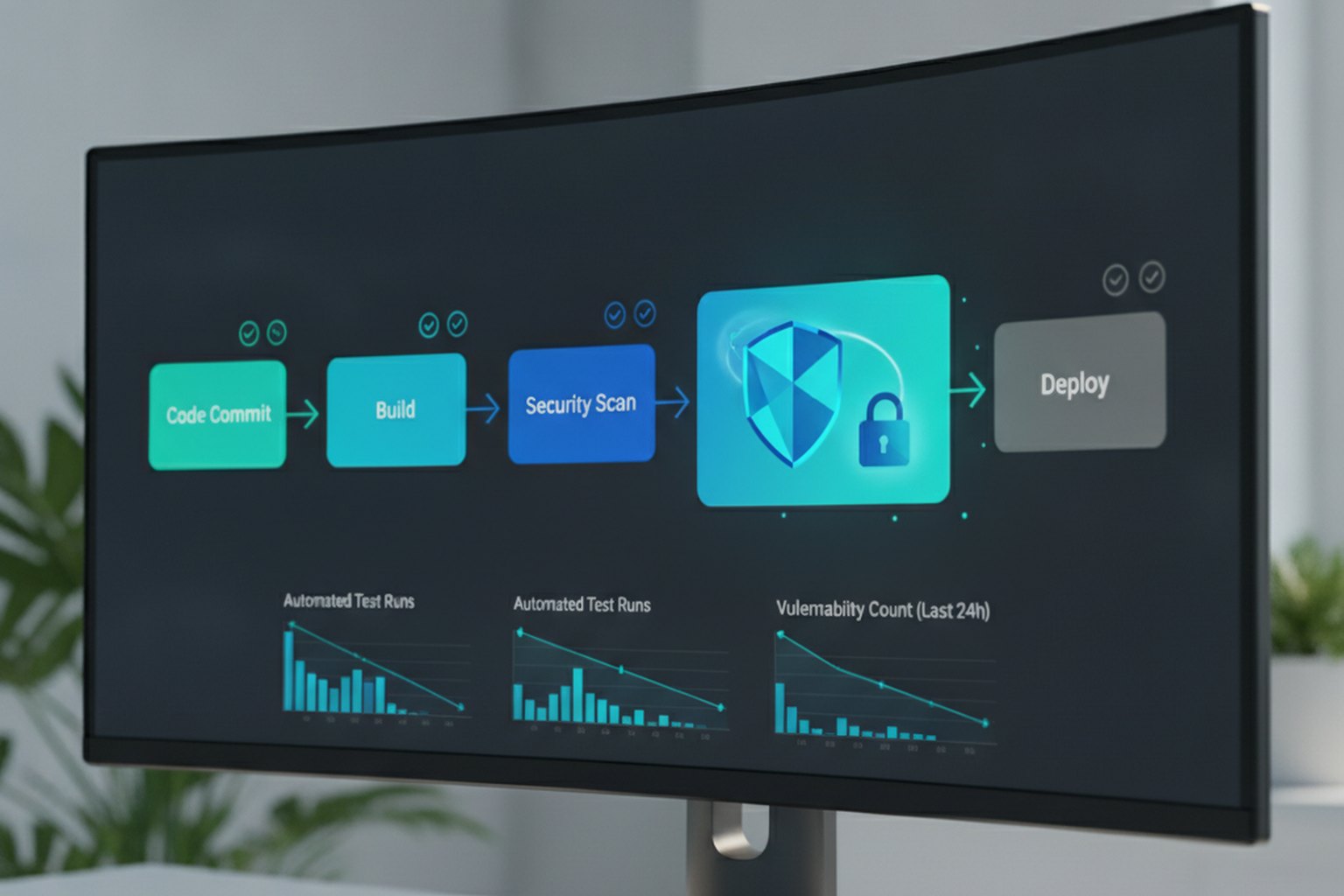
Wiring these into a pipeline is where DevSecOps meets the secure SDLC. The automation of DevOps carries the security gates, so scanning and policy checks run on every commit rather than in a quarterly review. If your delivery is already automated, these gates are just an extension of the pipeline you have. Our web app security best practices guide covers the runtime controls that sit alongside them, and our custom software development process shows where the gates land in a real engagement.
Compliance: EO 14028, self-attestation and audits
A secure SDLC is now a commercial requirement, not just an engineering ideal. Enterprise buyers and regulators increasingly want you to prove it. In the US, Executive Order 14028 and OMB Memorandum M-22-18 require software suppliers to the federal government to self-attest that they follow NIST SSDF practices, using a standard CISA self-attestation form. That same evidence pays off well outside federal sales too: a documented secure SDLC mapped to a framework shortens enterprise security reviews and satisfies SOC 2 and ISO 27001 auditors.
In practice, that means your secure SDLC has to be written down and traceable, not just practised. Auditors and procurement teams will not accept "we do threat modelling." They ask which policy requires it, which release it ran on, and who signed off. So the compliance conversation and the policy in the next section turn out to be the same conversation. For adjacent regulatory checklists, see our guides to SOC 2 Type II and, for health data, the HIPAA software development checklist.
How to write a secure SDLC policy
A secure software development lifecycle policy is the document that turns practice into process. For each phase, it names the required security activity, its owner, and the gate that blocks release if the activity is skipped. Keep it short enough that engineers actually follow it, and specific enough that an auditor can test against it. A workable policy answers these questions:
- Which activity runs in each phase? Threat modelling in design, SAST and SCA in development, DAST before release, patching in production — stated as requirements, not aspirations.
- What blocks a release? The severity thresholds (for example, no shipping with an open critical or high finding) that turn a scan result into a gate.
- Who owns each control? A named role for every activity, so nothing is "everyone's job" and therefore no one's.
- What are the patching SLAs? How fast production vulnerabilities must be remediated, by severity.
- Which framework does it map to? A column linking each control to a NIST SSDF practice, so the policy doubles as your self-attestation evidence.
Write the policy once, enforce it in the pipeline, and review it on a fixed cadence. A policy that lives only in a wiki and never blocks a build is decoration. Encode it as pipeline gates and it becomes a control.
Securing the SSDLC for AI systems
AI features stretch the secure SDLC rather than replace it. The phases stay the same; the threat surface grows. Models bring risks a traditional application never had: prompt injection, training-data poisoning, model and data exfiltration, and unpredictable output that downstream code must not trust blindly. NIST recognised this in 2025 by finalising SP 800-218A, a Community Profile that layers AI-specific practices and tasks on top of the core SSDF. You extend the framework you already have instead of starting over.
Securing an AI-enabled system, in practice, means adding a few activities to phases you already run. Threat-model the model and its data supply chain in design. Treat prompts and model outputs as untrusted input during development. Watch for model-specific abuse in production. If you are building AI into a product, pair this with our generative AI integration services and the EU AI Act compliance checklist, which covers the regulatory side of shipping AI features into the EU market.
Secure SDLC best-practice checklist
Most secure-SDLC failures are mundane. An activity gets skipped under deadline pressure, or a policy never gets wired into the pipeline. This checklist keeps the essentials visible:
- Give every phase a security owner. If an activity has no named owner, it will be nobody's job when the schedule tightens.
- Threat-model in design, not after launch. The cheapest security fix is a design decision; the most expensive is a rearchitecture after a breach.
- Automate scanning in the pipeline. SAST, SCA and DAST that run on every change catch far more than a quarterly manual review — and they do not slip.
- Set release-blocking thresholds. Decide in advance which severities stop a build, so security is a gate rather than a suggestion.
- Manage dependencies and secrets deliberately. Most modern breaches come through a vulnerable dependency or a leaked credential, not novel code.
- Patch to an SLA in production. A secure SDLC does not end at release; a live vulnerability-management loop is part of it.
- Write it down and map it to a framework. A documented policy tied to the NIST SSDF is what passes audits and closes enterprise deals.
Common secure SDLC mistakes to avoid
Most secure SDLC programmes do not fail because a framework was picked wrong. They fail because a handful of avoidable mistakes creep in under deadline pressure. Watch for these:
- Treating security as a once-a-year audit. An annual penetration test tells you where you stood on the day it ran, not where you stand today. Security has to run continuously, in the pipeline, on every change.
- Skipping threat modelling on "small" features. A feature that looks trivial in a sprint planning meeting can open a real trust boundary. Threat model by risk, not by story-point size.
- Bolting on scanners without acting on the findings. A SAST or SCA tool that runs but whose findings nobody triages produces alert fatigue, not security. A gate with no enforcement is not a gate.
- Leaving a phase without a named owner. An activity assigned to "the team" gets deprioritised the moment a deadline tightens. Name a role for every control.
- Writing a policy that never touches the pipeline. A secure SDLC policy that lives only in a wiki is documentation, not control. Encode its thresholds as build gates so it enforces itself.
- Ignoring AI-specific risk in new features. Prompt injection and model-data exfiltration do not show up in a classic SAST scan. Extend threat modelling and testing to cover the model and its data supply chain (see the AI section above).

How to measure secure SDLC effectiveness
A secure SDLC that nobody measures tends to erode quietly. A small set of metrics, tracked over time, shows whether the process is actually catching more and shipping less risk — and gives auditors and buyers something concrete beyond a policy document:
- Mean time to remediate (MTTR), by severity. How long a critical finding sits open is a better signal than how many findings exist.
- Vulnerability escape rate. The share of vulnerabilities found in production versus caught pre-release. A falling escape rate is the clearest sign the SSDLC is working.
- Percentage of releases blocked by a security gate. Near zero can mean a clean pipeline — or a gate nobody enforces. Read it alongside escape rate.
- Scan coverage. The share of repositories and services with SAST, SCA and DAST actually wired into their pipeline, not just licensed.
- Framework maturity score. Track your NIST SSDF or OWASP SAMM maturity level release over release, not just once at adoption.
- Patch SLA compliance. The percentage of production vulnerabilities patched within the SLA your policy sets, by severity.
Report these on the same cadence as the policy review, and the secure SDLC stops being a one-time project and becomes a number the organisation can actually manage.
FAQ
What is a secure software development life cycle?
A secure software development life cycle (SSDLC) builds security into every phase of software delivery — requirements, design, development, testing, deployment and maintenance — rather than testing for it once at the end. Each phase gains a security activity: security requirements and threat modelling early, secure coding and dependency scanning during the build, automated security testing before release, and hardened configuration plus patching in production. The goal is to find vulnerabilities when they are cheap to fix and to make security a property of the process.
What are the phases of a secure SDLC?
A secure SDLC uses the same phases as any SDLC, each with a security activity attached: requirements (security requirements), design (threat modelling and secure architecture), development (secure coding, review, software composition analysis), testing (SAST, DAST, IAST and penetration testing), deployment (hardened configuration, secrets management, a secure pipeline) and maintenance (vulnerability monitoring, patching and incident response). Security is never a separate phase here; it lives as a task inside each existing one.
What is the difference between the SDLC and the secure SDLC?
The SDLC is the process for building software; the secure SDLC is that same process with security work embedded in every phase. A standard SDLC treats security as a testing activity near the end; a secure SDLC shifts it left, spreading the work across threat modelling in design, secure coding during the build, automated scanning in the pipeline, and continuous vulnerability response in production. The difference is not a longer list of phases but a security owner and activity inside each one, which catches defects when they cost a fraction of a post-release fix.
What is the NIST SSDF (SP 800-218)?
The NIST Secure Software Development Framework (SSDF), published as SP 800-218, is a set of high-level secure development practices grouped into four families: Prepare the Organization, Protect the Software, Produce Well-Secured Software, and Respond to Vulnerabilities. It is methodology-agnostic, so its practices map onto Agile, DevOps and Waterfall alike, and it draws on OWASP SAMM and BSIMM. Version 1.1 is current; a draft version 1.2 went out for public comment in December 2025, and a companion profile, SP 800-218A, adds practices for generative-AI systems.
Do we need a secure SDLC policy?
Yes — a written secure SDLC policy turns good intentions into a repeatable process, and it is increasingly required for enterprise sales, audits and federal self-attestation. A useful policy names the security activity and owner for each phase, the tools that must run in the pipeline, the severity thresholds that block a release, the patching SLAs for production vulnerabilities, and how each control maps to a framework such as the NIST SSDF. It should be short enough to follow and specific enough to audit against.
How does DevSecOps relate to the secure SDLC?
DevSecOps is how most teams implement a secure SDLC in 2026: it takes the automation of DevOps and adds security gates into the CI/CD pipeline so scanning, dependency checks and policy enforcement run automatically on every change. The secure SDLC defines what security work each phase needs; DevSecOps is the operating model that makes that work continuous rather than a manual review. A secure SDLC without pipeline automation tends to slip under deadline pressure. That is exactly the failure DevSecOps prevents.
What are the most common secure SDLC mistakes?
The most common mistakes are treating security as an annual audit instead of a continuous pipeline activity, skipping threat modelling on features that look small, running scanners whose findings nobody triages, leaving a phase without a named security owner, and writing a policy that never gets enforced as a build gate. Most secure-SDLC failures are process gaps like these, not a missing tool or the wrong framework.
How do you measure whether a secure SDLC is working?
Track a small set of metrics over time rather than relying on a policy document alone: mean time to remediate by severity, the vulnerability escape rate (found in production versus caught pre-release), the percentage of releases blocked by a security gate, SAST/SCA/DAST scan coverage across repositories, your NIST SSDF or OWASP SAMM maturity score, and patch SLA compliance in production. A falling escape rate alongside stable or rising scan coverage is the clearest sign the secure SDLC is doing its job.
Last updated 27 September 2026. Framework references are to NIST SP 800-218 (SSDF v1.1), the draft SP 800-218 Rev. 1 (v1.2) published for comment in December 2025, SP 800-218A for generative AI, OWASP SAMM, BSIMM and US Executive Order 14028 / OMB M-22-18, cited as general guidance. Breach-cost figures are from IBM's Cost of a Data Breach Report 2026. The right activities, tools and gates depend on your risk profile, stack and regulatory scope — treat this as a starting point, not a prescription.