What is waterfall software development?
Waterfall software development is a linear, sequential model of the software development life cycle in which a project moves through a fixed series of phases — requirements, design, implementation, testing and maintenance — and each phase is completed and formally signed off before the next one starts. The name is the metaphor: like water cascading down a series of steps, work flows in one direction, downward through the stages, and does not normally loop back. Scope is defined up front, planned in full, and then executed to the plan.
The model was first described by Winston W. Royce in his 1970 paper Managing the Development of Large Software Systems. A historical irony worth knowing: Royce presented the pure single-pass version as a flawed baseline and argued for feedback loops between adjacent phases — the industry kept the diagram and, for decades, quietly dropped his warning. That is why waterfall is often contrasted, in one line, with iterative approaches: waterfall plans everything and builds once; iterative methods build a little, learn, and adjust in repeating cycles.
Getting this choice right is exactly the discipline behind our software product engineering practice: before committing to a plan-driven or an adaptive way of working, you match the delivery model to how well the requirements are actually understood, how the contract is written, and what a regulator will later ask to see. Waterfall belongs to the plan-driven family; for the wider map of options, our guide to software development methodologies compares the linear, iterative and hybrid families side by side.
One clarification up front, because it frames everything below: waterfall is not simply “old” or “wrong.” It is a plan-driven model that trades flexibility for predictability. When requirements are genuinely stable and the cost of changing course is high — a certified medical device, a fixed-price government contract — that trade is a feature, not a bug. The problems appear when teams apply it to products whose requirements are still being discovered.
The waterfall model: the 5 phases (with diagram)
The waterfall model runs a project through five sequential phases, each producing signed-off deliverables that feed the next: requirements analysis, system design, implementation, verification/testing, and deployment & maintenance. Between each pair of phases sits a phase gate — a formal review and sign-off that must pass before work moves downstream. The diagram below shows the classic cascade: each stage flows into the one beneath it.
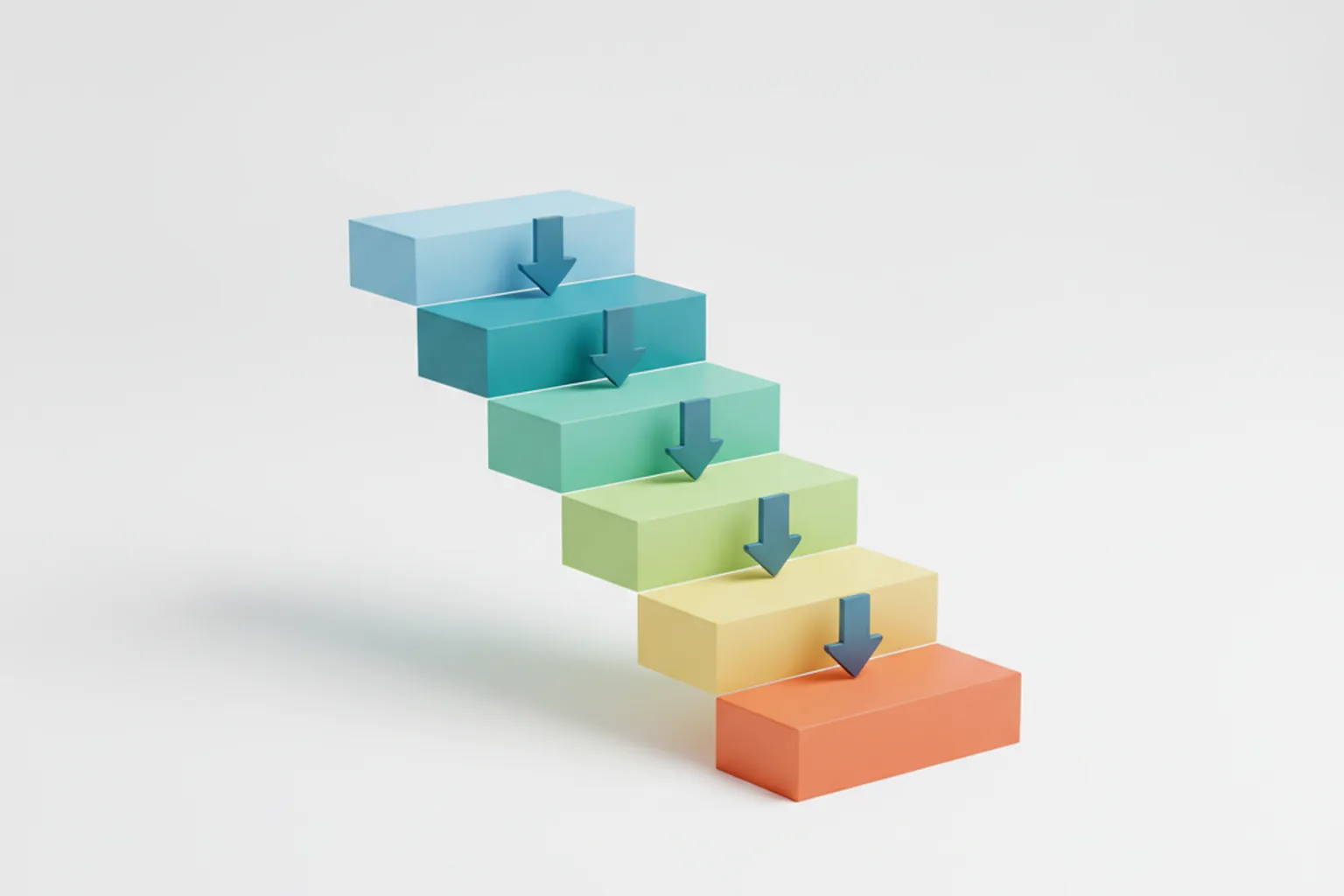
This is the whole waterfall software development life cycle in one picture: a big design up front (BDUF), then a single downstream pass to build, test and release. Here is what happens inside each phase.
1. Requirements analysis
Gather and document every requirement before any design begins. Business analysts and stakeholders capture functional and non-functional requirements in a detailed specification — often a Software Requirements Specification (SRS) — which is reviewed and signed off. In pure waterfall this document is the contract for everything that follows, so ambiguity here is the single most expensive kind of defect, because it is discovered last.
2. System design
Turn the approved requirements into architecture and detailed design. The team defines the technology stack, data models, interfaces, modules and how they fit together, usually splitting into high-level (architectural) and low-level (component) design. The output is a design specification precise enough that implementation becomes, in principle, a translation exercise rather than a discovery one.
3. Implementation (coding)
Build the software to the design. Developers write the code module by module against the design specification; in a strict waterfall project the whole system is coded in this phase before any end-to-end testing begins. Units may be checked in isolation, but integration and system verification are deliberately deferred to the next phase.
4. Verification / testing
Test the completed system against the original requirements. QA runs integration, system, performance and acceptance testing, and defects are logged and fixed before release. Because testing is concentrated here rather than spread throughout, this is where waterfall projects feel the most risk: any misunderstanding baked into the requirements or design surfaces now, late, when it is costliest to correct.
5. Deployment & maintenance
Release the software to production, then support it. Deployment moves the verified system into the live environment; maintenance covers bug fixes, patches, and enhancements over the product’s operational life. In practice maintenance is the longest phase of all, and in regulated settings it carries its own documentation and change-control obligations.
A crucial nuance the textbook diagram hides: Royce’s own version included backward arrows — feedback loops back to the immediately preceding phase — because he knew a single perfect pass was unrealistic. Real waterfall projects almost always allow limited iteration between neighbouring phases; the “no going back” caricature is stricter than anyone sensible ever practised. The model is best read as strongly sequential, not rigidly one-way.
A worked example: waterfall on a payments project
The five phases stay abstract until you see them applied. Take a typical fit: a bank commissioning a new card-payment authorisation module under a fixed-price contract with a hard regulatory audit at the end. Here is how the same project reads phase by phase.

- Requirements analysis (weeks 1–6). Business analysts sit with the bank’s compliance, risk and card-network liaison teams to capture every authorisation rule, fraud check and settlement flow into a signed-off SRS. PCI-DSS and the card network’s certification checklist go into the document as hard constraints, not nice-to-haves.
- System design (weeks 7–11). Architects turn the SRS into a component design: the authorisation service, the tokenisation boundary, the fraud-rule engine and the audit-log schema, each mapped back to the requirement it satisfies. The design review is the first formal phase gate — compliance signs off before a line of code is written.
- Implementation (weeks 12–20). Engineers build to the approved design module by module. Because scope is frozen, the team can plan the whole build calendar in week one and hold suppliers and internal stakeholders to fixed milestones.
- Verification and testing (weeks 21–26). QA runs integration tests against every authorisation scenario in the SRS, then a PCI-DSS assessor runs a formal certification pass. Every defect is traced back to the requirement it violates — the paper trail the regulator will ask to see.
- Deployment and maintenance (week 27 onward). The module goes live behind a phased rollout, and a change-control board takes over: any post-launch fix or card-network rule update goes through its own mini sign-off before it touches production.
Notice what makes this a genuine waterfall fit rather than a forced one: the requirements were externally fixed (card-network rules, PCI-DSS), the contract rewarded a fixed price over flexibility, and the audit trail was not optional. Swap the payments module for a product whose requirements are still being discovered, and the same rigid sequence turns into the liability described in the cons above.
Waterfall vs Agile: the key differences
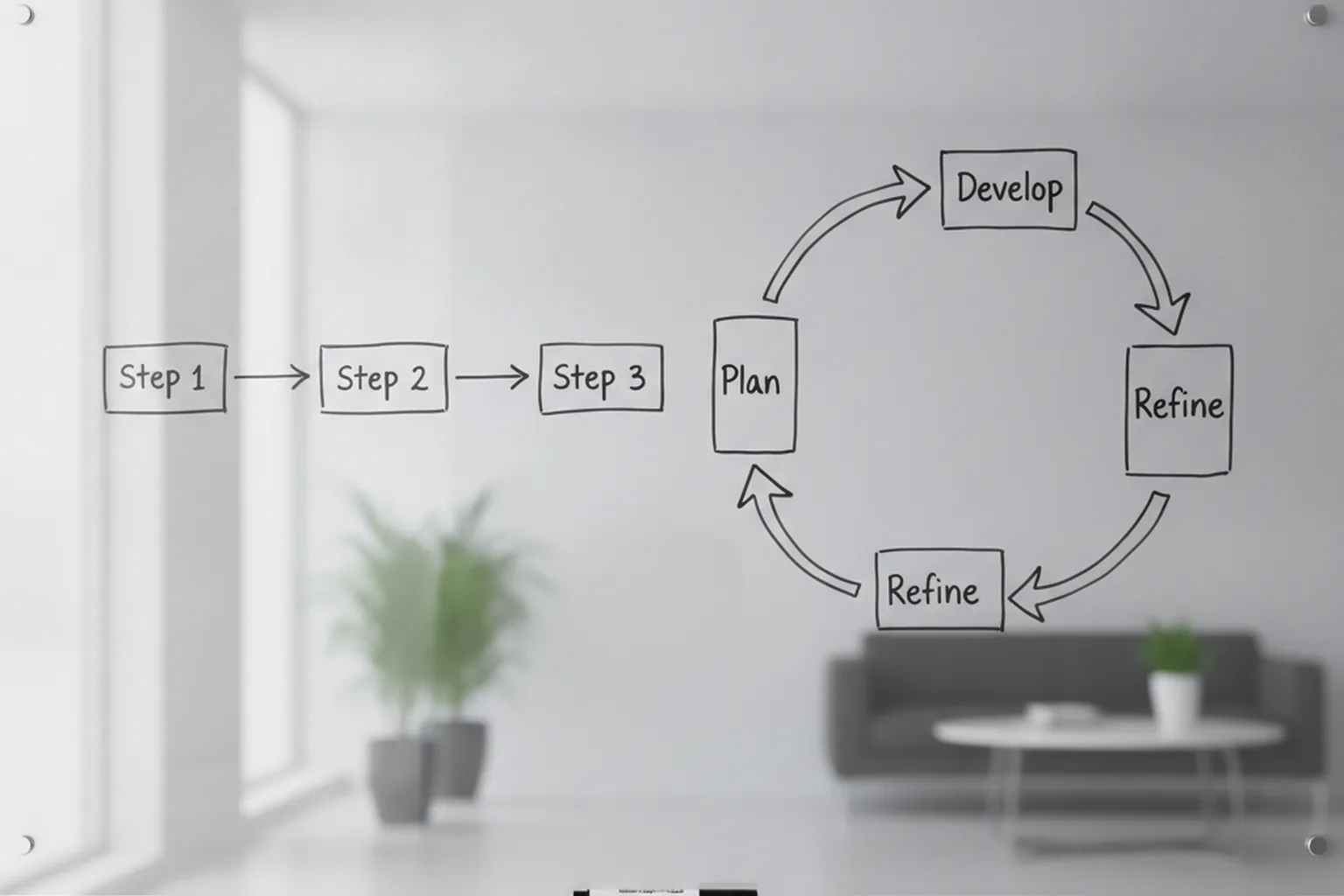
The core difference is timing and change: waterfall fixes scope up front and runs phases in sequence with testing near the end, while Agile software development delivers in short iterations, welcomes changing requirements, and tests continuously. Waterfall optimises for predictability and documentation; Agile optimises for flexibility and fast feedback. Neither is universally “better” — they suit different risk profiles, which the whiteboard below captures: a straight line versus a repeating loop.
| Dimension | Waterfall | Agile |
|---|---|---|
| Planning | Big design up front; full scope fixed at the start | Rolling; planned iteration by iteration |
| Change handling | Formal change-control board; changes are costly | Change welcomed; re-prioritised each cycle |
| Delivery cadence | One release at the end of the cycle | Working increments every 1–4 weeks |
| Documentation | Heavy, formal, signed-off at each gate | Lightweight; “working software over documentation” |
| Testing timing | Concentrated in a late verification phase | Continuous, inside every iteration |
| Risk profile | Risk concentrated at the end; late feedback | Risk spread out; problems surface early |
| Best-fit projects | Fixed-scope, regulated, stable requirements | Evolving products, uncertain or changing scope |
| Success rate (2026) | ~50% (industry Agile stats, 2026) | ~70% (industry Agile stats, 2026) |
The numbers explain the market shift. In 2026, at least 75% of US companies use Agile in some form (Businessmap Agile Statistics 2026), Scrum remains the leading framework at around 63% adoption, and Agile projects report roughly a 70% success rate against about 50% for pure waterfall. That gap is why waterfall is rarely chosen today as a whole-project method for new product work — and why, where it survives, it is usually blended with iterative execution. For the iterative side of that blend, our guide to Scrum covers the most common framework teams pair with or replace waterfall.
Pros of waterfall software development
Waterfall’s strengths all flow from one thing: everything is planned and documented up front, which makes the project predictable and auditable. For the right kind of work, that predictability is worth more than flexibility. The main advantages:
- Predictability. With scope, timeline and cost fixed at the start, stakeholders know what they are getting and when — invaluable for budgeting and for fixed-price contracts.
- Clear milestones and budget. Phase gates create unambiguous checkpoints; progress is easy to report against a plan, and deliverables map cleanly to payment schedules.
- Heavy, structured documentation. Each phase produces a signed-off artefact, so the system is thoroughly specified rather than living only in the team’s heads.
- Easy onboarding and handover. Because requirements and design are written down, new engineers — or an entirely different maintenance team — can get up to speed from the documents.
- Strong fit for fixed-scope contracts. When a client wants a defined deliverable for a defined price, waterfall’s up-front scope aligns naturally with the commercial model.
- Traceability for audits. A documented chain from requirement to design to test is exactly what regulators and auditors ask for — each requirement can be traced to the code and the test that verifies it.
- Low ambiguity for stable requirements. When the problem is genuinely well understood, front-loading the thinking removes rework and keeps the build phase focused.
Cons and limitations
Waterfall’s weaknesses are the mirror image of its strengths: the same up-front rigidity that buys predictability makes the model slow and expensive to correct when reality diverges from the plan. The main limitations:
- Inflexible to change. Once a phase is signed off, revisiting it is disruptive and costly; a requirement that changes mid-project fights the entire process.
- Late testing, late feedback. Verification is concentrated near the end, so fundamental problems can stay hidden until the most expensive possible moment to fix them.
- No working software until late. Stakeholders see nothing runnable until the build phase is largely done — there is no early increment to react to.
- High cost of late-discovered defects. A defect rooted in the requirements phase but found in testing is many times more expensive to fix than one caught early.
- Poor fit for evolving or uncertain scope. When requirements are still being discovered, freezing them up front guarantees the plan is partly wrong before coding starts.
- Customer sees the product only at the end. The feedback loop with the actual user is long, so misalignment between what was specified and what was needed surfaces after most of the money is spent.
- Risk is back-loaded. Integration and validation risk accumulate silently until the late phases, rather than being retired steadily as the project runs.
When should you use the waterfall methodology?
Use the waterfall methodology when requirements are stable and well understood, the scope is fixed, and the project is governed by regulation or a fixed-price contract that rewards documentation and formal sign-offs over mid-project flexibility. In short: choose waterfall when the cost of changing direction is higher than the cost of planning thoroughly up front. The decision criteria in practice:
- Requirements are clear, complete and unlikely to change during the build.
- The technology and domain are well understood — little needs to be discovered.
- The contract is fixed-scope or fixed-price, with deliverables tied to milestones.
- Compliance, safety or audit obligations demand traceability and phase-gate sign-offs.
- The project is relatively short, or a fixed release date is contractually mandatory.
Those criteria cluster in specific industries, where waterfall’s phase gates and paper trail are a regulatory necessity rather than a preference:
- Aerospace and defence. Safety-critical systems (think NASA-style mission software or avionics) require exhaustive up-front specification and verification against it — the environment where rigorous, documented phases are non-negotiable.
- Banking and finance. Core banking and payment systems carry heavy regulatory and audit requirements, so traceable, signed-off phases fit the governance model.
- Healthcare and medical devices. Device software under regimes such as the FDA or the EU MDR must demonstrate a documented development and verification trail; waterfall-style stage gates map directly to that.
- Government and public sector. Fixed-scope, fixed-budget public contracts and procurement rules favour a plan-driven model with defined deliverables.
- Construction and large infrastructure. Where software is one dependency in a physical, sequenced programme, its schedule often has to follow the same milestone logic.
Where waterfall still wins in 2026
In 2026 waterfall is best understood as a tool inside a hybrid toolbox, not a relic: it wins wherever compliance, fixed-price contracts and regulated stage gates make predictability the priority. The Project Management Institute reports that around 78% of the most successful organisations use a hybrid approach — combining plan-driven governance at the programme level with Agile execution inside phases. This blend is common enough to have earned a nickname: “Wagile.”
The pattern that dominates enterprise delivery in 2026 is exactly this: waterfall-style phase gates and milestone contracts on the outside, iterative build cycles on the inside. A regulated programme might still require a signed-off requirements baseline and a formal verification gate — the waterfall skeleton — while the engineering teams run Scrum or Kanban sprints to actually build each phase. Industry analyses of large-scale delivery in 2026 put hybrid usage across the majority of enterprise programmes, concentrated in exactly the regulated sectors listed above.
The takeaway for a delivery leader is not “waterfall is dead” but “waterfall is a component.” The plan-driven phase gate remains the right tool when you need an auditable baseline, a fixed commercial envelope, or a hard regulatory checkpoint — you just no longer have to run the entire project that way. Standards such as ISO/IEC 12207 frame the life-cycle processes in a way that supports either a sequential or an iterative execution, which is why the hybrid model sits comfortably on top of them.
How to run a waterfall project successfully
A waterfall project succeeds or fails on the quality of its up-front work: because change is expensive later, the discipline is to get requirements and design genuinely right before building, and to control change formally after. The waterfall method of software development rewards rigour at the front and governance throughout. A practical playbook:
- Nail requirements up front. Invest disproportionately in requirements analysis — workshops, prototypes, sign-off from every stakeholder — because this is the phase whose errors are discovered last and cost the most.
- Use formal sign-offs at every gate. Treat each phase gate as a real decision point with named approvers, not a rubber stamp; a gate that always passes is not a gate.
- Run a change-control board. Accept that some change is inevitable and channel it: a CCB assesses each change request for cost and impact before it is allowed into the baseline.
- Keep documentation current. The value of waterfall is its paper trail, so update the specification and design when an approved change lands — stale documents destroy the traceability you paid for.
- Build in verification milestones. Do not wait for one big test phase to learn whether the system works; schedule reviews and, where you can, phased verification so risk is retired earlier.
It also helps to hold a short list of do’s and don’ts in mind as the project runs:
- Do map each requirement to a design element and a test case, so traceability is built in rather than reconstructed for the auditor.
- Do anchor the whole effort in the software development life cycle so every phase has a clear entry and exit condition.
- Don’t use waterfall for a product whose requirements you are still discovering — that is what iterative delivery is for.
- Don’t treat the sign-off as the end of stakeholder involvement; the longer the feedback gap, the bigger the surprise at the end.
- Don’t skip the backward-feedback loops Royce built in — allow controlled iteration between adjacent phases when verification reveals a problem.
If your requirements are not actually stable, the honest move is to choose a different model rather than force-fit waterfall — the Lean software development and Agile guides cover the flow-based and iterative alternatives, and our software development methodologies overview helps you pick between the families.
FAQ
What is waterfall software development?
Waterfall software development is a linear, sequential model of the software development life cycle in which the project flows through fixed phases — requirements, design, implementation, testing and maintenance — and each phase must be completed and signed off before the next begins. The name comes from the cascading, one-directional flow: like water over a series of steps, work moves downward and does not normally loop back. The model was first described by Winston W. Royce in 1970 and remains the classic plan-driven counterpart to iterative approaches such as Agile.
What are the 5 phases of the waterfall model?
The five phases are: (1) requirements analysis — gather and document all requirements up front; (2) system design — turn requirements into architecture and detailed design; (3) implementation (coding) — build the software to the design; (4) verification / testing — test the completed system against the requirements; and (5) deployment and maintenance — release the software and then support, fix and enhance it in production. Each phase produces signed-off deliverables that feed the next, separated by a phase gate.
What is the difference between waterfall and Agile?
Waterfall is a linear, plan-driven model: scope is fixed up front, phases run in sequence, and testing happens near the end. Agile is iterative and adaptive: work is delivered in short increments, requirements can change every iteration, and testing is continuous. Waterfall favours predictability and documentation for stable projects; Agile favours flexibility and fast feedback for evolving ones. In 2026 roughly three-quarters of US companies use Agile, and industry data puts Agile project success near 70% against about 50% for pure waterfall.
When should you use the waterfall methodology?
Use waterfall when requirements are stable and well understood, the scope is fixed, and the project is governed by regulation or a fixed-price contract that demands heavy documentation and formal sign-offs. Classic fits include aerospace and defence, banking and finance, healthcare and medical devices, and government projects — anywhere phase gates, traceability and predictability matter more than mid-project flexibility. It is a poor fit for products with uncertain or fast-changing requirements.
Is waterfall still used in 2026?
Yes — mostly inside hybrid ways of working and compliance-gated contexts rather than as a standalone whole-project method. The Project Management Institute reports that around 78% of the most successful organisations use a hybrid approach, combining plan-driven stage gates with Agile execution inside phases (sometimes called Wagile). Regulated industries, fixed-price contracts and large infrastructure programmes still rely on waterfall-style phase gates for their audit trails and predictable milestones.
What does a waterfall project look like in practice?
A typical fit is a fixed-price, regulated build such as a bank’s card-payment authorisation module: requirements analysis captures every rule and compliance constraint into a signed-off specification, system design maps each requirement to an architecture component, implementation builds to that design against a fixed calendar, verification runs integration tests plus a formal regulatory certification, and deployment and maintenance hand control to a change-control board. Each phase produces a signed-off deliverable that traces back to the original requirement — exactly what an auditor asks to see. See the worked example above for the full phase-by-phase walkthrough.
Last updated 27 September 2026. The model definition follows Winston W. Royce, Managing the Development of Large Software Systems (1970) and ISO/IEC 12207 life-cycle processes. 2026 adoption and success-rate figures reference industry Agile statistics roundups (Businessmap Agile Statistics 2026) and the Project Management Institute Pulse of the Profession hybrid data, and are stated as industry estimates. Treat model choice as a starting point to validate with your specific team, contract and compliance constraints.