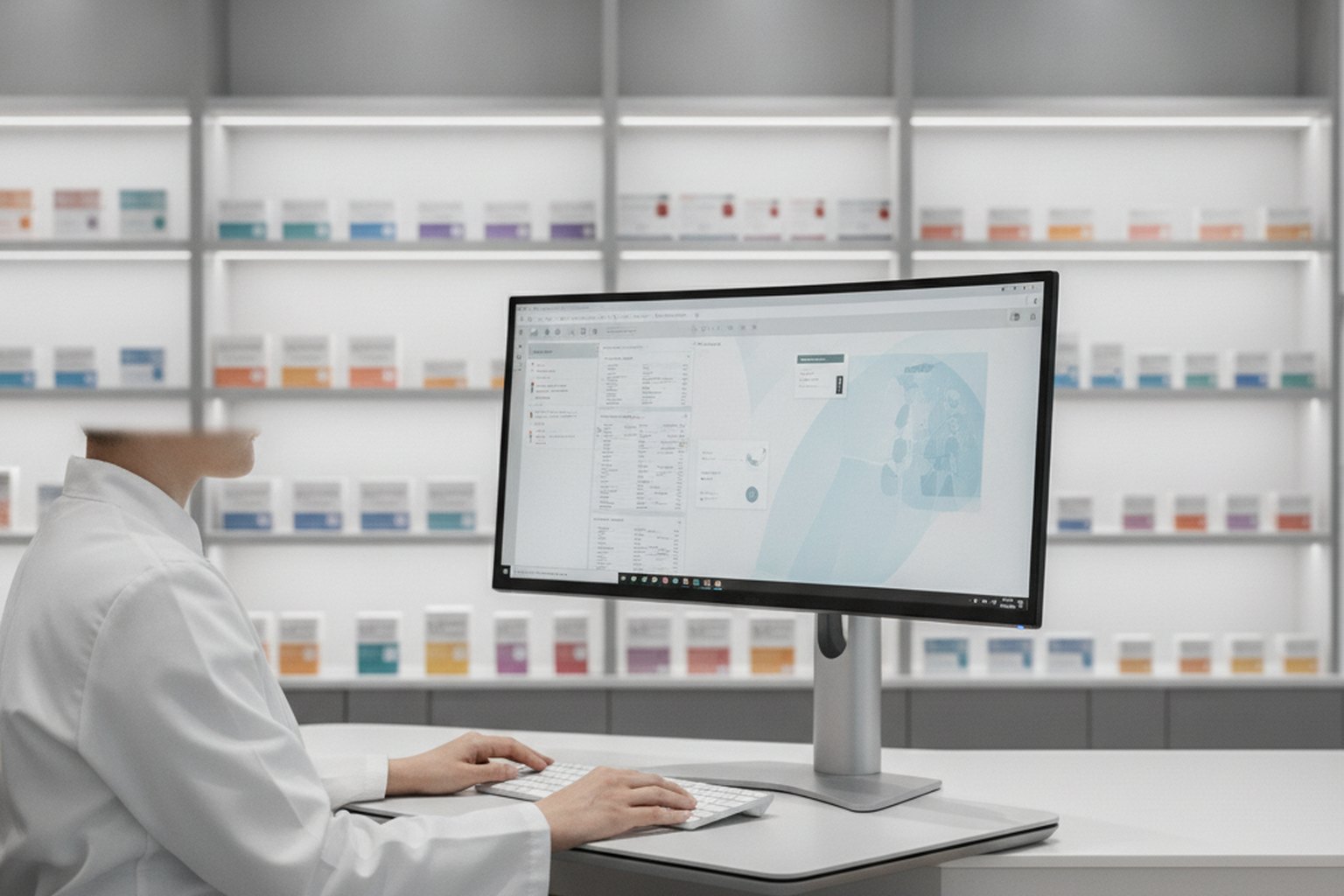

What is pharmacy management software development?
Pharmacy management software development is the work of building the system a pharmacy runs on — dispensing and prescription management, drug inventory, insurance claims, patient records and point of sale — on a HIPAA- and DEA-compliant foundation. It differs from pharmaceutical software, which serves drug makers, and its value depends as much on integrations and compliance as on features.
Pharmacy management software development is the process of designing and building the software a pharmacy uses to run its daily operations — prescription dispensing, drug inventory, insurance claim adjudication, patient records, point of sale and regulatory reporting. Where a paper-and-phone pharmacy relies on manual checks and separate tools, a pharmacy management software platform ties those workflows into one system that a pharmacist can trust to catch an interaction, flag an expired lot, or reject a claim before a patient is standing at the counter.
It is worth separating this from pharmaceutical software at the outset, because the two are often confused. Pharmaceutical software serves drug manufacturers and clinical research; pharmacy software serves the pharmacy that dispenses to patients. That distinction decides everything downstream — the users, the workflows and, above all, the regulations — which is why pharmacy builds sit squarely inside custom healthcare software development services rather than manufacturing or lab software. If your interest is drug development instead, our pharmaceutical software development guide covers that side.
Pharmacy software development is defined by its constraints as much as its features. A pharmacy system touches protected health information on every screen and controlled substances on many of them, so HIPAA, DEA rules and payer requirements are not add-ons — they shape the data model, the audit trail and the hosting from day one. The engineering job is to make a fast, usable dispensing workflow that is also, provably, compliant. Get either half wrong and the software fails: an unusable compliant system gets bypassed, and a usable non-compliant one gets shut down.
Why pharmacies build custom software
Pharmacies build custom software when off-the-shelf systems cannot match how they actually operate — a mail-order model, a specialty or compounding workflow, a multi-location group, or an integration a packaged product will not support. Standard pharmacy platforms cover the common retail case well, so the decision to build is rarely about basic dispensing; it is about a workflow, a margin or an integration that the shelf product blocks.
The most common trigger is fit. A specialty pharmacy handling prior authorizations and cold-chain shipping, or a long-term-care pharmacy serving facilities on cycle fills, works nothing like a corner drugstore, and forcing that model into generic software means manual workarounds that cost staff hours and invite errors. Custom software lets the system match the pharmacy instead of the other way round — and in a regulated setting, fewer manual workarounds also means fewer compliance gaps.
The second trigger is integration and ownership. Pharmacies that want to connect a patient app, a proprietary delivery network, an automation robot or a specific EHR often hit the limits of a closed product, and a custom build gives them the interfaces and the data ownership a packaged system withholds. This is the same buy-versus-build calculus that applies across healthcare; our custom healthcare software development guide walks through when each choice wins.
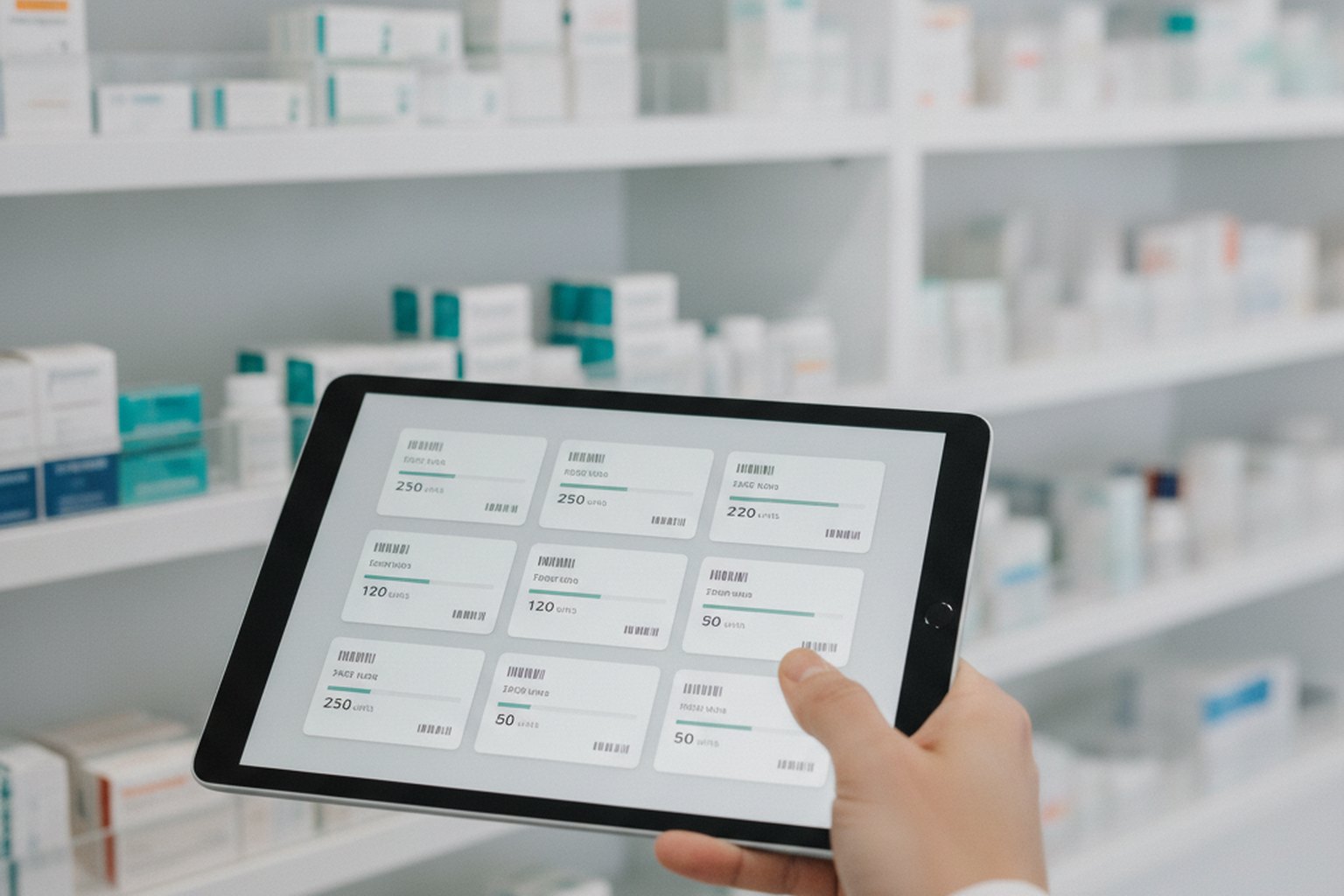
Types of pharmacy management software
Pharmacy management software comes in four main types, and the type sets the workflow, the integrations and the compliance load before a single feature is chosen. A retail system, a hospital system, a mail-order platform and a specialty or long-term-care system share a dispensing core but diverge sharply in everything around it, so naming the type is the first real design decision in any pharmacy software development project.
| Type | Setting | What defines it |
|---|---|---|
| Retail / community | Independent and chain drugstores | Walk-in dispensing, POS, insurance claims, refills and adherence at counter speed |
| Hospital / inpatient | Hospitals and health systems | Deep EHR integration, unit-dose and IV workflows, formulary control, barcode med administration |
| Mail-order / e-pharmacy | Online and delivery pharmacies | High-volume automation, patient app, shipping and delivery tracking, telepharmacy |
| Specialty / LTC / compounding | Specialty, long-term-care and compounding pharmacies | Prior authorizations, cold-chain, cycle fills, formula management, facility billing |
These types are not mutually exclusive — a modern platform may serve a retail front counter and a mail-order back end at once — but each added type multiplies the workflows and integrations the software must support. Deciding early which types are in scope, and which are explicitly out, is the single clearest way to keep a pharmacy build from sprawling.
Core features every pharmacy system needs
Every pharmacy management system needs a core set of features that turn a prescription into a safely dispensed, correctly billed and fully documented order. The list below is the baseline; the differentiators sit on top of it, but a system missing any of these is not yet a pharmacy platform. Aim to get this core right and compliant before adding the advanced modules.
- Prescription & dispensing management — intake, verification, drug-interaction and allergy checks, labelling and dispensing, with a full audit trail on every step.
- Drug inventory management — real-time stock, lot and expiry tracking, automated reordering, and reconciliation that keeps the shelf and the system in agreement.
- Insurance & claims adjudication — real-time claim submission and response, rejections handling, copay and pricing, and coordination of benefits.
- Patient profiles & medication history — a single record of allergies, current medications and history that powers safety checks and adherence.
- Point of sale — payment, signature capture, counselling prompts and integration with the dispensing and inventory records.
- Controlled-substance tracking — Schedule II–V record-keeping, dispensing limits and the reporting DEA and state programs require.
- Reporting & analytics — dispensing, inventory, financial and compliance reports, plus the dashboards owners use to run the business.
The differentiators — refill automation, adherence packaging, an e-prescribing-for-controlled-substances (EPCS) workflow, a patient-facing app, or delivery tracking — are where a custom build earns its keep, because they encode the specific way one pharmacy competes. But they only pay off on a solid, compliant core; bolting advanced features onto a shaky dispensing engine is how projects accumulate rework.

Compliance: HIPAA, DEA and DSCSA
Compliance is the defining constraint of pharmacy software, and it rests on three pillars: HIPAA for patient data, DEA rules for controlled substances, and DSCSA for drug traceability. These are not optional modules to add before launch — they shape the architecture, the audit trail and the hosting from the first sprint, which is why a pharmacy build should start with a compliance-aware design rather than retrofit one.
HIPAA governs every screen that touches protected health information. In practice that means role-based access control, encryption of data at rest and in transit, tamper-evident audit logging of who saw and changed what, and a Business Associate Agreement between the pharmacy and any vendor or hosting provider. Our HIPAA software development checklist breaks these requirements down into concrete engineering tasks.
DEA rules govern controlled substances. Software that dispenses Schedule II–V drugs must keep the records the DEA requires, enforce prescribing and dispensing limits, and — for electronic prescribing of controlled substances — meet the identity-proofing and two-factor requirements of EPCS. DSCSA, the Drug Supply Chain Security Act, adds traceability: the ability to receive, store and pass on product tracing information so a drug's chain of custody can be verified. A US pharmacy platform in 2026 is expected to handle all three, and international builds face parallel regimes such as the EU Falsified Medicines Directive.
Key integrations: eRx, insurance and EHR
The integrations often matter more than the features, because a pharmacy system that cannot receive an e-prescription, adjudicate a claim in real time, or exchange data with a hospital EHR is not usable no matter how good its interface is. Three integrations are effectively mandatory, and they are where much of the engineering risk in a pharmacy build lives.
Electronic prescribing (eRx) connects the pharmacy to prescriber networks so prescriptions arrive digitally rather than by phone or fax, with controlled-substance prescriptions flowing through EPCS. Insurance and claims switches connect to pharmacy benefit managers and payers for real-time adjudication, so the system knows what a patient owes and whether a claim will pay before dispensing. EHR and health-system integration — typically over HL7 and FHIR — lets hospital and clinic pharmacies share medication and patient data with the wider care record; our EHR integration guide covers those standards in depth.
Each integration carries its own certification, testing and partner onboarding, and they rarely behave like a clean REST API — legacy switches, network-specific quirks and strict conformance testing are the norm. That is why experienced teams schedule integration spikes early: proving a claims switch or an eRx connection in week one turns the biggest unknown in a pharmacy build into a known cost instead of a mid-project shock.
How do you build pharmacy management software?
You build pharmacy management software in a discovery-first sequence, because the compliance and integration decisions made at the start constrain everything that follows. The seven steps below turn a pharmacy's operational needs into a compliant, integrated system, and they apply whether you build in-house or with a partner.
- Discovery and compliance scoping. Map the pharmacy's real workflows, the drug schedules it handles, and the HIPAA, DEA and DSCSA obligations that follow. This is where the compliance architecture is decided.
- Requirements and system design. Turn workflows into requirements and a data model built around auditability, access control and the dispensing core.
- Integration planning and spikes. Prove the eRx, claims and EHR connections early, because they are the riskiest and least reversible parts of the build.
- Build the dispensing and inventory core. Implement prescription management, safety checks and real-time inventory first — the engine everything else depends on.
- Add claims, POS and advanced modules. Layer in adjudication, point of sale, controlled-substance handling and any differentiators such as a patient app.
- Security testing and validation. Run security testing, verify audit trails and access controls, and validate the compliance requirements before any patient data flows.
- Launch, training and support. Migrate data, train staff, launch in a controlled rollout, and support the system as regulations and integrations evolve.
The order is deliberate: compliance and integrations lead, not follow. Teams that build the pretty dispensing screen first and leave HIPAA auditing and the claims switch for later almost always rework the core, because those requirements reach back into the data model. For the wider delivery arc this planning sits inside, see our software development life cycle guide.
The technology stack for pharmacy software
There is no single right stack for pharmacy software, but the choices are constrained by the same forces as the rest of the build: reliability, auditability, integration support and compliant hosting. The winning stack is the one your team can operate securely and that your integration partners support — not the newest framework.
A typical 2026 pharmacy platform uses a strongly-typed backend (Java, C# or a mature Node.js or Python service layer) around a relational database such as PostgreSQL, chosen because dispensing, claims and controlled-substance data demand transactional integrity and a clean audit history. The frontend is usually a web application for pharmacy staff, often paired with a mobile app for patients or delivery drivers. Interfaces lean on HL7 and FHIR for clinical data and on the specific formats eRx and claims networks require.
Hosting is a compliance decision, not just an infrastructure one: pharmacy systems typically run on HIPAA-eligible cloud services (AWS, Azure or Google Cloud) under a signed Business Associate Agreement, with encryption, network isolation and logging configured to match the audit requirements above. The stack choices that matter most are the ones that make the system provably secure and interoperable — everything else is preference.
| Deployment | Best for | Trade-off |
|---|---|---|
| Cloud (HIPAA-eligible) | Most retail, mail-order and multi-location pharmacies | Lower upfront cost and faster scaling, but you depend on the vendor's uptime and shared-responsibility security model |
| On-premise / private hosting | Hospital systems with strict data-residency or existing data-center policy | Full control over infrastructure and audit surface, but the pharmacy carries the full cost and burden of patching, backup and disaster recovery |
Cloud deployment now accounts for the majority of new pharmacy management system rollouts, largely because it removes the burden of maintaining HIPAA-grade infrastructure in-house — but the choice still belongs in a discovery conversation, not a default.
How much does pharmacy software development cost?
Custom pharmacy management software development typically costs from about $60,000 for a focused module to $300,000 or more for a multi-location or hospital-grade platform, with most full dispensing-and-inventory systems landing between roughly $120,000 and $300,000. The spread is wide because a pharmacy build's cost is driven less by screens than by integrations, compliance depth and controlled-substance handling — the invisible plumbing, not the visible features.
| Scope | Typical 2026 range | What it buys |
|---|---|---|
| Focused module / MVP | $60k–$120k | One area — inventory, a refill app or a patient portal — on a compliant base |
| Full pharmacy platform | $120k–$300k | Dispensing, inventory, POS, claims and eRx with HIPAA and DEA compliance |
| Multi-location / hospital-grade | $300k+ | Deep EHR interoperability, controlled-substance handling, automation and scale |
These are directional 2026 ranges, not quotes. The biggest cost multipliers are the number and difficulty of integrations, the depth of compliance and validation, whether the software handles controlled substances, and whether it runs one site or many. A realistic estimate comes from discovery, where those drivers are pinned down — a step our discovery phase guide covers, and the reason a fixed price quoted before discovery is usually a guess wearing a number.
Common challenges and how to solve them
Most pharmacy software projects do not fail on features — they fail on the same handful of operational challenges, repeated across retail, hospital and specialty deployments. Naming them upfront, and designing around them from discovery, is cheaper than discovering them in production.
- Integration friction with eRx, claims and EHR partners. Legacy switches and prescriber networks rarely behave like a clean REST API, and conformance testing can stretch timelines by weeks. Solution: run integration spikes in the first sprint, not the last, so the riskiest connections are proven before the rest of the system is built around them.
- Staff resistance during rollout. Pharmacists and technicians are working against the clock at the counter, and any new system that slows dispensing gets bypassed or blamed. Solution: run a parallel-live pilot at one location, recruit a pharmacist champion, and keep the old system available as a fallback until the new one has proven itself under real volume.
- Data migration from a legacy PMS. Patient profiles, medication history and controlled-substance records must move without gaps, or the new system inherits blind spots on day one. Solution: migrate incrementally, validate record counts and spot-check high-risk fields (allergies, Schedule II history) before decommissioning the old system.
- Compliance drift after launch. HIPAA, DEA and DSCSA obligations do not freeze at go-live — state reporting rules and payer requirements change. Solution: budget ongoing compliance maintenance and audits into the support contract, not just the initial build.
- Zero tolerance for downtime. A pharmacy that cannot dispense is a pharmacy losing revenue and, in urgent cases, risking patient care. Solution: design for high availability and a documented offline fallback procedure, and test the failover path before launch, not during the first real outage.
How to choose a development company
Choose a pharmacy software development company on verifiable healthcare experience, not on price or a generic portfolio, because pharmacy software fails in ways only teams who have shipped regulated systems anticipate. The vendor that quotes lowest is often the one that has never signed a Business Associate Agreement, integrated a claims switch, or handled a DEA audit trail — and you will pay for that inexperience during compliance testing.
Ask hard, specific questions when comparing pharmacy software development services. Has the team delivered HIPAA-compliant software and can they sign a BAA? Have they integrated eRx networks, insurance switches and EHR systems, and can they show it? How do they handle controlled-substance and DSCSA requirements? Do they run security testing and hand over documentation and source code? A credible pharmacy management software development company answers these with evidence and a discovery-first process; a weak one answers with reassurance. For the deeper vetting framework, our how to choose a software development company guide applies directly.
FAQ
What is pharmacy management software development?
Pharmacy management software development is the process of designing and building the software a pharmacy uses to run its day-to-day operations: dispensing and prescription management, drug inventory, insurance claim adjudication, patient records, point of sale, and regulatory reporting. Unlike pharmaceutical software, which serves drug manufacturers and clinical trials, pharmacy management software serves the pharmacy itself — retail, hospital, mail-order or specialty — and its buyers are pharmacists and pharmacy operators. A build covers requirements, a compliant architecture, the core dispensing and inventory modules, the eRx, insurance and EHR integrations, and validation against HIPAA and DEA rules before go-live.
What features should pharmacy management software have?
Pharmacy management software should have prescription and dispensing management with drug interaction and allergy checks, real-time drug inventory with lot and expiry tracking, electronic prescribing (eRx) intake, insurance and claims adjudication, patient profiles and medication history, point of sale, controlled-substance tracking for DEA reporting, and reporting and analytics. Higher-end systems add refill automation, adherence and reminder tools, e-prescribing for controlled substances (EPCS), and a patient app. Every feature that touches protected health information must be built on a HIPAA-compliant foundation, and controlled-substance features must meet DEA requirements.
How much does it cost to develop pharmacy management software?
Custom pharmacy management software development typically costs from around $60,000 for a focused module such as inventory or a patient refill app, roughly $120,000 to $300,000 for a full dispensing and inventory system with insurance and eRx integrations, and $300,000 or more for a multi-location or hospital-grade platform with controlled-substance handling and deep EHR interoperability. The main cost drivers are the number of integrations, the depth of compliance and validation, controlled-substance features, and whether the software runs one site or many. These are directional 2026 ranges, not fixed quotes — the real figure depends on scope and integrations.
Does pharmacy software need to be HIPAA and DEA compliant?
Yes. Any pharmacy software in the United States that stores or transmits protected health information must meet HIPAA's privacy and security rules, including access controls, audit logging and encryption, and the vendor usually signs a Business Associate Agreement. Software that handles controlled substances must also meet DEA requirements — EPCS for electronic prescribing of controlled substances and record-keeping for Schedule II–V drugs — and pharmacies increasingly need to support DSCSA drug traceability. Compliance is not a feature added at the end; it shapes the data model, the audit trail and the hosting from the first day of the build.
What is the difference between pharmacy software and pharmaceutical software?
Pharmacy software runs a pharmacy — dispensing, inventory, insurance claims, patient records and point of sale — and its users are pharmacists and pharmacy staff. Pharmaceutical software serves drug developers and manufacturers and covers clinical trials, laboratory information management (LIMS), manufacturing execution (MES) and drug-safety systems under GxP validation. They share a healthcare context and some compliance vocabulary, but the workflows, users and regulations are different: pharmacy software is dominated by HIPAA, DEA and payer rules, while pharmaceutical software is dominated by FDA GxP and manufacturing validation.
How do you choose a pharmacy software development company?
Choose a pharmacy software development company by verifiable healthcare experience, not by price alone. Ask for evidence of HIPAA-compliant delivery, experience integrating eRx networks, insurance claim switches and EHR systems, and a clear approach to controlled-substance and DSCSA requirements. Confirm they can sign a Business Associate Agreement, run security testing, and hand over documentation and source code. A strong pharmacy software development services partner shows a discovery-first process, references in regulated healthcare, and engineers who understand both the clinical workflow and the payer and regulatory landscape.
How big is the pharmacy management software market?
The global pharmacy management system market was valued at roughly $101 billion in 2025 and is forecast to reach about $207 billion by 2030, a compound annual growth rate of around 15.5%, according to Mordor Intelligence. Growth is driven by pharmacy digitization, e-prescribing adoption and a shift toward cloud deployment, and it is one reason more pharmacies are weighing a custom build against a generic package.
What are the biggest challenges in pharmacy software projects?
The most common challenges are integration friction with eRx, claims and EHR partners; staff resistance during rollout; data migration from a legacy system without gaps in patient or controlled-substance records; compliance drift after launch as regulations change; and zero tolerance for downtime, since a pharmacy that cannot dispense loses revenue and risks patient care. Each is solved by planning for it during discovery — integration spikes, a parallel-live pilot, incremental migration with validation, budgeted compliance maintenance, and a tested failover procedure — rather than treating it as a launch-week surprise.
Published 22 August 2026, last updated 27 September 2026. Cost ranges are directional 2026 guidance drawn from typical custom healthcare software engagements and vary widely with integrations, compliance scope and controlled-substance handling. Market-size figures are third-party estimates (Mordor Intelligence) and may vary by source. Regulatory references (HIPAA, DEA/EPCS, DSCSA) summarise US requirements as of 2026 and are not legal advice — confirm your obligations with qualified counsel.