

This guide is written from the same seat we sit in when a client asks us to re-architect their SaaS billing: it has to survive contact with real metering, real invoices and a finance team that will ask hard questions in month two. Below is every credible 2026 pricing pattern, benchmarked against named industry research, plus a step-by-step process for choosing and shipping the right one.
The 60-second answer
TL;DR: No SaaS pricing model is universally best in 2026 — match the billable axis to the customer’s value axis. Per-seat suits collaboration tools, usage-based fits infrastructure and AI, hybrid (seat + AI credits) is the 2026 default for AI-heavy SaaS, and tiered is the safe early-stage starting point.
By 2026, five pricing patterns do most of the work in SaaS. Not one of them wins everywhere, so ignore anyone selling you a single answer. What you actually want is the pattern whose billable axis lines up with the value axis your customer already feels:
- Tiered — good for early-stage products with limited usage data. Three tiers, anchor pricing in the middle.
- Per-seat — default for collaboration tools (Slack, Notion, Linear). Scales with team size.
- Usage-based — default for infrastructure (Twilio, Vercel, Snowflake). Scales with consumption.
- Hybrid (seat + usage) — the 2026 default for AI products. A base seat fee plus metered AI credits.
- PLG/freemium — only for products with viral loops or content leverage.
Pick the right value axis first
Everything starts with one question: what unit does the customer use in their own head to measure value? Slack users count people in the workspace. Twilio bills against messages sent. Snowflake, queries run. Cursor, by 2026, sells AI completions. Get that unit right and price stops being a topic; buyers barely notice it. Get it wrong and you re-argue the same point at every renewal. And the choice does not stay on the pricing page. It reaches down into billing architecture, metering and renewal mechanics, which is the reason we treat pricing as SaaS engineering rather than a marketing-page edit.
| Product type | Customer value axis | Recommended billing axis |
|---|---|---|
| Team collaboration tool | Number of collaborators | Per-seat |
| CRM / sales tool | Pipeline value × contacts | Tiered + contact volume |
| Email / messaging API | Messages delivered | Usage-based |
| Vertical SaaS (e.g., HVAC ops) | Revenue managed × users | Tiered with seat floor |
| AI copilot / coding tool | Hours saved / completions accepted | Hybrid (seat + AI credits) |
| AI agent / autonomous workflow | Tasks completed end-to-end | Outcome-based or per-run |
Pricing models at a glance — pros and cons
Before the deep dive, here is every model side by side. Use it to shortlist two candidates, then read the sections below for the real numbers.
| Model | Pros | Cons |
|---|---|---|
| Tiered | Simple to sell and forecast; works with zero usage data | Leaves money on the table with heavy users; tier gaps are easy to mis-price |
| Per-seat | Predictable revenue; easy to explain to buyers | Punishes AI-heavy products; invites shared-login workarounds |
| Usage-based | Cost and value stay in step; expands naturally with customer growth | Revenue is harder to forecast; needs real metering infrastructure |
| Hybrid (seat + usage) | Protects margin on AI spikes; budgetable base plus fair overage | Most complex to build (credit ledger, caps, top-ups) and to explain |
| PLG / freemium | Low-friction acquisition; free users can generate viral or product signal | Expensive without a viral loop; support cost accrues on non-paying users |
| Flat-rate | Dead simple to buy and to bill | No expansion path; heavy users are subsidised by light ones |
| Feature-based | Ties price directly to perceived capability | Collapses into tiered pricing in practice; adds packaging overhead for little gain |
Tiered pricing — the workhorse
Three tiers, Starter to Pro to Business, with feature gates between them. The middle one is your anchor. Design the page so 60–70% of buyers land there on their own. When you have no usage data yet to build metered billing on, tiered is simply the sensible place to begin.
Typical 2026 mid-market B2B SaaS tiered prices:
- Starter: $29–59/month. Feature-gated, no admin controls, community support.
- Pro: $79–199/month. The intended default. Real admin features, integrations, email support.
- Business: $299–799/month. SSO, audit logs, SLA, priority support.
- Enterprise: custom. SAML, DPA, EU data residency, dedicated CSM.
The mistake we see most often is a Pro tier priced too close to Starter. Aim for roughly 3× between Starter and Pro, then 3–4× again between Pro and Business. Squeeze those gaps and buyers quietly settle for the cheapest option.
Per-seat pricing — the collaboration default
Per-seat earns its keep when every extra person on the tool actually adds value. Think collaboration tools (Slack, Notion, Linear, Figma, GitHub), CRMs (HubSpot, Salesforce) and project management (Asana, Monday).
Through 2026, mid-market collaboration seats run from $8–15/seat at the basic tier, to $18–30/seat at the standard tier, up to $45–90/seat for business. Drop below $8 and you cannot cover CAC. Push past $90 and procurement reaches for an RFP.
The real risk with per-seat is buyers optimising against you. They quietly license fewer seats than they have people and route the rest through shared logins. The usual counter is SSO plus audit at the business tier, conveniently the same tier where per-seat starts to pinch.
Usage-based pricing — infrastructure and AI
When the unit of value is something you consume, usage-based pricing keeps cost and value in step. Twilio charges per message. Stripe, per transaction. AWS, per GB. OpenAI, per token. For context, here are 2026 reference prices across the major frontier LLMs:
| Model (2026) | Input / 1M tokens | Output / 1M tokens |
|---|---|---|
| Claude 4.6 Opus | $15 | $75 |
| Claude 4.6 Sonnet | $3 | $15 |
| GPT-4o | $2.50 | $10 |
| o3 | $10 | $40 |
| Gemini 2.5 Pro | $1.25 | $5 |
| Mistral Large 3 | $2 | $6 |
| DeepSeek V3 | $0.27 | $1.10 |
| Llama 4 (Bedrock) | $0.90 | $2.70 |
That 5–50× spread between model tiers means your “cost per AI feature” is really a question of how you route traffic, nothing more. We go through the mechanics under generative AI integration and AI agents development.
None of this works without real metering underneath: an event pipeline, idempotent counters, usage dashboards your customers can actually read, and a billing engine such as Stripe Billing’s metered subscriptions, Orb, Metronome or Lago. Budget 4–8 weeks of engineering to get metering production-ready.
Hybrid pricing — the 2026 default for AI SaaS
This is the breakout pattern of 2025–2026. A base seat fee carries your fixed costs, support and the product baseline. A separate metered component then absorbs the variable cost of AI inference. Customers get a seat line they can budget for and an AI line they pay in proportion to what they actually use. The shift is not anecdotal: Maxio’s 2025 SaaS Pricing Report puts the share of SaaS vendors with a usage-based component at 67%, up from 52% just three years earlier — and the fastest-growing slice of that is AI credits layered on top of a seat, not usage replacing the seat entirely.
Reference 2026 implementations:
- Cursor — $20/seat/month with included “fast” credits and metered overage for premium model use.
- Linear with AI — $14/seat plus AI credits for agent runs.
- Notion AI — $10/seat add-on with effectively-unlimited usage but throttled to non-frontier models.
- HubSpot Breeze — tiered seat license + AI credits per workflow run.
Hybrid hands you a defensible 75–85% gross margin on the seat and a passthrough-plus-margin of 20–40% on the AI credits. The part that matters most: when a customer suddenly runs 10× the AI, your COGS does not detonate. They cover it.
PLG and freemium — viral loop or trap?
Product-led growth pays off in exactly two situations. Either free users pull in paying ones (Slack, Loom, Calendly, Figma), or free users throw off signal that makes the product better (analytics, search, marketplace). Miss both and freemium is just a very large cost centre wearing a growth badge.
A few honest numbers from 2026 PLG benchmarks:
- Free-to-paid conversion in healthy PLG SaaS: 2–5% within 90 days.
- Below 1%, your free tier is a charity.
- Above 8%, your free tier is too constrained — you are leaving viral pipeline on the table.
- Support cost per free user in collaboration SaaS: $0.40–1.20/month. Multiply by your free user count to see the bill.
Enterprise pricing — talk to sales, but smartly
“Contact sales” is still the right call for enterprise in 2026. Run it lazily, though, and you lose deals. The strongest enterprise pages now put three things in the open:
- The capabilities (SSO/SAML, DPA, audit logs, EU data residency, custom DPA, BAA on request).
- An indicative starting price (“starts at $30k/year”).
- A buyer-friendly procurement kit (security pack, sub-processor list, ISO/SOC reports under NDA).
Hiding the starting price was fine in 2018. In 2026 it costs you deals, because mid-market procurement teams quietly filter out any vendor that will not commit to a floor.
Flat-rate, feature-based and per-active-user — the models we skipped
Three older models still pad out most pricing round-ups. They rarely win in 2026. Still, it is worth knowing exactly why before you strike them off:
- Flat-rate — one price, one product, unlimited use (early Basecamp). Dead simple to buy, but it leaves money on the table with heavy users and starves you of an expansion path. Viable only for a single-persona, low-variance product with a deliberate simplicity story.
- Feature-based — the price rises as the customer unlocks capabilities rather than seats or usage. In practice this collapses into tiered pricing, because feature bundles simply become tiers. Use tiers and skip the abstraction.
- Per-active-user — you only bill seats that actually logged in that month (Slack’s fair-billing model). It is buyer-friendly and defuses the “we’re paying for shelfware” objection, but it makes revenue harder to forecast. Treat it as a per-seat modifier, not a base model.
AI gross margin and pricing implications
Traditional SaaS clears 75–85% gross margin on hosting and support. AI SaaS in 2026 settles at 55–72%, because inference stays genuinely expensive once you run it at scale. That changes a few things about how you price:
- Route aggressively. Use Claude 4.6 Sonnet or GPT-4o for the bulk of traffic, escalate to Opus or o3 only for hard cases. Routing saves 40–70% of inference cost.
- Cache aggressively. Prompt caching with Anthropic (90% discount on cached tokens) or OpenAI (50% discount) typically saves 30–55% of input cost on repeat-pattern workloads. See GenAI integration.
- Distil where possible. Fine-tune a small open model (Llama 4 8B, Mistral 7B) on logged Claude/GPT outputs for narrow tasks. 5–15× cheaper inference at 92–97% quality retention.
- Meter the customer. Pure flat-rate AI pricing is suicidal at scale. Even “unlimited” plans must have soft caps and fair-use language.
- EU AI Act note. If your product offers high-risk uses (recruitment, credit, education) you also pay for documentation, logging and human-oversight infra. See EU AI Act compliance for what to budget.
Decision matrix
| Situation | Recommended model |
|---|---|
| Early-stage, no usage data, B2B | Tiered (3 tiers) |
| Collaboration tool, multi-user value | Per-seat with tier modifiers |
| Infrastructure, API-shaped product | Usage-based with monthly minimum |
| AI-heavy product, mid-market | Hybrid (seat + AI credits) |
| Consumer product with viral loop | Freemium → per-user paid tier |
| Vertical SaaS, regulated buyer | Annual contracts, seat floor, tier |
| Autonomous agent / outcome-driven | Outcome-based or per-run |
Six packaging traps
- Anchoring on competitor pricing. Competitors are wrong as often as right. Use Van Westendorp on 30 target customers instead.
- Free tier with no metering. Within 6 months you have power free users costing more than paid customers earn.
- Per-seat on an AI-heavy product. A 5-seat team running 1,000 agent invocations per day per seat destroys your margin overnight.
- Hidden enterprise pricing. Procurement filters you out at the first round.
- Yearly billing discount > 25%. You are training customers that the monthly price is fake. 15–20% is the right anchor.
- Price changes without grandfathering. Existing customers feel betrayed. Always grandfather for at least 12 months, communicate the change 60+ days in advance.

How to choose and ship your pricing model — 6 steps
Picking the model is the easy part. Here is the process we run with clients to go from “we think we’re under-priced” to a shipped, metered, grandfathered price change.
- Name the customer’s value axis. Interview 8–10 customers and ask what they would measure if they had to justify this spend to their own boss. That answer is your billable unit — not the unit that is easiest for you to log.
- Price-test before you build billing. Run the Van Westendorp Price Sensitivity survey on 30 target customers (four questions: too cheap, cheap, expensive, too expensive). It gives you a defensible price band before a single line of metering code exists.
- Map the model to your cost structure. If your marginal cost per unit of usage is near zero (most CRUD SaaS), tiered or per-seat is safe. If marginal cost scales with usage (AI inference, compute, SMS), you need usage or hybrid or your gross margin erodes silently as you grow.
- Build the metering before the pricing page. Ship the event pipeline, idempotent counters and a usage dashboard customers can read first. A pricing page that promises metering you cannot yet produce accurately is a support-ticket generator and, eventually, a trust problem.
- Grandfather existing customers. Lock current customers into their existing price for 12 months minimum and give 60+ days’ notice before any change takes effect. New customers see the new price immediately.
- Instrument the rollout and watch the metrics in the next section. Track expansion MRR, gross churn and support ticket volume weekly for the first 90 days after a pricing change — that window is where you find out if you got it right.

Metrics to track after you change price
A price change is not done at launch — it is done when the numbers below confirm it worked. Pull these weekly for the first quarter after any pricing or packaging change:
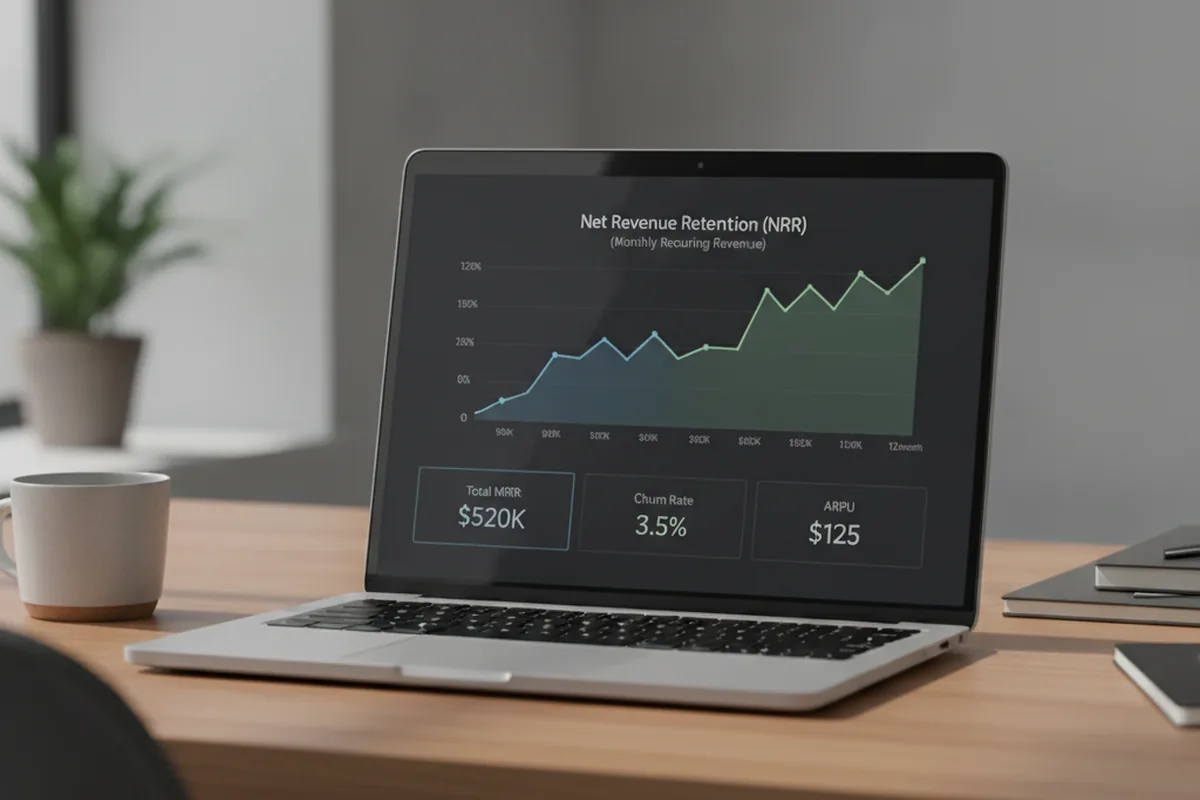
- Net revenue retention (NRR). Above 110% means expansion is outpacing churn and downgrades — a healthy sign the new price captures more value without pushing customers out. Below 100%, your existing base is shrinking even before you count new sales.
- Gross MRR churn. Isolates lost revenue from cancellations and downgrades, separate from new bookings. A spike in the first 60 days after a price change is your earliest warning that the increase went too far, too fast.
- Expansion MRR. Revenue growth from existing customers upgrading tiers, adding seats or crossing usage thresholds. In a well-designed hybrid or usage model, this line should grow faster than new-logo MRR within two quarters.
- LTV / CAC ratio. A ratio at or above 3:1 signals your pricing supports profitable acquisition. If a repricing pushes this down, either the new price under-delivers value or your CAC assumptions were already too optimistic.
- Support ticket volume tied to billing. A short-lived spike after launch is normal. A sustained increase past week three usually means the pricing page or the metering dashboard is not explaining itself clearly enough.
FAQ
What is the best SaaS pricing model in 2026?
None universally. Per-seat for collaboration; usage for infrastructure and AI; hybrid for AI SaaS; tiered as a sensible default for early-stage B2B.
How do I price an AI-heavy SaaS product?
Decouple AI cost from seat price. Base seat fee plus metered AI credits is the 2026 default (Cursor, Linear, Notion all converged here).
What gross margin should a SaaS aim for?
Traditional SaaS 75–85%. AI-native SaaS 55–72%. Below 55% investors price you as a passthrough.
Should I offer a free tier?
Only if there is a viral loop or content/SEO leverage. Otherwise a 14-day trial converts better.
How often should I raise prices?
Once a year on new customers; grandfather existing customers for at least 12 months.
What is the most common SaaS pricing mistake?
Pricing too low. Most SaaS we audit is 30–100% under-priced relative to delivered value.
Re-price and re-engineer with confidence
We help product and finance leaders redesign pricing, build the metering behind it, and ship the change without breaking the customers you already have.
Last updated 27 September 2026.