Discovery & requirements
Operator-workflow interviews, four-role definition (calculator, nomenclature specialist, manager, administrator), three-scenario auto-fill specification, GDPR + CCPA posture mapping.

Case study · Logistics · Customs clearance · Web
How we shipped a production freight transportation cost calculator — live on the web, operated by a logistics company processing hundreds of customs-clearance specification lines per request — built on Laravel and React with a four-role access model, a three-scenario auto-fill engine, and a self-learning knowledge base that compresses calculation time on every new request. Audit-ready for audiences in the United States and the European Union with GDPR and CCPA-aligned data handling from day one.
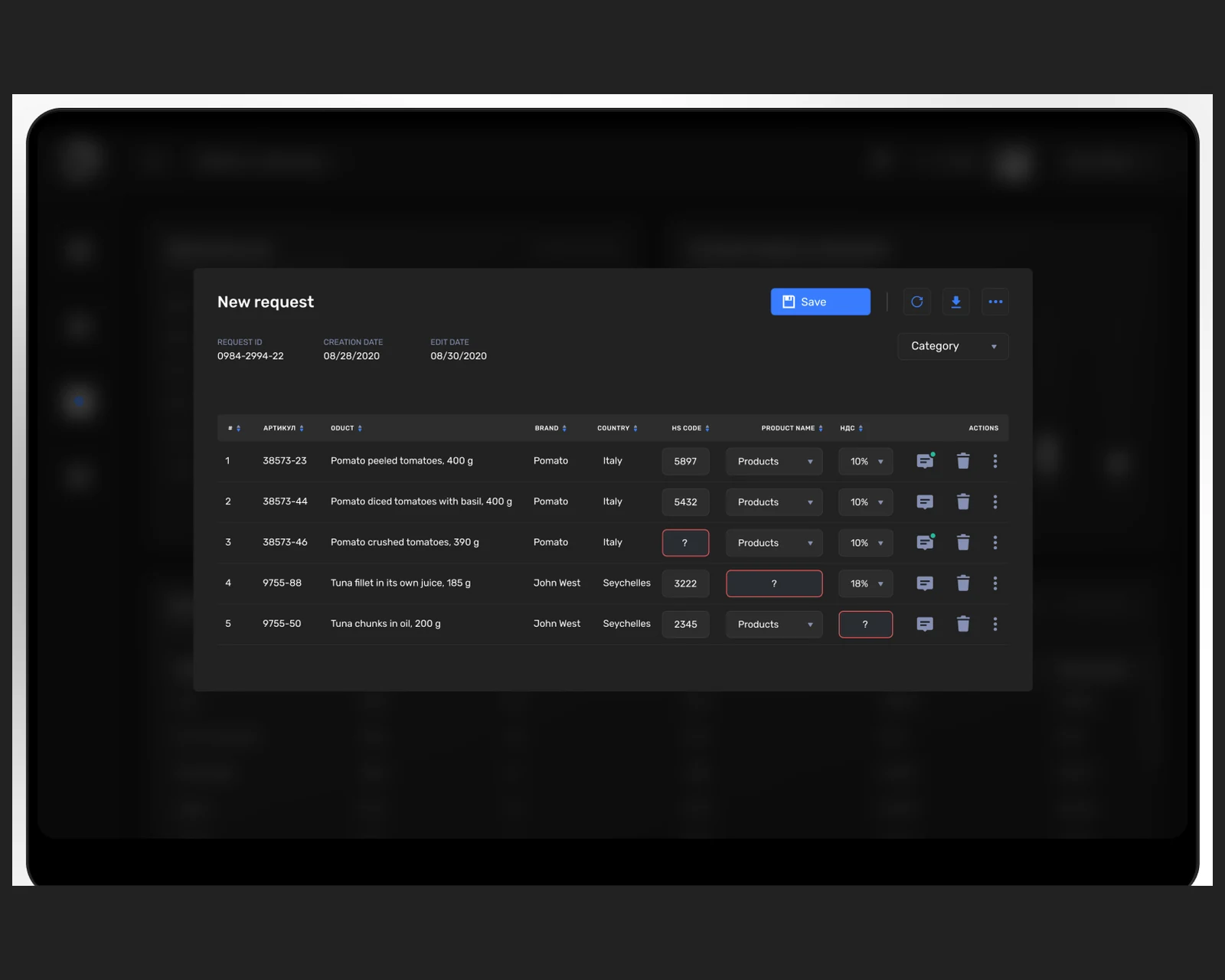
The EasyTrain operating team handled inbound freight customs-clearance requests by hand, every day, against requests that contained dozens or hundreds of specification lines — HS codes, brand attributions, VAT class, country of origin, product names. The calculation work was repetitive, the response time to the client was visibly degraded by the manual lookup, and the institutional knowledge that did exist lived in spreadsheets and senior calculators' heads. We built EasyTrain from first principles as a web application that turns the accumulated request history into a knowledge base: a thin React operator UI, a Laravel control plane that owns identity, role-based permissions, and the prediction engine, and a three-scenario auto-fill flow that turns full historical matches into single-click auto-closes and partial matches into pre-filled forms a calculator can finish in seconds. The platform is operated by a transport and logistics company and is positioned for audiences across the US and EU under GDPR and CCPA expectations from day one.
A snapshot of what the EasyTrain build delivered across the web operator console and the Laravel admin portal for audiences in the US and EU.
The stack decision dominates every other architectural choice in a B2B logistics operator portal build. We chose Laravel on the backend and React on the frontend because the trade-offs line up cleanly with a domain-specific workflow that a generic CRM cannot model. Laravel ships with a battle-tested permission model, queue workers, Horizon-grade observability, and a 1st-party admin tooling story (Nova, Filament) that a SaaS workflow tool replaces with vendor primitives. React lets the operator console behave like a desktop application — bulk row editing, keyboard navigation, visual highlighting of auto-filled fields — without the latency penalty of a low-code form builder.
Generic CRM platforms — the kind that try to absorb every B2B workflow into a single object model — were eliminated early: the four-role access model (calculator, nomenclature specialist, manager, administrator) does not map cleanly to CRM lead / contact / opportunity primitives, and the bulk-line entry pattern with three-scenario auto-fill would have required custom code that broke the SaaS upgrade path on every minor version. Going with Laravel + React meant the entire stack — operator console, control plane, knowledge base — is open, citable, and operable by a small product team end-to-end.
| Dimension | Laravel + React (EasyTrain) | Generic CRM | SaaS workflow tool |
|---|---|---|---|
| Domain modeling | First-class — specification-line objects, four-role model, three-scenario engine | Lead / contact / opportunity primitives | Limited to vendor metamodel |
| Permission model | First-class role / policy primitives | CRM role / profile presets | Vendor presets only |
| Bulk row editing | Desktop-grade React grid | Often clunky — record-at-a-time | Low-code form builder limits |
| Auto-fill / prediction | Custom deterministic engine over knowledge base | Add-on or marketplace | Vendor “AI” — opaque |
| Audit trail | Full chain of custody on every tuple write | Vendor-controlled audit log | Vendor-controlled audit log |
| Time to MVP | 8–12 weeks typical | 3–6 weeks for the off-the-shelf shape | 2–4 weeks but vendor-locked |
| Long-term flexibility | Open source — full extensibility | CRM upgrade path constrains customization | Vendor roadmap dictates pace |
Stack references: Laravel documentation, React documentation, WCO Harmonized System nomenclature.
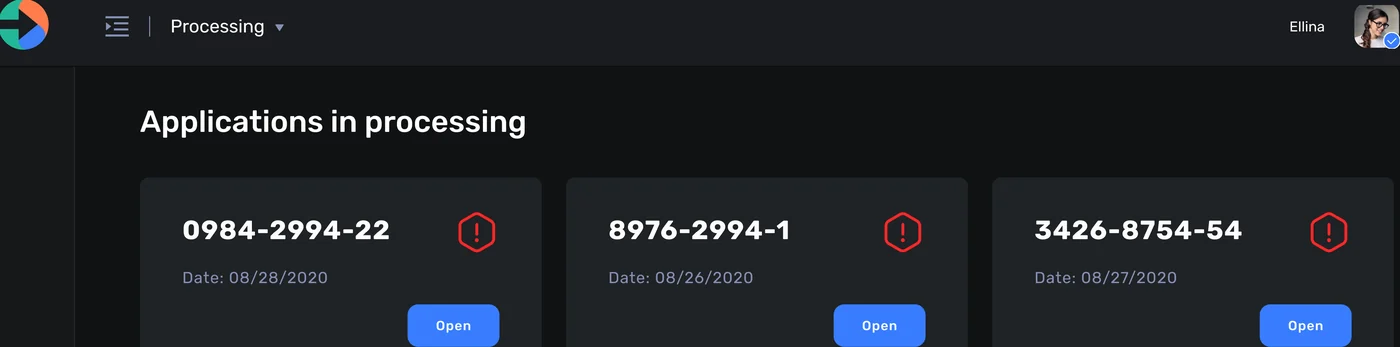
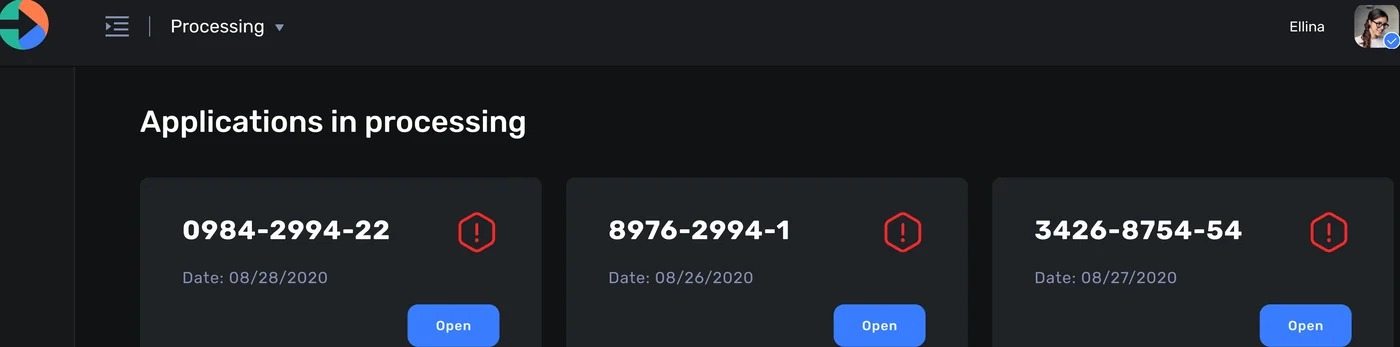
The React operator console is built as a single-page application served from a Laravel route. The entire operator-facing surface collapses into a small set of states — applications in processing, applications closed, new request entry, knowledge-base review — and each card is a single tap target that drives into the corresponding flow. The applications-in-processing dashboard surfaces inbound customs-clearance requests with their ID, creation date, and a clear “Open” action. Bulk specification entry lives inside the request detail view, with keyboard navigation, paste-from-spreadsheet support, and visual highlighting of every cell the auto-fill engine has pre-populated.
The bulk entry pane is where most B2B logistics products under-invest, and where we spent disproportionate engineering effort. Every operator has a complete archive of their handled requests with timestamps, request IDs, and the resolved values for each specification line. Operators in California, New York, Texas, Florida, and Washington in the US, and operators in the Netherlands, Germany, France, Ireland, and Sweden in the EU, see exactly the same interface in English. The end-to-end React surface is delivered as part of our web application development practice.
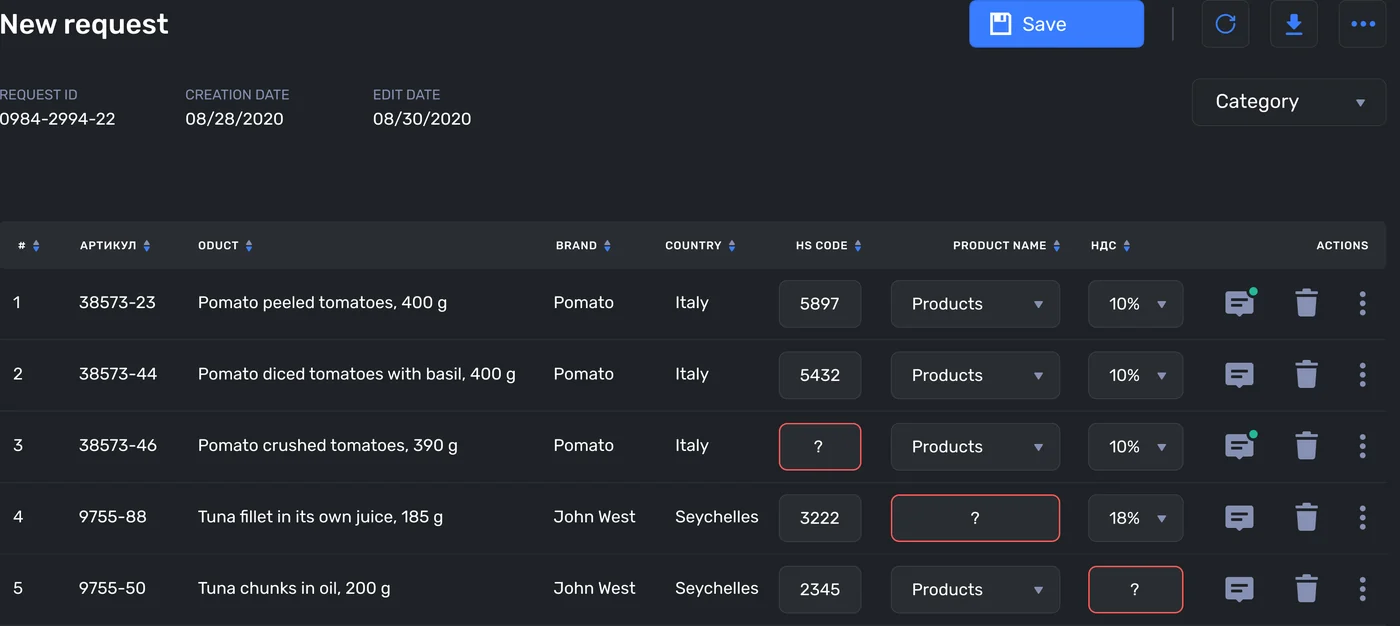
The auto-fill engine is the single most operationally valuable component in the product, and it runs three distinct paths. A complete match — every specification line on the inbound request maps cleanly to a previously-resolved tuple in the knowledge base — closes the request automatically and routes it to the manager role for sign-off. A partial match pre-fills every line for which a historical tuple exists, highlights the resolved cells in the UI so the calculator can see at a glance what the system filled in, and leaves the remaining lines for manual nomenclature work. A no-match scenario falls back to the manual entry path the team had before EasyTrain — but every successful close adds new tuples to the knowledge base, so the no-match share shrinks over time.
Behind the operator surface, Laravel queues handle the slower work — bulk knowledge-base lookups across hundreds of specification lines per request, re-indexing on new resolutions, and notification fan-out to the calculator and nomenclature specialist roles when a request transitions state. The four-role permission model (calculator, nomenclature specialist, manager, administrator) keeps the blast radius of a misassigned role low, and a single operator can hold multiple roles for small-team deployments. The whole engine was built with extensibility in mind: adding a new specification dimension, a new role, or a new auto-close criterion is a configuration change against the rules service, not a code release.
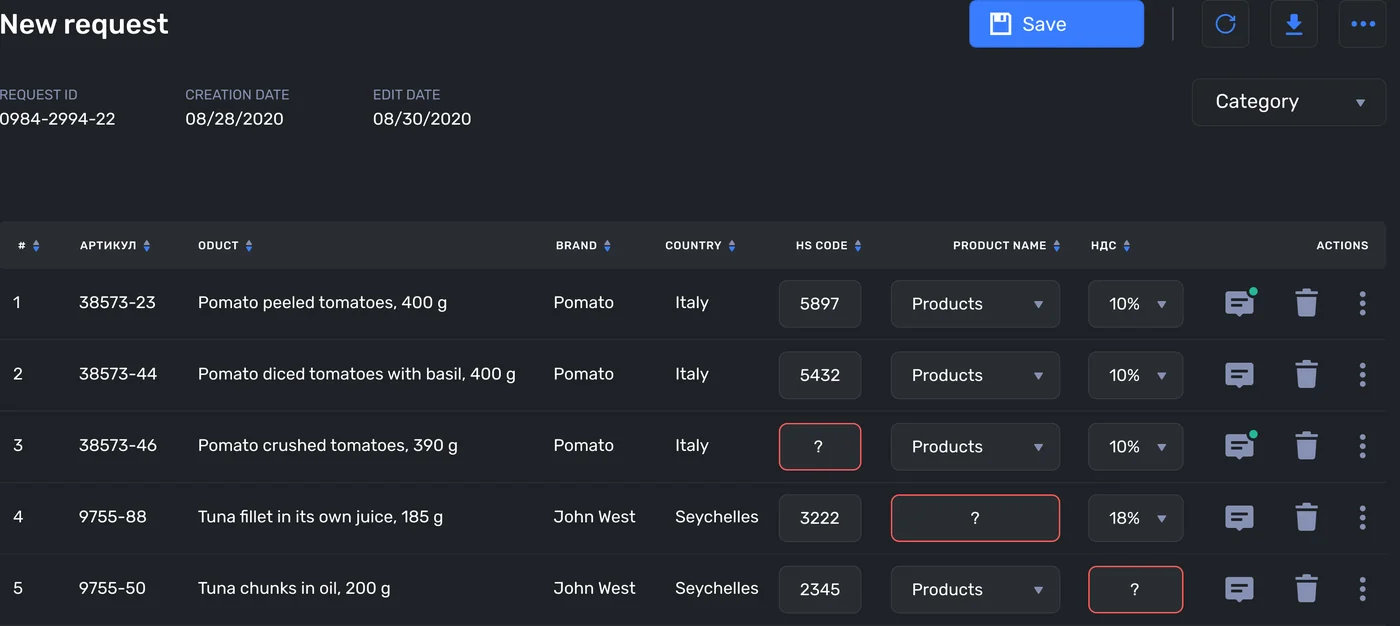
EasyTrain's self-learning posture was an architecture decision before it was a marketing claim. The knowledge base is a structured store of historical specification tuples — HS code, brand, country of origin, product name, VAT class, resolved category — keyed by the request that introduced each tuple. Every closed request adds new tuples to the store, and every new inbound request runs against the store via a deterministic lookup that the operator team can reason about, audit, and override. There is no opaque ML black box and no model-drift hazard: the system is honestly a deterministic predictive index over the company's own historical work.
Operator identity is deliberately separated from the knowledge base. The four-role admin permission model keeps the right to mutate historical tuples isolated to the administrator role, and infrastructure-as-code policies enforce the audit invariants — any pull request that would introduce a bypass of the role check, an unlogged tuple write, or a long-lived identifier in the prediction plane fails CI. The posture is built to align with GDPR obligations for users in the European Union and CCPA / CPRA obligations for users in California and the broader United States — and to make a future independent readiness review a documentation exercise, not an architectural retrofit.
Compliance posture: GDPR-aligned · ISO 27001 ready · SOC 2 Type II in progress · HIPAA-capable · CCPA-acknowledged.
A five-phase build that took EasyTrain from product specification to production for users across the United States and the European Union.
Operator-workflow interviews, four-role definition (calculator, nomenclature specialist, manager, administrator), three-scenario auto-fill specification, GDPR + CCPA posture mapping.
Laravel control plane skeleton, React operator console scaffold, four-role permission model, knowledge-base schema, three-scenario engine rules service.
React applications-in-processing dashboard, bulk specification-line entry grid, auto-fill highlighting, Laravel admin console, role-aware permission enforcement.
Infrastructure-as-code policies that block role-check bypass regressions, administrator-only knowledge-base mutation, anti-fraud queue for unusual operator behavior, third-party readiness scaffolding.
Web launch across US- and EU-overlapping regions, operator runbooks for the four roles, monitoring dashboards on the trading API and queue workers, post-launch support.
EasyTrain's operational layer was built to keep the platform extensible toward a multi-tenant, multi-region future without a v2 rewrite. The entitlement service already supports multiple role assignments per operator, the admin permission model already isolates administrator privileges from manager sign-off and calculator throughput, and the queue infrastructure already handles delayed knowledge-base re-indexing and notification fan-out. The published roadmap adds a multi-tenant deployment where a parent logistics holding can host several subsidiary companies on one EasyTrain instance with isolated knowledge bases, a public API for direct EDI integration with customer ERPs, a deeper analytics dashboard with calculator throughput and resolution-rate trends, and an audit-export module that surfaces every tuple-write event in a single download — each layered on the existing Laravel control plane rather than as a separate stack. Inside the operator plane, all that flows through is a short-lived opaque session token; the knowledge base never sees the operator's identity surface even if compromised. The four-role model, the multi-role assignment flag, and the manager sign-off step all read from the same entitlement record, so a single operator state resolves cleanly across the console, the admin portal, and the eventual public API. The whole subsystem was built with extensibility in mind: adding a B2B tier, a multi-tenant view, or an EDI partner endpoint is a configuration change against the entitlement service, not a code release.
EasyTrain launched on the web with the operator console active across the United States and the European Union. The English-language build serves operators in California, New York, Texas, Florida, and Washington in the US, and operators in the Netherlands, Germany, France, Ireland, and Sweden in the EU, without a separate codebase per region. Consent flows are region-aware at the client layer: operators in the EU and EEA receive a GDPR-style granular consent screen with separate toggles for any optional product analytics; operators in California receive a CCPA-style “Do Not Sell or Share My Personal Information” disclosure in the same flow. Data-handling practices are aligned with GDPR for European users and with the US state-privacy patchwork — CCPA / CPRA (California), VCDPA (Virginia), CPA (Colorado), CTDPA (Connecticut), UCPA (Utah), TDPSA (Texas), and Oregon CPA. Because the operator audit-trail architecture documents every tuple write the patchwork is most concerned with, regional compliance reduces to honest disclosure rather than per-jurisdiction data segregation.
The Laravel deployment was rolled out across EU and US-overlapping cloud regions in parallel, with each region's workers provisioned identically from immutable images. The matching service that resolves three-scenario auto-fill per request runs stateless workers that can be pinned to EU or US regions independently for future data-residency commitments. The in-app privacy policy was drafted to document exactly the architecture above, citing GDPR obligations and California CCPA obligations directly. The engineering team behind the build sits across CET and runs a CET workday with East-Coast US overlap (9 AM–1 PM ET) for stand-ups, operator-rollout choreography, and incident response — the timezone that lets a US product team and an EU engineering team share four hours of live overlap every day.
The active custom software development roadmap for EasyTrain includes a multi-tenant deployment for parent logistics holdings, a public API for direct EDI integration with customer ERPs, a deeper analytics view with calculator throughput and resolution-rate trends, and an audit-export module that surfaces every tuple-write event in a single download. A B2B tier with team management and SSO is planned for US and EU enterprise logistics use cases, with the entitlement subsystem already structured for multi-seat assignment. Infrastructure plans include further admin-console automation, an internal continuous-verification harness against the role-check invariants, and a future independent readiness assessment scaffolded into the cloud & DevOps roadmap.
If you are planning a B2B logistics operator portal, a customs-clearance automation product, or any web app where the audit trail and role-based access have to survive an outside reviewer for audiences in the US and EU, we have shipped this stack end-to-end and can compress the build timeline meaningfully. The engineering team behind it sits inside YuSMP Group. We work fixed-price for well-scoped MVPs and on dedicated development teams for ongoing delivery, with a CET workday and a guaranteed East-Coast US overlap (9 AM–1 PM ET) window for stand-ups, demos, and incident response.
A B2B logistics operator portal MVP covering a web React console, a Laravel control plane, a four-role permission model, a three-scenario auto-fill engine, and a historical knowledge base typically costs $70k–$160k. Adding multi-tenant deployment, a public EDI API, deeper analytics, and an audit-export module brings a full-featured product to $200k–$420k. The dominant cost drivers are the four-role permission model, the knowledge-base schema and migration story, and the operator-rollout choreography across calculator, nomenclature specialist, manager, and administrator workflows.
Laravel ships with a battle-tested permission model, queue workers, observability through Horizon, and a first-party admin tooling story that a generic CRM replaces with vendor primitives that do not map cleanly to a four-role calculator / nomenclature specialist / manager / administrator workflow. React lets the operator console behave like a desktop application — bulk row editing, keyboard navigation, visual highlighting of auto-filled cells — without the latency penalty of a low-code form builder. For a domain-specific workflow like customs-clearance specification entry, Laravel + React is the lower-risk choice.
A defensible self-learning posture is an architecture decision, not a marketing claim. The knowledge base is a structured store of historical specification tuples — HS code, brand, country of origin, product name, VAT class, resolved category — keyed by the request that introduced each tuple. Every closed request adds new tuples to the store, and every new inbound request runs against the store via a deterministic lookup that the operator team can audit and override. There is no opaque ML black box and no model-drift hazard — the system is honestly a deterministic predictive index over the company's own historical work.
For operators in the European Union and EEA, GDPR requires a granular consent mechanism, a clear privacy policy, and a documented basis for any processing of operator-linked data. For operators in California, CCPA / CPRA requires a “Do Not Sell or Share My Personal Information” disclosure and the right to delete — with the Virginia VCDPA, Colorado CPA, Connecticut CTDPA, Utah UCPA, Texas TDPSA, and Oregon CPA adding similar state-by-state expectations across the United States. An audit-trail architecture that documents every tuple write is the cleanest way to make regional compliance survivable for a B2B portal.
A focused MVP with Laravel + React, a four-role permission model, a three-scenario auto-fill engine, a historical knowledge base, and an operator console typically takes 8–12 weeks. Adding a multi-tenant deployment, a public EDI API, deeper analytics, and an audit-export module adds 6–10 weeks. The audit-ready hardening pass — role-check invariants enforced in IaC, administrator-only knowledge-base mutation, third-party readiness assessment — is frequently underestimated and should be budgeted at 3–5 weeks of dedicated work.
Related cases
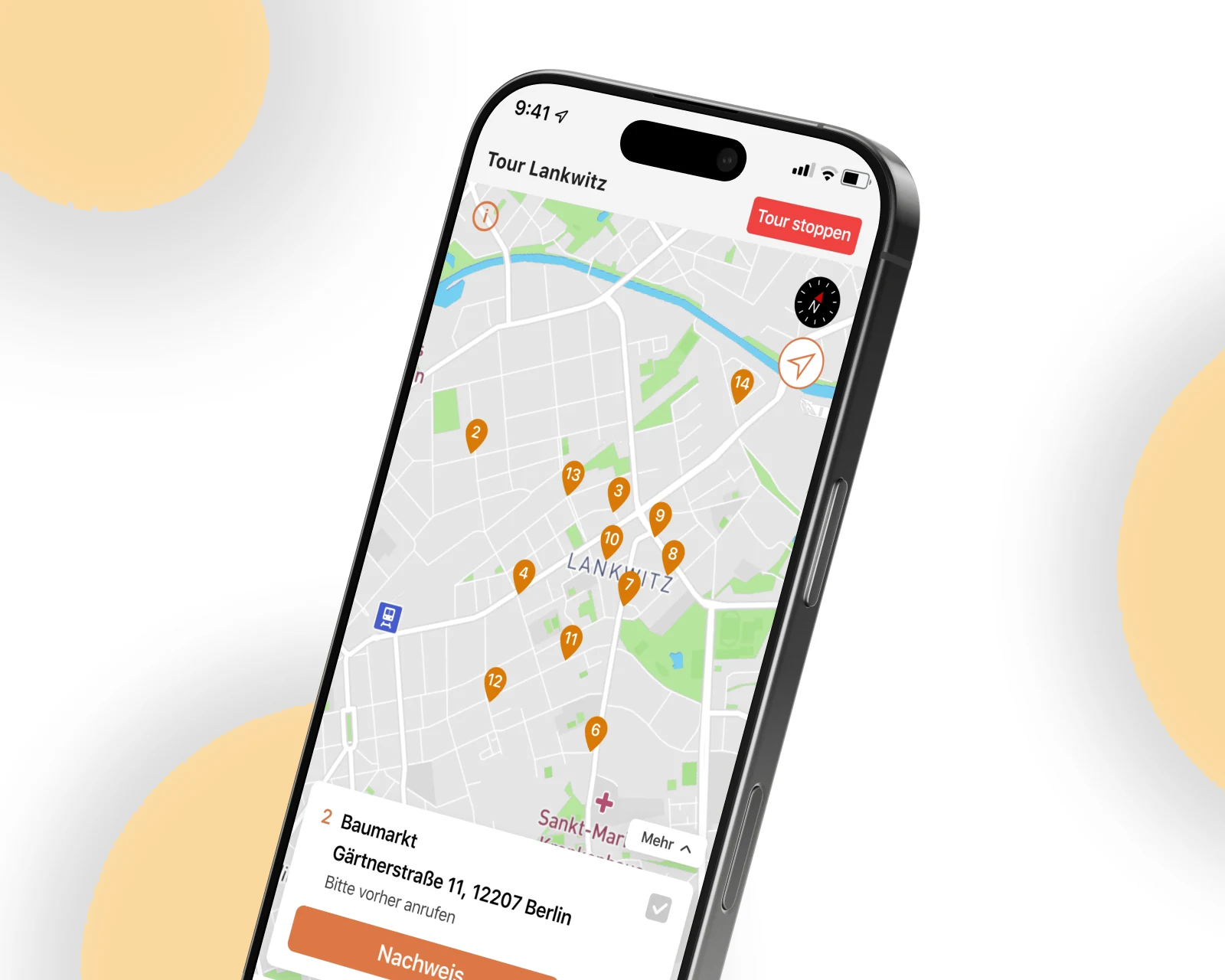
Logistics mobile app for freight-route planning and driver workflows — native iOS and Android, US + EU data-handling posture.
View case →
Discovery for a flower-delivery app pair — stock-aware catalog, dynamic product cards, three-step checkout, florist inventory tool.
View case →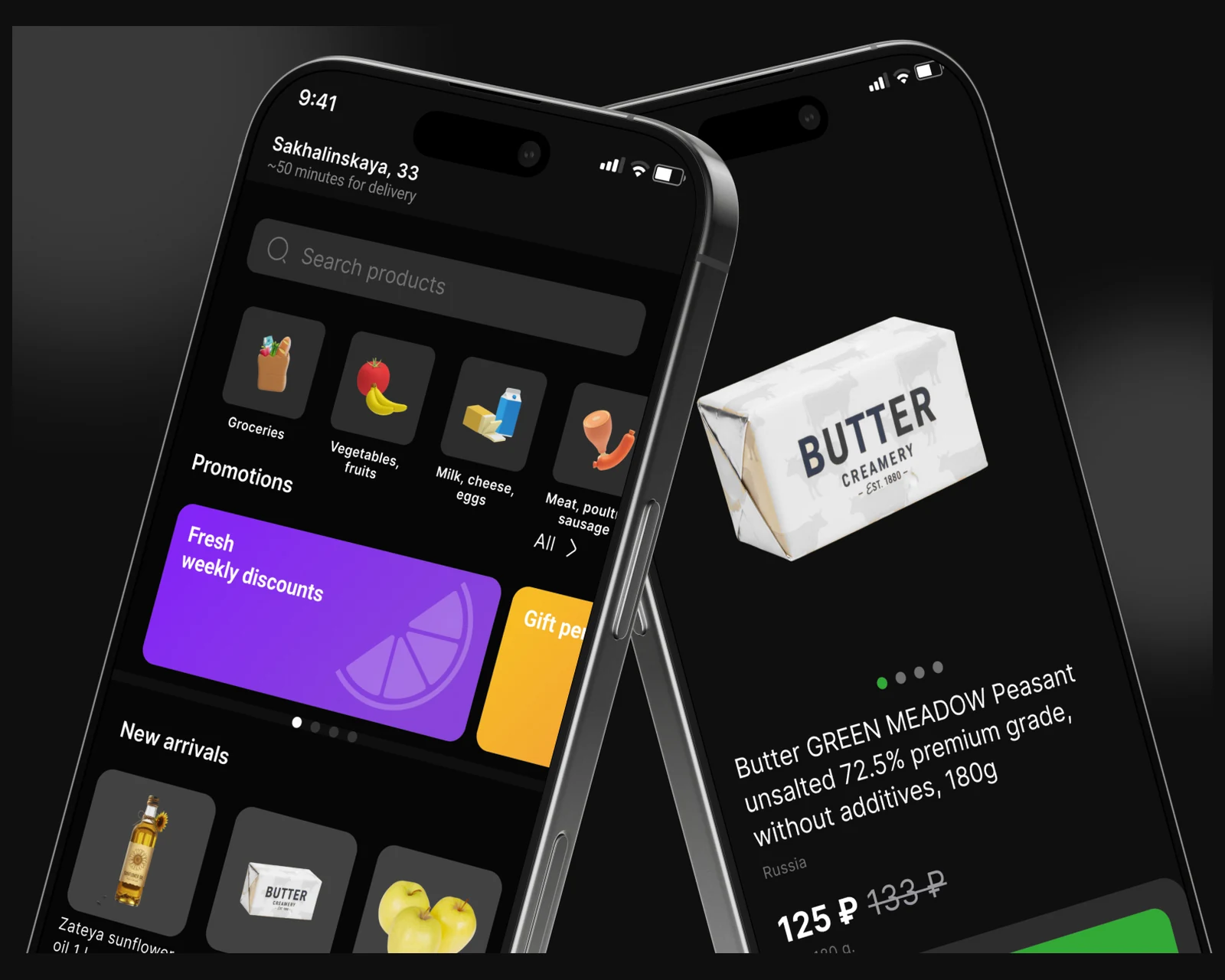
Four coordinated products on one Laravel backend — customer app, picker app, admin panel — with designed-from-scratch logistics.
View case →Share a few details and a senior consultant will reply within one business day.