Discovery & data model
Branch and warehouse process mapping, drug-level catalog design, the multi-branch analytics model, and GDPR + CCPA data-ownership posture mapping done in large analysis blocks.

Case study · Retail · Pharmacy
How we shipped a web application for a multi-branch pharmacy chain — an executive analytics dashboard, per-branch sales monitoring, a drug-level product catalog, barcode-driven warehouse automation, and inter-branch replenishment requests — built for operations teams across the United States and the European Union under GDPR and CCPA expectations from day one.
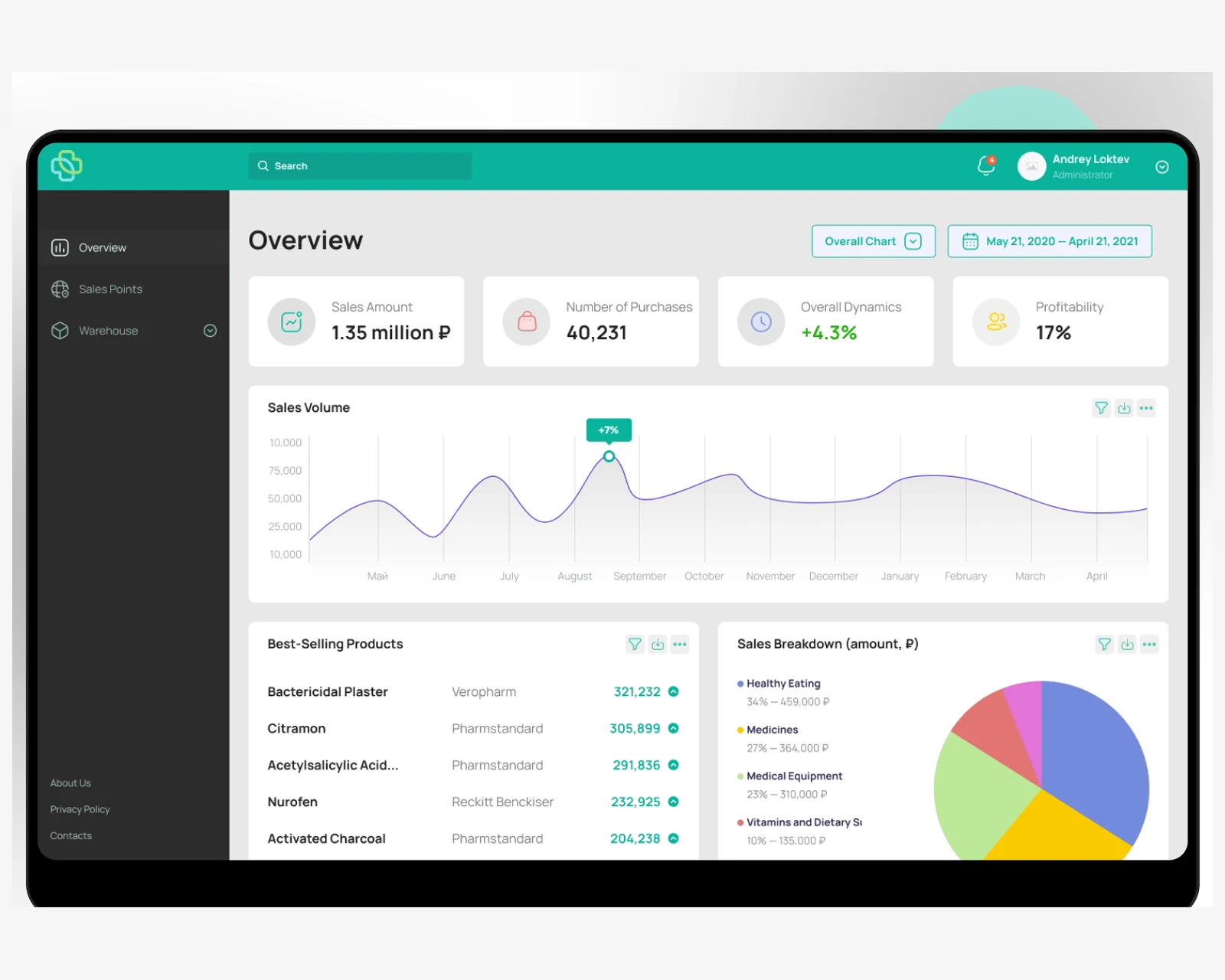
The client ran a pharmacy chain where each branch tracked its own sales, stock, and orders in isolation, and head office had no single, current picture of how the network was performing. For retail operations teams in the United States and the European Union, that model breaks the moment a chain scales past a handful of stores: sales figures arrive late and inconsistent, slow-moving and out-of-stock drugs go unnoticed, and an executive has no live read on profitability or which branch needs attention this week. The brief was to automate warehouse operations and point-of-sale reporting, make the numbers transparent, and do it on a tight timeline — a single web application that turns a chain of independent pharmacies into one observable, plannable operation. Off-the-shelf retail software failed the first test: it assumes a generic store and a single point of sale, and could not model per-branch plan execution, drug-level catalog articles, or the inter-branch replenishment a pharmacy network depends on. We built the system from first principles at YuSMP Group as a unified web platform — a React front end on a Laravel API — engineered with our custom software development practice for the US and EU markets.
A snapshot of what the pharmacy platform delivered across analytics, multi-branch operations, and warehouse automation in its first production cycle.
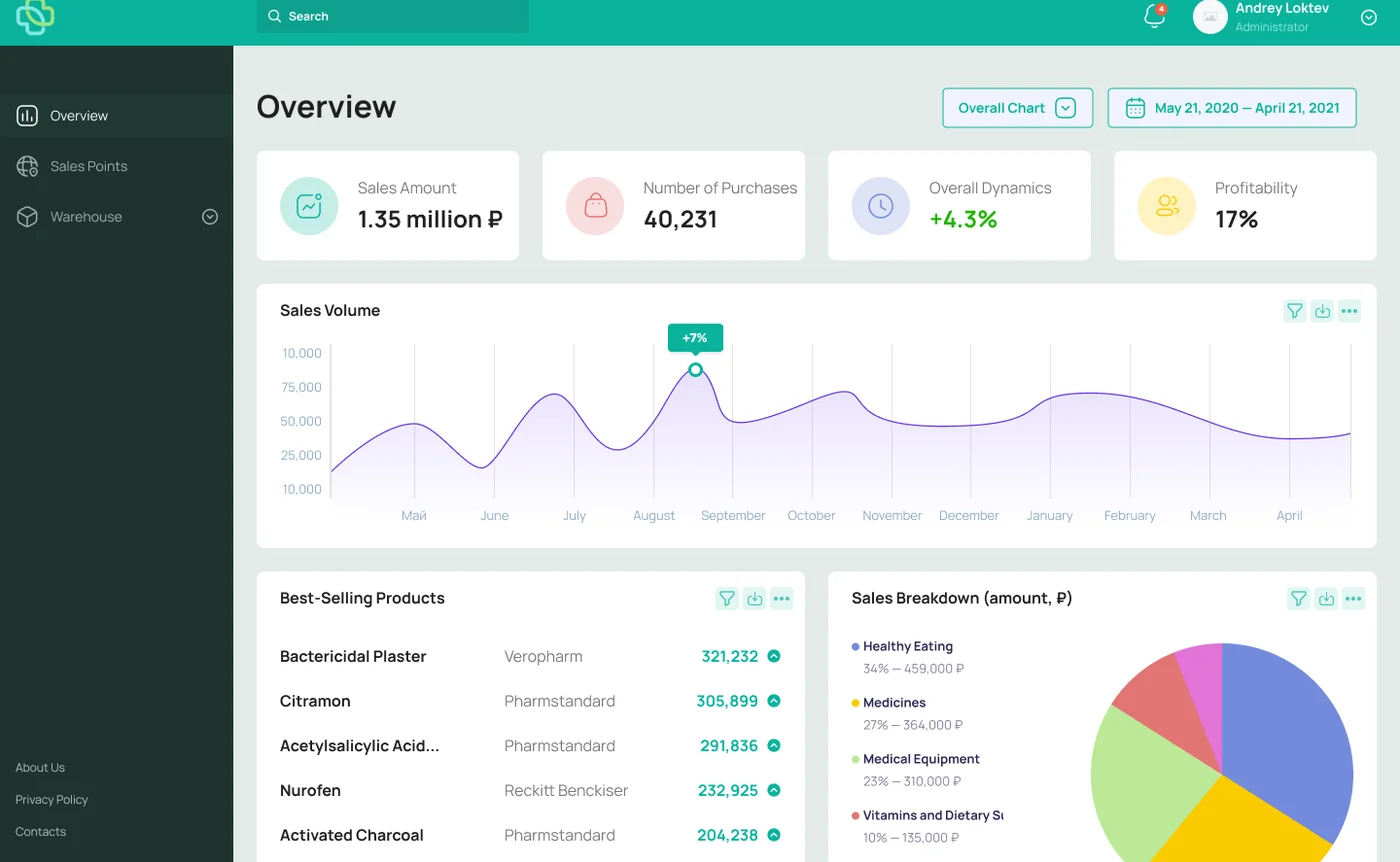
The platform decision dominates every other architectural choice in a multi-branch retail build. We chose a custom system over packaged retail software because a pharmacy chain's reality — per-branch plan execution, drug-level catalog articles with stock availability, inter-branch replenishment, and executive profitability views across the whole network — does not fit the generic single-store template that off-the-shelf products assume. The configuration tax of bending a packaged platform to those rules typically exceeds a clean custom build, and it leaves the most operationally important behavior locked behind a vendor's roadmap. A custom application let us model the real chain, design the analytics rollups the way head office actually reasons about the business, and own the data end-to-end — which matters for US and EU companies that have to answer to GDPR and CCPA obligations.
The trade-off most teams underweight is the analytics layer. Packaged retail suites surface a generic sales report, but they rarely let an executive pivot from a network-wide profitability number straight into a single branch's monthly dynamics and plan execution on the same basis. Building it ourselves meant the aggregation pipeline, the multi-branch data model, and the drill-down paths were first-class concerns rather than reporting plugins, and the entire stack — React dashboards, Laravel API, warehouse automation — stays open and maintainable for the long run.
| Dimension | Custom platform (this build) | Off-the-shelf retail software | Spreadsheets / paper |
|---|---|---|---|
| Multi-branch model | Per-branch plan execution and dynamics | Single-store assumptions | None — siloed per file |
| Executive analytics | Live network sales, dynamics, profitability | Generic, often batch reports | Manual consolidation |
| Drug-level catalog | Article codes, categories, availability | Generic SKU lists | Handwritten lists |
| Warehouse automation | Barcode receipt and shipment flows | Limited or add-on module | Manual transcription |
| Inter-branch replenishment | Branch requests against the warehouse | Rare or manual | Phone and email |
| Data ownership (GDPR / CCPA) | Full ownership and residency control | Vendor-hosted, shared tenancy | Uncontrolled |
| Role-based access | Admin, manager, and branch views | Varies; often coarse | None |
Platform references: React documentation, Laravel documentation, PostgreSQL documentation.
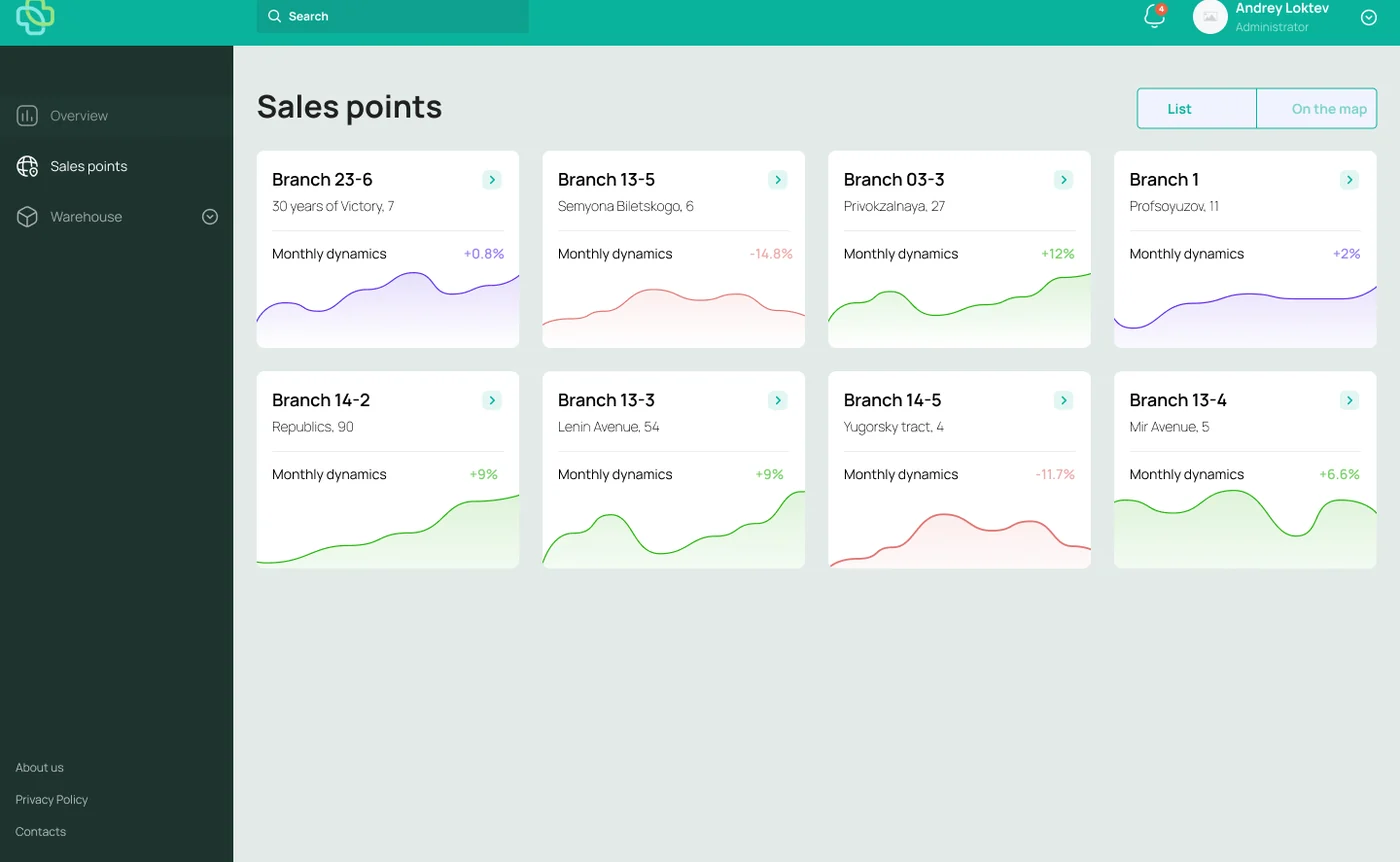
The web front end is built in React and is where head office actually runs the chain. The executive overview opens on the numbers that matter — total sales amount, number of purchases, overall dynamics, and profitability — alongside a sales-volume trend, best-selling products with their suppliers, and a category breakdown of where revenue comes from. From there a manager moves into the sales-points view: every branch laid out as a card with its address and a monthly-dynamics sparkline, so a store that is slipping shows up at a glance before it becomes a quarterly surprise. The whole front end is delivered as part of our web application development practice.
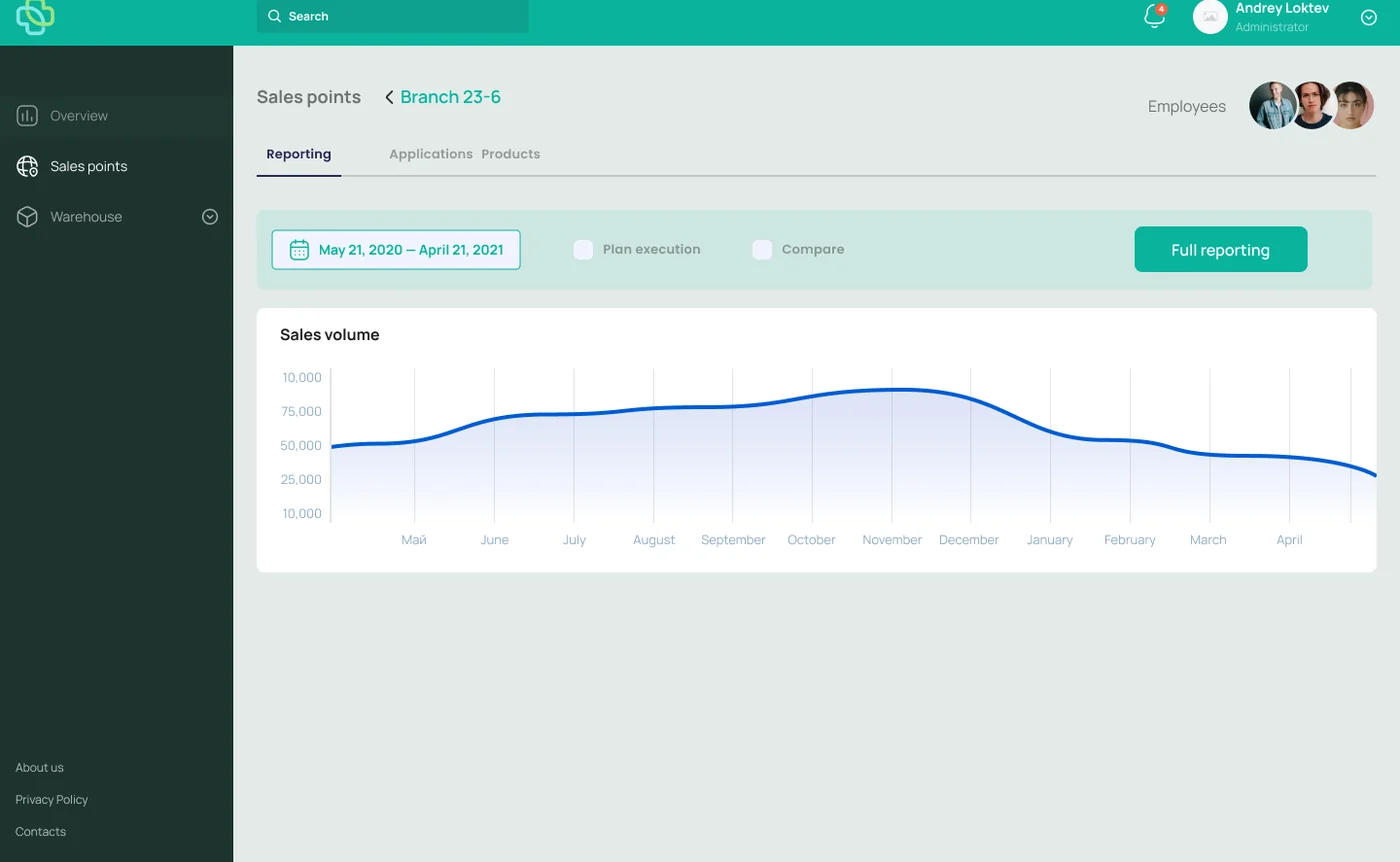
Drilling into a single branch opens its own workspace — a Reporting tab with sales volume and plan execution, a Requests tab for replenishment, and a Products tab for the local catalog. The design assumes a non-technical operator: one primary action per screen, date-range and compare controls kept out of the way until needed, and a consistent layout so the same person can manage one branch or the whole network. Because the platform is engineered on our cloud & DevOps foundation, the API, the analytics workers, and the dashboards scale together as the chain adds stores.
The backend is a Laravel API that carries the catalog, the multi-branch data model, and the warehouse subsystem. The warehouse module gives an operations lead a single read on the flow of goods — total transaction amount, receipts, and shipments over a chosen period, with a cargo-logistics chart that overlays what was received against what was shipped. Underneath it, warehouse staff work a barcode-driven loop: scan a product, and the system resolves the barcode to the full record — product name, article code, supplier, and current availability — then surfaces the next instruction for goods receipt or shipment. Removing that manual transcription step is the single largest contributor to accurate stock accounting across the chain.
The catalog itself is drug-aware. Each product carries an article code and a category — medicines, medical equipment, vitamins and dietary supplements, healthy eating, and others — and an availability state that branches and the warehouse share. When a branch runs low, it raises a replenishment request that the warehouse sees in one consistent queue, so assembly and shipment run against the same source of truth a manager monitors remotely. The API and its background workers are carried by the same team across the build as part of our enterprise software development practice.
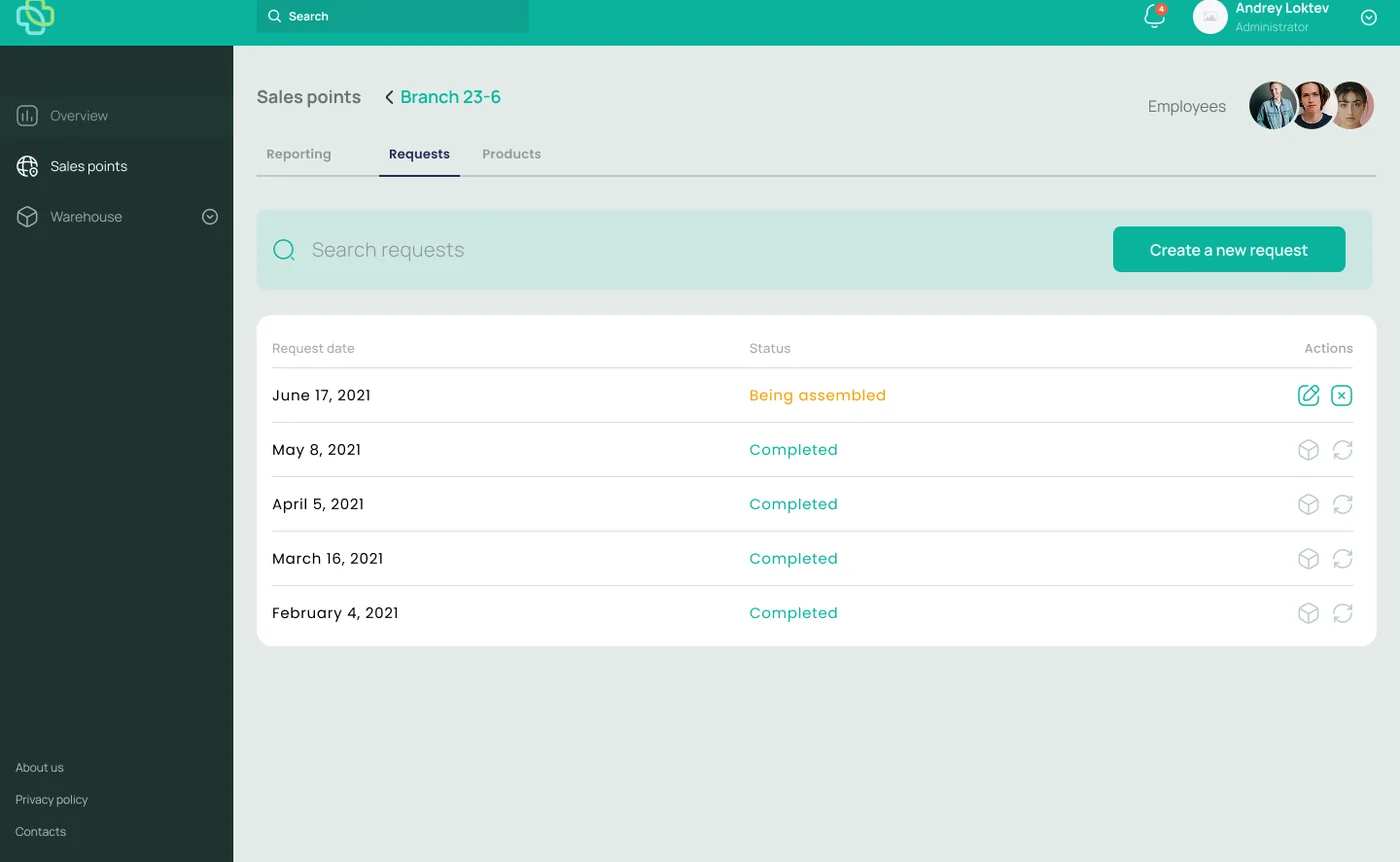
The replenishment subsystem is what ties branches and the warehouse into one operation. A branch creates a request against the warehouse, the request moves through clear states — being assembled, then completed — and every status change is visible to both the requesting branch and the warehouse team. Because each request is bound to the shared catalog and its availability, a manager never has to chase a phone call to find out where stock is; the queue itself is the source of truth, and the same record drives the analytics that head office sees. This is healthcare-adjacent retail, so the data model was built to keep operational and any sensitive records cleanly separated and access-controlled from the start.
Because the client owns its own deployment, data ownership and residency are design choices rather than vendor defaults. Operational data can be pinned to US or EU infrastructure for future data-residency commitments, role-based access keeps admin, manager, and branch views separated, and the system aligns with GDPR obligations for users in the European Union and CCPA / CPRA obligations for users in California and the broader United States — making a future readiness review a documentation exercise rather than an architectural retrofit.
Compliance posture: GDPR-aligned · ISO 27001 ready · SOC 2 Type II in progress · HIPAA-capable · CCPA-acknowledged.
A five-phase Agile build that took the pharmacy chain from siloed, per-branch spreadsheets to a live web platform with integrated warehouse automation.
Branch and warehouse process mapping, drug-level catalog design, the multi-branch analytics model, and GDPR + CCPA data-ownership posture mapping done in large analysis blocks.
React + Laravel skeleton, the sales-event aggregation pipeline, the catalog and availability schema, and the replenishment-request state machine.
Executive dashboard, sales-points monitoring, product catalog, and the warehouse module with barcode-driven goods receipt and shipment, shipped as incremental blocks.
Warehouse barcode flow QA, inter-branch replenishment testing, role-based access validation, and reconciliation of branch and warehouse data.
Branch onboarding, role-based access rollout, live analytics across US and EU deployments, and ongoing optimization of reporting and warehouse processes.
Beyond the scan-and-sell core, the platform carries an analytics rollup that turns a stream of branch-level events into the views head office actually plans against. Every sale, receipt, and shipment is keyed by branch, product article, and time, then aggregated into the executive overview — sales amount, purchases, overall dynamics, and profitability — and into a category breakdown of where revenue concentrates across the network. The same pipeline feeds per-branch plan execution, so a manager can compare a single store against its target and against its peers on the same basis, and can switch a date range or a compare mode without leaving the view. The subsystem was built with extensibility in mind — adding a new metric card, a forecasting overlay that projects sales from historical dynamics, or a new category to the catalog breakdown is a configuration change against the analytics service rather than a code release. It is the layer that turns a chain of independent pharmacies from a set of disconnected ledgers into one operational planning tool, and it is where the platform earns its keep for executives who have to commit to inventory and staffing weeks in advance across the US and EU.
The system shipped as a single English-language build serving retail operations teams across the United States and the European Union, without a separate codebase per region. It serves users in California, New York, Texas, Florida, and Washington in the US, and users in the Netherlands, Germany, France, Ireland, and Sweden in the EU. Because the client owns its own deployment, data-handling practices are aligned with GDPR for users in the EU and with the US state-privacy patchwork — CCPA / CPRA (California), VCDPA (Virginia), CPA (Colorado), CTDPA (Connecticut), UCPA (Utah), TDPSA (Texas), and Oregon CPA. Role-based access separates admin, manager, and branch views, and operational data can be pinned to US or EU infrastructure for future data-residency commitments — so regional compliance reduces to honest disclosure and access discipline rather than per-jurisdiction rework. For pharmacy operators this is doubly important: the platform is healthcare-adjacent, so the data model keeps operational and sensitive records cleanly separated rather than assuming a generic retail posture, a pattern we carry across our HealthTech work.
The platform is built to roll out across EU and US chains in parallel, with each branch's catalog, analytics, and warehouse queue provisioned identically and bound to the local product data. The matching between physical stock and digital records runs the same way in every region, so a multi-site operator gets one consistent picture across geographies. The engineering team behind the build runs a CET workday with East-Coast US overlap (9 AM–1 PM ET) for stand-ups, integration choreography, and incident response — the window that lets a US operations team and an EU engineering team share four hours of live overlap every day. Data-handling references are documented directly against GDPR obligations and California CCPA obligations.
The active custom software development roadmap for the pharmacy platform includes a forecasting overlay that projects branch demand from historical sales dynamics, automated replenishment suggestions that raise requests before a branch runs out, and a financial reporting module that turns the sales ledger into margin and shrinkage analytics. A supplier-integration layer for automated purchase orders is planned for larger US and EU chains, with the catalog already structured for multi-supplier articles. Infrastructure plans include further analytics-worker automation, a continuous data-integrity harness that reconciles branch and warehouse ledgers, and regional deployment scaffolded into the cloud & DevOps roadmap.
If you are planning a pharmacy-chain platform, a multi-branch retail analytics product, or any operations app where head office needs one live picture across many stores for audiences in the US and EU, we have shipped this stack end-to-end and can compress the build timeline meaningfully. The product overview is available at yusmpgroup.ru (web), and the engineering team behind it sits inside YuSMP Group. We work in Agile blocks for evolving scope and on dedicated development teams for ongoing delivery, with a CET workday and a guaranteed East-Coast US overlap (9 AM–1 PM ET) window for stand-ups, demos, and incident response.
A pharmacy-chain web application covering an executive analytics dashboard, multi-branch sales monitoring, a product catalog with stock availability, and basic warehouse receipt and shipment flows typically costs $80k–$190k. Adding barcode-driven warehouse automation, inter-branch replenishment requests, per-branch plan execution, and role-based access for a larger network brings a full-featured build to $220k–$520k. The main cost drivers are the analytics layer, the multi-branch data model, and the warehouse integrations.
Off-the-shelf retail platforms assume a generic store and a single point of sale. A pharmacy chain has its own reality — per-branch plan execution, drug-level catalog articles, stock availability that drives inter-branch transfers, and executive-level profitability views across the network. Bending a packaged product to those rules often costs more than a custom build, and it leaves the most important behavior locked behind a vendor roadmap. A custom platform lets you model the real chain and own the data, which matters for US and EU companies with GDPR and CCPA obligations.
Each branch streams its sales, receipts, and shipments into a shared data model keyed by branch, product article, and time. The analytics layer rolls those events up into executive views — total sales amount, number of purchases, overall dynamics, and profitability — and drills back down into a single branch with monthly dynamics and plan execution. Building the aggregation as a deliberate pipeline rather than ad-hoc queries keeps dashboards fast as the chain grows and lets managers compare branches on the same basis.
Warehouse staff scan a product barcode and the system resolves it to the full record — product name, article code, supplier, and current availability — then surfaces the next instruction for goods receipt or shipment. That removes manual entry, which is the single largest source of accounting drift. The same catalog powers per-branch availability, so when a branch runs low it can raise a replenishment request against the warehouse, and the warehouse sees one consistent picture of what to assemble and ship.
A focused build with an executive analytics dashboard, multi-branch sales monitoring, a product catalog with availability, and goods receipt and shipment flows typically takes 14–22 weeks. Adding barcode warehouse automation, inter-branch replenishment requests, per-branch plan execution, and role-based access for a larger network adds 8–12 weeks. The analytics aggregation layer and the multi-branch data model are frequently underestimated and should be budgeted as first-class work rather than afterthoughts.
Related cases
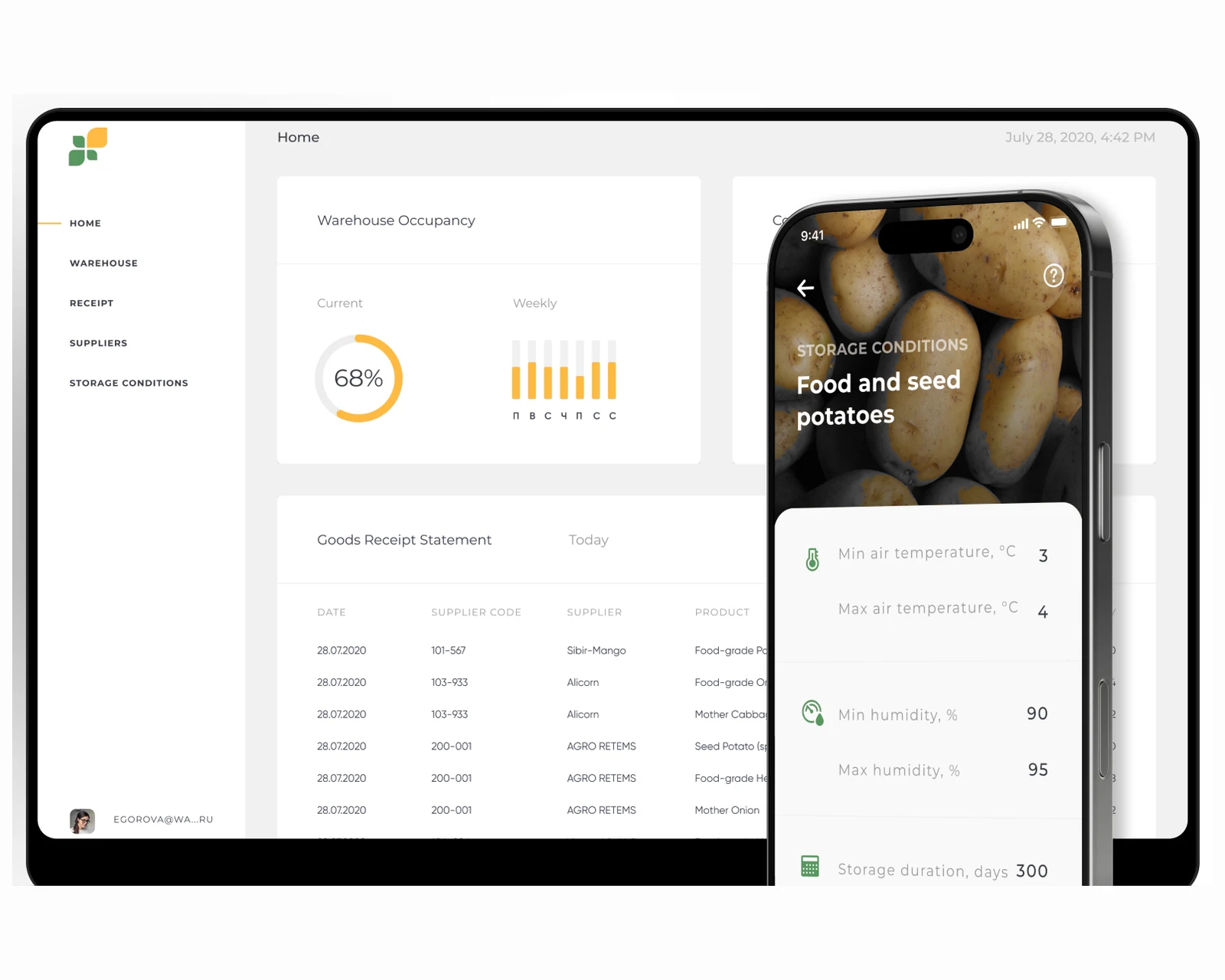
React control plane, native scanners, QR container tracking, and offline-first sync for high-volume storage across US & EU.
View case →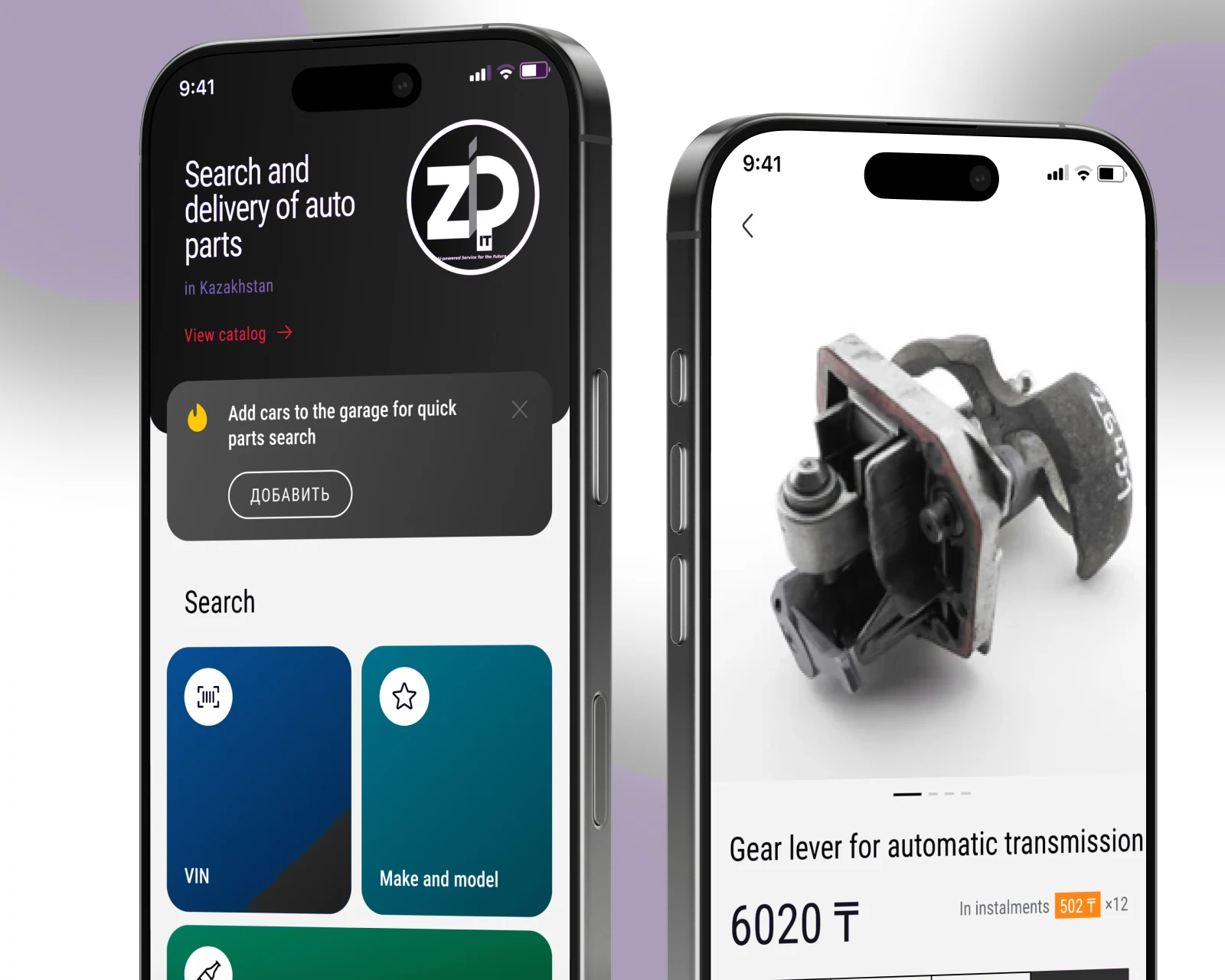
Auto-parts catalog, supplier CRM, and order-to-logistics flow connecting buyers and suppliers across US & EU.
View case →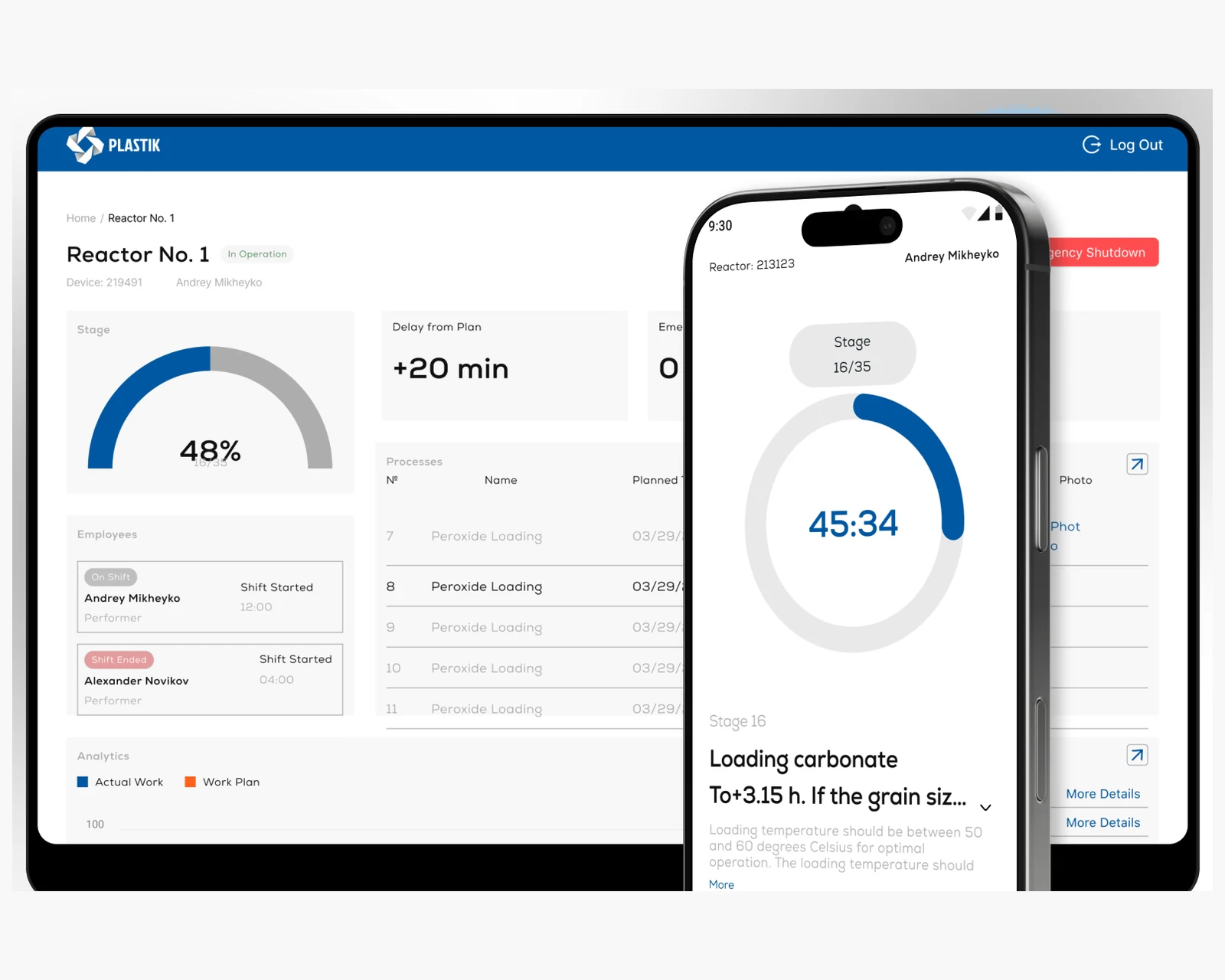
Field-audit tablet app, ops dashboard, and compliance reporting for distributed operations teams across US & EU.
View case →
Custom platforms engineered to your business model, scaling cleanly from MVP to millions of users.
Explore custom software development →
React and TypeScript front ends on robust APIs, built for analytics-heavy, multi-tenant platforms.
Explore web application development →
Containerized infrastructure, CI/CD pipelines, and Terraform-managed deployments across US & EU regions.
Explore cloud & DevOps →Share a few details and a senior consultant will reply within one business day.