Discovery & marketplace model
Traveler and supplier journey mapping, supplier-feed normalization scheme, monetization rules, and GDPR + CCPA data-ownership posture mapping.

Case study · Travel · Marketplace
How we built a travel-planning platform that assembles flights, hotels, and insurance into a single bookable tour in real time — a React traveler catalog, a Laravel supplier dashboard, virtual accounts with automated payouts, and one-transaction checkout for multi-service packages — engineered for travel businesses and suppliers across the United States and the European Union under GDPR and CCPA expectations from day one.
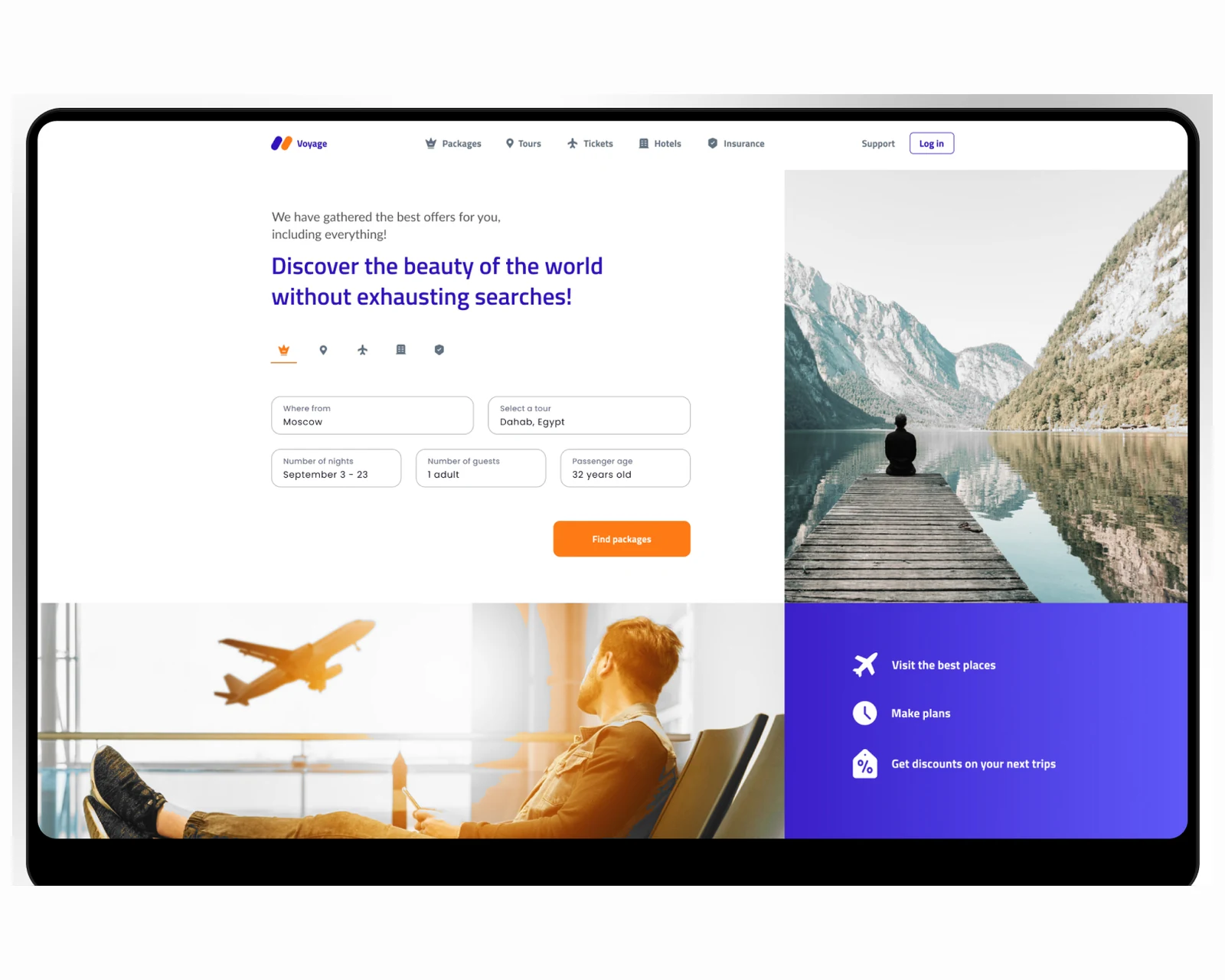
The client wanted to collapse the messy reality of planning a trip — separately searching airlines, comparing hotels, then bolting on travel insurance — into a single flow where a traveler describes the trip once and receives ready-made packages to book in one transaction. For travel businesses serving the United States and the European Union, the manual model leaks margin to intermediaries and buries small hotels and niche carriers under aggregators they cannot influence. The brief was twofold: give travelers a real-time tour builder that combines flights, hotels, and insurance into personalized packages, and give suppliers a self-service portal to control their own inventory, pricing, promotions, and payouts. Off-the-shelf booking engines failed the first test because they treat each category as an isolated funnel and rarely expose a coherent multi-supplier control plane. We built the platform from first principles at YuSMP Group as a unified product — a React traveler-facing catalog, a Laravel supplier dashboard, a combination engine, and a payment-and-payout ledger — engineered with our custom software development practice for the US and EU markets.
A snapshot of what the travel-platform build delivered across a traveler-facing catalog, a multi-supplier dashboard, and a payment-and-payout ledger.
The combination engine is the decision that shapes every other part of a travel platform. We chose a custom build over a packaged booking engine because the product's whole value is combining independently sourced flights, hotels, and insurance into one priced package — and packaged engines treat each category as an isolated funnel that the traveler has to stitch together by hand. A custom tour builder lets the platform query each supplier category in parallel, reconcile availability and currency, rank the valid combinations against the user's filters, and present a single bookable price. That is exactly the surface that off-the-shelf products do not expose, and it is where a travel business in the US and EU either wins on convenience or loses the customer to an aggregator.
The trade-off most teams underweight is the supplier side. A booking engine optimized for a single brand has no real notion of many independent suppliers each owning their own inventory, pricing, and promotions. Building the platform ourselves meant the combination logic, the supplier feeds, and the payout ledger were first-class concerns rather than plugins, and the entire stack — React catalog, Laravel dashboard, combination engine, ledger — is open and maintainable as the marketplace grows across the United States and the European Union.
| Dimension | Custom tour builder (this build) | Off-the-shelf booking engine | Manual multi-site search |
|---|---|---|---|
| Cross-category bundling | Flights + hotels + insurance in one package | Usually one category per funnel | User stitches three bookings |
| Checkout | Single transaction for the whole trip | Separate checkout per service | Multiple payments, multiple sites |
| Supplier self-service | Full dashboard — inventory, pricing, promos | Limited or single-brand only | None |
| Payouts & accounting | Virtual accounts, ledger, scheduled payouts | Vendor-controlled, opaque | Manual reconciliation |
| Filtering & ranking | Price, dates, comfort, class, rating | Fixed, category-scoped filters | Per-site, inconsistent |
| Data ownership (GDPR / CCPA) | Full ownership and residency control | Vendor-hosted, shared tenancy | Scattered across sites |
| Promotions & promo codes | Supplier-managed campaigns and codes | Platform-controlled, rigid | None |
Platform references: React documentation, Laravel documentation, Stripe Connect (split payments) docs.
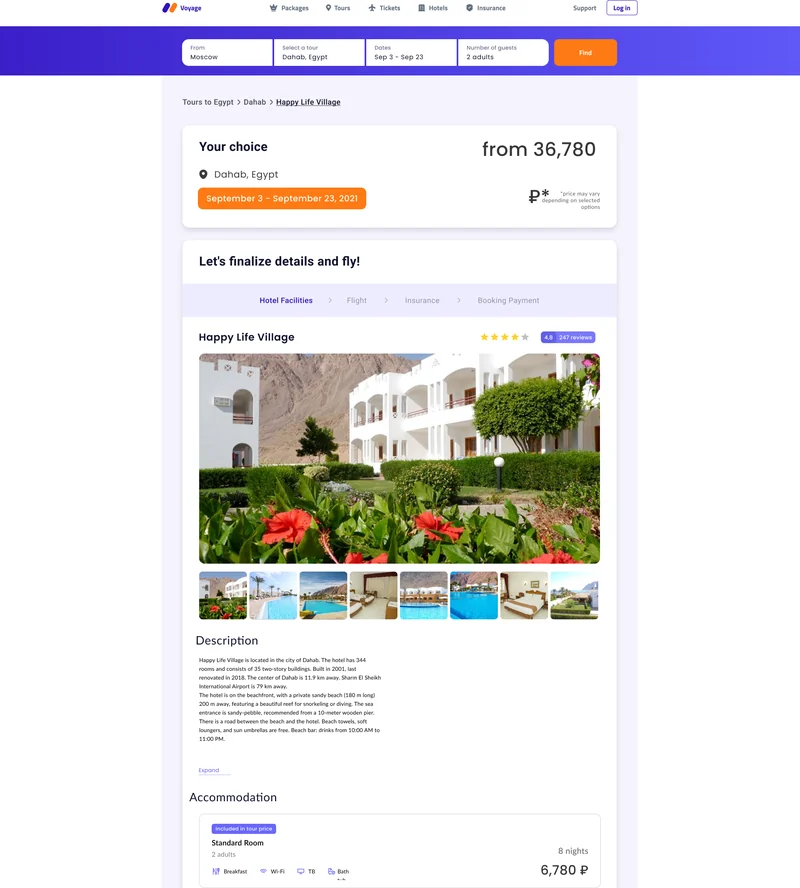
The traveler-facing catalog is built in React and is the surface where a trip comes together. The interaction starts with a single search — where from, the destination tour, number of nights, party size, and passenger age — and the platform returns ranked packages that already satisfy the filters, so a traveler is choosing between complete trips rather than assembling one. Drilling into a package opens a finalize-the-trip flow with clear steps: hotel facilities, flight selection, insurance, and booking payment. Each step shows exactly what is in the package — the chosen hotel with its facilities, reviews, and accommodation options, the outbound and return flights with times and airports, and the insurance cover — so there are no surprises at checkout.
Advanced filtering does the heavy lifting that makes a combined search usable: price, dates, hotel comfort level, flight class, and airline ratings all narrow the candidate set before the combination engine ranks it. The catalog is responsive and reads cleanly on a phone, because trip research starts on mobile far more often than it finishes there, and the whole front end is delivered as part of our web application development practice for audiences across the US and EU.
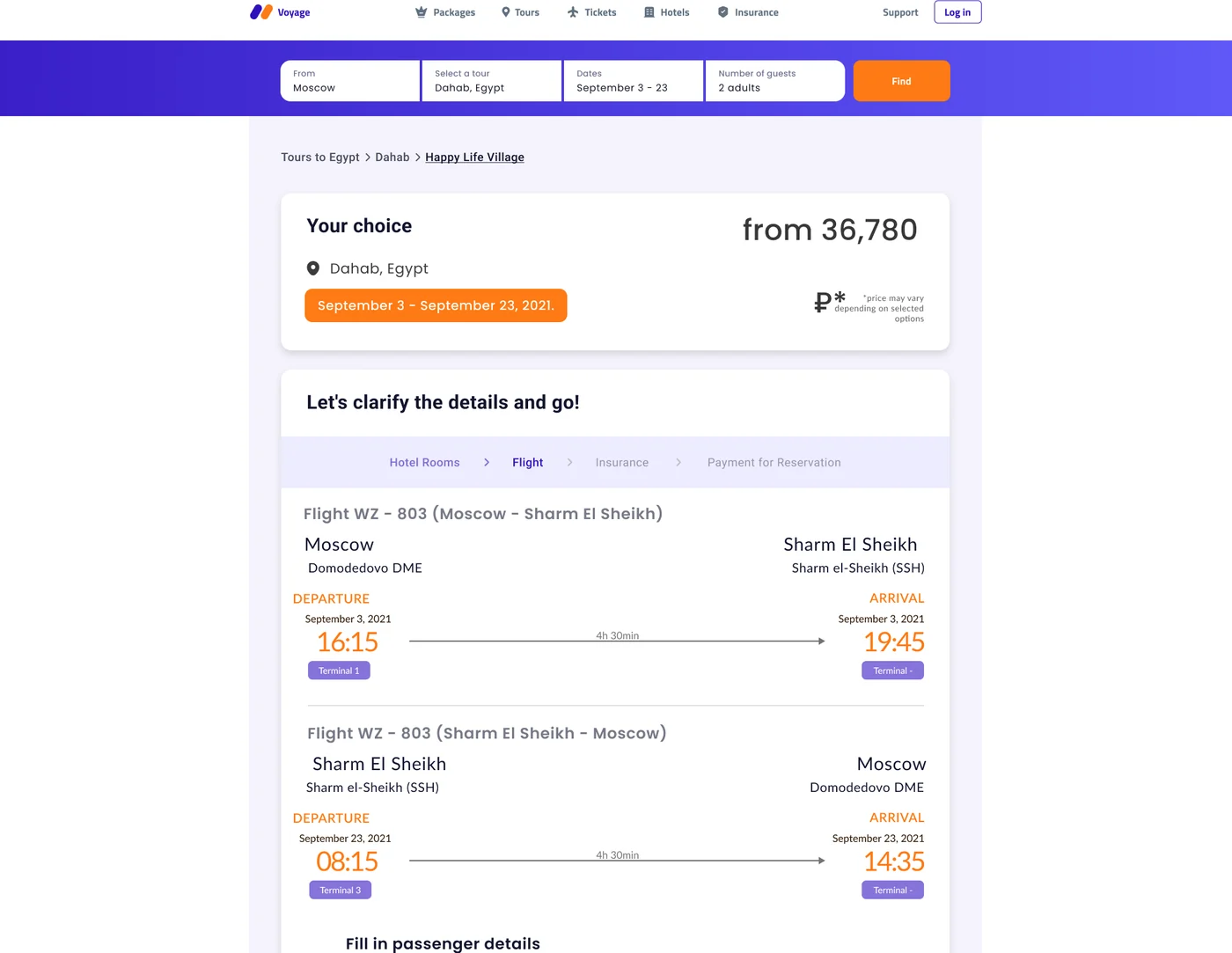
Behind the catalog, a Laravel combination engine is what turns three categories into one package. When a traveler searches, the engine queries flights, hotels, and insurance in parallel, prices the valid combinations, and reconciles availability, dates, and currency so the result is a coherent trip rather than three unrelated quotes. The flight step is a good example of the detail involved: the engine binds matching outbound and return legs — origin and destination airports, departure and arrival times, and class — to the rest of the package, so a change in nights or party size reflows the whole quote consistently. The same engine powers the filters, so price, comfort, class, and rating constraints are applied at combination time, not bolted on afterward.
Single checkout is the payoff. Because the package is one logical entity, the traveler authorizes one transaction for the whole trip while the platform handles the split internally. That single-payment flow is technically the hardest part of the build — it has to capture once, allocate to multiple suppliers, and stay reconcilable — and it is engineered on our cloud & DevOps foundation so the API, the sourcing workers, and the payment pipeline scale together as traffic grows across the United States and the European Union.
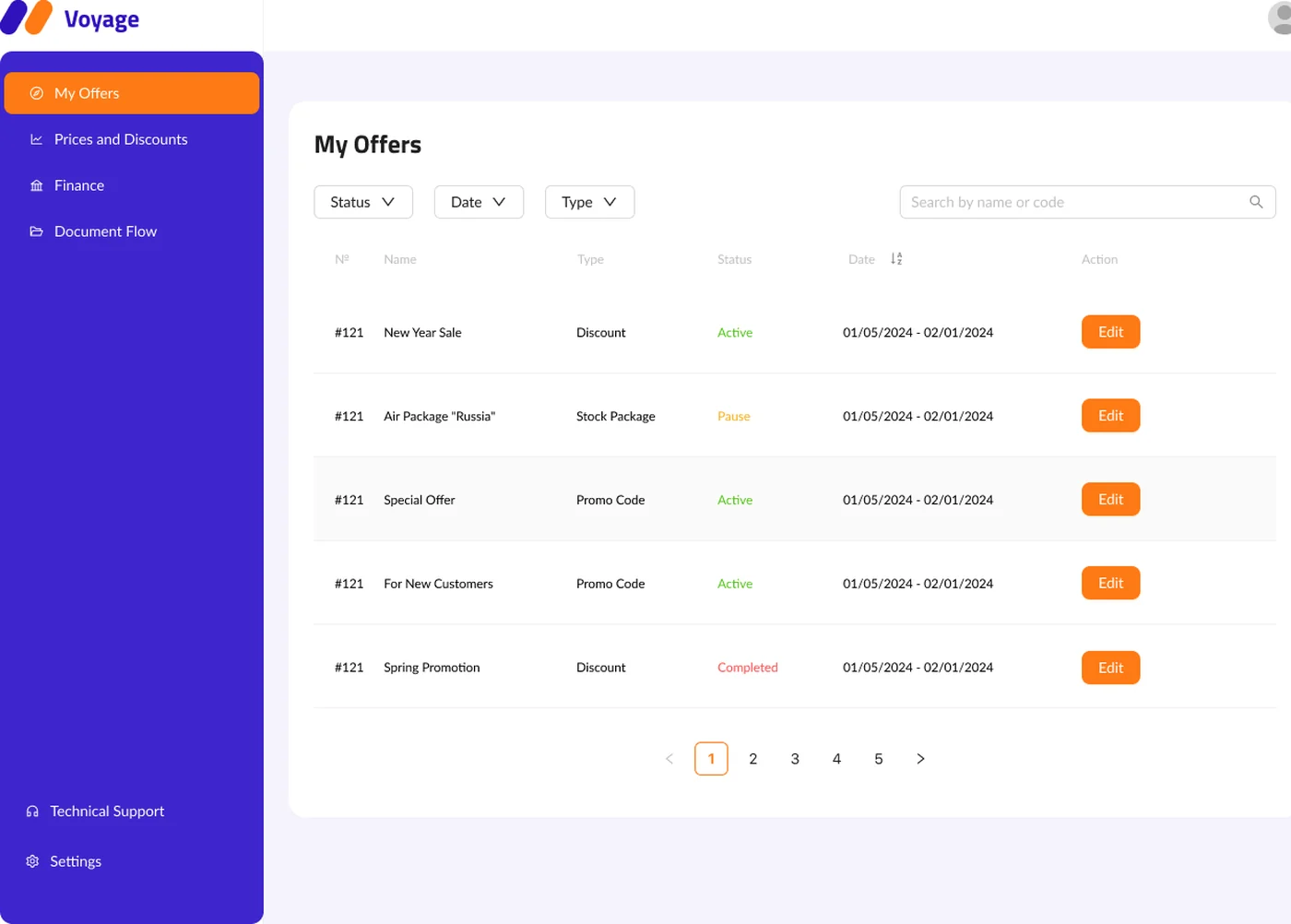
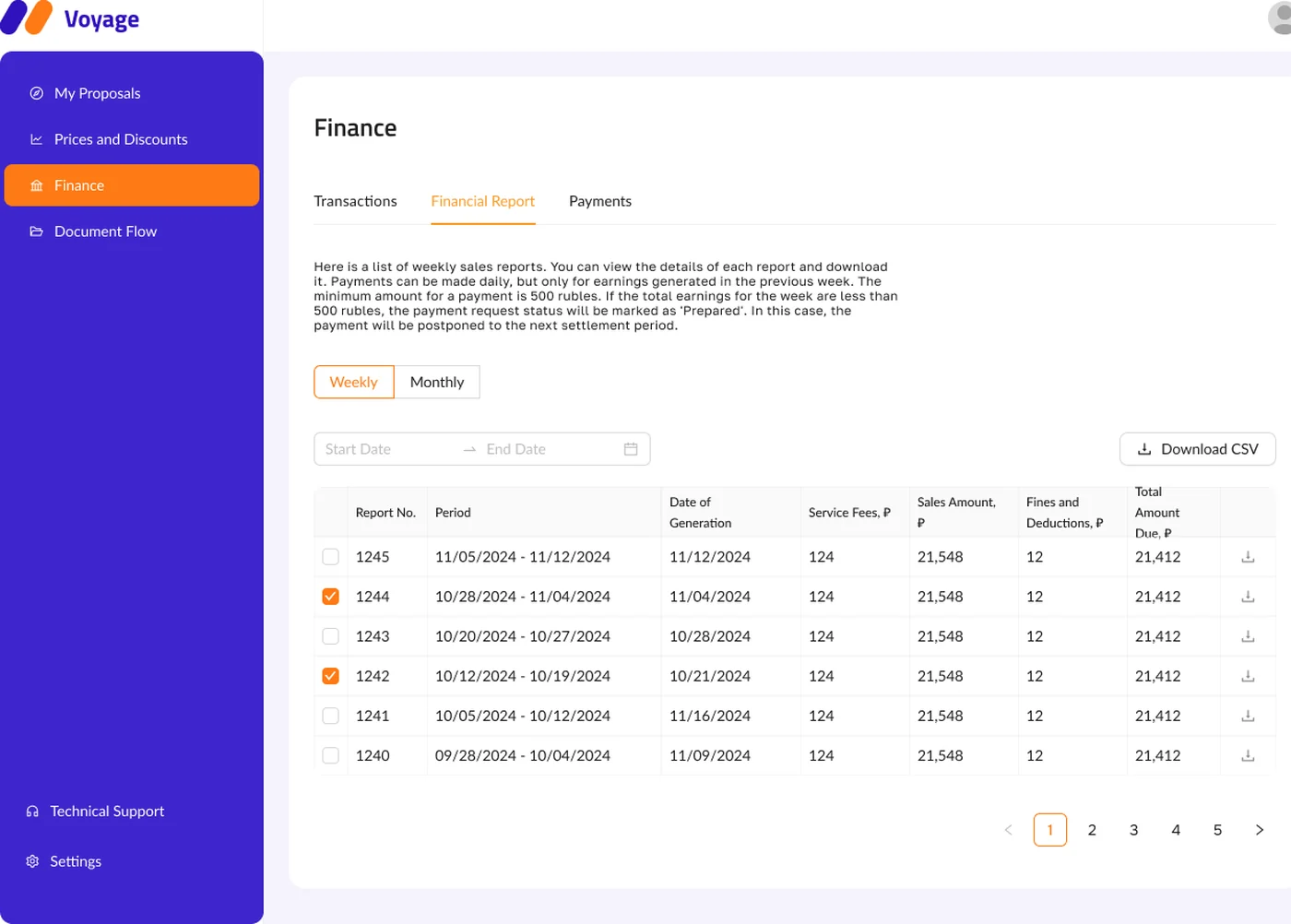
The supplier dashboard is the second coherent surface, and it is what makes the marketplace self-sustaining. Airlines, hotels, and insurers manage their own offers, prices and discounts, finance, and document flow from a single portal — creating discounts, stock packages, and promo codes, and toggling each between active, paused, and completed. A virtual-account system gives every supplier financial transparency: a ledger tracks sales, service fees, and deductions, weekly and monthly financial reports are exportable to CSV, and payouts settle on a schedule subject to a minimum threshold so balances reconcile cleanly. Keeping that supplier view and the public catalog eventually consistent as prices and availability change is the quiet engineering challenge the whole platform is built around.
Because the client owns its own deployment, data ownership and residency are design choices rather than vendor defaults. Operational and financial data can be pinned to US or EU infrastructure for future data-residency commitments, role-based access keeps traveler, supplier, and admin views separated, and the system aligns with GDPR obligations for users in the European Union and CCPA / CPRA obligations for users in California and the broader United States — making a future readiness review a documentation exercise rather than an architectural retrofit.
Compliance posture: GDPR-aligned · ISO 27001 ready · SOC 2 Type II in progress · HIPAA-capable · CCPA-acknowledged.
A five-phase SCRUM build that took the platform from a fragmented booking idea to a live two-sided travel marketplace over roughly ten months.
Traveler and supplier journey mapping, supplier-feed normalization scheme, monetization rules, and GDPR + CCPA data-ownership posture mapping.
React + Laravel skeleton, parallel sourcing contract for flights, hotels, and insurance, the ranking and filtering model, and the payment-and-payout ledger design.
Traveler-facing tour builder and finalize-the-trip flow, supplier offers, prices, promotions, finance, and document-flow surfaces.
Single-checkout capture, supplier split and virtual accounts, financial reporting, reconciliation QA, and consistency testing between catalog and supplier views.
Supplier onboarding, role-based access rollout, promotions go-live, and conversion and settlement telemetry across US and EU deployments.
Beyond the search-and-book core, the platform carries a financial subsystem that turns a two-sided marketplace into a sustainable business. A commission-based model takes a service fee on each booking, with premium partnership options layered on top for suppliers that want more visibility or richer promotional tools. Every transaction flows through a ledger that records the sales amount, the platform's service fee, and any fines or deductions, then nets to the total due to each supplier's virtual account. Suppliers see this in their own finance view — weekly and monthly reports, downloadable to CSV — and can request payouts on a daily cadence subject to a minimum threshold, with smaller balances rolling to the next settlement period. The subsystem was built for extensibility: adding a new fee structure, a new payout schedule, or a new promotion type is a configuration change against the financial service rather than a code release. It is the layer that lets the platform reduce travel costs by removing intermediaries while still funding itself, and it is where the marketplace earns the trust of the small hotels and niche carriers it was built to serve across the US and EU.
The platform is built as a single English-language product serving travelers and suppliers across the United States and the European Union, without a separate codebase per region. It serves travelers in California, New York, Texas, Florida, and Washington in the US, and travelers and suppliers in the Netherlands, Germany, France, Ireland, and Sweden in the EU. Because the client owns its own deployment, data-handling practices are aligned with GDPR for users in the EU and with the US state-privacy patchwork — CCPA / CPRA (California), VCDPA (Virginia), CPA (Colorado), CTDPA (Connecticut), UCPA (Utah), TDPSA (Texas), and Oregon CPA. Role-based access separates traveler, supplier, and admin views, and operational and financial data can be pinned to US or EU infrastructure for future data-residency commitments — so regional compliance reduces to honest disclosure and access discipline rather than per-jurisdiction rework.
The marketplace is built to onboard suppliers across EU and US markets in parallel, with the same combination engine, filters, and payout ledger serving every region so a multi-market operator gets one consistent picture. The engineering team behind the build runs a CET workday with East-Coast US overlap (9 AM–1 PM ET) for stand-ups, supplier-integration choreography, and incident response — the window that lets a US-based travel business and an EU engineering team share four hours of live overlap every day. Data-handling references are documented directly against GDPR obligations and California CCPA obligations.
The active custom software development roadmap for the travel platform includes deeper supplier integrations via GDS and channel-manager connectors, a recommendation overlay that learns from booking history to pre-rank packages, and a loyalty and points engine layered on the existing financial subsystem. Native mobile app development for iOS and Android is planned so trip research that starts on a phone can finish there, and a multi-currency, multi-language layer is scoped for broader EU and US reach. Infrastructure plans include further payout-reconciliation automation, a continuous consistency harness that reconciles the supplier dashboard against the public catalog, and regional deployment scaffolded into the cloud & DevOps roadmap.
If you are planning a travel-planning platform, a two-sided booking marketplace, or any product where independently sourced services have to combine into one bookable package and settle cleanly across many suppliers for audiences in the US and EU, we have shipped this stack end-to-end and can compress the build timeline meaningfully. The product overview is available at yusmpgroup.ru (web), and the engineering team behind it sits inside YuSMP Group. We work fixed-price for well-scoped MVPs and on dedicated development teams for ongoing delivery, with a CET workday and a guaranteed East-Coast US overlap (9 AM–1 PM ET) window for stand-ups, demos, and incident response.
A travel-platform MVP with a React tour builder, flight and hotel search, single-checkout payments, and a basic supplier portal typically costs $90k–$230k. Adding insurance bundling, multi-supplier onboarding, virtual accounts with automated payouts, financial reporting, and a promotions engine brings a full marketplace to $260k–$650k. The dominant cost drivers are the real-time combination logic across independent suppliers, the payment and payout flows, and the supplier-side dashboards that have to stay consistent with the traveler-facing catalog.
A tour builder assembles a complete trip from separately sourced components — flights, hotels, and insurance — into one bookable package. The traveler enters origin, dates, party size, and preferences, and the engine queries each supplier category in parallel, prices the combinations, and presents ranked packages that satisfy the filters. Behind the scenes it reconciles availability, currency, and policy rules so the user sees a single price and books the whole trip in one checkout rather than stitching three reservations together by hand.
A multi-supplier marketplace needs two coherent surfaces: a traveler-facing catalog and a supplier dashboard that feeds it. Suppliers manage their own inventory, pricing, promotions, and documents, while the platform normalizes those feeds into a common schema the tour builder can combine. A ledger tracks sales per supplier, virtual accounts hold balances, and payout rules settle funds on a schedule. The hard part is keeping the supplier view and the public catalog eventually consistent as prices and availability change.
A bundled package spans several suppliers, so the platform captures one payment from the traveler and then splits the funds internally. Each supplier accrues its share into a virtual account, service fees and deductions are recorded against a financial report, and payouts settle on a daily or weekly cadence subject to a minimum threshold. Single-checkout means the traveler authorizes one transaction for the whole trip, while reconciliation, refunds, and settlement run server-side against an auditable ledger.
A focused travel-platform MVP with a React tour builder, flight and hotel search, filtering, and single-checkout payments typically takes 14–22 weeks. Adding insurance bundling, the supplier dashboard, virtual accounts, payouts, financial reporting, and a promotions engine adds 10–16 weeks. The combination engine and the payment-and-payout reconciliation are the most underestimated areas and should each be budgeted with dedicated hardening time before launch across US and EU markets.
Related cases
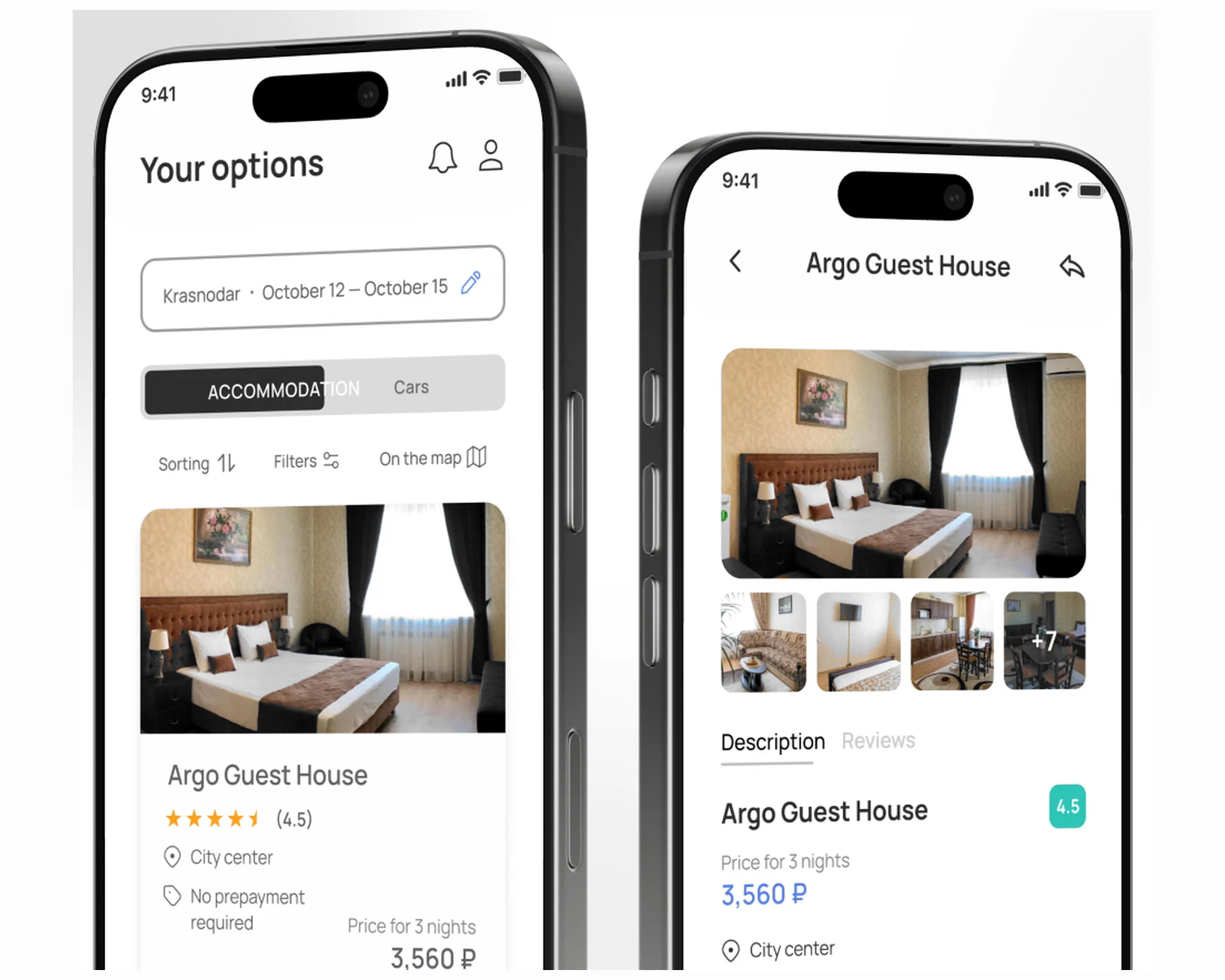
Housing and car rental marketplace for travelers, with listings, booking, and supplier tools across US & EU.
View case →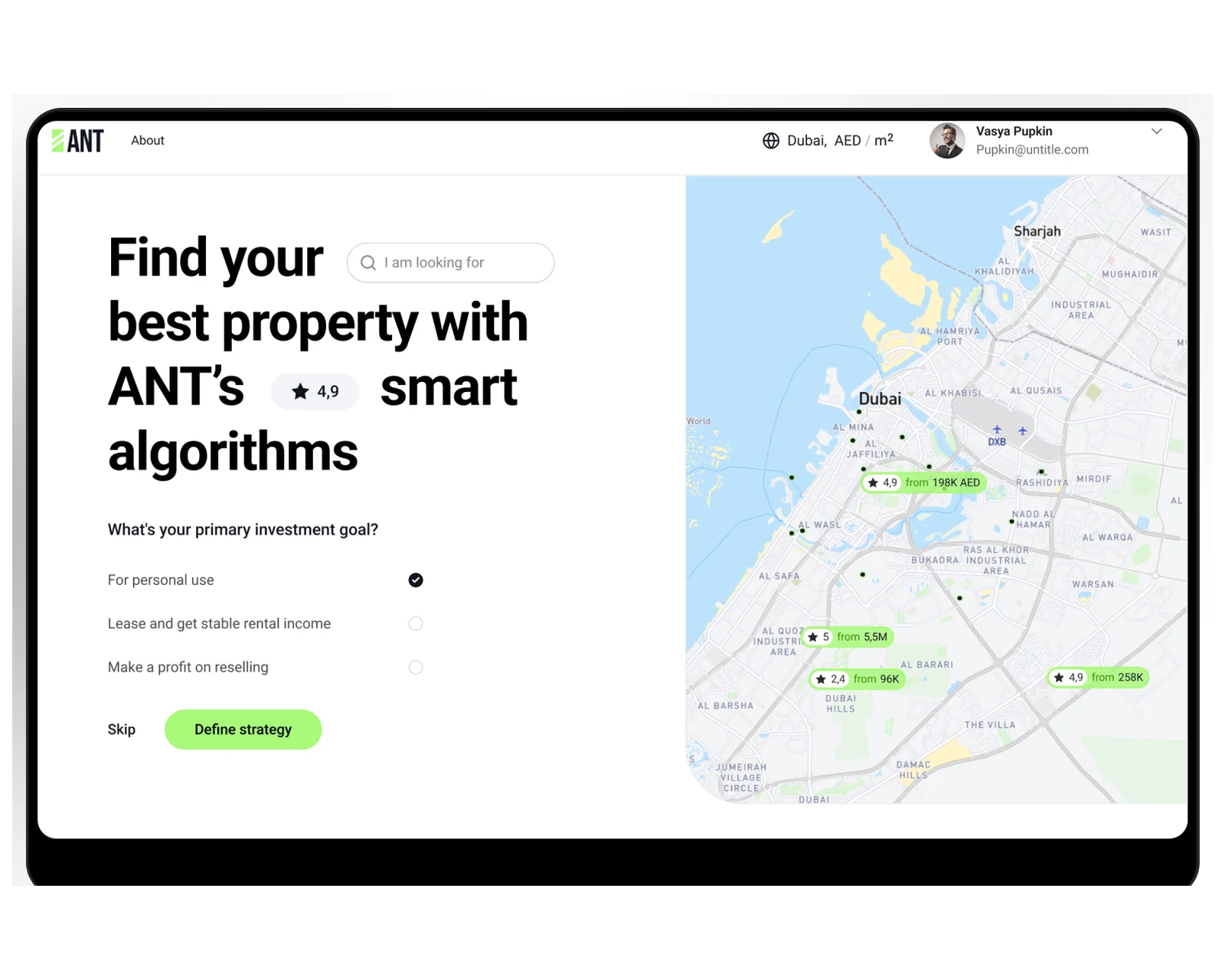
A two-sided property marketplace with supplier listings, search, and transaction flow for the US & EU.
View case →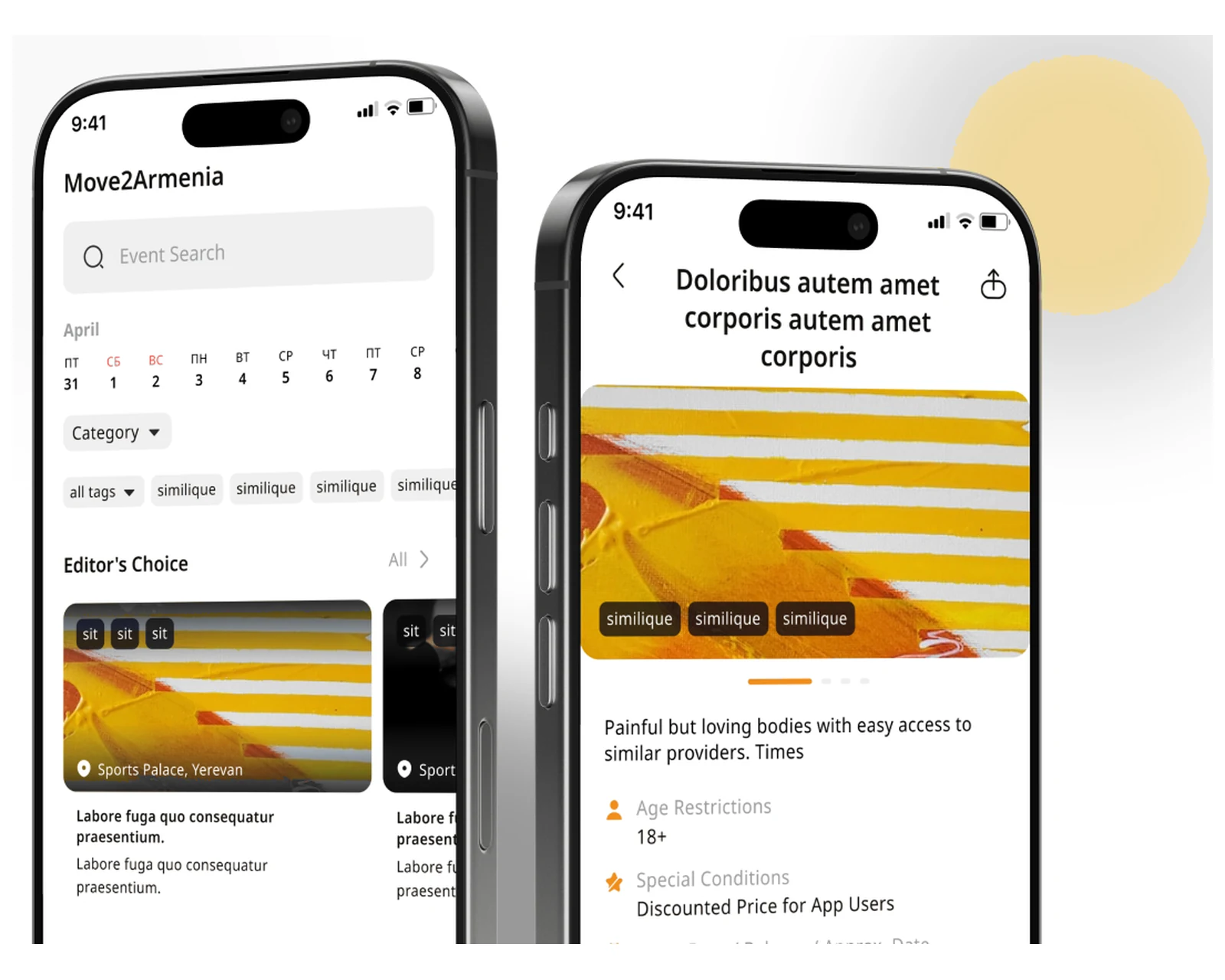
A relocation and travel services platform aggregating guidance, listings, and bookings for newcomers.
View case →
Custom platforms engineered to your business model, scaling cleanly from MVP to millions of users.
Explore custom software development →
Fast, accessible React web apps with production-grade APIs and release pipelines.
Explore web application development →
Containerized infrastructure, CI/CD pipelines, and Terraform-managed deployments across US & EU regions.
Explore cloud & DevOps →Share a few details and a senior consultant will reply within one business day.