

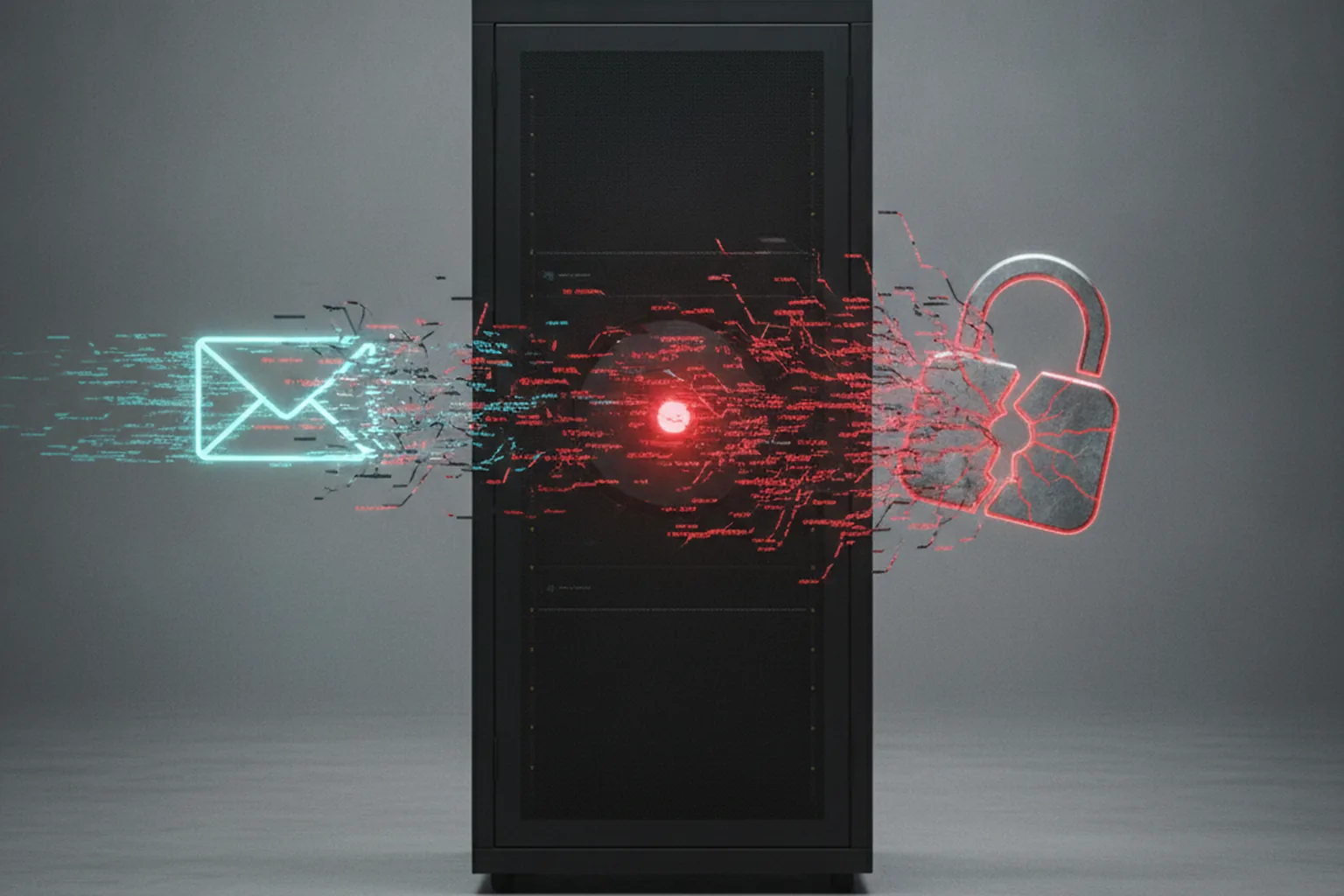
The short answer
An unpatched Cisco Secure Email Gateway can be taken over by a single crafted email — no login, no click. CVE-2026-76461 (CVSS 9.8) is a SQL-injection flaw in the appliance’s email-parsing logic that ends in arbitrary command execution as root on the underlying operating system. Cisco reported active exploitation, CISA added it to the Known Exploited Vulnerabilities catalog on September 14, 2026, and Cisco says there is no workaround. The fix is to update AsyncOS immediately.
For US and EU teams, the uncomfortable part is where the flaw lives: the very appliance that filters your inbound mail is exposed to the internet by design, so it is a pre-authentication target sitting at the edge of the network. Devices like this rarely make it into a test scope — which is exactly why they belong in one. That is the posture we build into a penetration test and security audit: treat the boxes meant to protect you as attack surface and prove they hold up.
What Cisco disclosed
A Secure Email Gateway is the appliance an organization puts at the boundary of its mail flow: every inbound message passes through it to be scanned for spam, phishing, and malware before reaching a user’s inbox. By definition it accepts connections from anyone on the internet who wants to send your company email — which is what makes a flaw in how it parses those messages so dangerous.
On September 14, 2026, Cisco disclosed CVE-2026-76461, a vulnerability in the email-parsing logic of AsyncOS Software for Cisco Secure Email Gateway. The root cause is insufficient validation of message input, which allows SQL injection: an attacker sends a crafted email containing malicious SQL statements, the gateway processes them against its database, and the chain culminates in arbitrary command execution with root privileges on the underlying operating system. Cisco rated it CVSS 9.8 — near the top of the scale — and confirmed there is no workaround. The same fix also covers Cisco Secure Email and Web Manager.
Crucially, Cisco disclosed that the flaw is being exploited in the wild. Within hours, CISA added CVE-2026-76461 to its Known Exploited Vulnerabilities catalog on September 14, 2026, and the Canadian Centre for Cyber Security published a parallel advisory (AV26-921). KEV inclusion is the strongest routine signal a defender gets that a bug is not theoretical: it means confirmed attacks, and for US federal civilian agencies it triggers a mandatory remediation deadline under Binding Operational Directive 26-04.
Why an email becomes a root shell
What makes this bug stand out is the total absence of friction for the attacker. There is no credential to steal, no phishing lure a user must click, no second stage that depends on internal access. The attacker sends one email — the single thing the appliance exists to receive — and the payload rides in through normal mail flow. The malicious SQL executes when the gateway parses the message, and because the parsing process runs with high privilege, successful injection lands as command execution as root on the host operating system.
That combination — unauthenticated, remote, zero user interaction, root-level outcome — is why the CVSS score is 9.8 and why exploitation followed disclosure so quickly. An attacker who owns the email gateway owns a device that already sees every message entering the company: they can read mail in transit, tamper with filtering, harvest credentials and internal routing details, and use the box as a quiet foothold to pivot deeper into the network. For a security appliance, that is a worst-case failure mode, because the compromise happens inside the control the organization installed specifically to prevent it.
There is no configuration flag or filtering rule that neutralizes CVE-2026-76461, which is why Cisco is explicit that no workaround exists. The vulnerable code is in the parsing path itself, so the appliance cannot safely process the very traffic it is built to process until it is patched. Cisco released fixed AsyncOS builds — 15.5.5-014 for 15.5 and earlier, 16.0.4-302 for 16.0, and 16.5.0-780 for 16.5 — and stated that it upgraded its cloud-managed Secure Email devices. Applying one of those builds is the only remediation.
What it means for US & EU software teams
The first lesson is that the perimeter appliance is part of your attack surface, not a substitute for securing it. Teams tend to trust the security stack implicitly — the gateway, the firewall, the VPN — and leave those devices out of the assessments they run against their own applications. But an internet-facing box with a pre-auth RCE is exactly what an attacker looks for first, and it grants root in one step. The same edge-hardening discipline you apply to your cloud and DevOps platform — least privilege, tight network exposure, fast patch pipelines, and monitoring — has to extend to vendor appliances, not stop at the code you wrote.
The second lesson is about patch velocity as an operational capability. When a bug goes from disclosure to CISA KEV in the same day and there is no workaround, the only variable you control is how quickly you can identify affected devices and roll the fix. Organizations that maintain a current asset inventory, know which appliances are internet-reachable, and can schedule an out-of-band update within hours will close this before it is used against them; those that discover their exposure during an incident will not. That readiness is a process to build in advance, not to improvise under fire.
Third, this is a compliance and reporting event, not just an IT ticket. An email gateway processes messages that routinely contain personal and regulated data, so a root compromise of that device is squarely within GDPR, NIS2, and DORA expectations for access control and prompt, documented remediation in the EU, and within HIPAA and SOC 2 obligations for US teams handling health or financial information. Being able to show which appliances were affected, when you patched, and what evidence of exploitation you checked for is the record auditors and regulators will ask for first.
What to do now
- Inventory every affected appliance. Find all Cisco Secure Email Gateway and Secure Email and Web Manager devices, including cloud-managed instances and forgotten test or standby units — the ones missing from your list are the ones that stay unpatched.
- Patch AsyncOS immediately. Apply the fixed build for your release — 15.5.5-014, 16.0.4-302, or 16.5.0-780. There is no workaround, so treat this as an emergency change, not a scheduled maintenance window.
- Hunt for exploitation. Review mail and appliance logs for anomalous SQL patterns, unexpected root-level processes, and outbound connections from the gateway. If a device was internet-reachable and unpatched, investigate on the assumption it may already be compromised.
- Contain and rotate. Restrict management interfaces to trusted networks, rotate any credentials, keys, or certificates the appliance stored or could observe, and validate the integrity of mail-flow rules that an attacker could have altered.
- Put edge appliances in scope for testing. Add email gateways and other perimeter devices to your next penetration test, and stand up a process that flags KEV additions affecting your estate so the next one triggers action automatically.
Frequently asked questions
What is CVE-2026-76461?
It is a critical SQL-injection vulnerability (CVSS 9.8) in the email-parsing logic of Cisco AsyncOS for Secure Email Gateway. Insufficient input validation lets an unauthenticated, remote attacker send a crafted email containing malicious SQL and, through it, execute arbitrary commands with root privileges on the underlying operating system. It also affects Cisco Secure Email and Web Manager. Cisco disclosed it on September 14, 2026 and there is no workaround.
How is the flaw exploited?
The attack needs no authentication and no interaction from anyone on the target side. An attacker sends an email crafted to carry malicious SQL to an affected device; when the gateway parses the message, the SQL runs against the appliance’s database and the chain ends in command execution as root. Because the gateway accepts inbound mail from the internet by design, the attack surface is exposed by default rather than hidden behind a login.
Which products and versions are affected, and what are the fixes?
Cisco AsyncOS for Secure Email Gateway releases 15.5 and earlier, 16.0, and 16.5 are affected, as is Cisco Secure Email and Web Manager. Cisco released fixed builds: update 15.5 and earlier to 15.5.5-014, 16.0 to 16.0.4-302, and 16.5 to 16.5.0-780, and it upgraded its cloud-managed Secure Email devices. There is no workaround, so applying the fixed release is the only remediation.
Is CVE-2026-76461 being exploited in the wild?
Yes. Cisco disclosed active exploitation, and on September 14, 2026 CISA added the flaw to the U.S. Known Exploited Vulnerabilities catalog, which obliges federal civilian agencies to remediate on a set timeline under Binding Operational Directive 26-04. The Canadian Centre for Cyber Security issued a parallel advisory (AV26-921). KEV inclusion means every organization running an affected appliance should treat the patch as an emergency.
What should teams do right now?
Inventory every Cisco Secure Email Gateway and Secure Email and Web Manager appliance, including cloud-managed and forgotten units, and apply the fixed AsyncOS build immediately. Review mail logs for suspicious SQL and unexpected root-level activity, and assume compromise if the box was internet-reachable and unpatched. Restrict management interfaces, rotate credentials the appliance held, and add edge security appliances to the scope of your next penetration test.
Sources
CISA — CISA Adds One Known Exploited Vulnerability to Catalog (September 14, 2026)
ISSSource — Cisco Fixes Secure Email Gateway SQL Injection
Security Online — CVE-2026-76461 (CVSS 9.8): Cisco Email Root RCE Exploited