
What is embedded software development?
Embedded software development is the practice of writing the software that runs inside a physical device — a car, a medical monitor, a router, an industrial controller — rather than on a PC or in the cloud. This firmware runs on constrained hardware, is dedicated to one device's job, and usually has to react to the real world within strict timing limits.
Embedded software development is the practice of writing the software that lives inside a physical product and makes it work — the code that reads a sensor, drives a motor, lights a display, manages a battery and talks to other devices. It runs not on a general-purpose computer but on a microcontroller or system-on-chip built into the device, often with only kilobytes or a few megabytes of memory, a tight power budget, and hard deadlines to meet. This software is frequently called firmware, and unlike an app it is inseparable from the hardware it controls: change the board and you change the software.
Because that software-hardware boundary is where most of the difficulty (and most of the value) sits, embedded work is a specialised discipline distinct from web or app development, and it is usually delivered as part of embedded and firmware development services that own both the code and its relationship with the silicon. This guide walks through how embedded software differs from application software, where it runs, the development process end to end, the languages and tools, the choice between bare-metal, an RTOS and embedded Linux, how you test it, the safety and security standards that govern it, what it costs, and how to choose a partner — so you can scope an embedded project with a clear picture of what it involves.
The layers of an embedded software system
Most embedded systems are not one block of code but a short stack of layers, each solving a different part of the problem — and understanding that stack is what lets you scope a project accurately instead of treating "the firmware" as a single line item. Working from the hardware up:
- Firmware. The lowest-level software, burned onto the chip, that initialises the hardware and provides the bare-metal drivers everything else builds on.
- Device drivers. The layer that talks directly to specific peripherals — sensors, radios, displays, storage — and exposes them to the rest of the software as a consistent interface.
- RTOS or scheduler. On anything beyond the simplest device, a real-time operating system or lightweight scheduler manages tasks, timing and interrupts so multiple jobs can run predictably (see bare-metal vs RTOS vs embedded Linux below for when you need one).
- Middleware. Reusable services — communication stacks (Bluetooth, Wi-Fi, CAN), file systems, update managers — that sit between the OS and the application so it does not reinvent them per device.
- Application layer. The device-specific logic on top: the actual behaviour the product is built to deliver, from a thermostat's control loop to a wearable's activity tracking.
Not every device needs every layer — a simple bare-metal sensor may skip the RTOS and middleware entirely — but knowing which layers a device requires is exactly what the architecture stage of the development process below is for.
Embedded software vs application software
The core difference is that application software runs on a general-purpose operating system with plenty of resources and a user who can restart it, while embedded software runs directly on constrained, dedicated hardware and often must meet hard real-time deadlines with nobody around to reboot it. An app can assume gigabytes of memory, a fast processor and a forgiving environment; embedded code has to fit in a fraction of that, use power sparingly, and keep running unattended for years. That single constraint reshapes almost every engineering decision.
Those differences are worth spelling out, because they explain why embedded projects are scoped, staffed and tested differently from ordinary software work:
- Resources. Kilobytes to a few megabytes of RAM and flash, versus the effectively unlimited memory an application assumes.
- Timing. Many embedded tasks are real-time — a response must happen within microseconds or milliseconds, every time, or the device fails; most apps only need to feel responsive.
- Reliability. The software has to run for years without crashing or leaking memory, because there is no user to close and reopen it.
- Hardware coupling. The code is written for one specific board and its peripherals; it cannot be moved to different hardware without rework.
- Updates. Field updates are cautious and carefully staged — a bad update can brick a device in a customer's hands rather than just show an error message.
Where embedded software runs
Embedded software runs in almost every powered product that is not itself a computer — from a thermostat to a car's braking system — which is why the field spans consumer, industrial, automotive, medical and aerospace devices at very different levels of criticality. The device class matters more than any buzzword, because it sets the timing, safety and certification bar the software has to clear. The main domains look like this:
- Automotive. Engine and battery management, ADAS, infotainment and the dozens of electronic control units in a modern vehicle — a domain governed by functional-safety standards.
- Medical devices. Monitors, infusion pumps, diagnostic and wearable devices, where a fault can harm a patient and software is regulated in its own right (see our medical device software development guide).
- Industrial and IoT. PLCs, controllers, sensors and gateways on the factory floor and in the field; many of these are also connected devices, which overlaps with IoT software development.
- Consumer electronics. Wearables, appliances, routers, smart-home devices and accessories — high volume, cost-sensitive, often battery-powered.
- Aerospace and defence. Avionics and control systems with the strictest certification and the longest lifecycles of all.
Embedded and IoT overlap but are not the same thing: all IoT devices contain embedded software, yet plenty of embedded devices — an air-bag controller, a pacemaker — are deliberately not connected to anything. Whenever a device does gain connectivity, its embedded software inherits a security problem it did not have before, which is why the network boundary is one of the first things to design carefully.
The embedded software development process
The embedded software development process runs from hardware and requirements through firmware, integration, testing and certification to field maintenance — and it is more interleaved with hardware than any other kind of software work. Because the code and the board evolve together, the process is less a straight line than a tight loop between software and hardware engineers. In practice it moves through these stages:
- Requirements and constraints. Pin down what the device must do, its timing and power budgets, the target hardware, and the safety and regulatory bar — these constraints, not features, drive every later decision.
- Architecture and platform choice. Decide bare-metal, RTOS or embedded Linux, select the microcontroller or SoC, and design how tasks, interrupts and memory will be organised.
- Board bring-up. Get the first firmware talking to the real hardware — clocks, power, and the low-level drivers for each peripheral — the step where hardware and software problems first surface together.
- Firmware development. Build the device's actual behaviour on top of the drivers: the control logic, state machines, communication and power management.
- Integration and testing. Verify the software against the hardware continuously — on the bench, with automated tests and hardware-in-the-loop rigs — because a bug that only appears on real silicon is the norm here, not the exception.
- Certification and release. Produce the testing evidence and documentation any safety or regulatory standard requires, then release the production firmware.
- Maintenance and field updates. Ship secure over-the-air or serviced updates and fix issues for a device lifecycle that often runs a decade or more.
This loop is why embedded delivery works best when software and hardware engineers sit close together rather than hand work across a wall — the same reason many teams run it as part of a broader custom product engineering services engagement that owns the whole product, not just the code. If you want the software side of that end to end, our software product development guide covers the wider product process this fits inside.
Programming languages and tools
C is still the dominant language of embedded software development, and in 2026 it runs roughly 70% of projects because it gives fine-grained control over hardware and produces small, predictable binaries. Modern C++ follows at about 23% where teams want structure and code reuse without sacrificing performance, and Rust has climbed to around 4.7% of production embedded systems in 2026 — more than double its 2.1% share in 2023 — as safety- and security-critical projects adopt its memory-safety guarantees. The table below maps the common choices to when each fits.
| Language | Where it fits | 2026 share (approx.) |
|---|---|---|
| C | The default for microcontrollers and drivers; maximum control, smallest footprint | ~70% |
| C++ | Larger firmware that benefits from structure and reuse without losing performance | ~23% |
| Rust | New safety- and security-critical work where memory safety without a GC matters | ~4.7% |
| Assembly | Tiny timing- or performance-critical routines and early boot code | Niche |
| MicroPython / Lua | Prototyping and less constrained, higher-memory devices | Niche |
The toolchain around the language matters as much as the language itself. A typical embedded stack includes:
- Cross-compiler and IDE. Typically GCC or LLVM/Clang, paired with a vendor IDE or editor set up for the target chip.
- Debugger and probe. GDB driven through a JTAG or SWD hardware probe to step through code and inspect registers on real silicon.
- Hardware-abstraction layer or vendor SDK. The chip vendor's driver layer, so application code is not rewritten for every board revision.
- Static and dynamic analysis. Tools that catch memory, concurrency and undefined-behaviour bugs before they run, standard practice in safety-critical work.
- Version control and CI/CD. A build and release pipeline that compiles for the target hardware and runs on-target tests automatically, not just on a developer's PC.
For the wider engineering toolchain beyond the embedded-specific pieces, our best software development tools guide covers the general build, CI/CD and observability stack that embedded projects also rely on.
Bare-metal vs RTOS vs embedded Linux
The single biggest architecture decision in embedded software development is whether to run bare-metal, on a real-time operating system, or on embedded Linux — and it is driven by how much timing control, concurrency and processing power the device needs versus its cost and power budget. Pick too heavy a platform and you pay in memory, power and bill-of-materials cost; pick too light a one and you fight the lack of structure as the firmware grows. The comparison below is the practical map.
| Approach | Best for | Trade-off |
|---|---|---|
| Bare-metal | Simple, cost- and power-sensitive devices doing one or two jobs | Smallest, most deterministic and cheapest — but no scheduler to lean on as complexity grows |
| RTOS (FreeRTOS, Zephyr) | Devices juggling several time-critical tasks with hard deadlines | Tasks, timing guarantees and structure for a small memory cost |
| Embedded Linux | Gateways, rich UIs and connected devices doing heavy processing | Full OS, networking and file system — at the cost of more RAM, power and boot time |
A useful rule of thumb: start with the lightest platform that comfortably meets the device's timing and feature needs, because every step up costs memory, power and money for the life of the product. Many devices that begin bare-metal move to an RTOS as they take on more concurrent, time-critical work, while embedded Linux is reserved for hardware powerful enough to justify a full operating system.
Testing and debugging embedded software
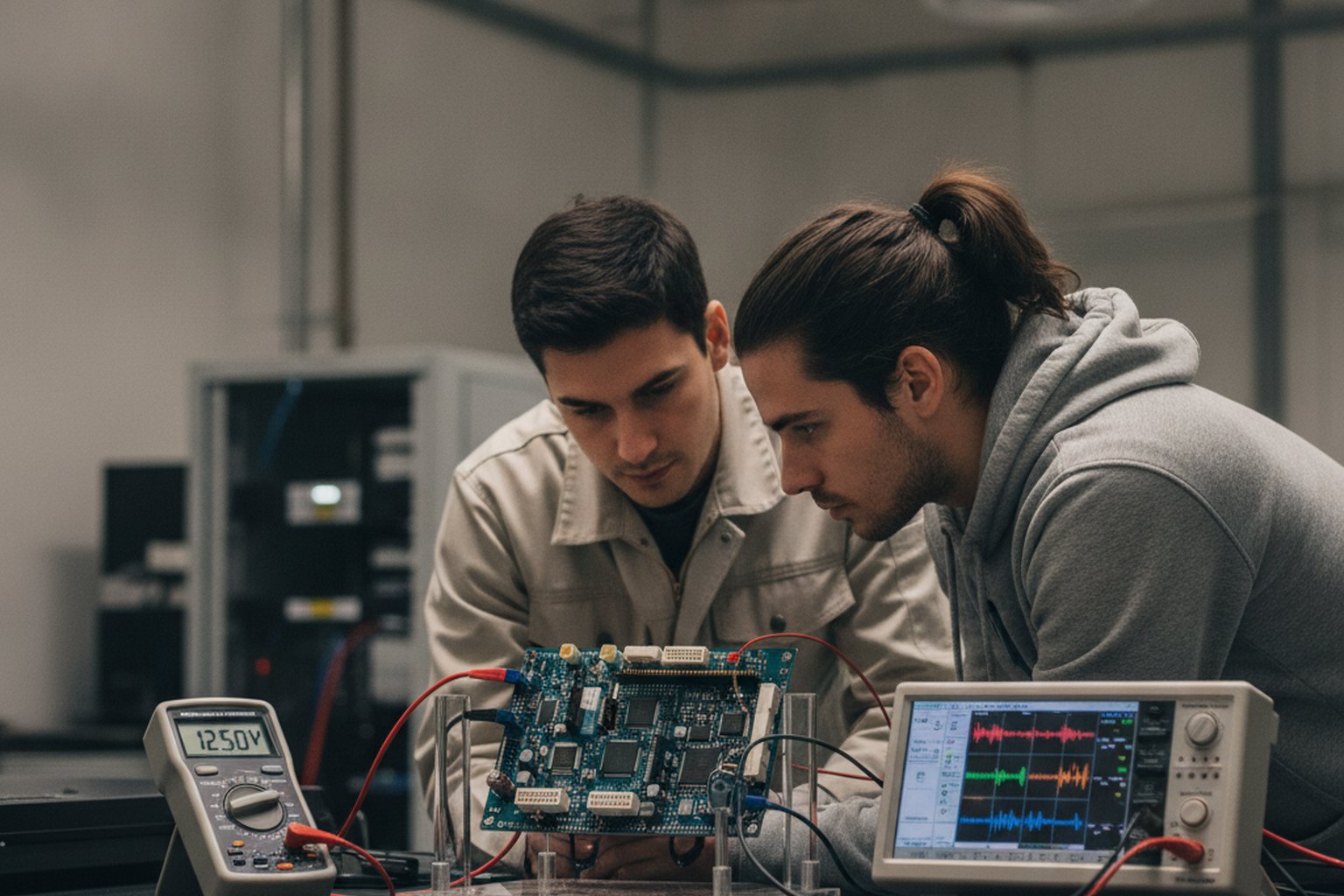
Embedded testing has to prove the software behaves correctly on the real hardware under real timing and fault conditions — which is far harder than testing an app, because you cannot fully trust a result until you have seen it on the silicon. The discipline that separates reliable devices from flaky ones is testing against hardware early and automatically, not just in a simulator at the end. A solid embedded test practice combines several layers:
- Unit and host testing. Run logic that does not touch hardware on a PC for fast feedback, isolating it from the board where you can.
- On-target testing. Run tests on the actual microcontroller, because behaviour on real silicon routinely differs from a simulator.
- Hardware-in-the-loop (HIL). Drive the device with simulated sensors and signals on an automated rig so you can exercise real-world and fault scenarios repeatably.
- Static analysis. Catch memory, concurrency and undefined-behaviour bugs before they run — mandatory in most safety-critical work.
- On-chip debugging. Use JTAG or SWD probes with GDB to step through code, inspect registers and watch timing on real hardware.
Two hardware realities make all of this non-negotiable: bugs often appear only on real silicon under real timing, and a defect shipped to the field is expensive or impossible to recall. That is why teams invest in automated hardware-in-the-loop rigs and static analysis up front — the cost of catching a fault on the bench is a rounding error next to the cost of catching it in a customer's device.
Safety, security and compliance
Safety and security are first-class requirements in embedded software development, not add-ons, because an embedded fault can injure a person or open a physical device to attack — and in regulated domains the software must meet named standards to ship at all. Which standards apply is set by the device class, and they shape the whole project, from architecture to the documentation you produce. The main ones to know:
- ISO 26262 — functional safety for road vehicles; governs automotive electronics and their software.
- IEC 62304 — the lifecycle standard for medical device software, required to bring most medical devices to market.
- IEC 61508 — the general functional-safety standard for industrial and process systems, and the parent of many sector-specific ones.
- MISRA C/C++ — coding guidelines (updated through MISRA C:2023) that constrain the language to a safer subset in critical systems.
- Cybersecurity rules — regimes such as the EU Cyber Resilience Act and UNECE R155 for vehicles now make secure design and update a legal requirement for connected devices, not just good practice.
The security shift is the big 2026 story: as more devices connect, regulators have made security a shipping requirement, so secure boot, signed and staged firmware updates, and a plan for patching devices in the field are now part of the baseline design rather than a later feature. The practical consequence is that in a safety- or security-critical project, testing, documentation and certification often cost more than writing the code — which is exactly why the safety and security scope has to be set at the start, not discovered near the end.
How much does embedded software development cost?
Embedded software development is priced by the engineering effort a device demands, so a simple accessory can be a tens-of-thousands-of-dollars project while a certified safety-critical device routinely reaches the hundreds of thousands — largely because certification, testing and documentation, not the code itself, dominate the budget. There is no single sticker price, but the cost drivers are consistent, and knowing them is how you keep an embedded budget under control:
- Hardware complexity and constraints. Tighter memory, power and timing budgets take more engineering to satisfy.
- Real-time and safety requirements. Hard deadlines and functional safety multiply design, review and testing effort.
- Regulatory certification. ISO 26262, IEC 62304 or IEC 61508 evidence and documentation are often the largest line item.
- Connectivity and security. Secure boot, encrypted communication and update infrastructure add scope on connected devices.
- Maintenance and field updates. A decade-long device lifecycle means budgeting for support and secure updates, not just the first release.
Because certification and testing so often outweigh the initial coding, the cheapest way to control an embedded budget is to get the architecture, the safety scope and the test strategy right early — a wrong platform choice or a missed safety requirement is far more expensive to fix once the hardware is built and the firmware written.
Trends shaping embedded software development in 2026
Three shifts are changing what "embedded software development" means in practice in 2026, on top of the security-by-design trend already covered above:
- AI and machine learning move onto the device. TinyML and on-device inference let embedded systems make decisions locally — flagging an anomaly, recognising a gesture, predicting a failure — without a round trip to the cloud, which cuts latency and keeps sensitive data on the device.
- RISC-V keeps gaining ground on ARM. Its open instruction-set architecture gives silicon vendors and product teams more flexibility on cost and customisation, and 2026 has seen it move from niche to a mainstream option teams evaluate alongside ARM by default.
- Edge and IoT convergence raises the bar for connectivity and updates. As more devices ship connected, embedded software increasingly has to manage networking, remote monitoring and staged over-the-air updates as core requirements rather than add-ons — reinforcing why the secure boot and update practices above are now table stakes, not extras.
None of this changes the fundamentals — timing, memory, power and reliability still govern the work — but it does mean today's architecture decisions have to leave room for on-device intelligence and remote management that a five-year-old device class often did not need.
How to choose an embedded development partner
Choose an embedded software development partner on proven hardware-plus-firmware experience in your device class, a real testing and safety practice, and the certifications your market requires — day rate is the least reliable signal. Embedded quality lives in the gap between the software and the silicon, so the questions that matter are about how a team works across that boundary. Use this checklist:
- Relevant device experience. Have they shipped devices like yours, at your level of criticality — not just software in general?
- Real-time and architecture depth. Can they explain their approach to timing, concurrency and the bare-metal / RTOS / Linux choice for your case?
- Testing practice. Do they run hardware-in-the-loop testing and static analysis as standard, or bolt testing on at the end?
- Standards fluency. Do they know the certifications you need (ISO 26262, IEC 62304, IEC 61508) and how to produce the evidence?
- Security and updates. Can they design secure boot and safe field updates for a connected device from day one?
- End-to-end ownership. Will they take a device from board bring-up through certification to long-term field maintenance?
The strongest sign is a team whose software and hardware engineers work as one unit, because the hardest embedded bugs surface precisely where the two meet. Whether you build in-house or bring in a partner, the aim is the same: firmware that behaves correctly on real hardware, meets its safety and security bar, and can be maintained for the full life of the product.
FAQ
What is embedded software development?
Embedded software development is the practice of writing the software that runs inside a physical device — a car, a medical monitor, a router, a thermostat, an industrial controller — rather than on a general-purpose computer or in the cloud. The software (often called firmware) runs on a microcontroller or system-on-chip with limited memory, processing power and energy, and it usually has to react to the real world within strict timing constraints. Unlike an app, it is tightly coupled to the hardware it controls: it reads sensors, drives motors and displays, manages power, and talks to other devices, frequently with no operating system or with a small real-time operating system underneath it.
What is the difference between embedded software and application software?
Application software runs on top of a general-purpose operating system (Windows, macOS, Android, a web browser) with abundant memory, storage and a user who can restart it; embedded software runs directly on constrained hardware, is dedicated to one device's function, and often must respond within hard real-time deadlines with no one around to reboot it. Embedded code has to fit in kilobytes or a few megabytes, manage power carefully, and keep running for years without crashing. It is also updated far more cautiously, because a bad update can brick a device in the field rather than just show an error dialog.
What programming languages are used for embedded software development?
C is still the dominant embedded language, used in roughly 70% of projects in 2026 for its close control over hardware and small, predictable binaries; modern C++ follows at around 23% where teams want structure and reuse without giving up performance. Rust has risen to about 4.7% of production embedded systems in 2026 — more than double its 2.1% share in 2023 — because it delivers memory safety without a garbage collector, which matters in safety- and security-critical devices. Assembly still appears in tiny performance- or timing-critical routines, and higher-level languages such as MicroPython show up in prototyping and less constrained devices.
What is the difference between bare-metal, an RTOS and embedded Linux?
Bare-metal means your code runs directly on the microcontroller with no operating system — the smallest, most deterministic and cheapest option, best for simple devices with tight cost and power budgets. A real-time operating system (RTOS) such as FreeRTOS or Zephyr adds a small scheduler, tasks and timing guarantees, which suits devices that must juggle several time-critical jobs at once. Embedded Linux runs on more powerful hardware with megabytes of RAM and gives you a full OS, networking stack and file system, at the cost of more memory, more power and a longer boot — the right choice for gateways, richer user interfaces and connected devices doing heavy processing.
How much does embedded software development cost?
Embedded software development is usually priced by the engineering effort a device needs, so a simple sensor or accessory can be a tens-of-thousands-of-dollars project, while a safety-critical or certified device (automotive, medical, industrial) routinely runs into the hundreds of thousands because certification, testing and documentation dominate the budget. The main cost drivers are hardware complexity and constraints, real-time and safety requirements, regulatory certification (ISO 26262, IEC 62304, IEC 61508), connectivity and security, and long-term maintenance and field updates. Because certification and testing often cost more than the initial code, the cheapest way to control an embedded budget is to get the architecture, safety scope and test strategy right early.
How do you choose an embedded software development partner?
Choose an embedded partner on proven hardware-plus-firmware experience in your device class, a real testing and safety practice, and the certifications your market requires — not on day rate alone. Look for teams that have shipped devices like yours, can show their approach to real-time design, testing (hardware-in-the-loop, static analysis) and secure updates, and understand the standards you must meet (ISO 26262 for automotive, IEC 62304 for medical, IEC 61508 for industrial). Confirm they can own the whole path from board bring-up to certification and field maintenance, and that their engineers work close to your hardware team, because embedded quality lives in the gap between the software and the silicon.
Published 15 August 2026, last updated 26 September 2026. Market-size and language-adoption figures reflect widely reported 2026 industry data (embedded software market sizing from Fortune Business Insights; language-share figures from 2026 embedded developer surveys) and vary by source, device class and region. Standards references are for orientation, not certification advice — treat this as guidance and confirm the exact requirements for your device.