
TL;DR — energy software development in one paragraph
An energy software development company builds and integrates the digital systems that run power and utility operations — energy management systems (EMS), SCADA and grid management, smart metering, DERMS and virtual power plants, EV charging and energy trading — powered by real-time telemetry, AI forecasting and cloud. In 2026 the energy software market is worth about USD 28.3 billion, heading for USD 52 billion by 2030. Custom projects typically run USD 70k–1M+, with SCADA integration and NERC CIP / NIS2 compliance driving cost more than features.
What does an energy software development company do?
An energy software development company designs, builds and integrates the software that monitors, controls and optimizes energy across the power system — from generation and the grid to metering, trading and the end customer. In practice that means the digital layer wrapped around physical energy infrastructure: real-time monitoring and analytics, metering and billing, market trading and settlement, EV charging, demand response, carbon and ESG reporting, and field service for utility crews. Its customers are utilities, grid and independent system operators (ISOs/RTOs), independent power producers (IPPs), renewable developers and large industrial energy users, and the defining trait of the work is that so much of it connects to operational-technology (OT) equipment and safety-critical control systems.
That is why energy software is, at its core, an enterprise build rather than ordinary business software. It demands the same architecture, data-model and integration discipline you would bring to any mission-critical platform, plus the domain knowledge to model a substation, a feeder, a metering point or a market bid correctly, and the security posture to satisfy regulators. Utilities that need this rarely get it from a generic template, which is why they lean on an experienced enterprise software development company to model their exact assets, market rules, meter estate and compliance obligations instead of bending their operation to fit an off-the-shelf product. This is a large and fast-growing market: the energy software sector is worth roughly USD 28.3 billion in 2025 and is forecast to reach USD 52 billion by 2030, driven by grid modernization, the renewables transition and AI, according to 2026 smart-grid market analysis (EnkiAI; Insoftex).
Energy software development therefore sits at the intersection of real-time operations, deep systems integration and regulatory rigor. Energy software development services combine the cloud, API and data-engineering skills familiar from any modern platform with an understanding of how a SCADA signal becomes a dispatch decision, how thousands of behind-the-meter batteries are aggregated into a virtual power plant, and how a grid-security control must be evidenced for an auditor. It is close kin to oil and gas software development in its OT/IT demands, but the scope here is the power system — utilities, renewables, the grid and the market — not petroleum. That dual nature, operational software that must also be secure and audit-ready, is what separates a specialist energy software development company from a generalist shop, and what the rest of this guide unpacks.
What types of energy software can you build in 2026?
Energy software spans roughly ten core categories in 2026, from behind-the-meter energy management to grid control, market trading and carbon reporting — and most real programs build or integrate several at once around a shared, real-time data backbone. The table below maps each type to what it does and its typical buyer; the subsections define each one and where the engineering effort concentrates. Strong energy software development services usually start with one high-value system — monitoring, metering or DERMS — then expand outward as the data model proves itself.
| Software type | What it does | Typical buyer |
|---|---|---|
| Energy management system (EMS) | Monitor, forecast & optimize energy use or dispatch | C&I energy users, aggregators, campuses |
| SCADA, ADMS & grid management | Real-time control of substations, feeders & switching | Utilities, DSOs, grid operators |
| Smart metering & AMI platforms | Ingest, validate & analyze meter data at scale | Utilities, metering operators |
| DERMS & virtual power plant (VPP) | Aggregate & dispatch distributed energy resources | Aggregators, utilities, IPPs |
| EV charging management | Operate charging networks, smart charging & billing | CPOs, fleets, utilities |
| Energy trading & settlement (ETRM) | Trade, schedule & settle energy across markets | Traders, utilities, IPPs |
| Renewable asset monitoring | Track solar, wind & battery performance & health | Renewable developers, asset owners |
| Utility billing & CIS | Rate, bill & serve energy customers | Utilities, retailers |
| Carbon, ESG & regulatory reporting | Capture, calculate & report emissions with audit trail | All energy firms, large industrials |
| Digital twins & predictive maintenance | Model assets & predict failures before downtime | Utilities, generators, asset owners |
Energy management systems (EMS)
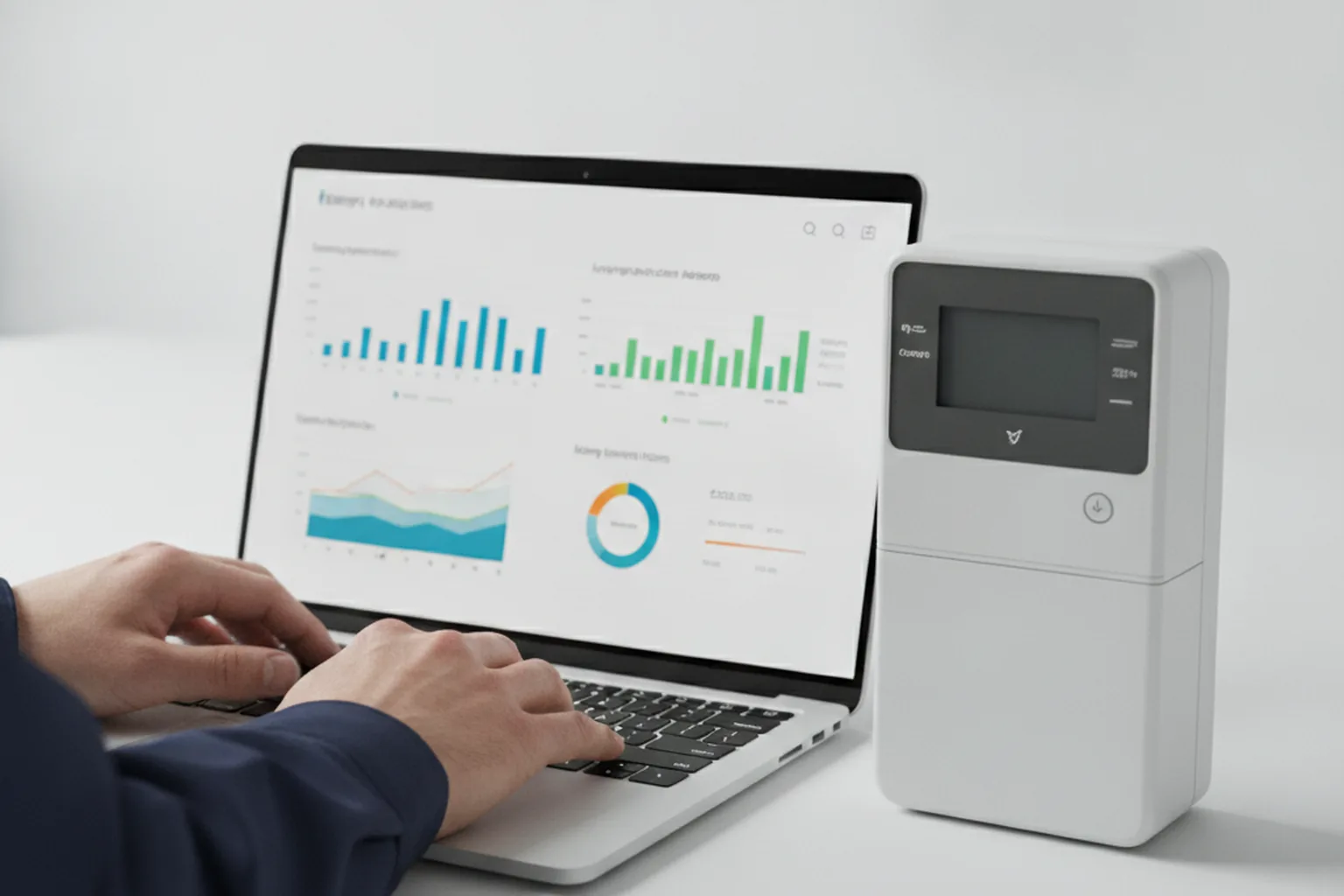
Energy management systems monitor, forecast and optimize how energy is consumed or dispatched at a site, building, campus or portfolio. They pull meter and sub-meter data, track consumption and cost, run load control and demand response, and increasingly orchestrate on-site solar, storage and flexible loads to cut bills and carbon. EMS is often the entry point for commercial and industrial energy users and for aggregators, and it is where behind-the-meter optimization and demand-response participation live.
SCADA, ADMS & grid-management software
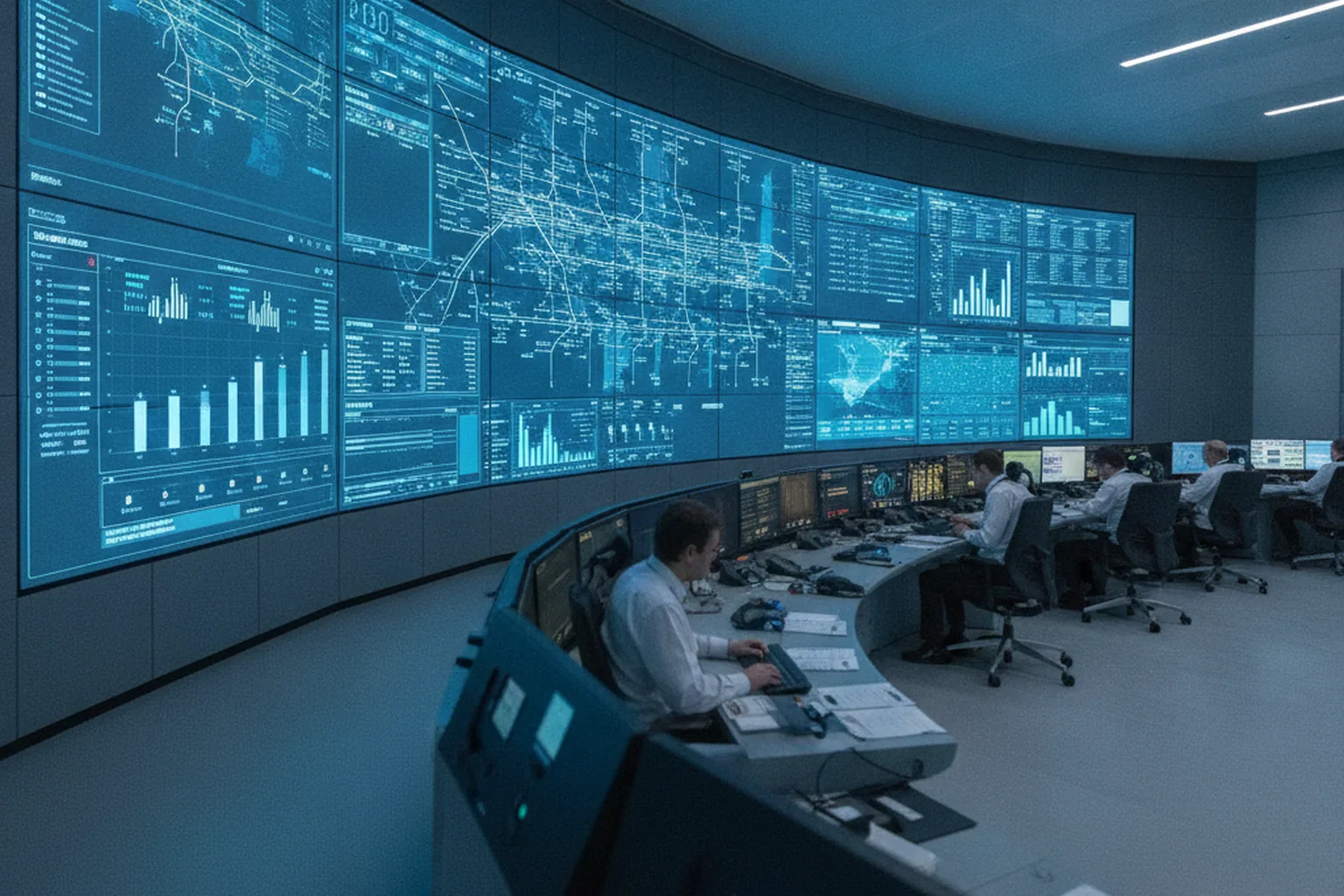
SCADA and advanced distribution management systems (ADMS) are the operational backbone of the grid, letting utilities and system operators monitor and control substations, feeders and switching in real time. This is the most safety-critical category: it drives outage management, fault location, voltage control and network reconfiguration, and it runs on hardened OT infrastructure. Because it touches the bulk electric system, grid software is where NERC CIP compliance, IEC 61850 substation automation and strict IT/OT segmentation matter most.
Smart metering & AMI data platforms
Smart metering and advanced metering infrastructure (AMI) platforms ingest, validate and analyze meter data at massive scale — millions of intervals per day across a utility's estate. They handle meter-data management (MDM), validation-estimation-editing (VEE), and feed billing, forecasting and grid analytics. The engineering challenge is high-volume, high-frequency data pipelines and clean integration with billing and grid systems, which is why AMI overlaps heavily with the sensor and data-ingestion discipline of IoT software development.
DERMS & virtual power plant (VPP) software
DERMS and virtual power plant software aggregate and dispatch thousands of distributed energy resources — rooftop solar, home and grid batteries, EV chargers and flexible loads — as a single, grid-responsive asset. This is one of the fastest-growing categories in 2026 because FERC Order 2222 is opening wholesale markets to DER aggregations. The VPP software-as-a-service market is projected to grow from USD 2.8 billion in 2026 to USD 13.81 billion by 2035 (a ~19.4% CAGR), while the DERMS market grows at about 16.7% CAGR, according to 2026 market research (MarkWide Research; Express Press Release, 2026).
EV charging management software
EV charging management software operates charging networks end-to-end: station monitoring and control, smart and managed charging, roaming, driver apps and billing. It typically speaks OCPP to the chargers and integrates with energy-management and grid systems so charging can be shifted to cheap, low-carbon or grid-friendly windows. For utilities and charge-point operators it is both a customer product and a grid-flexibility asset, which is why it increasingly connects to DERMS and demand-response platforms.
Energy trading & settlement (ETRM)
Energy trading and risk management (ETRM) software lets utilities, traders and IPPs trade, schedule and settle energy across wholesale markets. It covers deal capture, position and risk management, scheduling with market operators, and settlement and reconciliation. The demands are low-latency market data, accurate settlement logic and tight controls, and the software must track fast-changing market rules — a domain where correctness and auditability outweigh flashy features.
Renewable asset monitoring (solar, wind, battery)
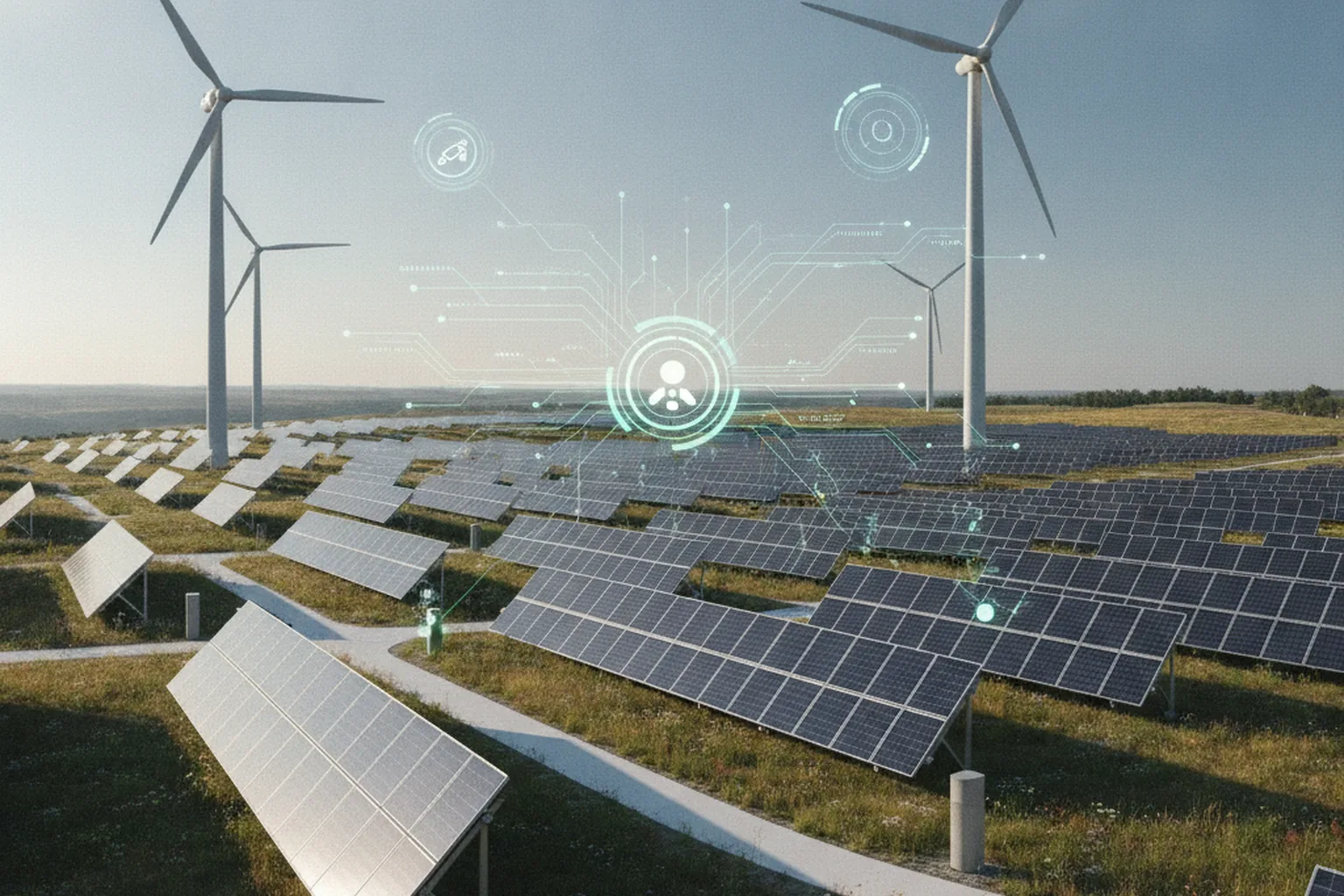
Renewable asset monitoring tracks the performance, yield and health of solar farms, wind fleets and battery storage in real time. It combines SCADA telemetry with performance analytics and forecasting so owners can spot underperformance, schedule maintenance and forecast output for the market. Because renewable output is variable, accurate forecasting here directly affects revenue and grid balancing, tying this category closely to AI load-and-generation forecasting.
Utility billing & customer information systems (CIS)
Utility billing and customer information systems (CIS) rate, bill and serve energy customers, handling complex tariffs, time-of-use pricing, net metering and customer self-service. Modern CIS must cope with prosumers who both consume and export energy, dynamic tariffs and high-volume interval data from AMI. It is the system of record for the customer relationship, so it integrates tightly with metering, payments and the wider ERP.
Carbon, ESG & regulatory reporting
Carbon, ESG and regulatory reporting software captures, calculates and reports emissions and sustainability data with a defensible audit trail. It is the fastest-rising category across energy in 2026 as disclosure rules tighten, turning what was a periodic spreadsheet exercise into a continuous, instrumented obligation. Building this on the same production and metering data early avoids a later scramble, and the same data often supports operational efficiency as well as compliance.
Digital twins & predictive maintenance
Digital twins and predictive maintenance model energy assets — a transformer, a wind turbine, a battery — as live virtual replicas fed by real-time data, then use machine learning to predict failures before they cause downtime. Paired with predictive analytics, a digital twin lets engineers simulate wear and test scenarios before touching the physical asset, turning maintenance from reactive to anticipatory and squeezing more availability out of costly generation and grid equipment.
Which features matter most in energy software?
The features that decide whether energy software succeeds are the non-negotiable engineering qualities beneath the screens — interoperability, real-time telemetry, security and resilience — not the dashboard polish. Energy platforms live or die on how cleanly they exchange data with the grid and how reliably they run when connectivity or equipment fails. The seven capabilities below are the ones to insist on in any serious build.
- Interoperability by protocol. Native support for IEC 61850, DNP3, Modbus, OpenADR and OCPP so the platform speaks the grid's and the market's languages rather than living in a silo.
- Real-time telemetry & control. Low-latency ingestion and, where authorized, supervisory control of field assets, with time-series data handled at grid scale.
- Scalability. Architecture that absorbs millions of meter intervals or thousands of DER endpoints without re-platforming as the estate grows.
- Cybersecurity by design. Zero-trust access, IT/OT segmentation and encryption engineered from the first sprint to satisfy NERC CIP, NIS2 and IEC 62443 rather than bolted on later.
- Forecasting & analytics. Load, generation and price forecasting plus AI-driven optimization that turn raw telemetry into dispatch, maintenance and trading decisions.
- Edge & offline resilience. Store-and-forward and edge processing so remote substations, wind sites and rural assets keep working through intermittent connectivity.
- Role-based access & auditability. Granular permissions and complete audit logs, because both grid safety and regulatory evidence depend on knowing exactly who did what.
What tech stack and integrations does energy software need?
Energy software runs on a specific stack of industry protocols, integration targets and a cloud-plus-edge data layer, and getting that foundation right matters more than the application framework. The differentiator versus generic enterprise software is that energy platforms must speak the grid's protocols and connect to OT and market systems safely. The groups below outline what a 2026 energy stack has to cover.
- Grid & OT protocols. IEC 61850 (substation automation), DNP3 and Modbus (SCADA telemetry), IEEE 1547-2018 (DER interconnection), OpenADR (automated demand response) and OCPP (EV charging) — the languages field and market systems already speak.
- Integration targets. SCADA/ADMS, meter-data management (MDM), GIS, ERP and customer information systems (CIS), IoT/AMI networks, and market-operator (ISO/RTO) interfaces — the systems the new platform must exchange data with cleanly.
- Cloud & edge. Cloud-native, scalable back ends for analytics and storage, paired with edge computing near substations and sites so latency-sensitive control and thin-connectivity assets keep working.
- Data & AI layer. Time-series databases, data lakes and streaming pipelines feeding load and generation forecasting, anomaly detection and optimization models — the engine that turns telemetry into decisions.
The recurring theme across every group is integration: an energy platform is most valuable when SCADA, metering, market and enterprise data flow into one governed backbone. Building that well depends on the same discipline described in our enterprise system integration guide, applied to the many operational, OT and market sources an energy business runs on.
How does the energy software development process work?
Energy software is built through a disciplined, integration-first sequence because a defect in a metering, dispatch or control flow carries safety, financial and regulatory consequences, not just a broken screen. The six steps below reflect how an experienced energy software development company delivers without compromising grid safety or data integrity.
- Discovery & requirements. Map the assets, users, integrations, market rules and exact compliance footprint (NERC CIP, NIS2, IEC 62443). Deliverable: a scoped backlog, an integration inventory and a prioritized MVP definition.
- Architecture & protocol/data design. Design the edge/cloud, real-time and data architecture for the expected telemetry volume and connectivity, and choose the protocol and data models (IEC 61850, DNP3, CIM) the platform will use. Deliverable: an architecture decision record and a data model.
- Build. Develop one high-value workflow end-to-end first — a monitoring dashboard, a DERMS dispatch loop, a metering pipeline — behind stable contracts. Deliverable: a working, testable increment.
- OT/IT integration & testing. Connect to SCADA, meters, ERP and market systems and test hard against reality, including bad-sensor readings, clock drift and dropped links, respecting IT/OT segmentation. Deliverable: validated integrations with failure handling.
- Deployment & commissioning. Roll out to one site or asset class first, monitor closely, then widen coverage — the safest path where downtime is costly and connectivity uneven. Deliverable: a live platform with monitored operational metrics.
- Maintenance & compliance updates. Operate with SRE practices, adapt to changing market rules and equipment, and keep NERC CIP / NIS2 evidence current as assets and regulations evolve. Deliverable: a maintained platform with a measurable improvement loop.
What compliance and security rules apply to energy software?
Energy software must be built to a stack of grid-security, OT and information-security standards, and getting this wrong risks grid incidents, regulatory penalties and breaches of connected control systems — not just a failed audit. Because so much energy software touches the grid and safety-critical equipment, cybersecurity is a first-class engineering concern and the area where a specialist partner adds the most value. The table below summarizes the standards that matter most across US and EU markets, and the subsections explain how they fit together.
| Standard / rule | Region | Why it matters |
|---|---|---|
| NERC CIP | US / North America | Mandatory security for the bulk electric system: MFA, patching, supply-chain risk, incident response |
| NIS2 Directive | EU | Extends cybersecurity duties across energy operators and their suppliers |
| FERC Order 2222 | US | Opens wholesale markets to DER aggregations, making VPP architecture baseline |
| IEC 62443 | Global | The core standard for securing OT and industrial control systems |
| ISO 27001 | Global | Information-security management for the IT side and data platforms |
| IEC 61850 / IEEE 1547 | Global | Substation automation and DER interconnection interoperability |
NERC CIP and the US bulk electric system
NERC CIP is the mandatory, enforceable security standard for software that touches the North American bulk electric system, and it is the single most important compliance concern for US grid software. It sets requirements across access control and multi-factor authentication, patch management, supply-chain risk, and incident response and recovery, and non-compliance carries financial penalties. Any software that reads from or writes to grid control systems must be architected to produce CIP evidence and respect its boundaries, which is why security is designed in from the first sprint — a discipline we lay out in our secure software development lifecycle guide.
NIS2 and EU energy operators
In the EU, the NIS2 Directive is the equivalent obligation, extending cybersecurity duties across energy operators and, crucially, their software suppliers. It raises the baseline for risk management, incident reporting and supply-chain security for essential services including energy, and it means a vendor building software for EU utilities is itself in scope. Building to NIS2 and IEC 62443 together gives a platform a defensible security posture on both sides of the Atlantic without maintaining two divergent architectures.
FERC Order 2222 and DER aggregation
FERC Order 2222 is materializing fully in 2026, requiring US RTOs and ISOs to open their wholesale markets to aggregations of distributed energy resources. The practical effect on software is that DERMS and virtual power plant architecture moves from optional to baseline: platforms must be able to register, forecast, bid and settle aggregated DER capacity in the market. Any 2026 energy software strategy that involves distributed resources should assume Order 2222 participation as a design requirement, not a future nice-to-have.
Zero-trust and AI threat detection
Zero-trust architecture and AI-assisted threat detection are becoming the practical foundation of energy cybersecurity in 2026. Because the grid is a high-consequence target, energy platforms increasingly assume no implicit trust between IT and OT zones, segment aggressively, and use anomaly-detection models tuned to OT rather than IT threats. Bridging aging SCADA and meter systems to modern platforms without weakening that segmentation is a large share of the work, which is why much of energy software delivery is careful legacy system modernization rather than greenfield build.
How much does energy software development cost in 2026?
Custom energy software costs roughly $70,000 for a focused MVP to $1 million or more for a full grid, DERMS or trading platform in 2026, with integration complexity, real-time scale and compliance burden — not the feature list — driving the number. The table below gives 2026 planning ranges by project type; treat every figure as a scoping starting point rather than a quote. These ranges are synthesized from published 2026 software cost analyses and are consistent with what we see in delivery.
| Project type | Typical 2026 cost | Timeline |
|---|---|---|
| Energy-monitoring / metering dashboard MVP | $70,000–$150,000 | 3–5 months |
| DERMS / VPP / EV-charging module | $180,000–$400,000 | 6–12 months |
| AMI data / trading (ETRM) platform | $300,000–$600,000 | 9–16 months |
| Full grid-management / multi-asset VPP platform | $500,000–$1,000,000+ | 12–24 months |
The feature list is rarely the biggest cost line; integration and environment are. The main drivers are integration complexity (connecting to SCADA, MDM, ERP and market systems across vendors and protocols), real-time scale (high-frequency telemetry from millions of meters or thousands of DER endpoints demands robust ingestion and storage), compliance scope (NERC CIP or NIS2 hardening and audit evidence add QA and security effort), and data volume and legacy modernization (bridging or replacing aging SCADA and metering systems). After launch, plan for annual maintenance of about 15–20% of the build cost per year. Where the team is based also moves the number materially; for a fuller breakdown of what shapes a build price, see our guide to custom software development cost in 2026.
What are the key energy software trends in 2026?
Five trends define energy software in 2026, and together they point toward more autonomous, distributed and AI-driven operations. The market backdrop is strong: energy software is worth about USD 28.3 billion in 2025 and heads for USD 52 billion by 2030, propelled by grid modernization, renewables and AI (2026 industry analysis). The direction of travel is clearly toward software that forecasts and orchestrates, not just reports.
- AI forecasting and optimization. Better load and generation forecasting has hard dollar value: every +1% accuracy is worth roughly USD 1–5 million per year per 1,000 MW, and AI-driven optimization can deliver an estimated 5–15% CAPEX and 1–3% OPEX improvement, according to 2026 grid-optimization analysis (EnkiAI).
- VPP and DERMS growth. Virtual power plants and DER management are the fastest-growing category, with the VPP SaaS market projected to rise from USD 2.8 billion in 2026 to USD 13.81 billion by 2035 (~19.4% CAGR) and DERMS growing at ~16.7% CAGR.
- FERC Order 2222 DER aggregation. With Order 2222 materializing in 2026, US wholesale markets are opening to aggregated distributed resources, making market-ready VPP architecture a baseline design requirement.
- Cloud migration of operational data. Moving outage management, asset performance and predictive analytics to the cloud — including cloud-connected substation aggregation — is a top grid-modernization trend, unlocking analytics on data once trapped in isolated systems.
- Digital twins. Live virtual replicas of grid and generation assets, fed by real-time data, are moving from pilots into fleet-scale asset management, turning maintenance from reactive to anticipatory.
Underlying all five is the same prerequisite: clean, unified, real-time data. The operators getting value from AI, VPPs and autonomy in 2026 are the ones that invested first in integration and data quality, which is why the energy programs that succeed start with the data backbone, not the flashiest use case.
How do you choose an energy software development company?
Choose an energy software development company on proven grid and OT experience, a real cybersecurity track record and interoperability capability — not on price or generic development skill. Energy is a specialist discipline: a team that ships clean web apps but has never handled SCADA integration, NERC CIP or an IEC 61850 substation will stall exactly where the safety and money are. Use the criteria below to evaluate a partner, and treat the red flags as disqualifiers.
- Grid & OT domain proof. References in EMS, SCADA/ADMS, metering, DERMS or trading, and a team that can talk fluently about protocols and dispatch — not just cite acronyms.
- Security track record. Hands-on experience meeting NERC CIP, NIS2 and IEC 62443 with real IT/OT segmentation and zero-trust practice.
- Interoperability capability. Demonstrated integration with SCADA, MDM, GIS, ERP and market systems across IEC 61850, DNP3, Modbus, OpenADR and OCPP.
- Data & AI depth. Proven time-series, forecasting and optimization work, since that is where energy software now creates the most value.
- Partnership mindset. A partner who scopes a paid discovery, ships in phases and stays for continuous compliance, not one who disappears at launch.
Red flags to walk away from:
- No OT or protocol experience — a portfolio of business apps with no SCADA, metering or grid integration.
- No NERC CIP or NIS2 track record — security treated as a checklist at the end rather than an architecture from the start.
- No interoperability testing — integrations demoed on happy-path data, with no plan for bad sensors, clock drift or dropped links.
- Opaque pricing — a fixed number with no discovery, no integration audit and no compliance scoping behind it.
- No cybersecurity posture — the vendor cannot describe its own IT/OT segmentation, access controls or incident response.
For custom energy software development, the safest engagement starts with a discovery phase covering the integration audit, security and compliance mapping and architecture before committing to the full build. A serious enterprise software development partner will insist on that groundwork, because in energy it is what separates a platform that secures and scales from one that stalls. Operators evaluating the wider space can also review our energy software development capabilities for broader industry context.
FAQ
What does an energy software development company do?
An energy software development company designs, builds and integrates the software that runs modern power and utility operations. That includes energy management systems (EMS), SCADA and advanced distribution management (ADMS), smart metering and AMI data platforms, distributed energy resource management (DERMS) and virtual power plant (VPP) software, EV charging management, energy trading and settlement, and carbon and ESG reporting. Because these systems connect to operational-technology (OT) equipment and the bulk electric system, the company also engineers real-time telemetry, OT/IT integration and cybersecurity to standards such as NERC CIP in the US and the NIS2 Directive in the EU from the first sprint, rather than adding them later.
What is the difference between energy management software and grid software?
Energy management software (EMS) optimizes how energy is consumed or dispatched at a site, building, campus or portfolio — metering, monitoring, load control, demand response and cost optimization for the energy user or aggregator. Grid software (SCADA, ADMS and grid-management platforms) operates the network itself — the utility or system operator monitoring and controlling substations, feeders and switching to keep power flowing safely across the distribution or transmission grid. In short, EMS optimizes the demand and behind-the-meter side, while grid software runs the delivery infrastructure. Modern projects increasingly connect the two, because DERMS and virtual power plants coordinate thousands of behind-the-meter EMS assets to support the grid.
How long does it take to build energy software?
Timelines scale with integration and compliance scope. A focused energy-monitoring or metering dashboard MVP typically takes 3–5 months; a DERMS, VPP or ADMS module 6–12 months; and a full grid or trading platform 12–24 months or more. The biggest schedule risks are not the screens but SCADA and meter-data integration, real-time data volume, interoperability testing against protocols such as IEC 61850 and DNP3, and the security and compliance hardening that NERC CIP and NIS2 require. Shipping one priority workflow and one integration first reduces risk and delivers value far earlier than a big-bang launch.
Is NERC CIP compliance mandatory for energy software?
NERC CIP compliance is mandatory for software that touches the North American bulk electric system — transmission and large generation assets — and it is enforced with financial penalties. It sets requirements for access control and multi-factor authentication, patch management, supply-chain risk, incident response and recovery. Software for smaller distribution, behind-the-meter or purely commercial energy-management use may fall outside the strict CIP scope but is still expected to meet strong security baselines such as IEC 62443 for OT and ISO 27001 for information security. In the EU, the equivalent obligation is the NIS2 Directive, which extends cybersecurity duties across energy operators and their suppliers. The safe default is to engineer to NERC CIP and NIS2 expectations wherever the software connects to grid or control systems.
How much does energy software development cost in 2026?
In 2026, custom energy software typically ranges from about $70,000 for a focused MVP to $1 million or more for a full grid, DERMS or trading platform, with integration complexity, real-time scale and compliance scope driving the number more than the feature list. A rough scope ladder is: an energy-monitoring or metering dashboard MVP at $70,000–$150,000 over 3–5 months; a DERMS, VPP or EV-charging module at $180,000–$400,000 over 6–12 months; and a full grid-management, trading or multi-asset VPP platform at $500,000–$1,000,000+ over 12–24 months. OT/SCADA integration, high-frequency telemetry, NERC CIP or NIS2 evidence and legacy modernization are the biggest cost drivers, and annual maintenance usually runs about 15–20% of the build cost per year.
Can energy software integrate with existing SCADA and ERP systems?
Yes — deep integration with existing SCADA, meter-data management, GIS, ERP and market-operator systems is the core of most energy software projects, not an add-on. It is done through the industry protocols and data models the sector already runs on: IEC 61850 for substation automation, DNP3 and Modbus for SCADA telemetry, OpenADR for demand response, and standard APIs for ERP and customer information systems. The critical constraint is that integration with OT and control systems must respect IT/OT network segmentation and NERC CIP or IEC 62443 security boundaries, so field telemetry can feed cloud analytics without exposing control systems to the corporate network or the internet.
Last updated 18 September 2026. Cost figures are 2026 market planning ranges synthesized from published software cost analyses (2026) and YuSMP delivery experience; actual costs depend on scope, integration depth, region and compliance requirements. Market-size figures (energy software ~USD 28.3B in 2025 to ~USD 52B by 2030), VPP SaaS growth (~USD 2.8B in 2026 to ~USD 13.81B by 2035, ~19.4% CAGR), DERMS (~16.7% CAGR) and AI-forecasting value (~USD 1–5M/yr per 1,000 MW per +1% accuracy; 5–15% CAPEX, 1–3% OPEX) are drawn from 2026 industry market reports (EnkiAI, Insoftex, MarkWide Research). All figures are planning references, not quotes.