
What is agriculture custom software development?
Agriculture custom software development is the process of building software tailored to a specific farm, agribusiness or AgTech product — farm management, precision agriculture, livestock, traceability or marketplaces — instead of buying an off-the-shelf tool. In 2026 a typical build costs $50,000–$250,000+ and takes 3–14 months, driven by sensor hardware, imagery data and offline field needs.
Agriculture custom software development is the end-to-end process of designing and building software that fits how a particular farm or agribusiness actually works, rather than forcing operations into a generic app. It usually pulls together data from field sensors, satellite and drone imagery, farm machinery, weather feeds and financial records, then turns that raw data into decisions a grower, agronomist or operations manager can act on — when to irrigate, where yield is at risk, which batch to recall.
Because agriculture spans hardware, geospatial data, unreliable rural connectivity and hard offline conditions, few teams hold all of those skills in-house, so most agribusinesses commission a partner for custom agriculture software development services that cover the whole system — device data, cloud platform, mapping and the apps people use in the field. The digital opportunity is real and growing: the global agricultural software market is worth around $24.6 billion in 2026 and is projected to reach $28.64 billion by 2030 at roughly 4.4% CAGR, according to The Business Research Company.
This guide covers the software types you can build, the core features buyers expect, the technologies behind modern AgTech, realistic 2026 cost and timeline ranges, the build process step by step, the challenges that sink field projects, and how to choose a development company. The goal is a clear picture of what you are commissioning before you write a brief or sign a contract.
Why agribusinesses invest in custom software in 2026
Agribusinesses invest in custom software because thin margins, tighter compliance and volatile weather make data-driven decisions a competitive necessity in 2026, and off-the-shelf tools rarely fit a specific crop, region or operation. The market signals back this up: the broader agritech market is around $38.56 billion in 2026 and is projected to reach roughly $58.79 billion by 2030, according to The Business Research Company, while smart agriculture is forecast to hit about $83.72 billion by 2033 at 14.6% CAGR, according to Grand View Research.
The specific gains custom software delivers to a farm or agribusiness are consistent across operations of every size:
- Higher, more predictable yields. Field-level monitoring and forecasting flag stress — pests, disease, water — before it spreads, so interventions are targeted rather than blanket.
- Resource optimization. Variable-rate application of water, seed and fertilizer cuts input costs and waste by matching what each zone of a field actually needs.
- Traceability and compliance. A digital record from field to shelf makes audits, certifications and recalls fast instead of frantic — increasingly a buyer and regulator expectation.
- Data-driven decisions. One source of truth across sensors, imagery, machinery and finance replaces spreadsheets and gut feel with defensible numbers.
- Lower operating cost. Automating records, scheduling and reporting frees skilled staff for fieldwork instead of paperwork.
- Sustainability reporting. The same data that optimizes inputs also documents climate-smart practices for grants, carbon programs and supply-chain partners.
Digital farming software specifically is growing fast — about $9.48 billion in 2026, heading to $16.3 billion by 2030 at 14.5% CAGR, according to The Business Research Company — because the tools have finally caught up with what growers need in the field.
Types of agriculture software you can build
There are five main types of agriculture software, and most real products combine two or three of them rather than fitting neatly into one box. Knowing which type anchors your product is the fastest way to scope a build honestly, because each type carries its own users, data sources and integration burden. This is also where good product engineering pays off — deciding what to build first and what to leave for later releases.
Farm management systems (FMS)
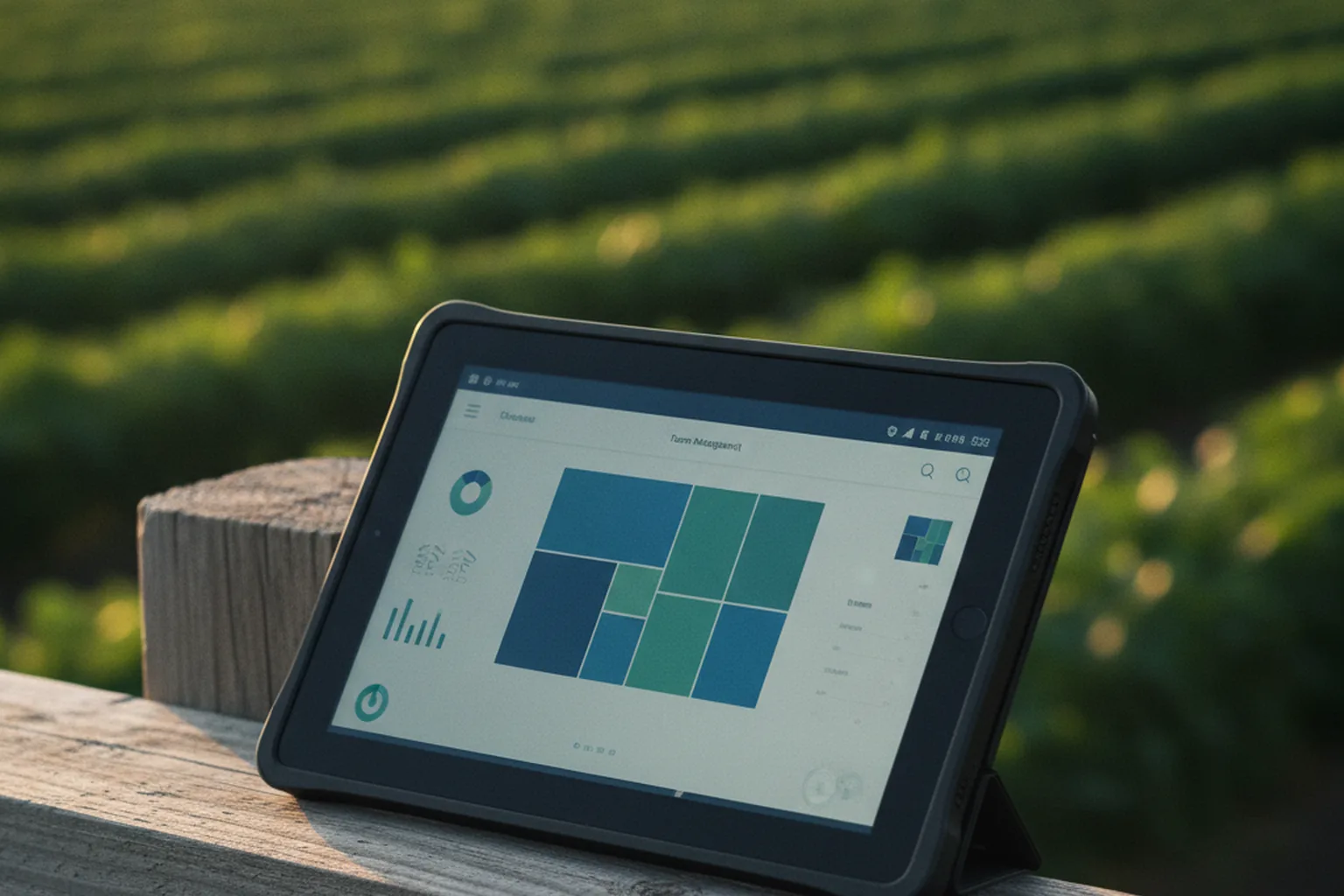
A farm management system is the operational backbone: it plans fields and seasons, schedules tasks and labor, tracks inputs and inventory, and rolls everything up into financials. It is the "ERP for the farm," and it is usually the first module an agribusiness commissions because it replaces the spreadsheets that run most operations.
Precision agriculture & crop monitoring
Precision-agriculture software turns sensor, satellite and drone data into field-level decisions — moisture maps, NDVI crop-health imagery, variable-rate application plans and irrigation optimization. It is the highest-growth segment: precision-farming software and services is around $2.78 billion in 2026 and projected to reach $9.68 billion by 2035 at 14.89% CAGR, according to Business Research Insights.
Livestock management
Livestock software tracks animal health, feeding, breeding and movement, often tied to ear-tag sensors or RFID. It reduces disease risk, improves feed efficiency and produces the health records that welfare and export rules increasingly demand.
Supply chain & traceability
Traceability systems follow produce from field to shelf, recording provenance, handling and certifications at each step. They are what make a recall a same-day operation instead of a week-long crisis, and they are where blockchain and analytics show up most often.
Agri-marketplaces & farm financial tools
Marketplaces connect growers with buyers, inputs suppliers or equipment; farm financial tools handle budgeting, lending, insurance and subsidy claims. Both turn a platform's data into transactions and are common as a second-phase revenue layer on top of an FMS.
The table below summarizes how the five types differ — a comparison none of the leading guides publish in one place:
| Software type | Primary users | Core capability | Typical data sources |
|---|---|---|---|
| Farm management (FMS) | Farm owners, operations managers | Planning, tasks, inputs, finance | Field records, machinery, accounting |
| Precision agriculture | Agronomists, growers | Crop monitoring, variable-rate plans | IoT sensors, satellite, drones |
| Livestock management | Ranchers, herd managers | Health, feeding, breeding records | Ear-tag sensors, RFID, vet records |
| Supply chain & traceability | Processors, distributors, retailers | Provenance, handling, recall | Batch scans, logistics, certifications |
| Agri-marketplace & finance | Buyers, suppliers, lenders | Trade, budgeting, lending, subsidies | Listings, payments, platform data |
Core features of modern agriculture software
Whatever the type, modern agriculture software shares a core set of features, and buyers in 2026 treat these as table stakes rather than extras. Scoping them explicitly up front is what keeps a build from ballooning later.
- Real-time dashboards that show field, herd or supply-chain status at a glance, with alerts for anything out of range.
- Offline-first mobile mode so data entry and field maps keep working with no signal and sync when connectivity returns — non-negotiable in agriculture.
- Geospatial / GIS mapping because almost every agricultural record has a location; fields, zones and machinery paths all live on a map.
- Sensor and telemetry ingestion that reliably takes in soil, weather and machinery data at scale and stores it as time series.
- Role-based access for owners, agronomists, field staff and external partners, each seeing only what they need.
- Reporting and analytics for yield, cost, compliance and sustainability, exportable for audits and grant claims.
- Integrations with machinery (ISOBUS), accounting, weather services and marketplaces, so the platform is a hub, not another silo.
Key technologies behind AgTech software
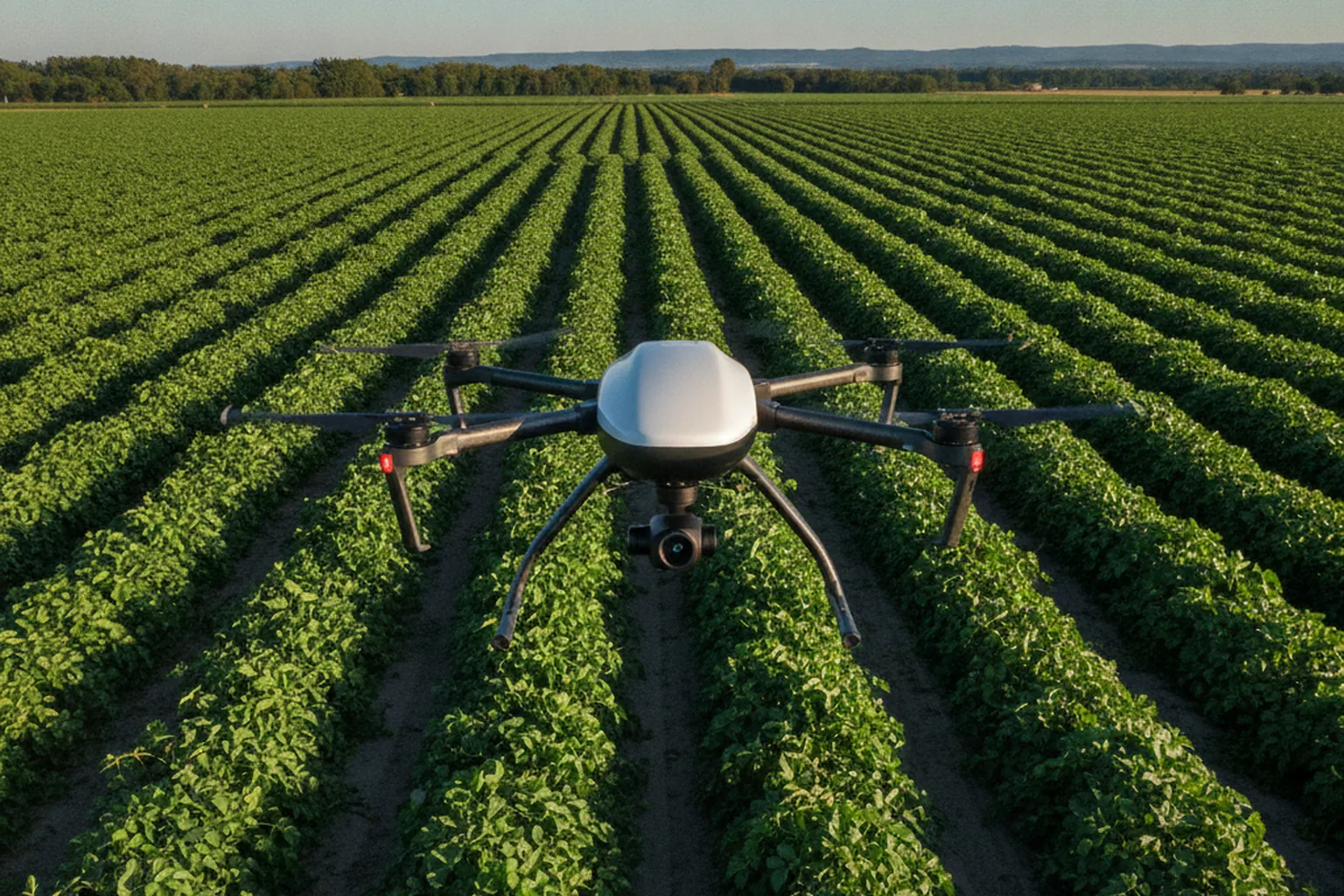
Agriculture software leans on five technology families in 2026, and the art is combining them so field data becomes a reliable decision. Underneath all of them sit geospatial GIS mapping and time-series storage, because nearly every agricultural record carries a location and a timestamp.
AI & machine learning
Machine learning drives the forecasting that makes precision agriculture worth it — yield prediction, pest and disease detection, and irrigation optimization from historical and live data. The value of this data layer is clear: the agriculture analytics market is around $8.63 billion in 2026 and projected to reach $25.76 billion by 2034, according to Fortune Business Insights. This is the same class of predictive work we describe in our guide to machine learning software development.
IoT & sensor networks
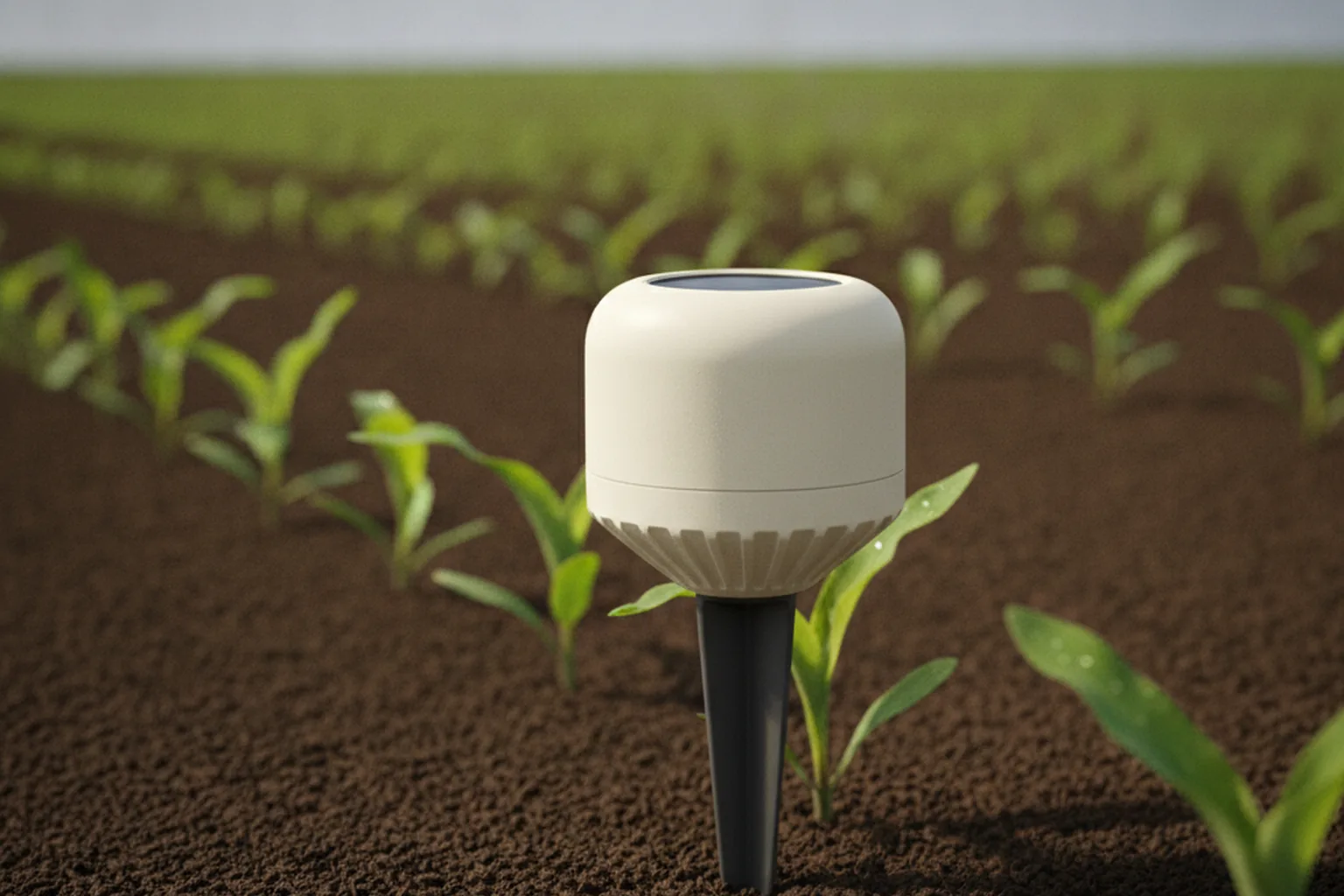
IoT sensor networks are the nervous system of a modern farm — soil moisture, weather, tank levels and machinery telemetry, all streaming into the platform. Installed farm sensors are projected to exceed 85 million units by 2025 (industry estimates, 2025), and turning that firehose into something useful is a classic IoT software development problem of connectivity, ingestion and device management.
Satellite imaging, drones & computer vision
Satellite and drone imagery, read by computer vision, scans crop health across whole fields at once — NDVI maps highlight stress invisible from the ground, and repeat passes track change over the season. This remote sensing is what scales precision agriculture from a few sensors to entire operations.
Blockchain for traceability
Blockchain gives supply-chain traceability a tamper-evident record every partner can trust, which matters most for high-value or certified produce where provenance is the product. It is the backbone of credible food-safety and origin claims, and it connects directly to the traceability patterns in our supply chain software development guide.
Cloud, edge & connectivity
Cloud platforms store and process farm data at scale, while edge computing runs logic close to the hardware so decisions happen even when the signal drops. Because rural connectivity is unreliable, designing for edge-and-sync from the start is what keeps a platform usable where the crops actually grow.
How much does agriculture software development cost in 2026?
Agriculture software development costs from about $50,000 for a single-module MVP to $250,000 or more for an enterprise precision-agriculture suite in 2026, with most multi-module farm platforms landing around $120,000 to $220,000. The software is only part of the picture — sensor hardware, imagery data, connectivity and offline requirements all add real cost that a pure software estimate misses. If you want to go deeper on the drivers, see our full breakdown of custom software development cost in 2026.
| Project type | Typical 2026 cost | Timeline | Example |
|---|---|---|---|
| Single-module MVP | $50,000–$90,000 | 3–4 months | Crop-monitoring dashboard or livestock record app |
| Multi-module platform | $120,000–$220,000 | 6–9 months | FMS with sensor ingestion, mapping and integrations |
| Enterprise / precision-ag suite | $220,000–$400,000+ | 9–14 months | Satellite imagery, predictive analytics, hardware integration |
Two cost drivers surprise first-time AgTech teams. The first is data and hardware: sensors, satellite or drone imagery subscriptions, and connectivity plans are recurring costs that scale with acreage, not a one-off. The second is the field itself: offline-first design, ruggedized mobile testing and integration with machinery standards add engineering that a pure office-software estimate never includes. Treat the figures above as planning ranges, then get a scoped estimate for your crop, region and hardware.
The agriculture software development process, step by step
A well-run agriculture software project moves through six stages, each with an output that feeds the next. The field-integration stage carries more weight than in ordinary software, because you cannot re-run a growing season to fix a testing gap.
- Discovery & use case. Define the crop, operation and decision the software must improve, and the metric it moves — yield, input cost, compliance time. Scope, data sources and hardware are decided here.
- UX & architecture. Design offline-first workflows for the field, the data model and the integrations, and choose the cloud, mapping and sensor-ingestion foundations before feature work begins.
- Build. Develop the platform, mobile apps and data pipeline in iterations, integrating sensor, imagery and machinery data as core features rather than afterthoughts.
- Field & hardware integration and testing. Connect real sensors and machinery, then test under the conditions you will actually meet — no signal, dust, glare, seasonal timing.
- Launch. Roll out to real users with training, migrating existing records and standing up monitoring so problems surface fast.
- Support & iteration. Maintain, patch and extend the platform across seasonal peaks, adding modules as the operation grows.
The process is deliberately staged so the riskiest, hardest-to-reverse work — field and hardware integration — is validated before you commit to a full rollout. A structured discovery phase at the start is what keeps the later stages from drifting.
Challenges in agriculture software development (and how to solve them)
Agriculture software fails for a predictable set of reasons, and every one of them is solvable if you plan for it from the first architecture diagram rather than discovering it in the field. These are the challenges that separate a platform growers actually use from a pilot that stalls.
- Rural connectivity. Signal is weak or absent where the work happens. Solve it with offline-first design and edge processing, so the app works locally and syncs when connectivity returns.
- Hardware and sensor integration. Sensors, machinery and gateways speak different dialects. Solve it by treating integration as a first-class feature with a clear device-data layer, not a bolt-on.
- Data standardization. Agriculture has standards — ISOBUS for machinery, ADAPT for field data — and ignoring them locks you out of interoperability. Solve it by building to those standards from day one.
- Interoperability. Farms run a patchwork of tools. Solve it with open APIs and documented integrations so your platform becomes the hub rather than another silo.
- Seasonality of testing. You cannot fully test a planting feature in winter. Solve it by sequencing the roadmap to the growing calendar and using historical data to simulate what you can't yet observe.
- Data ownership. Growers are wary of who owns their field data. Solve it with clear ownership terms, transparent access controls and, where relevant, on-device or on-farm storage options.
How to choose an agriculture software development company
Choose an agriculture software development company that pairs real AgTech domain experience with deep data-engineering and IoT skills, because the hard part is never the dashboard — it is the seams where sensors, imagery, machinery and weather data meet, offline, in a field. A partner strong in generic web apps but new to agriculture will quietly push that integration risk back onto you.
When you evaluate an agriculture software development partner, use this checklist:
- Domain and AgTech experience. Shipped agriculture or industrial-IoT products, not just a portfolio of unrelated apps.
- IoT and data-engineering depth. Proven sensor ingestion, geospatial mapping and time-series data at scale.
- Integration track record. Real experience connecting machinery (ISOBUS), imagery providers, accounting and marketplaces.
- Compliance and traceability. Understanding of the records, certifications and recalls your market demands.
- Support model. A plan for seasonal peaks, offline field support and long-term maintenance, not just a launch.
A good partner will raise offline-first design, data standards and the hardware-to-software seam before you do — and will propose a small, honest field pilot rather than a big-bang rollout. That is also the fastest way to de-risk the budget, because a pilot tells you what the real data is worth before you scale.
FAQ
What is agriculture custom software development?
Agriculture custom software development is the process of designing and building software tailored to a specific farm, agribusiness or AgTech product rather than buying an off-the-shelf tool. It covers farm management systems, precision-agriculture and crop-monitoring platforms, livestock software, supply-chain traceability and agri-marketplaces, and it usually integrates field sensors, satellite and drone imagery, machinery data and weather feeds into one system a grower or agronomist can act on. Because agriculture spans hardware, data engineering, geospatial mapping and offline field conditions, most companies commission a specialist partner to build it end to end.
How much does agriculture software development cost in 2026?
Agriculture software development typically costs from about $50,000 for a single-module MVP to $250,000 or more for an enterprise precision-agriculture suite in 2026, with mid-range multi-module platforms landing around $120,000 to $220,000. A focused MVP — for example a crop-monitoring dashboard or a livestock record app — runs $50,000 to $90,000 and ships in about 3 to 4 months. A multi-module farm platform with sensor ingestion, mapping and integrations runs $120,000 to $220,000 over 6 to 9 months. A full precision-ag or supply-chain suite with satellite imagery, predictive analytics and hardware integration runs $220,000 to $400,000+ over 9 to 14 months. Sensor hardware, imagery data, connectivity and offline requirements are the biggest drivers on top of the software.
What types of agriculture software can be developed?
The main types are farm management systems (FMS) that plan fields, tasks, inputs and finances; precision-agriculture and crop-monitoring platforms that turn sensor, satellite and drone data into field-level decisions; livestock management software for health, feeding and breeding records; supply-chain and traceability systems that track produce from field to shelf; and agri-marketplaces and farm financial tools that connect buyers, sellers and lenders. Most real products combine two or three of these — for example an FMS with a precision-agriculture module and a traceability layer for compliance.
Which technologies are used in agriculture software development?
Agriculture software leans on five technology families in 2026: machine learning for yield, pest and irrigation forecasting; IoT sensor networks that feed soil, moisture and weather data into the platform; satellite imaging, drones and computer vision for remote crop-health scanning such as NDVI mapping; blockchain for tamper-evident supply-chain traceability; and cloud, edge and connectivity to run reliably across rural areas with weak signal. Geospatial GIS mapping and time-series data storage sit underneath all of them, because almost every agricultural record has a location and a timestamp.
How long does it take to build agriculture software?
Building agriculture software usually takes 3 to 14 months in 2026, depending on scope. A single-module MVP such as a crop-monitoring dashboard can ship in 3 to 4 months, a multi-module farm platform with sensor ingestion and mapping takes 6 to 9 months, and an enterprise precision-ag or traceability suite with satellite imagery, predictive analytics and hardware integration runs 9 to 14 months or more. Field testing is constrained by the growing season, so hardware integration and pilots often add calendar time that a pure software estimate misses.
How do I choose an agriculture software development company?
Choose an agriculture software development company that pairs real AgTech domain experience with deep data-engineering and IoT skills, because the hard part is the seams — getting sensors, imagery, machinery and weather data into one reliable system that works offline in the field. Look for shipped agriculture or industrial-IoT products, a clear approach to offline-first and rural connectivity, experience with data standards such as ISOBUS and ADAPT, a track record integrating third-party systems, and a support model that covers seasonal peaks. Ask how they run a field pilot and who owns the hardware-to-software seam.
Last updated 14 September 2026. Cost and timeline ranges reflect common 2026 US and EU market data and vary by scope, crop, region, hardware and data sources. Market figures are attributed inline to The Business Research Company, Business Research Insights, Fortune Business Insights and Grand View Research. Treat the numbers as planning ranges, not quotes — ask for a scoped estimate for your specific project.