

What is software development project management?
Software development project management is the discipline of planning, organising and steering the scope, schedule, budget and people of a software build so it ships working software that meets its goals. It blends classic project management — scope, time, cost, risk and stakeholder control — with software-specific practices like agile delivery, sprint planning and continuous integration, and its defining challenge is absorbing changing requirements without losing control of cost or quality.
Software development project management is the practice of turning a software goal into shipped, working software on a predictable schedule and budget. It covers everything between the idea and the release: defining scope, estimating effort, planning the work, assembling and coordinating the team, tracking progress, managing risk and change, and keeping stakeholders informed. The head term people search — software development project management — describes this whole discipline, not a single tool or ceremony.
What makes project management in software development different from managing, say, a construction project is that the requirements move. Users change their minds, markets shift, and the team learns what the product should be by building it. That is why software leans on iterative delivery rather than a single fixed plan, and why the manager's real job is controlling change rather than preventing it. This is exactly the discipline that sits at the heart of our end-to-end product engineering services: someone has to own scope, sequence and trade-offs so the engineering effort actually lands as a product. Get that ownership right and a project stays on course; leave it vague and even a strong team drifts.
The stakes are well documented. Standish Group CHAOS research consistently finds that only around 31 percent of software projects are fully successful, roughly half are "challenged" (late, over budget or short on features) and close to one in five fail outright. Almost all of that gap is decided by management, not raw engineering talent — which is what the rest of this guide is about.
Why project management matters in software development
Good project management is the single biggest lever on whether a software build succeeds, because most software projects fail for management reasons rather than technical ones. When projects go wrong, the causes are strikingly consistent across the research: unclear or shifting requirements, scope creep, thin planning and poor communication — not the choice of programming language.
| Leading cause of project failure | Roughly how often it's cited | What good management does about it |
|---|---|---|
| Unclear or changing requirements | ~39% | Discovery, a written scope and a change process |
| Scope creep | ~33% | A backlog, prioritisation and explicit trade-offs |
| Inadequate planning & estimation | ~29% | Realistic estimates and buffered schedules |
| Communication breakdowns | ~25% | Cadenced check-ins and transparent status |
The figures above come from widely cited Standish Group CHAOS data for 2026 and should be read as directional rather than exact — the underlying dataset is proprietary and has drawn academic criticism. But the pattern holds everywhere: the failure modes are managerial and, crucially, preventable. Every one of them has a standard project-management answer, which is why teams that invest in the discipline consistently ship more of what they promised. If you want the flip side — the recurring problems and how teams solve them — our guide to software development challenges in 2026 goes deeper.
Which methodology is best for software projects?
There is no single best methodology, but agile — most often Scrum or Kanban — is the default for software project management in 2026 because requirements change during the build. Standish data shows agile projects succeed at roughly 64 percent versus 49 percent for waterfall, and that advantage widens as projects get bigger. The right answer is to match the method to how stable your requirements really are, not to follow fashion.
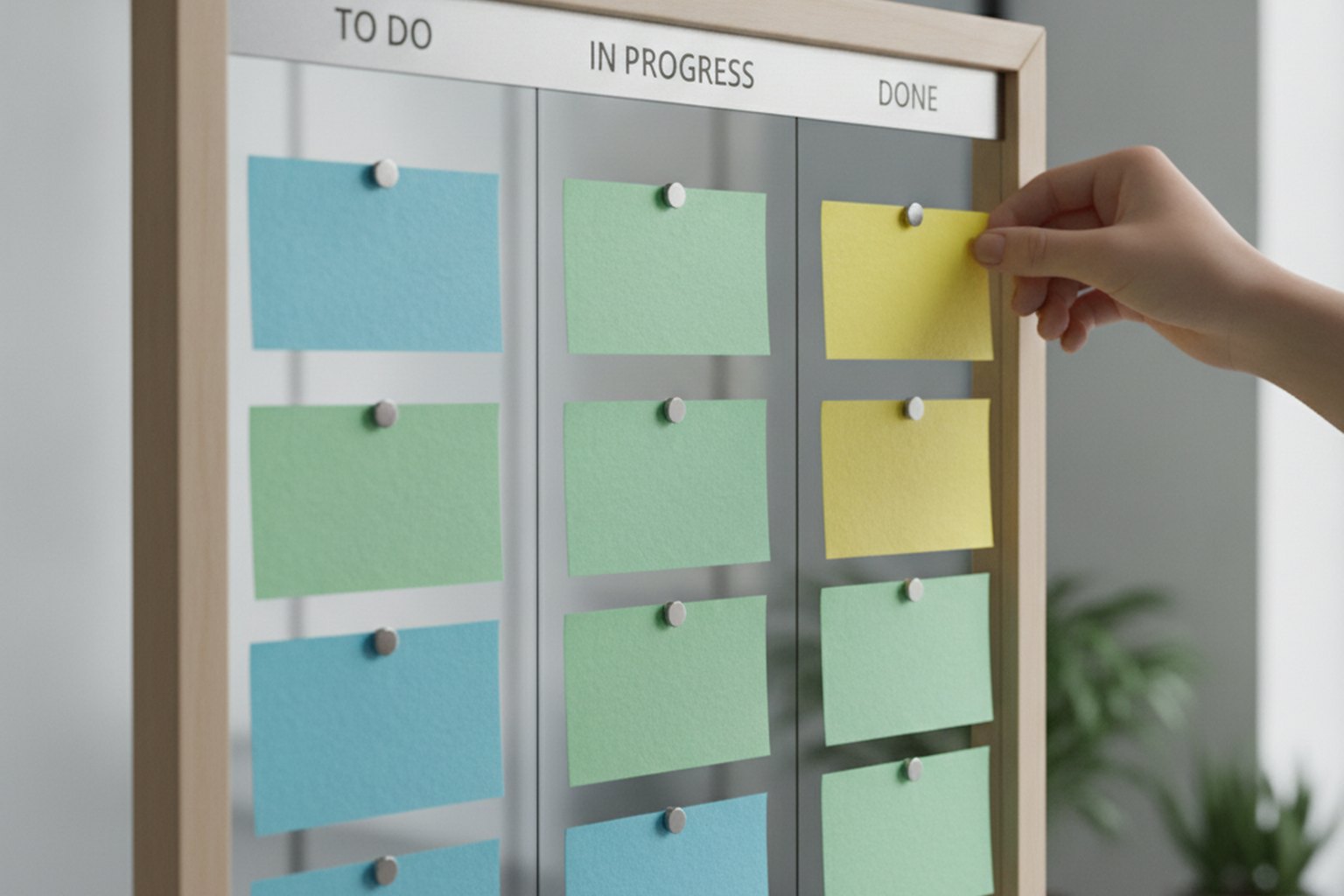
- Scrum. Time-boxed sprints (usually one to two weeks), a prioritised backlog and fixed ceremonies — planning, daily stand-up, review and retrospective. Best when scope evolves and you want a predictable delivery rhythm.
- Kanban. A continuous flow of work pulled from a backlog with limits on work in progress and no fixed sprints. Best for support, maintenance and streams where priorities shift day to day.
- Waterfall. Sequential phases — requirements, design, build, test, release — with sign-off at each gate. Still valid for fixed-scope, heavily regulated or hardware-linked work where requirements genuinely are stable up front.
- Hybrid. Predictive planning at the milestone and budget level with agile execution inside each phase. The pragmatic choice for enterprises that need both a committed roadmap and room to adapt.
Most real teams are not purists. They run Scrum or Kanban for delivery while reporting against fixed milestones for the business — a hybrid in all but name. For a deeper comparison of the frameworks and when each fits, see our guide to software development methodologies and our practical agile software development guide. The methodology is the frame; the process below is what you actually run inside it.
The software project management process, step by step
The software project management process moves through five stages — initiation, planning, execution, monitoring and control, and closure — and in agile delivery the middle three repeat every sprint rather than running once end to end. Naming the stages matters because each one has a distinct output, and skipping any of them is where projects quietly go wrong.
- Initiation. Define the goal, the business case, the success criteria and the stakeholders. Agree what "done" means at a high level and who can decide on scope. Most doomed projects were under-defined here, not under-built later.
- Planning. Break the goal into a scope and backlog, estimate the effort, set a schedule and budget, choose the methodology and write down the risks. Good estimation is its own skill — our software project estimation guide covers how to do it without guessing.
- Execution. Build the software in iterations, with the team pulling prioritised work, integrating continuously and demoing regularly so stakeholders see progress in working software, not status slides.
- Monitoring and control. Track progress, quality, cost and scope against the plan; run change requests through a clear process; and surface risks early. This is where a manager earns their keep — steering, not reporting after the fact.
- Closure. Release, hand over, document, and run a retrospective so the next project starts smarter. In continuous products, "closure" becomes a rolling transition into maintenance and the next roadmap increment.
In an agile setup, planning, execution and control collapse into the sprint cycle: you plan a sprint, build it, review it and adjust — every week or two. The five stages still exist, they just turn over faster, which is exactly what lets the process absorb change without losing control.
Key roles on a software project
A software project runs on a small set of clear roles, and the most common failure is leaving ownership of scope and priorities vague. Whatever the titles, someone must own the "what and why", someone the "how and when", and someone the technical decisions — and everyone must know which is which.
- Product owner (or client sponsor). Owns the vision, the priorities and the backlog; decides what gets built and in what order, and is the single voice on scope trade-offs.
- Project or delivery manager. Owns the plan, the schedule, the budget and the risks; coordinates the team, tracks progress and keeps stakeholders informed.
- Scrum master or agile lead. In agile teams, facilitates the process, removes blockers and protects the team's focus — a servant role, not a boss.
- Technical lead or architect. Owns the technical approach, the standards and the trade-offs between speed and long-term quality.
- Development team. Engineers, QA and designers who build, test and ship the software and give the estimates the plan depends on.
On smaller projects one person often wears several of these hats, and that is fine — as long as the responsibilities are explicit. The danger is not too few people; it is two people each assuming the other owns scope. Write the roles down at initiation and revisit them if the team grows.
What KPIs measure software project success?
The best KPIs for software project management combine delivery outcomes with engineering-performance metrics, so you can see both whether the project is on track and whether the team is healthy. Vanity numbers — lines of code, hours logged — measure activity, not progress; the metrics below measure whether you are actually shipping value predictably.

| KPI | What it tells you |
|---|---|
| On-time / on-budget delivery | Whether estimates and the plan match reality |
| Scope / requirement stability | How much scope creep the project is absorbing |
| Velocity & predictability | How much the team ships per sprint, and how consistently |
| Defect / change-failure rate | Whether speed is coming at the cost of quality |
| Stakeholder / user satisfaction | Whether the output is actually solving the problem |
For engineering performance specifically, many teams in 2026 track the DORA metrics — deployment frequency, lead time for changes, change-failure rate and failed-deployment recovery time — grouped into throughput and stability, with a growing number adding a rework rate to catch instability that shows up as unplanned work. One 2026 caveat matters: because AI now generates a large share of committed code on many teams, raw speed metrics like deployment frequency can flatter a project, so pair DORA with quality and rework measures rather than reading it alone. The point of any KPI is the conversation it starts, not the number itself — a metric no one acts on is just decoration.
The best project management tools for software development
The best project management tool for software development is the one your team will actually use consistently — the category matters more than the brand. In 2026 the field splits into engineering-centric trackers that live next to the code, cross-functional planners that give the whole business visibility, and lightweight boards for smaller teams, usually paired with a metrics layer for DORA reporting.
| Category | Common 2026 tools | Best for |
|---|---|---|
| Engineering-centric tracking | Jira, Linear, Azure DevOps | Sprint boards, backlogs and issues next to the codebase |
| Cross-functional planning | Asana, monday.com, ClickUp | Roadmaps and stakeholder visibility beyond engineering |
| Lightweight boards | GitHub Projects, Trello | Small teams and simple kanban flows |
| Delivery metrics | DORA dashboards and DevEx platforms | Measuring throughput, stability and rework |
Choose by three questions: how large the team is, whether tracking must sit beside the codebase, and how much cross-functional and stakeholder reporting you need. A five-person startup is well served by Linear or GitHub Projects; a regulated enterprise coordinating many squads usually needs Jira or Azure DevOps plus a planning layer on top. Whatever you pick, resist tool-hopping — the discipline of one consistent board beats the features of three half-used ones.
Common challenges and how to avoid them
Most software project problems are predictable, which means they are also preventable with a few disciplined habits. The recurring ones map almost exactly onto the failure causes from earlier — proof that the same small set of issues sinks most projects.
- Scope creep. Requests accumulate until the timeline breaks. The fix is a single prioritised backlog and a rule that new work displaces old work rather than simply adding to it.
- Unrealistic estimates. Optimistic timelines set at the start haunt the whole project. Estimate in ranges, buffer for the unknown, and re-forecast every sprint as reality comes in.
- Silent status. Problems surface too late because status is polished, not honest. The fix is a working-software demo cadence and a culture that rewards raising risks early.
- Unclear decision ownership. Progress stalls waiting for a decision no one owns. Name the decision-makers for scope and priorities at initiation.
- Ignoring technical debt. Speed now is borrowed from speed later. Budget a standing share of each sprint for quality so velocity does not quietly collapse.
None of these fixes is exotic. They are the ordinary discipline of project management in software development, applied consistently — which is exactly what separates the roughly one-third of projects that fully succeed from the rest.
Managing in-house vs with a development partner
Whether you manage a software project in-house or with a development partner, the same disciplines apply — the difference is where the ownership sits and how you keep visibility. In-house you own the process end to end; with a partner you delegate delivery management but must retain ownership of scope, priorities and the definition of done.
The most successful client-and-partner setups keep the product owner firmly on the client side while the partner supplies the delivery manager, the engineers and the process. That way the business keeps control of what and why, and the partner is accountable for how and when. For larger, multi-team programmes that span finance, operations and external systems, that governance needs to be built in from day one — which is where an enterprise software development practice earns its place. Insist on the same non-negotiables either way: a written scope, transparent status you can see for yourself, and code and IP you own outright. A good partner will welcome all three, because they are how trust is built and kept.
FAQ
What is software development project management?
Software development project management is the discipline of planning, organising and steering the people, scope, schedule and budget of a software build so it ships working software that meets its goals. It combines general project management — scope, time, cost, risk and stakeholder control — with software-specific practices such as agile delivery, sprint planning, continuous integration and change management. Unlike managing a fixed physical project, it has to absorb changing requirements without losing control of cost and quality, which is why iterative methodologies dominate the field in 2026.
Which methodology is best for software development project management?
There is no single best methodology, but agile — most often Scrum or Kanban — is the default for software projects in 2026 because requirements change during the build. Standish Group data shows agile projects succeed at roughly 64 percent versus 49 percent for waterfall, and the gap widens as projects get larger. Waterfall still suits fixed-scope, heavily regulated or hardware-linked work where requirements are stable, and many teams run a hybrid: predictive planning at the milestone level with agile execution inside each phase.
What are the stages of the software project management process?
The software project management process has five stages: initiation (define the goal, business case and stakeholders), planning (scope, estimate, schedule, budget and risk plan), execution (build the software in iterations), monitoring and control (track progress, quality, cost and scope against the plan), and closure (release, handover, retrospective and documentation). In agile delivery these stages repeat every sprint rather than running once end to end, so planning, execution and control happen continuously.
What KPIs measure software project success?
The core KPIs for a software project are on-time and on-budget delivery, scope and requirement stability, sprint velocity and predictability, defect and change-failure rate, and stakeholder or user satisfaction. In 2026 many teams add the DORA delivery metrics — deployment frequency, lead time for changes, change-failure rate and failed-deployment recovery time, now often joined by a rework rate — to measure engineering performance. Because AI now writes a large share of code, DORA is increasingly paired with quality and rework metrics so speed is not mistaken for progress.
What are the best software development project management tools in 2026?
The most widely used software development project management tools in 2026 are Jira, Linear and Azure DevOps for engineering-centric tracking, Asana, monday.com and ClickUp for cross-functional planning, and GitHub Projects or Trello for lighter workflows, usually paired with a delivery-metrics layer for DORA reporting. The right choice depends on team size, whether tracking must sit next to the codebase, and how much cross-functional and stakeholder visibility you need — the tool matters far less than using one consistently.
Why do so many software projects fail?
Software projects most often fail for management reasons rather than technical ones. Standish Group CHAOS data attributes failure largely to unclear or changing requirements (around 39 percent), scope creep (around 33 percent), inadequate planning (around 29 percent) and communication breakdowns (around 25 percent). Only about 31 percent of projects are fully successful, roughly half are challenged and near one in five fail outright. Strong project management — clear scope, realistic estimates, iterative delivery and honest status tracking — is what moves a project from the challenged column to the successful one.
Last updated 2 August 2026. Success, failure and methodology figures reflect widely reported Standish Group CHAOS data and 2026 industry sources, and are directional rather than exact. Treat every benchmark here as a planning reference, not a guarantee — the right process for your project depends on its scope, stakeholders and risk profile.