
TL;DR — travel software development in one paragraph
A travel software development company builds the booking engines, GDS/NDC integrations, payment flows and mobile apps that power OTAs, TMCs and hospitality brands. In 2026, custom travel platforms typically cost $45,000–$300,000+ depending on GDS/NDC scope. Choose a partner by travel-domain depth, integration track record, and compliance (PCI DSS, GDPR).
What is travel software development?
Travel software development is the custom design, engineering and integration of the software systems that travel and hospitality businesses use to sell, deliver and manage trips. It spans the booking engines and online travel agency (OTA) platforms travelers search on, the reservation and inventory systems that hold what is for sale, the connectivity layer that plugs into airlines, hotels and car suppliers through the GDS and NDC, the payment and settlement flows that take the money, and the web and mobile apps a traveler or a travel agent actually touches. Travel software development services are treated as their own engineering category because the domain combines constraints that rarely appear together elsewhere: real-time availability and pricing that change by the second, dozens of external supplier systems each with their own quirks, razor-thin margins that punish overselling or mispricing, and heavy payment and data-protection regulation across every market served.
Because those constraints are specific to each operator's suppliers, markets and pricing logic, travel companies rarely get everything they need from a single off-the-shelf template. They commission custom travel software either to differentiate their booking experience and packaging, or to escape the transaction fees and rigid workflows of white-label suites — which is why travel brands lean on experienced enterprise software development services to build platforms that model their exact supplier mix, fare rules and compliance obligations instead of forcing the business to fit what a package supports. That framing matters: a travel platform is an enterprise-scale build with the same architecture, data-model and integration discipline you would apply to any mission-critical system, plus the real-time distribution and settlement demands unique to travel.
In practice, travel software development sits at the intersection of e-commerce, real-time systems and airline/hospitality distribution. It requires the web APIs, cloud infrastructure and payment integrations familiar from any modern platform, alongside domain knowledge of how a fare is constructed, how a room-night is held and released, and how a booking is ticketed and settled through IATA/BSP. That dual nature — a consumer-grade storefront that must stay in lockstep with supplier inventory in real time — is what makes travel and hospitality software development demanding, and what separates specialist partners from generalist software shops.
Why travel companies need specialized software engineering
Travel companies need specialized software engineering because the travel domain breaks assumptions that hold in ordinary e-commerce. A retail catalog is static and owned; travel inventory is live, borrowed from suppliers, and priced dynamically, so the same seat or room can change price or vanish between a search and a checkout. Building for that reality — and for the thin margins, seasonality and regulatory load around it — is what a travel software development company does that a generalist team cannot.
Five characteristics make the domain hard, and each one shapes the architecture:
- Real-time, perishable inventory. A flight seat or hotel room-night is worthless the moment it departs or expires. Availability and rates must be cached carefully, revalidated at booking, and held atomically so two travelers cannot buy the same seat.
- Multi-supplier complexity. A single itinerary can combine flights from a GDS, hotels from a bedbank, transfers from a direct API and insurance from a fourth provider — each with different data formats, latencies and failure modes that must be aggregated into one coherent result.
- Seasonality and demand spikes. Search and booking volumes swing enormously around holidays and sales, so the platform must scale elastically and degrade gracefully rather than fall over at peak.
- Thin margins. Travel intermediaries often work on low single-digit margins, which makes overselling, mispricing and payment fraud existential rather than annoying — correctness and reconciliation are revenue-critical.
- Legacy and regulation. Distribution still runs partly on decades-old GDS infrastructure and EDIFACT messaging, while payments and traveler data fall under PCI DSS, GDPR and PSD2 — so a travel build is as much integration and compliance as it is application code.
The practical consequence is that travel and hospitality software development is an exercise in disciplined integration and real-time correctness, not just UI. A team that can ship a beautiful storefront but has never held and released inventory, reconciled a supplier's booking against a payment, or handled a GDS timeout mid-checkout will stall exactly where it matters.
Types of travel and hospitality software solutions
Travel and hospitality software development services cover a broad stack, from consumer-facing booking storefronts to the property- and inventory-management tools operators run behind the scenes. The categories below are the systems most travel projects build, extend or integrate; most real platforms combine several of them.
Booking engines and OTA platforms
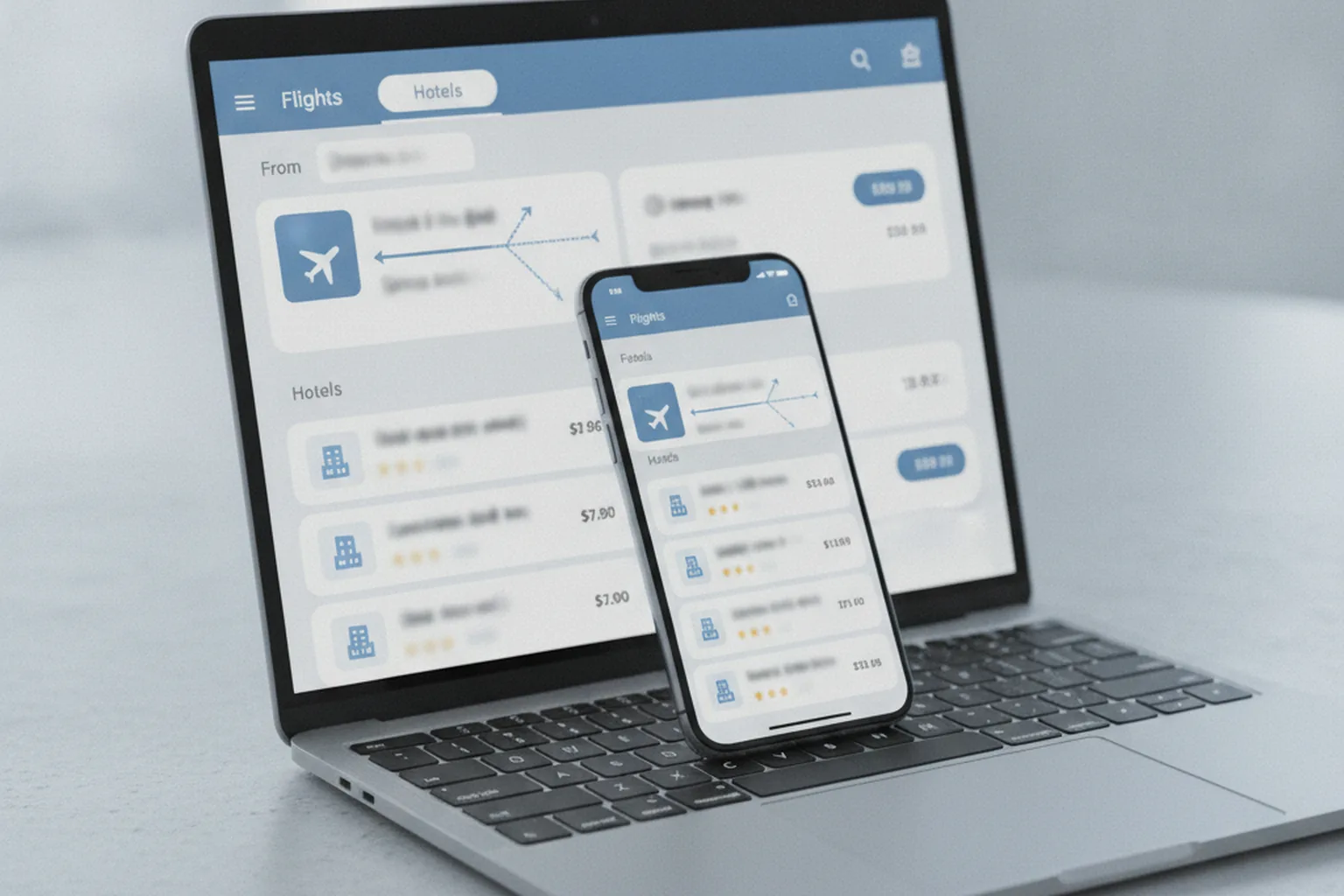
Booking engines and OTA platforms are the consumer storefront of travel: search across flights, hotels, cars or packages, real-time pricing and availability, and a checkout that turns a selection into a confirmed, paid booking. This is the heart of most travel software development projects, because it is where the business earns its margin and where the multi-supplier search, caching and atomic-booking logic all come together. A well-built booking engine returns fast, relevant results, revalidates price and availability before charging, and handles supplier failures without stranding the traveler mid-purchase.
GDS, aggregator and metasearch platforms
GDS, aggregator and metasearch platforms sit one layer up from a single storefront, pulling content from many suppliers and GDSs into one normalized inventory. Aggregators consolidate flights, hotels and ancillaries so a downstream OTA or agent can search a single API; metasearch platforms compare live prices across providers and hand off to the seller. Both are integration-heavy builds where the hard problems are normalizing inconsistent supplier data, caching without going stale, and controlling the cost of high-volume look-to-book traffic.
Corporate travel, TMC and expense systems
Corporate travel and travel management company (TMC) systems serve businesses rather than leisure travelers, adding policy enforcement, approval workflows, negotiated fares, duty-of-care traveler tracking and expense integration on top of a booking engine. The engineering emphasis shifts toward mid-office and back-office automation, reporting, and integration with corporate finance and HR systems, because the buyer cares as much about compliance and control as about the booking flow itself.
Hospitality: PMS, channel manager and guest apps
Hospitality software development builds the systems accommodation operators run: the property management system (PMS) that manages rooms, rates, availability, reservations and housekeeping; the channel manager that syncs that inventory out to OTAs and bedbanks so a room is never double-sold; the direct-booking engine on the hotel's own site; and guest-facing apps for contactless check-in, room service and messaging. Hospitality software development services are inventory- and property-centric, and the defining challenge is keeping one source of truth for availability and rates consistent across every channel in real time. Because a hotel both sells directly and distributes through OTAs, most hospitality software development company engagements end up touching the travel-distribution world too.
Mobile apps, loyalty and AI trip planners
The traveler-facing layer is where brands compete on experience: native mobile apps for booking, itinerary management, boarding passes and real-time trip updates; loyalty and personalization engines that reward repeat travelers and tailor offers; and the newer wave of AI trip planners and chatbots that turn a natural-language request into a bookable itinerary. These systems change fastest and are the most common first candidates for a custom build, because they are the brand — and they sit on top of the same reservation and supplier APIs everything else uses, often drawing on patterns from generative AI software development for the conversational and recommendation layers.
Core building blocks of a modern travel platform
Under the surface, almost every travel platform is assembled from the same five building blocks, and understanding them is how you scope a realistic architecture. Whatever the product on top — an OTA, a TMC or a hospitality suite — these components and the contracts between them are where a travel build succeeds or fails.
- Search and pricing engine. The component that takes a traveler's query, fans it out to suppliers and caches, applies fare/rate rules, markups and packaging, and returns ranked results fast. It is the most performance-sensitive part of the system and usually the hardest to get right.
- Inventory and reservation core. The source of truth for what is available, what is held, and what is booked. It must hold inventory atomically during checkout, release expired holds, and reconcile against supplier confirmations so nothing is oversold.
- Supplier connectivity layer. The adapters and anti-corruption layer that translate each GDS, NDC provider, bedbank and direct API into your internal model, isolating the rest of the platform from supplier-specific formats, latencies and outages.
- Payments and settlement. Tokenized card capture, multi-currency pricing, PSD2/SCA where required, fraud screening, and reconciliation of what the traveler paid against what each supplier is owed — including IATA/BSP settlement for ticketed air.
- Mid-office and back-office reporting. Booking management, ticketing/queue handling, refunds and changes, commissions and supplier reconciliation, plus the analytics and finance reporting the business runs on.
The discipline that ties these together — clean API contracts, an anti-corruption layer around every supplier, event-driven updates and continuous reconciliation — is the same one we lay out in our enterprise system integration guide, applied here to the travel domain. Getting the contracts right up front is what lets you add a supplier or a market later without rewriting the core.
Technology stack for travel software development
The technology stack is how the building blocks above get expressed as concrete engineering choices, and it has to support real-time supplier calls, elastic scaling for seasonal spikes, and strict compliance boundaries around payments and PII. There is no single correct stack, but most production travel platforms in 2026 converge on a similar shape, chosen to fit the architecture rather than the other way around.

| Layer | Typical choices | Why it fits travel |
|---|---|---|
| Backend & APIs | Node.js, Python or Java/Kotlin behind REST or GraphQL, in a modular monolith or microservices | Isolates a slow or failing supplier integration from search, checkout and payments |
| Web & mobile | React or Next.js for web; React Native or native Swift/Kotlin for mobile | Fast iteration on the traveler-facing layer, where brands actually compete |
| Cloud & infrastructure | AWS, GCP or Azure with containers (Kubernetes or ECS) and autoscaling | Absorbs seasonal look-to-book spikes without year-round over-provisioning |
| Data & caching | PostgreSQL or MySQL for transactional data; Redis for availability caching; Elasticsearch/OpenSearch for search | Sub-second multi-supplier search over inventory that changes by the second |
| Messaging & integration | Kafka or a managed queue, plus a dedicated anti-corruption layer per supplier | Decouples supplier latency and outages from the rest of the platform |
| AI & personalization | Managed LLM APIs for trip planning and support, plus lighter-weight recommendation models | Fastest path to AI features without owning model-training infrastructure |
None of these choices matter as much as the discipline around them: clean contracts between layers, an anti-corruption layer around every supplier, and monitoring on booking success and payment reconciliation from day one. A team that picks a fashionable stack but skips that discipline will still stall on the same integration and correctness problems described above.
GDS, NDC and API integration explained
GDS, NDC and direct APIs are the three ways a travel platform sources airline and hotel content, and choosing among them is one of the most consequential decisions in any travel build. A GDS (Global Distribution System — Amadeus, Sabre, Travelport) is the legacy backbone that aggregates most airline and hotel inventory into one connection; NDC (New Distribution Capability, an IATA XML standard) lets airlines distribute rich, personalized offers and ancillaries directly; and direct/aggregator APIs connect you straight to an individual supplier or a content consolidator. Most serious platforms end up using all three. The table below compares them on the factors that drive the decision.

| Dimension | GDS | NDC | Direct / aggregator API |
|---|---|---|---|
| What it is | Legacy hub aggregating most airline/hotel content into one connection | IATA XML standard for airlines to distribute rich, personalized offers directly | Point-to-point connection to a single supplier or content consolidator |
| Content depth | Broad coverage; limited ancillaries and branded fares | Rich fares, bundles and ancillaries; airline-specific | Deep for that supplier; no breadth |
| Setup cost | Medium–high; accreditation and certification | $15,000–$25,000 certification per integration | Low–medium per supplier; grows with count |
| Best for | Broad multi-airline/hotel coverage from one connection | Merchandising, branded fares and ancillary upsell | A few high-volume suppliers or niche content |
The industry trend is a clear shift toward NDC: NDC accounted for roughly 24% of indirect airline ticket sales in early 2026, up from about 11% in 2023 (industry distribution data tracked against IATA's NDC programme, 2026). That momentum is why new platforms increasingly build a hybrid connectivity layer — GDS for breadth, NDC for airline-direct richness, and direct APIs for a handful of high-volume suppliers. Whatever the mix, ticketed air still settles through IATA/BSP, which requires accreditation and adds financial and reporting obligations most first-time builders underestimate. Handling that connectivity as an isolated layer, behind a stable internal contract, is what keeps the rest of the platform from ossifying every time a supplier changes its interface — the same modernization discipline we describe for aging distribution stacks in our guide to legacy system modernization in 2026.
How much does travel software development cost in 2026?
Custom travel software in 2026 ranges from roughly $45,000 for a focused OTA build to $300,000+ for an advanced, multi-supplier GDS platform, with GDS/NDC connectivity and integration — not the storefront code — usually the largest line items. The table below gives 2026 market planning ranges by scope; treat every figure as a starting point for scoping rather than a quote, because supplier count, GDS/NDC depth and compliance requirements move the numbers significantly.
| Scope | Typical 2026 range | Notes |
|---|---|---|
| Full OTA platform (booking engine + agent portal + admin) | $45,000–$250,000+ | Range widens with supplier count and packaging |
| MVP GDS-based booking platform | $70,000–$110,000 | One GDS connection, core search, checkout, admin |
| Advanced GDS platform | $190,000–$300,000+ | Multi-supplier, dynamic packaging, mobile, mid-office |
| First GDS connection via Amadeus Self-Service APIs (year 1) | $15,000–$40,000 | Fastest path to first live air content |
| Direct GDS integration for a mid-size OTA (year 1) | $50,000–$120,000 | Deeper control; accreditation and certification |
| NDC certification per integration | $15,000–$25,000 | Plus IATA accreditation / BSP for ticketing |
What drives the cost of travel software development?
A handful of variables move a travel estimate more than the feature list does; understanding them lets you scope a realistic budget before committing. These 2026 ranges are drawn from published travel-software cost analyses (gurutechnolabs, oneclickitsolution, silviglobal, auspicioussoft, 2026) and are consistent with what we see in delivery.
- Number of supplier and GDS/NDC integrations. Every GDS, NDC provider, bedbank and direct API needs an adapter, certification and a reconciliation strategy. Connectivity is routinely the single largest cost line.
- Content breadth and dynamic packaging. Combining flights, hotels, cars and ancillaries into dynamic packages is far more complex than selling one product type.
- Payments and settlement scope. Multi-currency, PSD2/SCA, fraud screening and IATA/BSP settlement for ticketed air each add design and testing work.
- Look-to-book volume and scale. High search traffic against paid supplier APIs demands caching, rate control and elastic infrastructure that a low-volume MVP does not.
- Compliance and market coverage. PCI DSS scope, GDPR, and the number of markets and languages you launch in all expand the build.
The travel software development process, step by step
Travel software is built through a disciplined, phased sequence because a defect in a booking, pricing or settlement flow loses money or strands a traveler, not just a screen. The six stages below reflect how an experienced travel software development company delivers a build without breaking live bookings.
- Discovery & requirements. Map the target travelers, suppliers and GDS/NDC sources, the booking and payment flows, markets, and compliance obligations (PCI DSS, GDPR, IATA). Deliverable: a scoped backlog, integration inventory and a prioritized MVP definition.
- Solution & architecture design. Choose the service boundaries — search, inventory, connectivity, payments, mid-office — the supplier anti-corruption layer, caching strategy, data model and cloud topology. Deliverable: an architecture decision record and validated stack.
- Development. Build the components iteratively behind stable API contracts, integrating one supplier and one payment provider first, with automated tests against those contracts from day one. Deliverable: working, contract-tested services.
- QA & testing. Beyond functional tests, run booking-accuracy and price-revalidation tests, supplier-failure and timeout scenarios, load tests at peak look-to-book volumes, and end-to-end search-to-ticket tests. Deliverable: a platform proven under real supplier and load conditions.
- Launch & delivery. Roll out to one market and supplier set first, monitor booking success, price accuracy and payment reconciliation, then widen coverage. Deliverable: a live platform with monitored booking and revenue metrics.
- Support & maintenance. Operate with SRE practices — SLOs, monitoring, on-call — adapt to supplier API changes, and iterate on conversion and content. Deliverable: a maintained platform with a measurable performance loop.
Security and compliance for travel platforms
Security and compliance are non-negotiable in travel because a platform handles both card payments and rich personal data at scale, under multiple overlapping regimes. Get it wrong and the exposure is financial, legal and reputational at once. Four requirements define the baseline for any travel or hospitality build.
- PCI DSS for card data. Any platform that takes payment must protect cardholder data. The practical approach is to tokenize cards through a compliant payment provider and keep raw card data out of your systems entirely, minimizing PCI scope while still supporting refunds and changes.
- GDPR and traveler PII. Names, passports, dates of birth, itineraries and loyalty data are sensitive personal data. Lawful basis, consent where required, data-retention limits, encryption at rest and in transit, and the right to erasure all have to be designed in, not bolted on.
- PSD2 / SCA for EU payments. Strong Customer Authentication applies to European card payments; the checkout must support 3-D Secure and the exemptions that keep conversion high without breaking compliance.
- Secure supplier API handling. Credentials to GDSs, NDC providers and payment gateways are high-value secrets. Store them in a secrets manager, rotate them, scope them narrowly, and isolate supplier traffic so one compromised connection cannot expose the rest.
The right pattern is to treat payments and PII as a bounded, hardened part of the architecture — tokenized, encrypted, logged and access-controlled — so the bulk of the platform stays out of PCI and high-risk data scope. The payment flow itself follows the same patterns we detail in our payment gateway integration guide, applied to travel's multi-supplier settlement.
Build vs buy vs hybrid: choosing your approach
The right answer in travel is rarely pure build or pure buy — it depends on how much your booking experience and packaging differentiate you, and how fast you need to launch. There are three practical paths: build a fully custom platform, license a white-label travel product, or run a hybrid that extends a licensed core with custom modules where you differentiate. The decision table below scores each on the factors that matter most.
| Factor | Custom build | White-label | Hybrid / extend |
|---|---|---|---|
| Control & differentiation | Highest — you own the experience | Low — same as other licensees | High where it counts |
| Time-to-market | Slowest | Fastest | Fast core, custom where needed |
| Upfront cost | Highest | Lowest | Moderate |
| Long-run cost at scale | Lower run-rate; you own it | Per-booking fees grow with volume | Balanced |
| Fit to your model | Exact | Constrained to the product | Exact on custom modules |
| Best for | Differentiated OTAs/TMCs at scale | Fast market entry, standard needs | Growing brands escaping a template |
As a rule of thumb: an early-stage travel startup validating demand is usually best served by a white-label product or a lean custom MVP, while an established brand whose booking experience, packaging or margins are a competitive advantage justifies a custom build. The MVP-first path — ship one supplier, one market and one payment flow, then extend — de-risks the investment and is exactly the approach we lay out in our guide to MVP software development. Whatever the path, insist that anything you license exposes clean APIs, or you inherit tomorrow's lock-in.
How to choose a travel software development company
Choose a travel software development company on proven travel-domain experience, GDS/NDC integration track record and compliance posture — not on price or generic development capability. Travel is a specialist discipline: a team that ships clean web apps but has never certified an NDC integration or reconciled a BSP settlement will stall on the parts that decide whether the platform makes money. Use this checklist when evaluating travel and hospitality software development companies.
- Travel-domain portfolio. Ask for OTA, TMC or hospitality references at similar scale, and confirm the team can explain fares, holds, ticketing and reconciliation in practical terms — not just cite them.
- GDS/NDC integration proof. Which GDSs and NDC providers have they connected, and have they run certification and IATA/BSP settlement in production? Integration experience is the single best predictor of a working platform.
- Compliance posture. Confirm hands-on PCI DSS scoping, GDPR handling of traveler PII, and PSD2/SCA in the markets you serve.
- Architecture and scalability. Look for an anti-corruption layer around suppliers, caching and look-to-book cost control, and elastic scaling for seasonal peaks.
- Support model. Supplier APIs change constantly; you need a partner who monitors, adapts and maintains connectivity, not one who disappears at launch.
- Engagement model. Prefer a partner who scopes a paid discovery and a pilot supplier before quoting the full programme, and can field a dedicated development team as you scale.
For custom travel software development, the safest engagement is to start with a discovery phase covering the integration audit, supplier-response profiling and architecture design before committing to the full build. A serious enterprise software development company will insist on it — a custom travel software development company earns its keep on how well that groundwork is done, and hospitality software development company work succeeds or fails on the same discipline.
Travel software trends shaping 2026
The dominant trends in travel software for 2026 are AI-driven personalization, the continued shift to NDC, mobile-first and contactless experiences, cloud-native architecture, and embedded revenue-management analytics. The market backdrop explains the investment: the hospitality management software market is roughly $3.85B–$6.12B in 2026 and growing at about 11.8% CAGR toward ~$12.21B by 2032 (market-research synthesis, 2026), with AI and analytics now embedded in a majority of hospitality software offerings. Five shifts are shaping what teams build.
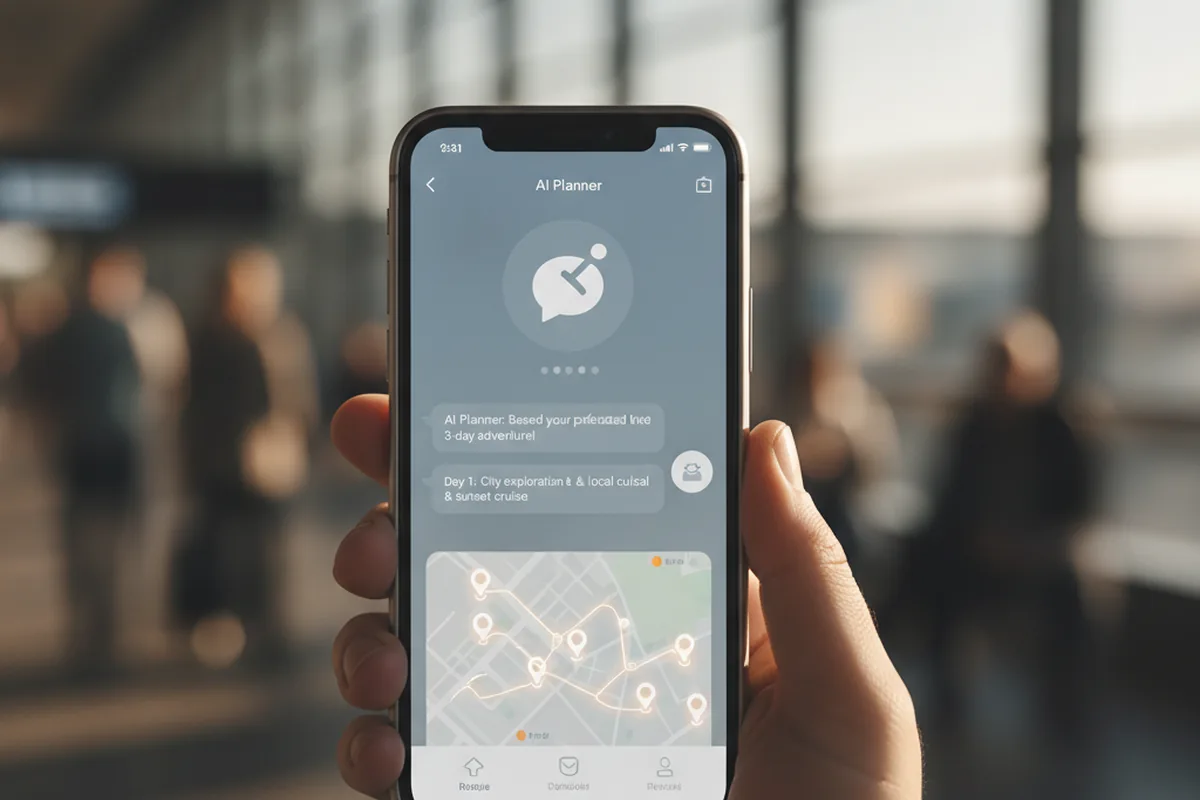
- AI personalization and agentic trip planning. Recommendation engines and conversational AI planners that turn a natural-language request into a bookable itinerary are moving from novelty to expectation, wired directly into search and merchandising.
- NDC adoption. With NDC at roughly 24% of indirect airline sales in early 2026, platforms are building hybrid connectivity to capture airline-direct fares, bundles and ancillaries the GDS cannot fully carry.
- Contactless and mobile-first. Mobile booking, digital boarding passes, and contactless check-in and keys are now baseline in hospitality, pushing investment into native apps and real-time trip updates.
- Cloud-native microservices. Elastic, service-based architectures handle seasonal demand spikes and let teams add suppliers and markets without rewriting the core.
- Revenue-management analytics. Dynamic pricing and demand forecasting, embedded in the platform rather than run in spreadsheets, protect thin margins and lift yield across seasons.
The common thread is that travel software in 2026 is less about a prettier storefront and more about intelligence and connectivity underneath it — AI in the experience, more direct supplier connections, and cloud-native scale to absorb demand. Teams that treat those as architectural decisions from the start, rather than features to bolt on later, are the ones whose platforms age well.
FAQ
What does a travel software development company do?
A travel software development company designs, builds and integrates the software that travel and hospitality businesses run on: booking engines and OTA platforms, GDS and NDC connectivity, reservation and inventory systems, payment and settlement flows, property management and channel-manager tools, and the web and mobile apps travelers use. Instead of configuring an off-the-shelf template, it models your specific suppliers, pricing rules, markets and compliance obligations, and connects everything through APIs so inventory, rates and bookings stay consistent in real time. The best partners pair travel-domain knowledge (GDS/NDC, IATA/BSP settlement, PCI DSS) with modern cloud and integration engineering.
How long does custom travel software development take?
A focused MVP booking platform — one supplier or GDS connection, core search, checkout and an admin panel — typically launches in 3 to 6 months. A mid-size OTA or TMC platform with multiple suppliers, payments and a mobile app usually takes 6 to 12 months. A full multi-supplier travel platform or a hospitality suite with GDS/NDC aggregation, dynamic packaging and revenue management runs 12 to 18 months or more. Supplier and GDS/NDC integration, certification and testing are the biggest drivers of the timeline, so a phased approach that ships one supplier and one market first reduces risk and delivers value earlier than a big-bang launch.
Do travel startups need a full platform or an MVP first?
Most travel startups should start with an MVP, not a full platform. An MVP focuses on one clear booking flow — a single supplier or GDS connection, search and pricing, checkout with one payment provider, and a lightweight admin panel — so you can validate demand and unit economics before investing in multi-supplier aggregation, dynamic packaging and a native app. Building a full platform up front is justified only when you already have supplier contracts, proven demand and funding to match. A good travel software development company will scope the MVP to be extended cleanly, so the first release becomes the foundation of the full platform rather than throwaway code.
What is hospitality software development and how does it differ from travel software?
Hospitality software development builds the systems that accommodation and venue operators run — property management systems (PMS), channel managers, direct-booking engines, guest apps, contactless check-in and revenue management — whereas travel software more broadly covers distribution and trip-selling platforms such as OTAs, TMCs and GDS/NDC aggregation. The two overlap heavily: a hotel's PMS and channel manager must talk to the OTAs and bedbanks that resell its rooms, so most projects touch both worlds. Hospitality software is inventory- and property-centric (rooms, rates, availability, housekeeping), while travel-distribution software is supplier- and itinerary-centric (flights, packages, multi-supplier search).
How much does custom travel software development cost in 2026?
In 2026, custom travel software typically costs $45,000–$250,000+ for a full OTA platform (booking engine, agent portal and admin), with an MVP GDS-based booking platform around $70,000–$110,000 and an advanced GDS platform $190,000–$300,000+. GDS connectivity is a separate line item: a first connection via Amadeus Self-Service APIs runs roughly $15,000–$40,000 in year one, a direct GDS integration for a mid-size OTA $50,000–$120,000, and NDC certification $15,000–$25,000 per integration plus IATA accreditation and BSP settlement for ticketing. Integration count, supplier scope and compliance move these numbers more than the feature list, so treat them as 2026 planning ranges rather than quotes.
What technology stack do travel software development companies use?
Most production travel platforms in 2026 run on a modular-monolith or microservices backend (Node.js, Python or Java/Kotlin) behind REST or GraphQL APIs, React or Next.js for web, and React Native or native Swift/Kotlin for mobile. They deploy on AWS, GCP or Azure with containers and autoscaling to absorb seasonal demand spikes, use PostgreSQL for transactional bookings, Redis to cache fast-changing availability, and Elasticsearch or OpenSearch for sub-second multi-supplier search. The specific stack matters less than the discipline around it: a clean anti-corruption layer per supplier and event-driven integration are what keep the platform maintainable as GDS connections and markets are added.
Should a travel platform use microservices or a monolith?
Most travel startups should start with a modular monolith — one deployable codebase with clean internal boundaries between search, inventory, payments and supplier connectivity — because it is faster to build and easier to operate with a small team. Microservices earn their complexity once search, booking and payments genuinely need to scale, deploy and fail independently, which typically shows up once a platform handles multiple suppliers, multiple markets or meaningful seasonal traffic spikes. The mistake to avoid is either extreme: a tangled monolith with no internal boundaries, or premature microservices that add operational overhead before the traffic or team size justifies it.
Last updated 27 September 2026. Cost figures are 2026 market planning ranges synthesized from published travel-software cost analyses (gurutechnolabs, oneclickitsolution, silviglobal, auspicioussoft, 2026) and YuSMP delivery experience; actual costs depend on supplier count, GDS/NDC scope and compliance requirements. NDC distribution share reflects industry data tracked against IATA's NDC programme (2026); hospitality-software market-size figures are drawn from market-research reports (2026). All figures are planning references, not quotes.