Discovery & requirements
Two-sided marketplace mapping (guest, owner, car partner, operator), trip-planning flow design, GDPR + CCPA posture mapping, and a deliberate decision to defer the loyalty system until market data exists.

Case study · Travel · Marketplace
How we built RentAll — a travel-planning marketplace where a traveler books a place to stay and a car to drive in one pass — as native iOS and Android apps backed by a Laravel and React control plane, with an owner listing dashboard and an operator admin panel built for the US and EU under GDPR and CCPA expectations.

The RentAll founder came to us with an ambitious travel-marketplace concept: a traveler in the United States or the European Union should be able to choose a city, pick dates, find a place to stay, and reserve a car for the same trip without leaving a single app. The market was full of single-purpose products — one app for short-term housing, another for car rental — and nothing that let a guest plan the complete journey in one flow. The hard part was not a single feature but the shape of the system: a two-sided model where property owners list and manage their own inventory (a C2C marketplace), layered with a B2C car rental aggregation that pulls availability from partner rental companies. We built RentAll from first principles as native iOS and Android applications talking to a Laravel REST API, with a React admin panel for verification and moderation. The result is a working MVP — guest search, property detail, a booking engine, an owner dashboard, car aggregation, and an operator console — positioned for audiences across the US and EU and architected to scale into new cities and countries.
A snapshot of what the RentAll MVP delivered across iOS, Android, an owner dashboard, and an operator admin panel in its first build cycle.
The stack decision shapes every later choice on a marketplace build. We chose Laravel for the backend and React for the admin panel because the trade-offs line up cleanly with a two-sided rental product that has to ship a defensible MVP fast and then scale. Laravel's mature queue, scheduler, and Eloquent ORM map directly onto the marketplace primitives — listings, bookings, payouts, notification jobs — so the path from data model to working API is short. React gives operators a fast, component-driven verification and moderation console that feels modern rather than a bolted-on CRUD screen. A single REST API then serves the native iOS and Android clients and the React panel from one data model, which keeps the US and EU build consistent and avoids the drift you get when each surface owns its own backend.
We deliberately avoided a single-stack monolith — for example, a server-rendered framework trying to be both the guest app and the operator console — because the mobile guest experience and the operator workflow have genuinely different needs. The native apps need offline-tolerant catalog caching and a tap-light booking flow; the operator panel needs dense tables, bulk actions, and a verification queue. Splitting the presentation layers while sharing one Laravel core gave us the best of both, end-to-end and citable from the framework documentation.
| Dimension | Laravel + React (RentAll) | Single-stack monolith | No-code builder |
|---|---|---|---|
| Native iOS / Android fit | Clean REST API for Swift and Kotlin clients | Server-rendered; mobile needs a separate API anyway | WebView wrappers; weak native feel |
| Operator console quality | Rich React panel — dense tables, bulk moderation | Templated CRUD — slower to refine | Limited to the builder's widgets |
| Marketplace primitives | Queues, scheduler, ORM map onto bookings and payouts | Available but less batteries-included | Generic; payouts need workarounds |
| Partner integrations | First-class HTTP client + jobs for car partners | Workable; more glue code | Often blocked by platform limits |
| Data ownership / portability | Full — self-hosted, exportable schema | Full | Vendor lock-in risk |
| GDPR / CCPA control | Explicit retention and consent in app code | Explicit, in app code | Depends on the vendor's posture |
| Scaling to new regions | Stateless API horizontally scaled | Possible; coupling slows it | Capped by the platform tier |
Framework references: Laravel documentation, React documentation.
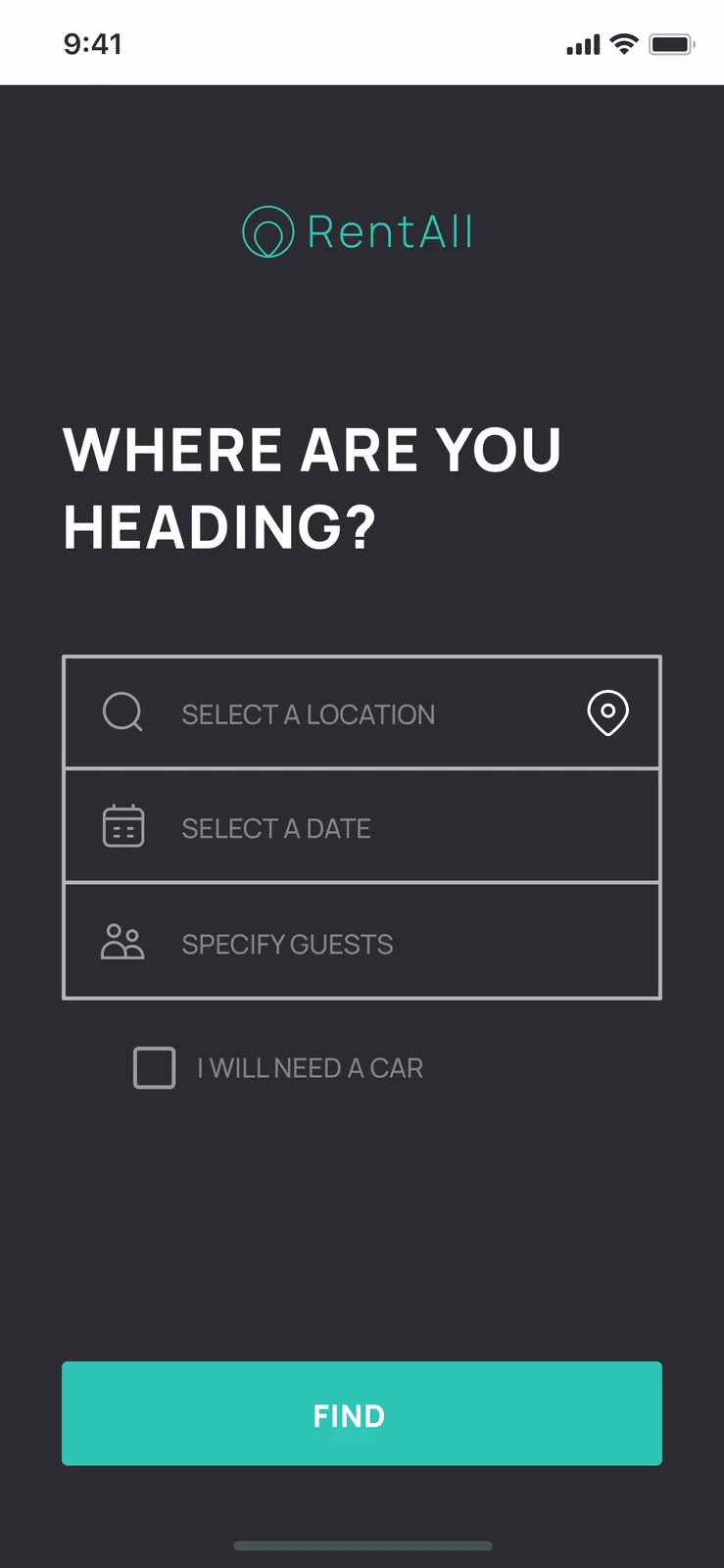
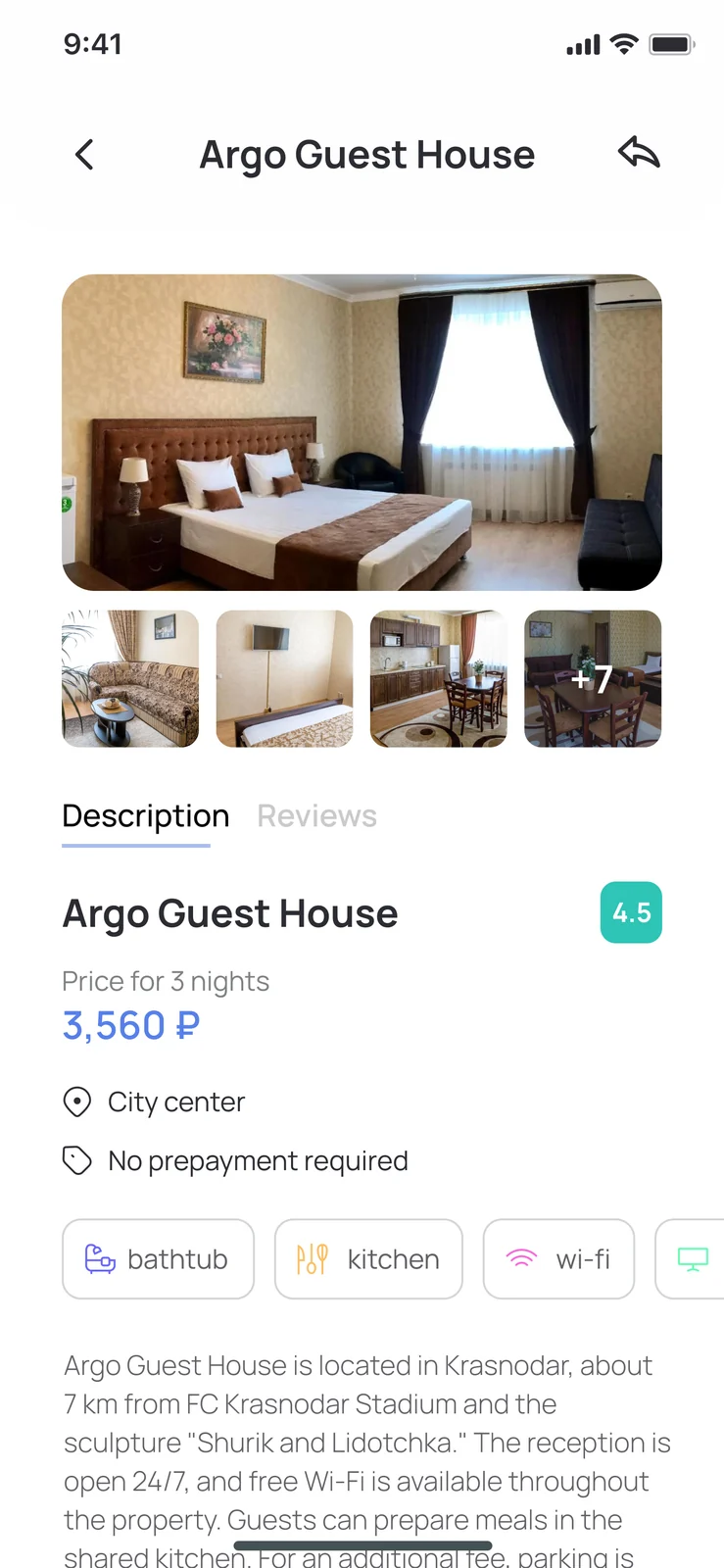
The iOS client is built in Swift, with the guest journey collapsing into a tight loop: search, browse, open a property, book. The home screen is a single search card — location, dates, guests, and an optional "I will need a car" toggle that quietly threads car rental into the same trip — backed by a latency-sorted, locally cached catalog so the picker never blocks on a network round-trip. The property detail screen carries a photo gallery, the nightly price, amenity chips (Wi-Fi, kitchen, parking), a rating, and a clear "no prepayment required" booking path. We used Apple's UIKit and SwiftUI patterns to keep the booking flow tap-light and the imagery fast on cellular.
Most rental apps leak time between "I like this place" and "it is booked," and that is where we spent disproportionate engineering effort. The flow validates the cached session, holds the booking in an explicit state from request to confirmation, and fires the confirmation over SMS and email so the guest is never left wondering. On typical US and EU mobile networks the path from property detail to a confirmed reservation completes in a handful of taps. The native iOS surface is delivered as part of our mobile app development practice.
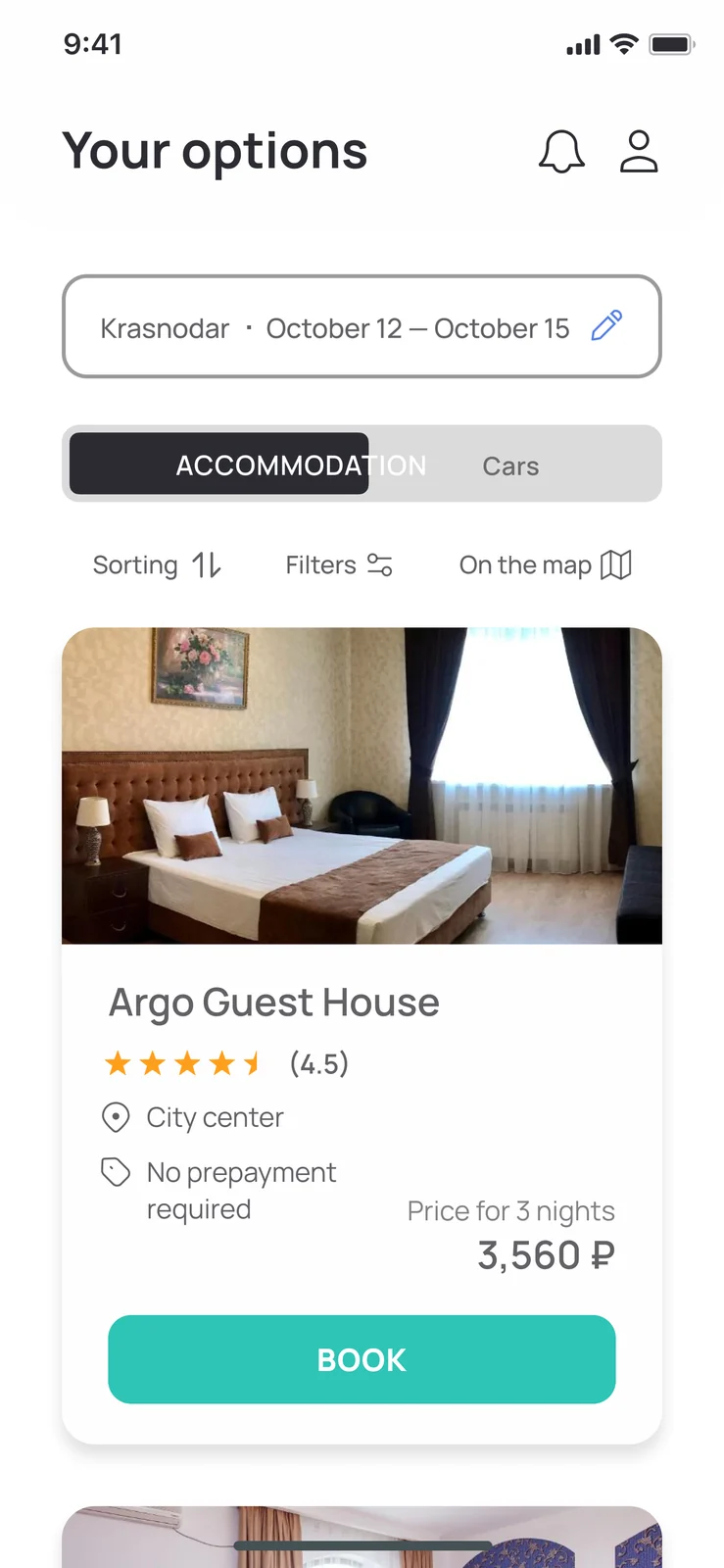
The Android client is written in Kotlin and carries the same two-sided model in lockstep with iOS. The "your options" results screen splits cleanly into Accommodation and Cars tabs, with sorting, filters, and an on-the-map view, so the dates and city a traveler chose for housing carry straight into the car search. The car side is a B2C aggregation: partner rental companies expose inventory that RentAll normalizes into a common catalog with class, transmission, and deposit filters, so a Toyota from one partner and a hatchback from another sit in one consistent list. Image loading, list paging, and filter state are tuned to stay smooth across the Samsung, Xiaomi, and Pixel device families that dominate the Android base.
The aggregation is the genuinely hard subsystem. Partner availability has to be reconciled in near real time, and each partner's cancellation and payout terms have to map into a single guest experience without confusing the traveler. We modeled vehicles, partners, and bookings as first-class entities in the shared Laravel schema, with background jobs refreshing availability and a normalization layer that hides partner-specific quirks behind one clean API. The same engineering team carries iOS and Android together as part of our iOS and Android engineering practice, serving the travel and mobility audience we describe on our travel industry page.
A rental marketplace lives or dies on trust, so the React admin panel was a first-class deliverable, not an afterthought. Every new owner listing and every car partner flows through a verification queue before it goes live; operators moderate content, resolve disputes, and oversee bookings from dense tables built for bulk action. Guest identity is deliberately separated from payout identity, so a leak in one plane does not expose the other, and bookings move through explicit states — request, confirmed, completed, cancelled — that the panel and the apps read from the same source of truth. SMS and email notifications keep guests, owners, and operators in sync at each state change.
For the US and the European Union, the data posture was designed to hold up to outside review from day one. Personal data is collected with granular consent, retained under a documented policy, and exportable on request — practices aligned with GDPR obligations for users in the European Union and CCPA / CPRA obligations for users in California and the broader United States. The verification queue and the moderation log double as an audit trail, so a future readiness review becomes a documentation exercise rather than an architectural retrofit.
Compliance posture: GDPR-aligned · ISO 27001 ready · SOC 2 Type II in progress · HIPAA-capable · CCPA-acknowledged.
A five-phase build that took RentAll from product concept to a working MVP across iOS, Android, an owner dashboard, and an operator admin panel.
Two-sided marketplace mapping (guest, owner, car partner, operator), trip-planning flow design, GDPR + CCPA posture mapping, and a deliberate decision to defer the loyalty system until market data exists.
Laravel REST API skeleton, listings / bookings / vehicles / payouts schema, car-partner normalization layer, notification jobs over SMS and email, React admin panel scaffold.
Swift iOS guest client and Kotlin Android guest client, the owner listing dashboard, and the booking engine with explicit state machine — search, detail, book, confirm.
Admin verification queue for listings and car partners, content moderation tooling, dispute handling, audit-ready data-retention and consent policies for US and EU users.
Working MVP across both stores and the operator console, car aggregation live with partner inventory, and a focus-group testing round to validate the trip-planning flow before wider rollout.
RentAll's supply side was built so that a property owner can run their inventory without ever touching the operator console. The owner dashboard exposes listing creation with photo upload and amenity tagging, an availability calendar that blocks dates the moment a booking is confirmed, and a clear view of upcoming stays. The booking engine keeps owner availability and guest demand reconciled in one place, so a date booked through the iOS app is instantly unavailable to the next Android guest. Payout identity is held separately from guest identity, so the financial plane never leaks into the browsing plane, and each booking carries its own state from request through completion. The whole supply subsystem was built with extensibility in mind: adding a deposit-and-damage flow, a multi-property owner role, or the deliberately-deferred loyalty program is a configuration change against the same Laravel data model rather than a rebuild, which is what lets RentAll grow from a handful of pilot cities toward a multi-region footprint across the US and EU. This adjacent supply-and-payout work sits inside our custom software development practice.
RentAll is architected to launch on Apple App Store and Google Play with storefronts active across the United States and the European Union. The English-language build is designed to serve travelers in California, New York, Texas, Florida, and Washington in the US, and travelers in the Netherlands, Germany, France, Ireland, and Sweden in the EU, without a separate codebase per region. Consent flows are region-aware at the client layer: users in the EU and EEA receive a GDPR-style granular consent screen with separate toggles for any optional product analytics; users in California receive a CCPA-style "Do Not Sell or Share My Personal Information" disclosure in the same flow. Data-handling practices are aligned with GDPR for users in the European Union and with the US state-privacy patchwork — CCPA/CPRA (California), VCDPA (Virginia), CPA (Colorado), CTDPA (Connecticut), UCPA (Utah), TDPSA (Texas), and Oregon CPA. Because the data model minimizes what is retained and ties retention to a documented policy, regional compliance reduces to honest disclosure rather than per-jurisdiction data segregation.
The marketplace is built to roll city by city — adding a region is a configuration of supply (owners and car partners) against the same stateless API, which can be pinned to EU or US infrastructure independently for future data-residency commitments. Both the App Store age rating and the Google Play content rating are calibrated for a travel and booking feature set, and the in-app privacy policy documents exactly the architecture above, citing GDPR obligations and California CCPA obligations directly. The engineering team behind the build runs a CET workday with East-Coast US overlap (9 AM–1 PM ET) for stand-ups, store-review choreography, and incident response — the timezone that lets a US product team and an EU engineering team share four hours of live overlap every day.
The active custom software development roadmap for RentAll includes the deliberately-deferred loyalty and rewards program (held until focus-group and early-market data justify the mechanics), a deposit-and-damage flow for car rentals, a multi-property owner role with team management, and richer in-app messaging between guests and owners. A B2B tier for property-management companies and car-rental fleets is planned for US and EU operators, with the listing and verification model already structured for multi-seat assignment. Infrastructure plans include further region-by-region rollout automation and per-region data-residency pinning, scaffolded into the cloud & DevOps roadmap.
If you are planning a travel-rental marketplace, a vacation-rental product, or any two-sided platform where housing, cars, and trust workflows have to work together for audiences in the US and EU, we have shipped this stack end-to-end and can compress the build timeline meaningfully. The full case write-up and product context are available at yusmpgroup.ru, and the engineering team behind it sits inside YuSMP Group. We work fixed-price for well-scoped MVPs and on dedicated development teams for ongoing delivery, with a CET workday and a guaranteed East-Coast US overlap (9 AM–1 PM ET) window for stand-ups, demos, and incident response.
A two-sided rental marketplace MVP covering iOS and Android guest apps, an owner listing flow, a booking engine, and a basic admin panel typically costs $130k–$280k. Adding car rental aggregation with partner integrations, payment and payout flows, availability calendars, verification and moderation tooling, and multi-region scaling brings a full product to $320k–$700k. The dominant cost drivers in the US and EU are the two-sided trust workflows, the partner integrations, and the payment compliance work.
Laravel gives a marketplace a mature, well-documented PHP framework with first-class queues, scheduling, and an ORM that maps cleanly onto listings, bookings, and payouts, which shortens the path to a defensible MVP. React powers a fast, component-driven admin panel for verification and moderation that operators actually enjoy using. The pairing lets one backend serve native iOS and Android clients through a single REST API while the same data model feeds a rich operator console, which keeps the US and EU build consistent.
Trust on a rental marketplace is an architecture decision before it is a policy. RentAll routes every new owner listing and car partner through an admin verification queue, holds bookings in clear states from request to confirmation, and separates guest identity from payout identity so a leak in one plane does not expose the other. Notifications over SMS and email keep both sides informed at each state change. For the US and EU, granular consent and a documented data-retention policy round out a posture that holds up to GDPR and CCPA review.
Car rental aggregation is a separate B2C inventory model bolted onto the same booking engine. Partner rental companies expose availability and pricing, which RentAll normalizes into a common vehicle catalog with class, transmission, and deposit filters. The guest flow reuses the same dates and location chosen for housing, so a traveler plans a complete trip in one pass. The hard part is reconciling partner availability in near real time and mapping each partner's payout and cancellation terms into a single consistent guest experience across US and EU markets.
A focused MVP with a guest search, property detail, booking flow, an owner listing dashboard, and a basic admin panel on both stores typically takes 14–20 weeks. Adding car rental aggregation with partner integrations, payment and payout flows, availability calendars, and verification tooling adds 8–12 weeks. The trust-and-safety and moderation pass — verification queues, dispute handling, audit-ready data policies — is frequently underestimated and should be budgeted at 4–6 weeks of dedicated work.
Related cases
Booking and scheduling platform with native mobile clients and an operator console across US & EU.
View case →
Travel and relocation services platform with multi-role content and a mobile-first experience.
View case →
Native iOS + Android sharing app with real-time vehicle inventory, booking, and an operator dashboard.
View case →
Native iOS, Android, and cross-platform apps with store-ready release pipelines.
Explore mobile app development →
Custom platforms engineered to your business model, scaling cleanly from MVP to millions of users.
Explore custom software development →
Region-by-region rollout automation, data-residency pinning, and observability for marketplaces.
Explore cloud & DevOps →Share a few details and a senior consultant will reply within one business day.