Choosing a Java software development company is really a decision about the engine room of your product: the backend services, APIs and enterprise systems that everything else depends on. Java has powered mission-critical software for nearly three decades, and in 2026 it is not coasting on legacy — it is modernizing fast, with virtual threads, a refreshed Spring stack and a central role in enterprise AI. The right partner brings deep JVM and Spring Framework expertise, cloud-native delivery discipline and an engagement model that fits how your team actually works. It is the same discipline that underpins any custom Java software development engagement — architecture first, delivery second.
This guide is deliberately not another "top 10 vendors" list. Instead, it gives you the decision framework: what a Java company delivers, why Java still wins for certain systems in 2026, when you should reach for something else, the stack signals that separate specialists from generalists, how to run the selection, the engagement models available, and honest 2026 cost ranges by region. By the end you should be able to scope a build, brief a shortlist and read a proposal critically — whether you engage YuSMP or anyone else.
Java's staying power is not nostalgia. According to Keyhole Software's 2026 Java trends analysis, 62% of enterprises now use Java to support AI functionality, and the language remains dominant in banking, big data, Android and large enterprise systems — precisely the domains where reliability and a deep talent pool matter more than novelty.
TL;DR — hiring a Java software development company in 2026
A Java software development company builds and maintains backend systems, REST/event-driven APIs, Spring Boot microservices and enterprise applications on the JVM, plus cloud migration and Android work. In 2026 Java is modernizing fast (Java 25 LTS, virtual threads, Spring Boot 4.0). Choose a partner on Java/Spring/cloud-native depth, not price alone; expect blended rates of roughly $25–$180/hour depending on region and a typical mid-size build of $80k–$250k.
What does a Java software development company do?
A Java software development company designs, builds, integrates and maintains software that runs on the Java Virtual Machine (JVM) — most often server-side backends, enterprise applications and the APIs that connect them. Beyond writing code, a good Java partner owns architecture, JVM performance tuning, security, testing and cloud deployment, delivering a production system rather than a prototype. Java software development services generally span the categories below.
Custom Java application development
Custom Java application development means building bespoke systems that model your specific business logic instead of forcing your processes into an off-the-shelf package. This is the heart of custom Java software development: transactional cores, workflow engines, rules systems and internal platforms where correctness, auditability and long-term maintainability outweigh time-to-market shortcuts. Java's static typing and mature testing culture make it a natural fit for software that has to be right, not just fast to ship.
Backend & API development (REST, Spring Boot)
Backend and API development is where most Java engagements concentrate. Teams build REST and GraphQL APIs, event-driven services and integration layers using Spring Boot — the de facto standard framework for Java backends — so that web apps, mobile clients and partner systems share one reliable, well-documented interface. If you want a deeper primer on the discipline itself, see our guide to back-end software development; Java and Spring Boot are among the most common stacks it describes.
Spring Boot microservices
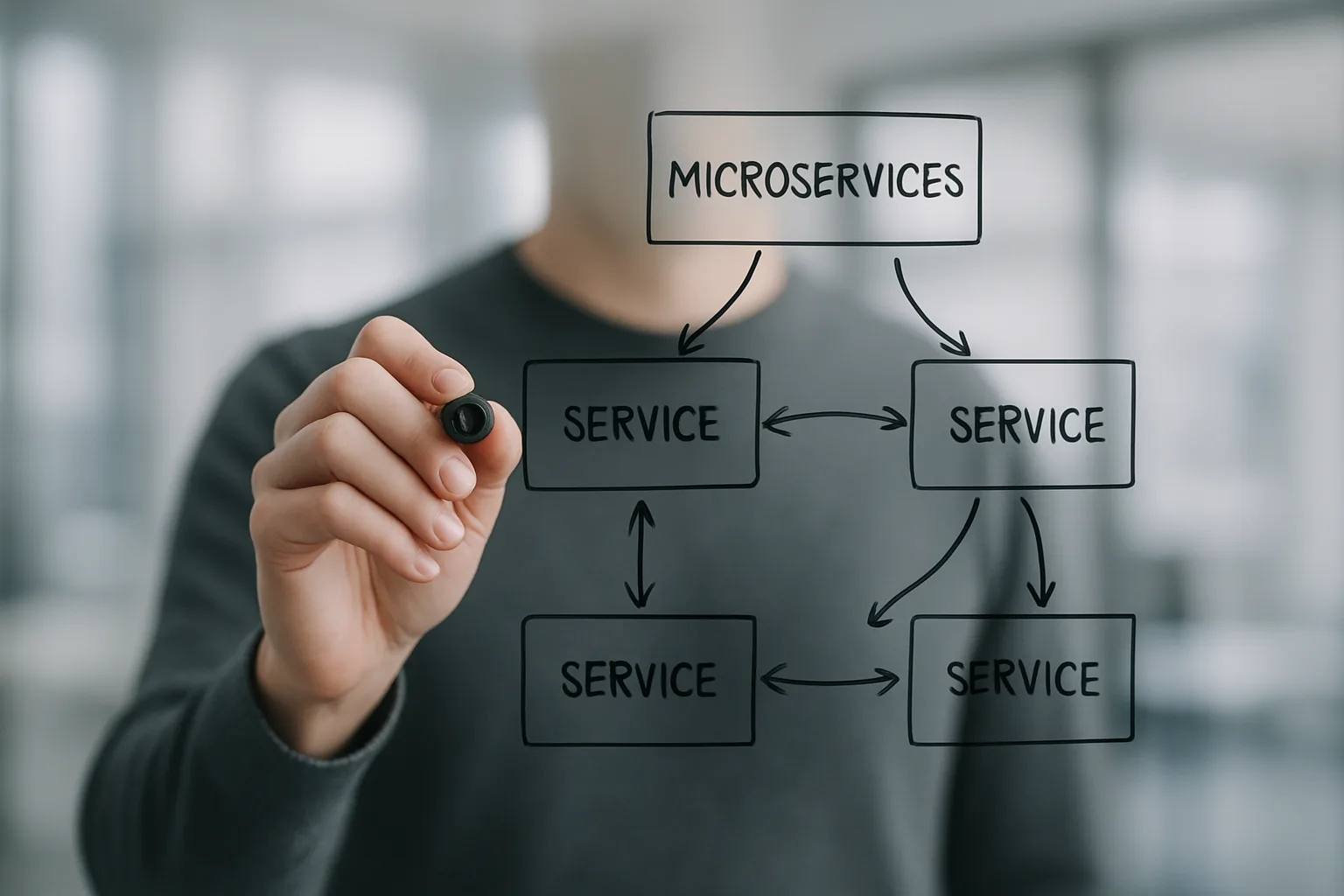
Spring Boot microservices break a large application into independently deployable services, each owning its data and scaling on its own. Spring Boot, combined with Spring Cloud, provides the service discovery, configuration, resilience and observability patterns that make microservices manageable rather than chaotic. This architecture suits large teams and high-throughput systems, but it adds operational overhead — which is why the decision to split a monolith should be deliberate. Our walkthrough of a monolith-to-microservices enterprise migration covers when and how that transition pays off.
Enterprise Java & system integration
Enterprise Java development covers the large, long-lived systems that run banks, insurers, telcos and logistics operators — often integrating with SAP, Oracle, mainframes, message buses and dozens of internal services. Here a Java software development company earns its fee through integration expertise: Jakarta EE where required, robust transaction management, messaging with Kafka or RabbitMQ, and the security and compliance controls that regulated enterprises demand. These systems reward a partner who has connected Java to a real enterprise landscape before.
Java cloud migration & modernization
Cloud migration and modernization moves aging Java applications — old application servers, monoliths on outdated JDKs — onto modern, cloud-native foundations. Typical work includes upgrading to a current LTS (Java 21 or 25), containerizing with Docker, orchestrating on Kubernetes, and gradually decomposing the monolith where it delivers value. Done well, modernization cuts infrastructure cost, improves scalability and unlocks features like virtual threads that older runtimes cannot use.
Maintenance, support & dedicated Java teams
Maintenance and support keep Java systems secure and performant after launch — dependency and CVE patching, JVM tuning, monitoring and incident response. Many companies also offer dedicated Java teams or staff augmentation so you can add sustained backend capacity, which we cover under engagement models below.
Why is Java still a top choice in 2026?
Java is still a top backend choice in 2026 because it is actively modernizing while keeping the stability, ecosystem and talent depth that made it an enterprise default. The last twelve months delivered some of the most significant Java releases in years, and adoption data shows the language moving into new territory rather than retreating. The concrete reasons:
- Java 25 LTS raised the performance ceiling. Released on September 16, 2025, Java 25 LTS brought virtual threads to production maturity, graduated Structured Concurrency and Scoped Values, and improved Generational ZGC. For a Java software development company, an LTS release means years of support and a stable base to build on.
- Virtual threads change how backends scale. Per JavaPro's 2026 coverage, virtual threads release the underlying platform thread while blocked, so a single JVM can handle far more concurrent requests. The synchronized-block pinning issue was fixed in JDK 24 and carried into 25 — removing the last big caveat for high-concurrency services.
- Spring Boot 4.0 modernized the framework. Spring Boot 4.0 reached general availability in November 2025, with Spring Framework 7 adding JSpecify null-safety annotations, deeper Project Leyden work and stronger virtual-thread support (with full benefit on Java 21+). The most widely used Java framework is current, not legacy.
- Java is now an enterprise AI backbone. According to Keyhole Software's 2026 Java trends analysis, 62% of enterprises use Java to support AI functionality — orchestrating models, serving inference and wiring AI into existing transactional systems where the data already lives.
- The ecosystem and talent pool are unmatched. Per OpenLogic's 2026 Java ecosystem trends, Java stays dominant across banking and finance, big data, Android and healthcare enterprise systems. A vast library ecosystem, mature tooling and a large global hiring pool reduce delivery risk and long-term maintenance cost.
When is Java the right choice — and when is it not?
Java is the right choice when you are building a high-concurrency, long-lived backend where reliability, type safety and a deep talent pool matter more than raw prototyping speed — and it is the wrong choice for tiny throwaway MVPs or data-science-first workloads. Being honest about that boundary is the fastest way to avoid picking the wrong stack (and the wrong vendor). The table and lists below make the call explicit.
Java is a strong fit when you have:
- High-concurrency backends — payment processing, trading, booking, messaging or any system serving heavy concurrent load, where virtual threads and the JVM shine.
- Regulated fintech and banking systems where auditability, transactional integrity and long-term support are non-negotiable.
- Large enterprise platforms with complex integrations, multiple teams and a multi-year lifespan.
- Big-data and streaming pipelines — much of the ecosystem (Kafka, Spark, Flink, Hadoop) is JVM-native.
- Android applications, where Java (alongside Kotlin) remains a first-class language.
Java is a weaker fit when you have:
- A tiny MVP on a shoestring that one founder needs live next month — a lighter runtime may ship faster.
- Data-science or ML-first products where Python's libraries dominate the core workload.
- Ultra-lightweight serverless functions where cold-start latency is critical — though GraalVM native image narrows this gap considerably.
The comparison below positions Java against the alternatives a Java software development company is most often weighed against, so you can match the language to the system rather than to fashion.
| Language | Best for | Concurrency | Ecosystem | Hiring pool | Typical cost band |
|---|---|---|---|---|---|
| Java | Enterprise backends, fintech, big data, Android | Excellent (virtual threads, JVM) | Very large, mature | Very large | Mid |
| Node.js | Real-time apps, lightweight APIs, full-stack JS | Good (event loop, I/O-bound) | Large | Very large | Low–mid |
| Python | Data science, ML, scripting, rapid prototypes | Moderate (GIL constraints) | Very large (data/ML) | Very large | Low–mid |
| .NET (C#) | Microsoft-stack enterprise, Windows, Azure-first | Excellent (async/await, CLR) | Large, mature | Large | Mid |
The Java tech stack: what to look for
The right Java tech stack signals whether a company is a modern specialist or a team coasting on old habits — look for current LTS Java, a Spring-centric framework layer and genuine cloud-native tooling. When you evaluate a Java software development company, ask which of the following they use by default, and why. The categories below map the stack from language core to production operations.
- Core Java (LTS versions). Modern teams standardize on Long-Term-Support releases — Java 17, Java 21 and now Java 25 LTS — not end-of-life JDKs. Java 21+ is required to get full value from virtual threads and the latest Spring Boot.
- Frameworks. Spring Boot and Spring Framework 7 for the majority of backends; Hibernate/JPA for persistence; and lightweight, cloud-native alternatives like Quarkus and Micronaut for fast-start, low-memory services, especially on serverless or Kubernetes.
- Messaging & events. Apache Kafka for high-throughput event streaming and RabbitMQ for classic message queuing — the backbone of event-driven and microservices architectures.
- Databases. Relational stores (PostgreSQL, MySQL, Oracle) accessed through JPA/Hibernate, plus NoSQL (MongoDB, Cassandra) and caching (Redis) where the access pattern calls for it.
- Cloud & containers. AWS or Azure as the platform; Docker for packaging; Kubernetes for orchestration; and GraalVM native image where fast cold starts and small footprints matter.
- CI/CD. Automated build and deploy pipelines (GitHub Actions, GitLab CI, Jenkins) with Maven or Gradle, so releases are repeatable and low-risk.
- Observability. Metrics, tracing and logging (Micrometer, OpenTelemetry, Prometheus, Grafana) built in from day one — essential for microservices you cannot debug by guesswork.
- Security. Spring Security for authentication and authorization, dependency scanning for CVEs, and secure-by-default configuration rather than bolt-on hardening.

How to choose a Java software development company
Choose a Java software development company on demonstrated Java, Spring and cloud-native depth backed by relevant case studies — not on the lowest hourly rate. The wrong partner shows up as missed deadlines, fragile integrations and a codebase your own team dreads inheriting; the right one behaves like an extension of your engineering org. Work through this six-point checklist when you evaluate Java software development companies.
- Verify Java, Spring and cloud-native depth. Ask which LTS versions and Spring Boot releases they run in production, how they use virtual threads, and how they deploy to Kubernetes. Specific, current answers separate specialists from generalists who happen to know some Java.
- Review industry case studies. Look for delivered Java systems in your domain — fintech, healthcare, logistics, enterprise SaaS — at a similar scale and complexity. Ask for references you can actually call.
- Probe architecture and code-quality practices. How do they handle testing, code review, API design and technical-debt management? A team that can walk you through its testing pyramid and CI gates will hand you a maintainable system.
- Confirm security and compliance capability. If you are regulated, verify experience with SOC 2, GDPR and — for healthcare — HIPAA, plus secure coding and dependency-scanning practices. Compliance retrofitted after the build is expensive and risky.
- Check engagement flexibility. Can they offer a dedicated team, staff augmentation and fixed-price work, and switch models as your needs change? Rigid commercial structures are a warning sign.
- Assess communication and time-zone overlap. Clarify project-management approach, reporting cadence and daily overlap hours. For nearshore or offshore engagements, a few hours of guaranteed overlap is the difference between a partner and a black box.
If you want a language-agnostic version of this evaluation to reuse across vendors, our guide on how to choose a software development company covers the broader diligence process; the Java-specific items above sit on top of it.
Java development engagement models
The engagement model determines who owns delivery, how much you manage day to day, and how costs scale — pick it deliberately, because it shapes the relationship as much as the technology does. Most Java software development companies offer some combination of the four models below.
- Dedicated development team. The vendor assembles a full Java team — engineers, lead, QA, sometimes a PM — that works as your outsourced product unit. Best when you are outsourcing a whole product or module and want the partner to own architecture and velocity. You get delivery ownership at the cost of some day-to-day control.
- Staff augmentation. You add individual Java or Spring Boot engineers to your existing team under your own management. Best when you have a strong in-house function and a clear architecture and simply need more capacity or a specific skill. Maximum control, minimum vendor overhead — but you lead the work.
- Fixed-price / project-based. The vendor commits to a defined scope, timeline and price. Best for well-specified projects with stable requirements; less suited to exploratory work where scope will change.
- Onshore vs nearshore vs offshore. Onshore maximizes overlap and communication at the highest rate; nearshore (for US clients, Latin America) balances cost and time-zone overlap; offshore (Eastern Europe, South Asia) minimizes cost with the widest time gap. The right choice depends on how much real-time collaboration your project needs.
How much does Java software development cost in 2026?
In 2026, engaging a Java software development company costs roughly $25–$180 per hour depending on region and seniority, with a typical mid-size enterprise application landing between $80,000 and $250,000. The single biggest variable is where the team sits; the second is how complex and regulated the system is. Treat every figure here as a 2026 market estimate for planning, not a quote — actual pricing depends on scope, seniority mix and engagement model.
| Region | Typical 2026 hourly rate (Java) | Notes |
|---|---|---|
| North America (US, Canada) | $100–$180 | Highest rates; maximum time-zone overlap for US clients |
| Western Europe | $70–$130 | Strong overlap with EU clients; deep enterprise Java talent |
| Latin America (nearshore) | $45–$75 | Balance of cost and US-hours overlap |
| Eastern Europe | $40–$70 | Strong engineering pool; partial overlap with US, good with EU |
| South Asia | $25–$50 | Lowest rates; widest time-zone gap, so overlap hours matter most |
On a whole-project basis, budgets cluster into three bands:
- MVP or single service: $30,000–$80,000 — a focused Spring Boot backend or one microservice with a clear, bounded scope.
- Mid-size enterprise application: $80,000–$250,000 — multiple services, real integrations, authentication, and a production-grade cloud deployment.
- Large enterprise platform: $250,000+ — multi-team, multi-year systems with complex integrations, high availability and compliance requirements.
Java pricing models: fixed price vs time & material vs dedicated team
The hourly rate and project band above are only half the picture — how a Java software development company bills you (the pricing model) determines who carries the risk of scope changing mid-project. The table below maps the three models most Java vendors offer against when each one actually fits.

| Pricing model | How it works | Best fit | Who carries scope risk |
|---|---|---|---|
| Fixed price | Vendor quotes a total for a defined scope and timeline | MVPs, single services, well-specified PoCs | Vendor (they pad estimates to cover risk) |
| Time & material | You pay for actual hours logged against the hourly rate | Evolving requirements, ongoing feature work | Client (needs active scope management) |
| Dedicated team (monthly) | Flat monthly fee per engineer, team works exclusively for you | Multi-month to multi-year product builds | Client (owns backlog and priorities) |
| Per-ticket support | Fixed fee per resolved maintenance ticket or SLA tier | Post-launch L1/L2 maintenance with predictable volume | Shared (SLA caps vendor exposure) |
Beyond the hourly rate, the real number to plan against is total cost of ownership, not the quoted price. A cheaper vendor that under-scopes testing, security review or documentation hands you technical debt that costs more to unwind later than the discount was worth. Budget explicitly for: management and communication overhead if you are coordinating an offshore team yourself, QA and code-review capacity (not just development hours), security and compliance work if you are regulated, and a maintenance retainer for the first 3–6 months after launch — the period when most defects surface.
The factors that move a Java estimate most are team seniority and size, system and integration complexity, security and compliance scope (SOC 2, GDPR, HIPAA), the engagement model, and how much legacy code has to be modernized rather than written fresh. For a language-agnostic breakdown of these drivers, see our custom software development cost guide for 2026.
Which industries rely on Java software development?
Java concentrates in industries where systems are large, regulated, high-throughput and long-lived — finance leads, but healthcare, commerce, logistics and enterprise SaaS all lean heavily on the JVM. That industry mix is a big part of why a specialist Java software development company is worth the premium in these domains.
- Fintech & banking. Core banking, payments, trading and risk systems run on Java for its transactional integrity, auditability and long-term support. This is Java's flagship domain; our fintech software development practice builds exactly these systems.
- Healthcare. Hospital information systems, EHR integrations and health platforms use Java for reliability and its capacity to meet HIPAA and interoperability requirements.
- E-commerce & retail. High-traffic commerce backends, order-management and inventory systems rely on Java to stay stable under peak load.
- Logistics & supply chain. Routing, tracking, warehouse and fleet systems process large real-time data volumes on JVM-based streaming stacks.
- Enterprise SaaS. Multi-tenant B2B platforms choose Java for scalability, security and the maintainability that a multi-year product roadmap demands.
FAQ
What does a Java software development company do?
A Java software development company designs, builds, integrates and maintains software that runs on the Java Virtual Machine (JVM). In practice that means custom backend systems, REST and event-driven APIs, Spring Boot microservices, enterprise applications and integrations, Android apps, big-data pipelines, and cloud migration or modernization of legacy Java systems. A specialist Java company brings JVM performance tuning, Spring Framework expertise and cloud-native delivery (Docker, Kubernetes, CI/CD) that a generalist agency typically cannot match. Most offer several engagement models — dedicated teams, staff augmentation or fixed-price projects — so you can match the commercial structure to your roadmap.
How much does it cost to hire a Java software development company in 2026?
In 2026, Java developer hourly rates vary widely by region: roughly $100–$180 in North America, $70–$130 in Western Europe, $45–$75 in Latin America (nearshore for US clients), $40–$70 in Eastern Europe, and $25–$50 in South Asia. On a project basis, a Java-backed MVP or single service typically runs $30,000–$80,000; a mid-size enterprise application $80,000–$250,000; and a large, multi-team enterprise platform $250,000 and up. The main cost drivers are team seniority, system complexity, integration and compliance scope, and whether you engage onshore, nearshore or offshore. Treat these as 2026 market estimates rather than fixed quotes.
Is Java still worth using in 2026?
Yes. Java remains one of the most widely used backend languages in 2026, and it is actively modernizing rather than fading. Java 25 LTS, released on September 16, 2025, brought virtual threads to production maturity for high-concurrency workloads, and Spring Boot 4.0 reached general availability in November 2025 with Spring Framework 7 and JSpecify null-safety. According to Keyhole Software's 2026 Java trends analysis, 62% of enterprises now use Java to support AI functionality. Java stays dominant in banking and finance, big data, Android, and large enterprise systems where stability, a deep talent pool and a mature ecosystem matter most.
Java vs Python — which is better for enterprise backends?
For large, high-concurrency, long-lived enterprise backends, Java is usually the stronger choice: static typing catches errors at compile time, the JVM delivers predictable performance under load, and Spring Boot provides a battle-tested framework for transactional, regulated systems. Python is better when the workload is data-science-heavy, machine-learning-first, or optimized for rapid scripting and prototyping. Many enterprises run both — Java for the transactional core and service backbone, Python for analytics and ML — so the practical question is which language owns which part of the system, not which language wins outright.
Should I choose a dedicated Java team or staff augmentation?
Choose a dedicated Java team when you are outsourcing a whole product or module and want the vendor to own delivery, architecture and velocity end-to-end. Choose staff augmentation when you already have a strong in-house engineering function and a clear architecture, and simply need to add Java or Spring Boot capacity under your own management. Dedicated teams reduce your management overhead but give you less day-to-day control; staff augmentation gives you maximum control but requires you to lead the work. A capable Java software development company can offer both and help you pick based on your internal maturity and the size of the gap.
Fixed price, time and material, or dedicated team — which Java pricing model should I choose?
Fixed price suits a well-specified project with stable requirements, such as an MVP or single service, because the vendor commits to scope, timeline and cost upfront. Time and material fits work where requirements will evolve — you pay for actual hours and can reprioritize as you learn. A dedicated team on a monthly retainer suits an ongoing product build where the vendor effectively becomes an extension of your engineering org for months or years. Most Java software development companies offer all three and will recommend one based on how fixed your scope is, not the other way around.
What is L1, L2 and L3 support in Java application maintenance?
L1, L2 and L3 describe escalation tiers for post-launch Java support. L1 handles first-line triage — monitoring alerts, restarting services, logging incidents and routing anything non-trivial upward. L2 is hands-on engineering: reproducing bugs, patching dependencies and CVEs, and tuning JVM or Spring Boot configuration. L3 is deep architecture-level work — root-causing systemic issues, redesigning a failing component or leading a modernization effort. Ask a prospective Java software development company which tiers they staff directly versus subcontract, since L3 capability is what separates a maintenance vendor from a strategic partner.
Published 3 September 2026, last updated 26 September 2026. Java release and framework facts are drawn from JetBrains (Java 25 LTS, 2025), JavaPro (virtual threads, 2026), Spring Boot 4.0 release notes (2025), Keyhole Software Java trends (2026) and OpenLogic Java ecosystem trends (2026). Cost and pricing-model figures are 2026 market estimates for planning; actual pricing depends on scope, seniority, region and engagement model.