
Automotive software development is the engineering of digital systems used inside vehicles and across the wider automotive ecosystem. It includes embedded control software, infotainment and driver-assistance functions, connected-vehicle cloud platforms, mobile apps, diagnostic and OTA services, and business systems for manufacturing, dealerships, service, mobility, and fleets. The required rigor depends on whether software can affect vehicle safety, security, compliance, or only a business workflow. Most programs succeed by pairing that risk classification with the right custom software development partner and an evidence trail from day one.
Key takeaways
- "Automotive software" is not one risk class. A brake-control component, remote-unlock service, dealer inventory portal, and marketing website require different architecture, evidence, and testing.
- Standards should be selected through applicability analysis. ISO 26262, ISO/SAE 21434, Automotive SPICE, AUTOSAR, and UN R155/R156 solve different problems and are not interchangeable badges.
- The most important software-defined vehicle decision is ownership: which functions execute in a real-time ECU, a high-performance computer, an edge gateway, the cloud, or a mobile device?
- Safety and cybersecurity require lifecycle evidence. A passing final test cannot replace traceable requirements, risk analysis, controlled changes, verification, and field monitoring.
- OTA is a product and operational capability, not just file delivery. It needs signed artifacts, compatibility logic, campaign controls, safe installation, rollback or recovery, and a complete audit trail.
- Cost and schedule vary by system class. A dealership workflow can be delivered in months; a production vehicle function follows hardware, safety, validation, and homologation timelines.
What does automotive software development include?
The automotive ecosystem spans software with radically different consequences. A useful discovery starts by placing the proposed product into one or more of four classes.
| Class | Examples | Primary engineering concern | Typical release cadence |
|---|---|---|---|
| In-vehicle control and safety | Powertrain, braking, body control, battery management, ADAS | Determinism, hardware interaction, functional safety, cybersecurity | Vehicle program milestones and controlled updates |
| In-vehicle experience | Infotainment, cockpit, navigation, voice, media, personalization | Boot time, usability, performance, distraction, integration, updateability | Vehicle releases plus managed OTA |
| Connected cloud and mobile | Telemetry, remote commands, digital key, charging, fleet, diagnostics | Identity, authorization, latency, privacy, scale, unreliable connectivity | Continuous cloud/mobile delivery with vehicle compatibility gates |
| Automotive enterprise | Manufacturing, quality, dealer, inventory, service, warranty, ecommerce | Workflow fit, integration, data quality, availability, adoption | Iterative SaaS or enterprise releases |
One product can cross classes. A mobile app that shows vehicle status is a connected service. The same app sending a remote-start or unlock command participates in a higher-risk chain involving customer identity, cloud authorization, vehicle state, network delivery, and in-vehicle execution. The interface may look similar, but the assurance burden changes.
Work involving embedded software development sits firmly in the in-vehicle control and safety class, with the strictest requirements for determinism and lifecycle evidence. Connected and enterprise products follow a different — though not lighter — discipline.
Common automotive software products
- electronic control unit (ECU) and middleware software;
- battery management and EV energy services;
- digital cockpit and infotainment;
- advanced driver-assistance systems (ADAS);
- telematics and remote diagnostics;
- OTA update management;
- companion mobile apps and digital keys;
- vehicle-data and fleet platforms;
- charging and energy-management apps;
- manufacturing execution and quality systems;
- dealer management, sales, inventory, and service applications;
- warranty, parts, logistics, and supplier portals;
- car-sharing, rental, subscription, and mobility platforms.
The phrase "custom automotive software development" is therefore incomplete until the system boundary, users, vehicle interaction, markets, and failure consequences are known.
Benefits vs. general enterprise software
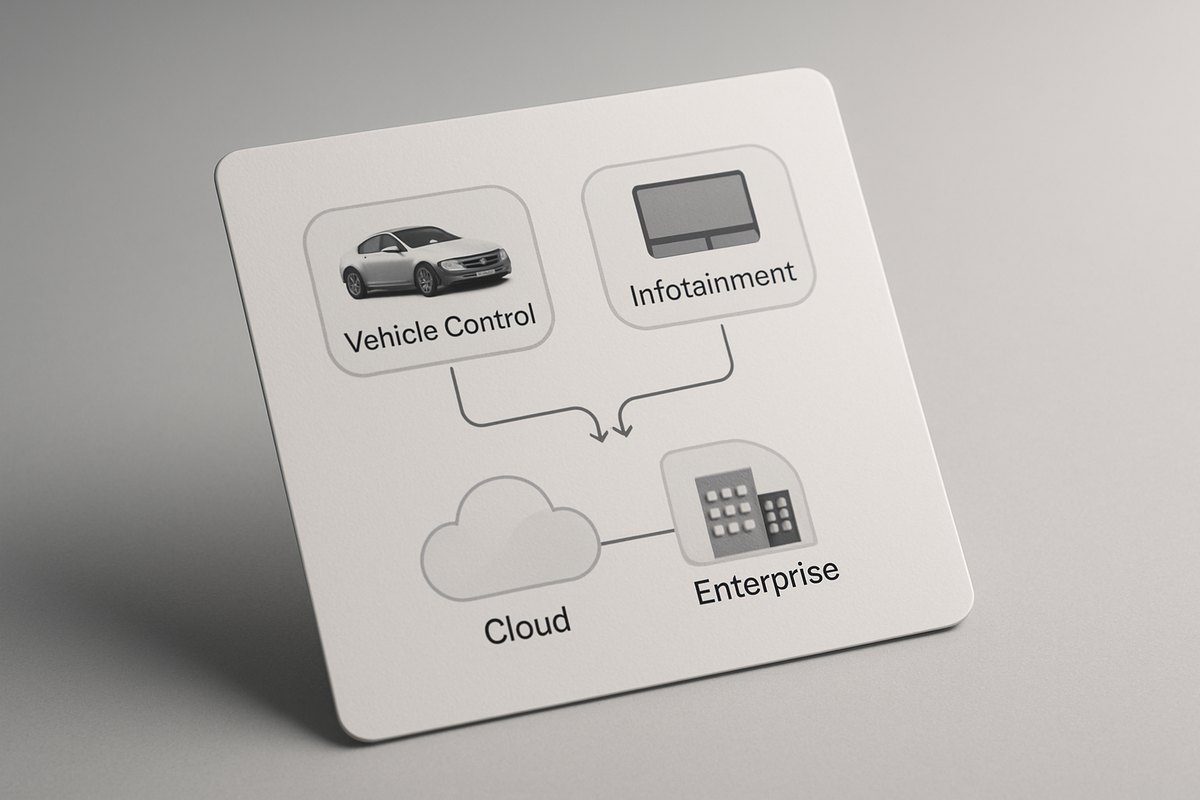
Treating an automotive product as "just another app" understates both the payoff and the discipline it requires. A well-classified program returns real advantages that generic enterprise software rarely offers, but it earns them through a different engineering model.
- Longer monetization window: a vehicle sold once can generate subscription, data, and feature revenue for a decade or more through OTA-delivered upgrades.
- Lower field-failure cost: traceable requirements and staged verification catch defects before they reach a fleet, where a recall or safety incident costs orders of magnitude more than a backend outage.
- Reusable safety and security evidence: a documented safety case and TARA can be reused and extended across model years and variants instead of rebuilt each release.
- Data products beyond the vehicle: telemetry pipelines built for OTA and diagnostics also feed predictive maintenance, insurance, and fleet-optimization products.
- Competitive differentiation through software-defined features: centralized compute and zonal architecture let manufacturers ship new capability without a hardware refresh cycle.
| Dimension | General enterprise software | Automotive software (vehicle-facing) |
|---|---|---|
| Lifecycle length | Typically 2–5 years before major rewrite | 10–15+ years of field support per vehicle program |
| Failure consequence | Business disruption, revenue loss, data exposure | Potentially safety, liability, and regulatory consequence |
| Update cadence | Continuous deployment, minutes to hours | Staged OTA campaigns with eligibility, rollback, and audit evidence |
| Hardware coupling | Loosely coupled to commodity servers or devices | Tightly coupled to ECUs, sensors, and vehicle variants |
| Certification burden | Framework-level compliance (SOC 2, ISO 27001, GDPR) | Functional safety and cybersecurity evidence (ISO 26262, ISO/SAE 21434), plus the above |
The two columns are not mutually exclusive: a connected-car cloud backend inherits most of the left column's engineering practices while still carrying obligations from the right column wherever it touches vehicle state or remote commands.
Which automotive standards apply?
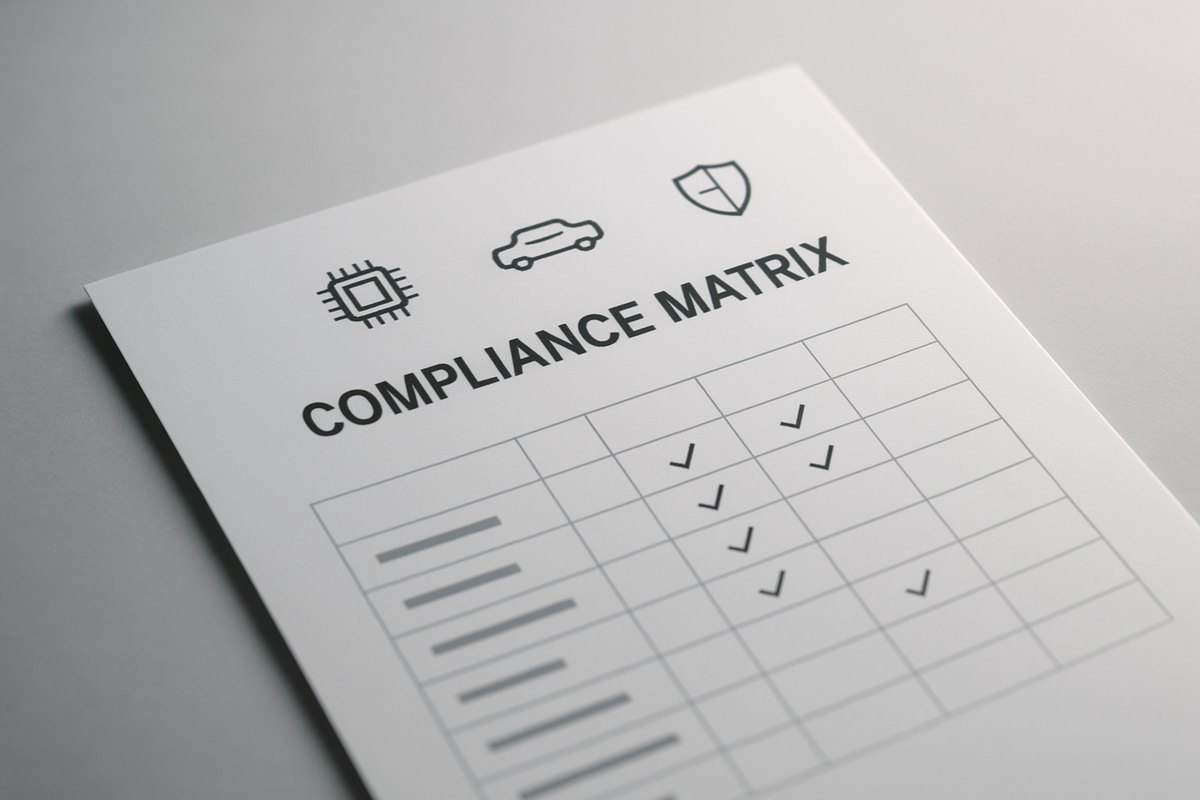
Standards are selected by scope, customer contract, market, vehicle type, function, and risk. Engage qualified safety, cybersecurity, regulatory, and homologation specialists for the actual program.
| Framework or regulation | Main purpose | Most relevant to | Not a substitute for |
|---|---|---|---|
| ISO 26262 | Functional safety of road-vehicle electrical/electronic systems | Safety-related in-vehicle functions and their lifecycle | Cybersecurity or proving intended-function performance |
| ISO/SAE 21434 | Cybersecurity risk management across the road-vehicle E/E lifecycle | Vehicle systems, components, interfaces, and related suppliers | General enterprise security or functional safety |
| Automotive SPICE | Assessing and improving system/software development process capability | OEM and supplier development processes | Product certification or a technical architecture |
| AUTOSAR | Standardized automotive software architecture and interfaces | Embedded ECUs and high-performance automotive computing where adopted | A safety or cybersecurity management system |
| ISO 24089 | Software update engineering | Vehicles, ECUs, infrastructure, and update packages | Market-specific update regulation or cybersecurity alone |
| UN R155 | Vehicle cybersecurity and cybersecurity management systems | Type approval in markets applying the regulation | ISO/SAE 21434 certification by itself |
| UN R156 | Software updates and software update management systems | Type approval and update governance in applying markets | A specific OTA technology |
| SAE J3016 | Taxonomy for levels of driving automation | Communicating the role allocation between driver and automation | Safety validation or an approval to deploy automation |
The current ISO 26262:2018 series provides a functional-safety framework for safety-related E/E systems. ISO/SAE 21434:2021 addresses automotive cybersecurity engineering across the vehicle E/E lifecycle. Automotive SPICE 4.0 is used by OEMs and suppliers to evaluate development process capability.
For updates, ISO 24089:2023 covers organizational and project-level software update engineering. UNECE publishes UN Regulation No. 155 for cybersecurity and UN Regulation No. 156 for software updates. Applicability to a US program can still arise through global vehicle platforms, target export markets, or OEM requirements even when the immediate launch is domestic.
Do these standards apply to dealership or manufacturing software?
Not automatically. A standalone dealer CRM is normally governed by enterprise security, privacy, financial, and contractual requirements — not ISO 26262. But an enterprise system that creates vehicle configuration, signs update artifacts, controls diagnostic access, or feeds a safety-related process may enter the evidence chain. Map the interface and consequence rather than assigning standards based on the word "automotive."
Software-defined vehicle architecture
A software-defined vehicle (SDV) moves differentiation and lifecycle value toward software, centralized compute, connectivity, data, and updateability. It does not mean every function moves to the cloud. Vehicle control must still satisfy timing, availability, safety, security, and offline requirements.
From distributed ECUs to domain and zonal designs
Traditional architectures distribute functions across many dedicated ECUs connected through vehicle networks. Domain architectures consolidate related functions such as body, cockpit, ADAS, or powertrain. Zonal architectures organize I/O around physical areas of the vehicle and connect zones to central high-performance computers.
Potential benefits include fewer duplicated components, clearer compute allocation, more flexible features, and easier lifecycle management. New risks include shared-resource interference, larger failure domains, network dependence, complex partitioning, and a broader cybersecurity blast radius.
Architecture teams should answer:
- Which function must execute when external connectivity is unavailable?
- What are its worst-case timing and startup constraints?
- What is the safe state after compute, sensor, network, or power failure?
- Which software and hardware share resources, and how are they isolated?
- Which component owns authoritative vehicle state?
- How will variants and dependencies be represented over the fleet lifetime?
- How will a field issue be detected, contained, corrected, and evidenced?
Vehicle, edge, cloud, and mobile boundaries
| Layer | Appropriate responsibilities | Avoid |
|---|---|---|
| Real-time ECU | Deterministic sensing/control, local diagnostics, safety mechanisms | Cloud-dependent control loops |
| Central/domain compute | Sensor fusion, cockpit, service orchestration, higher-level functions | Uncontrolled resource contention |
| Telematics/edge gateway | Secure external connectivity, protocol boundary, buffering, command mediation | Trusting cloud messages without vehicle-side checks |
| Cloud platform | Fleet identity, telemetry ingestion, campaign management, analytics, account services | Treating cloud state as more current than the vehicle |
| Mobile/web channel | Customer intent, status, consent, user communication | Direct authority over a vehicle function without server and vehicle enforcement |
Remote actions should be designed as distributed transactions. "Unlock vehicle" may require recent authentication, device and account risk checks, vehicle ownership authorization, rate limiting, command signing, replay prevention, vehicle state validation, expiration, acknowledgement, customer notification, and audit evidence. A timeout is not proof that the command failed; the product needs an unambiguous status model.

AUTOSAR Classic vs Adaptive Platform
AUTOSAR defines standardized automotive software platforms and methodology. It is relevant when required by the OEM architecture, ECU scope, suppliers, and reuse strategy — not because it is a fashionable stack.
AUTOSAR Classic Platform
The Classic Platform targets deeply embedded systems with a layered architecture and strong separation between application software, runtime environment, and basic software. It is commonly associated with resource-constrained ECUs and statically configured functions requiring predictable behavior.
AUTOSAR Adaptive Platform
The Adaptive Platform supports adaptive applications on higher-performance computing platforms. It is suitable for use cases needing dynamic deployment, service-oriented communication, and more powerful POSIX-based environments, subject to the program's safety and security architecture.
Classic and Adaptive can coexist. Neither automatically makes a system safe or secure. Teams still need risk analysis, correct configuration, verified implementations, controlled tooling, integration evidence, and operational governance.
Functional safety engineering
Functional safety addresses unreasonable risk caused by malfunctioning behavior of safety-related E/E systems. It begins before code and continues through production, operation, service, and decommissioning.
1. Item definition and hazard analysis
Define the item, environment, interfaces, dependencies, operating modes, and boundaries. Hazard analysis and risk assessment considers severity, exposure, and controllability to derive safety goals and Automotive Safety Integrity Levels (ASILs), where applicable.
2. Safety concept and requirements
Translate safety goals into functional and technical safety requirements. Allocate them to system elements and define mechanisms such as monitoring, plausibility checks, redundancy, degraded operation, fault containment, and safe states.
3. Architecture and dependent failure analysis
Show how the design meets the requirements under random hardware faults and systematic failures. Analyze shared resources, common causes, communication, power, timing, and freedom from interference where functions of different criticality coexist.
4. Implementation and verification
Apply coding, modeling, review, static analysis, unit verification, coverage, integration, and tool-qualification measures appropriate to the safety plan and ASIL. Independence requirements should be planned, not improvised near release.
5. Validation and safety case
Validate safety goals in the intended vehicle context. The safety case organizes claims, arguments, and evidence showing why the item is acceptably safe. It is not a folder of disconnected test reports.
Safety requirements must remain traceable to architecture, implementation, verification, anomalies, changes, and release configuration. When a requirement changes, the team needs reliable impact analysis across that chain.
SOTIF and intended-function risk
ISO 26262 focuses on malfunctioning behavior. Functions based on complex sensing or perception can also create hazards while operating as designed but facing limitations or triggering conditions. Safety of the Intended Functionality (SOTIF) analysis addresses that different problem. Projects involving ADAS or automated behavior should determine the applicable safety frameworks with specialists rather than forcing all risk into one standard. The intersection with computer vision software development is particularly significant for perception-based ADAS functions.
Automotive cybersecurity engineering
Connected vehicles combine long lifetimes, physical consequences, many suppliers, wireless interfaces, mobile and cloud accounts, service tools, and valuable data. Security must cover the full ecosystem.
The US National Highway Traffic Safety Administration's Cybersecurity Best Practices for the Safety of Modern Vehicles is non-binding guidance that emphasizes governance, risk management, secure development, monitoring, incident response, and collaboration.
Threat analysis and risk assessment
Identify assets, attack paths, damage scenarios, feasibility, impact, and treatment. Consider:
- cellular, Wi-Fi, Bluetooth, V2X, USB, diagnostic, and physical interfaces;
- compromised mobile accounts or backend services;
- malicious or vulnerable supplier components;
- debug and manufacturing access left enabled;
- update infrastructure and signing keys;
- vehicle network pivoting;
- privacy leakage through telemetry and location;
- denial of service and resource exhaustion;
- fleet-scale exploitation and unsafe recovery.
Defense in depth
- secure boot and verified software where appropriate;
- hardware-backed identity and protected key storage;
- signed artifacts and authenticated communication;
- least-privilege processes and network segmentation;
- gateway filtering and command allowlists;
- removal or control of debug interfaces;
- secret isolation from source code and build logs;
- rate limits, freshness, anti-replay, and state validation;
- secure diagnostics and service-tool authorization;
- tamper-aware logging and field telemetry;
- a vulnerability intake, triage, remediation, and coordinated disclosure process.
Backend security matters as much as ECU security. A perfectly hardened vehicle can still be exposed by broken object authorization in a cloud API that lets one user retrieve or command another user's vehicle.
Supply-chain security
Maintain a software bill of materials at useful granularity, record provenance, scan dependencies, control build environments, sign releases, and define vulnerability-notification duties in supplier contracts. Require enough evidence to assess a component, but avoid a document-only process that does not verify the delivered binary and configuration.

OTA updates and software configuration management
An OTA system manages vehicle eligibility, artifacts, campaigns, installation, evidence, and recovery. File transport is the smallest part.
Core OTA capabilities
- Configuration inventory: know the hardware, software, calibration, dependencies, and prior campaign state of each vehicle.
- Artifact pipeline: build reproducibly where required, scan, test, approve, sign, and preserve release evidence.
- Compatibility resolution: prevent invalid combinations across ECUs, variants, regions, and dependencies.
- Campaign targeting: select eligible vehicles, cohorts, windows, prerequisites, and rate of rollout.
- Secure delivery: encrypt where needed, authenticate endpoints, resist replay, and tolerate interrupted transfer.
- Safe installation: check power, connectivity, vehicle state, storage, and execution conditions.
- Recovery: support rollback, A/B partitions, retry, or service recovery as appropriate to the component.
- Observability: separate downloaded, verified, installed, activated, failed, recovered, and confirmed states.
- Customer and service communication: explain prerequisites, downtime, progress, failure, and support paths.
- Auditability: retain approvals, artifact hashes, signing identity, target logic, results, and exceptions.
Roll out in rings: internal assets, test fleets, small cohorts, then larger populations. Define automated stop conditions for failure rate, battery impact, performance, safety signals, connectivity cost, or support volume. A safe update service must also handle vehicles that remain offline for months.

Connected-car cloud and mobile development
Developing connected-car cloud services requires deep expertise in IoT software development — from device identity and telemetry pipelines to fleet-scale data management and secure remote command delivery.
Vehicle identity and digital ownership
A vehicle may have an owner, co-owner, driver, fleet manager, service technician, dealer, and temporary guest. Account deletion or resale should not leave access behind. Model roles, delegated permissions, consent, proof of ownership, transfer, revocation, and recovery explicitly.
Telemetry pipeline
Define which signals are collected, for what purpose, at what frequency, under which consent or lawful basis, and for how long. Buffer on the vehicle or edge when connectivity fails. Version schemas and units. Detect impossible values and clock problems. Separate raw operational streams from curated data products with documented lineage.
Remote commands
Commands need end-to-end authorization and a lifecycle: requested, accepted, delivered, evaluated, executed, rejected, expired, or unknown. Design UI wording for uncertainty. Never show "completed" merely because the cloud queued a message.
Mobile app engineering
Native iOS and Android can be preferable for deep Bluetooth, digital key, background, wallet, or platform-security integration. Cross-platform frameworks can work well for content, account, status, service, and commerce journeys if critical native integrations are isolated and tested. The decision should follow capability and lifecycle needs, not a universal rule. Experienced mobile app development teams understand these trade-offs and can advise on architecture for vehicle-companion apps specifically.
Test weak networks, switching accounts, shared vehicles, stale telemetry, clock drift, background restrictions, permission denial, app reinstall, device loss, and backend-version compatibility. The vehicle's supported lifetime will usually exceed the phone app's normal technology cycle.

Automotive software development process
Automotive programs can combine iterative software practices with a V-model assurance structure. "Agile versus V-model" is a false choice: teams can develop in increments while maintaining approved baselines, traceability, planned verification, and release evidence.
1. Classify the system and markets
Define users, vehicle interaction, potential harm, markets, vehicle programs, suppliers, and contractual standards. Decide whether the product is safety-related, cybersecurity-relevant, part of an update chain, or enterprise-only.
Outputs: context diagram, applicability matrix, preliminary risk class, stakeholder and market map.
2. Define outcomes and concept
Specify the user and business outcome, operational scenarios, misuse, degraded modes, constraints, and success metrics. For a vehicle function, include item definition and initial hazard and threat analysis.
Outputs: concept, scenarios, baseline metrics, high-level safety and cybersecurity goals.
3. Establish requirements and traceability
Decompose stakeholder needs into system, hardware, software, interface, safety, cybersecurity, privacy, performance, and operational requirements. Give each requirement an owner, rationale, verification method, and bidirectional links.
Outputs: baselined requirements, interface contracts, traceability model, verification plan.
4. Design the architecture
Allocate responsibilities across vehicle compute, gateways, cloud, mobile, and enterprise systems. Define timing, data, state, failure handling, variants, resources, security boundaries, update strategy, and observability.
Outputs: architecture views, decisions, safety/cyber concepts, resource budgets, supplier boundaries.
5. Build integrated increments
Implement thin vertical slices on target-representative environments. Automate build, analysis, unit and integration tests, artifact creation, provenance, and trace links. Keep generated code and configuration under control alongside handwritten code.
Outputs: reproducible increments, test results, software bill of materials, updated risk and anomaly records.
6. Integrate progressively
Move from virtual components and simulated networks to boards, ECUs, benches, vehicles, and connected backends. Validate assumptions about timing, resource contention, sensors, connectivity, power states, and third-party behavior.
Outputs: integration baselines, interface evidence, measured budgets, defect trends.
7. Verify, validate, and release
Complete the planned verification at every level, resolve or formally disposition anomalies, confirm configuration, audit evidence, rehearse deployment and recovery, and obtain authorized release decisions.
Outputs: verification report, safety/cyber evidence, release configuration, campaign or production approval.
8. Monitor and maintain in the field
Collect operational, quality, security, update, and support signals with appropriate privacy controls. Triage incidents, analyze fleet impact, issue updates, manage end-of-support, and feed lessons into the next release.
Outputs: field dashboards, incident records, vulnerability response, update campaigns, improvement backlog.
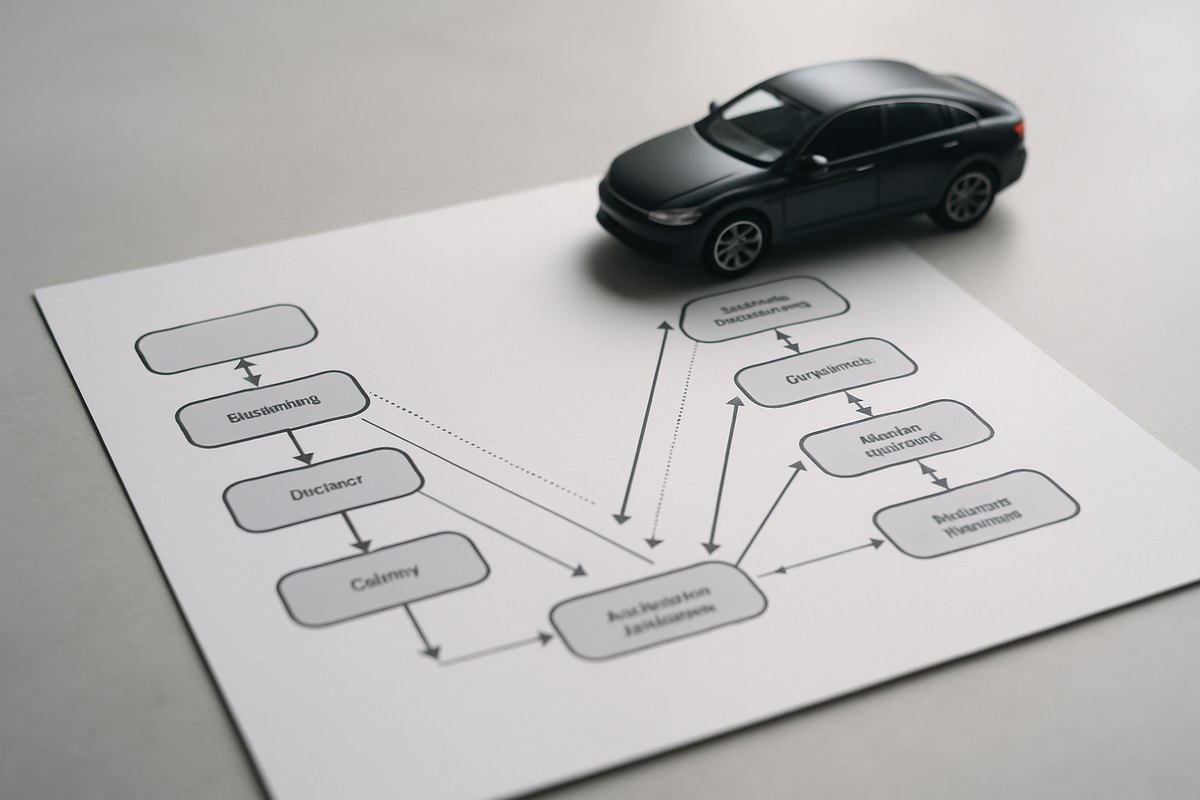
Verification ladder: from model to road
| Level | Purpose | Typical evidence |
|---|---|---|
| Static verification | Find defects without execution | Reviews, coding-rule results, static analysis, architecture checks |
| Unit / model testing | Verify isolated behavior and boundaries | Automated tests, coverage, model-in-the-loop results |
| Software integration | Verify components, middleware, timing, resources | Interface tests, fault injection, resource measurements |
| Software-in-the-loop (SIL) | Execute integrated software in a simulated environment | Scenario results, regression suites, performance evidence |
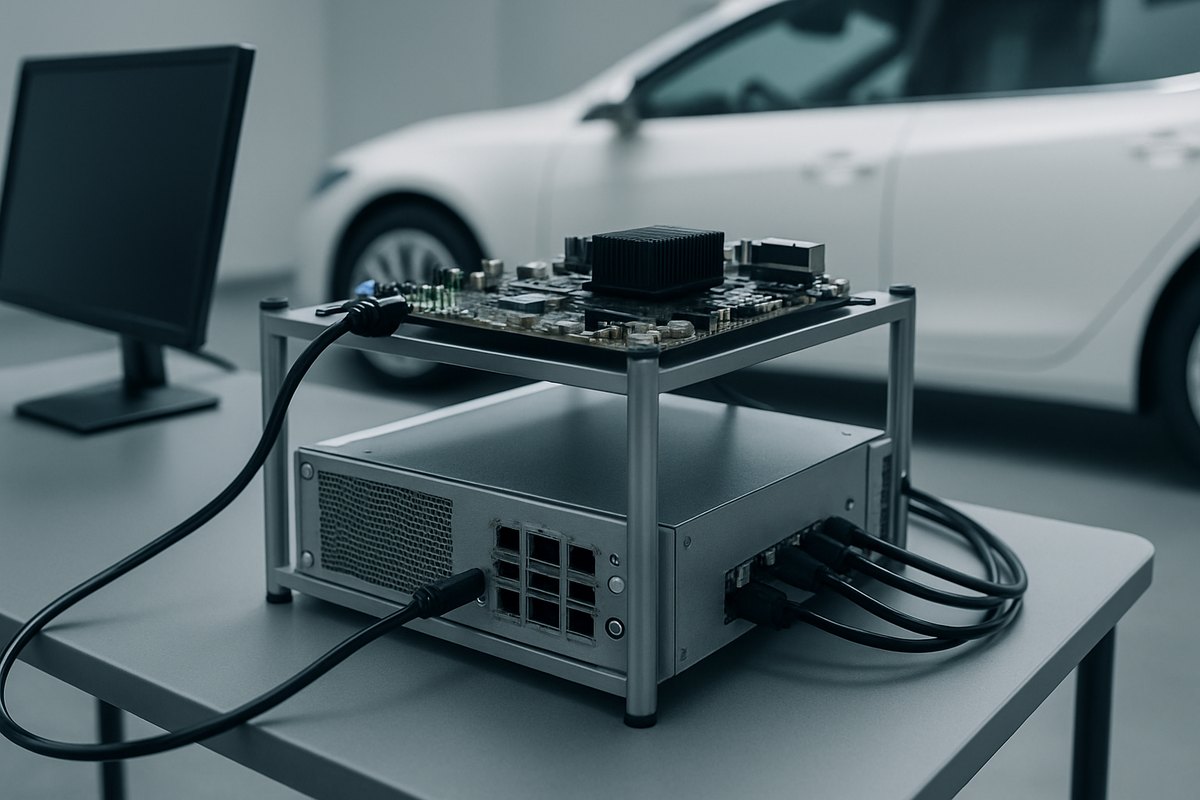
| Processor/board testing | Expose compiler, target, I/O, memory, and timing issues | Bench results, hardware interface tests |
| Hardware-in-the-loop (HIL) | Test ECU behavior against simulated plant and networks | Real-time scenarios, fault injection, timing and diagnostic results |
| Vehicle integration | Verify cross-ECU and real-environment behavior | Network, power-mode, thermal, EMC-related, usability, road/track evidence |
| Fleet / field validation | Observe diversity and lifecycle operation | Pilot metrics, update success, incidents, telemetry and support trends |
Not every enterprise product needs HIL. Not every safety-related function can rely on road testing to cover dangerous or rare scenarios. The verification strategy should maximize early, repeatable simulation and reserve physical validation for risks that require it.
Test cases often missed
- startup, shutdown, sleep, wake, low voltage, and interrupted power;
- delayed, duplicated, reordered, corrupted, or missing messages;
- stale cloud state and intermittent connectivity;
- resource exhaustion and priority inversion;
- incompatible software/calibration combinations;
- service and manufacturing modes;
- clock drift and certificate expiration;
- partial OTA installation and repeated recovery;
- vehicle resale, account transfer, and revoked access;
- supplier component downgrade or changed behavior.
Data, AI, and machine-learning systems
Automotive AI can support perception, driver monitoring, predictive maintenance, manufacturing inspection, personalization, voice, energy optimization, and development automation. Each use case has a different risk envelope.
For road-vehicle AI safety, ISO lists ISO/PAS 8800:2024 among relevant smart-system standards. Automotive SPICE 4.0 also includes process coverage for machine-learning engineering. Applicability and acceptance criteria must be determined within the actual safety and product context.
ML lifecycle controls
- define intended function, operational design domain, limitations, and fallback;
- establish dataset provenance, labeling rules, rights, representativeness, and versioning;
- separate training, validation, test, and challenge datasets;
- evaluate rare, adverse, and boundary conditions;
- trace model, code, configuration, hardware, and calibration versions;
- measure accuracy alongside safety-relevant failure modes;
- detect distribution shift and field performance degradation;
- protect models and pipelines from tampering and data poisoning;
- make rollback and safe degradation possible;
- retain evidence sufficient to reproduce an approved release.
Generative AI used in engineering can accelerate search, test generation, documentation, and code assistance, but generated output needs review under the same process as human-created work. Do not allow an unverified assistant to become the source of a requirement, safety argument, or security decision.
Automotive software trends shaping 2026 programs
These trends should inform architecture and vendor decisions today, not just future roadmaps — most already affect discovery-phase choices on new programs.
- Zonal architecture consolidation: more programs are moving from distributed ECUs toward zonal and central-compute designs to cut wiring, unify updates, and simplify variant management.
- OTA becomes standard below the premium tier: update infrastructure once reserved for flagship EVs is spreading to mainstream vehicles, raising expectations for eligibility, rollback, and audit evidence at scale.
- Widening regulatory scope: UN R155/R156 enforcement and evolving national cybersecurity guidance increasingly reach connected mobile and cloud components, not only in-vehicle ECUs.
- Simulation-first validation: digital twins and virtual ECUs are absorbing more of the verification ladder before hardware is available, shortening the path from SIL to HIL.
- AUTOSAR Adaptive adoption growing alongside Classic: higher-performance domain and zonal computers increasingly run Adaptive Platform services while Classic Platform continues to own deterministic control.
- Software-defined revenue models: manufacturers are formalizing subscription and one-time feature unlocks, which pushes entitlement, billing, and revocation logic into the same trust boundary as remote commands.
How long does automotive software development take?
| Scope | Typical elapsed time | Important dependencies |
|---|---|---|
| Discovery and feasibility | 4–10 weeks | System classification, interfaces, target hardware/data, standard applicability |
| Dealer, service, or automotive enterprise MVP | 4–7 months | ERP/DMS integration, migration, users, security, rollout |
| Connected-car cloud or companion-app MVP | 6–10 months | Vehicle APIs, identity, telemetry, commands, mobile platforms, test fleet |
| Production telematics or OTA capability | 12–24+ months | Vehicle programs, hardware, fleet configuration, security and validation |
| Safety-related in-vehicle function | 18–36+ months | Hardware cycle, ASIL, suppliers, integration, vehicle validation, production gates |
These ranges are for planning, not commitment. A mobile UI can be built quickly while access to a representative vehicle, ECU interface, test fleet, or supplier evidence controls the critical path.
Automotive software development cost
Early US-facing planning ranges vary by class:
| Scope | Illustrative planning range |
|---|---|
| Discovery, architecture, and prototype | $35,000–$100,000 |
| Automotive enterprise MVP | $150,000–$400,000 |
| Connected mobile and cloud product | $300,000–$900,000 |
| Production telematics or OTA platform | $800,000–$3 million+ across releases |
| Safety-related in-vehicle product | $1.5 million–$10 million+ depending on system boundary and vehicle program |
These are not quotes. A supplier may deliver one component within a larger OEM program, while a complete production function includes hardware, tools, licenses, benches, vehicles, safety and cybersecurity work, independent assessments, supplier management, cloud operations, and years of support.
Main cost drivers
- target hardware, variants, and vehicle programs;
- safety integrity and cybersecurity scope;
- number and maturity of suppliers and interfaces;
- simulation, benches, HIL capacity, test vehicles, and track access;
- AUTOSAR or proprietary platform integration;
- cloud scale, telemetry frequency, retention, and connectivity cost;
- mobile platforms, digital key, Bluetooth, and regional stores;
- OTA, signing infrastructure, configuration complexity, and recovery;
- traceability, tool qualification, assessment, and evidence requirements;
- production support, vulnerability response, and long vehicle lifetime.
Estimate by workstream and maturity gate. State assumptions about supplied hardware, interface specifications, reusable platform assets, test environments, safety/cyber responsibilities, and acceptance authority.
Team structure
Depending on scope, the team may include:
- product and program management;
- automotive system and software architects;
- safety manager and safety engineers;
- cybersecurity manager and TARA specialists;
- requirements and process engineers;
- embedded C/C++ and model-based developers;
- AUTOSAR and middleware specialists;
- cloud, data, backend, web, iOS, and Android engineers;
- HMI and UX designers with driver-distraction awareness;
- ML, perception, or computer-vision engineers;
- test automation, SIL, HIL, and vehicle-validation engineers;
- DevSecOps, build, release, and configuration engineers;
- homologation, privacy, legal, manufacturing, service, and support stakeholders.
Name the organization responsible for each safety requirement, cybersecurity goal, interface, artifact, test level, anomaly, and release decision. Supplier contracts should define evidence delivery and change notification, not only executable binaries.
How to choose an automotive software development company
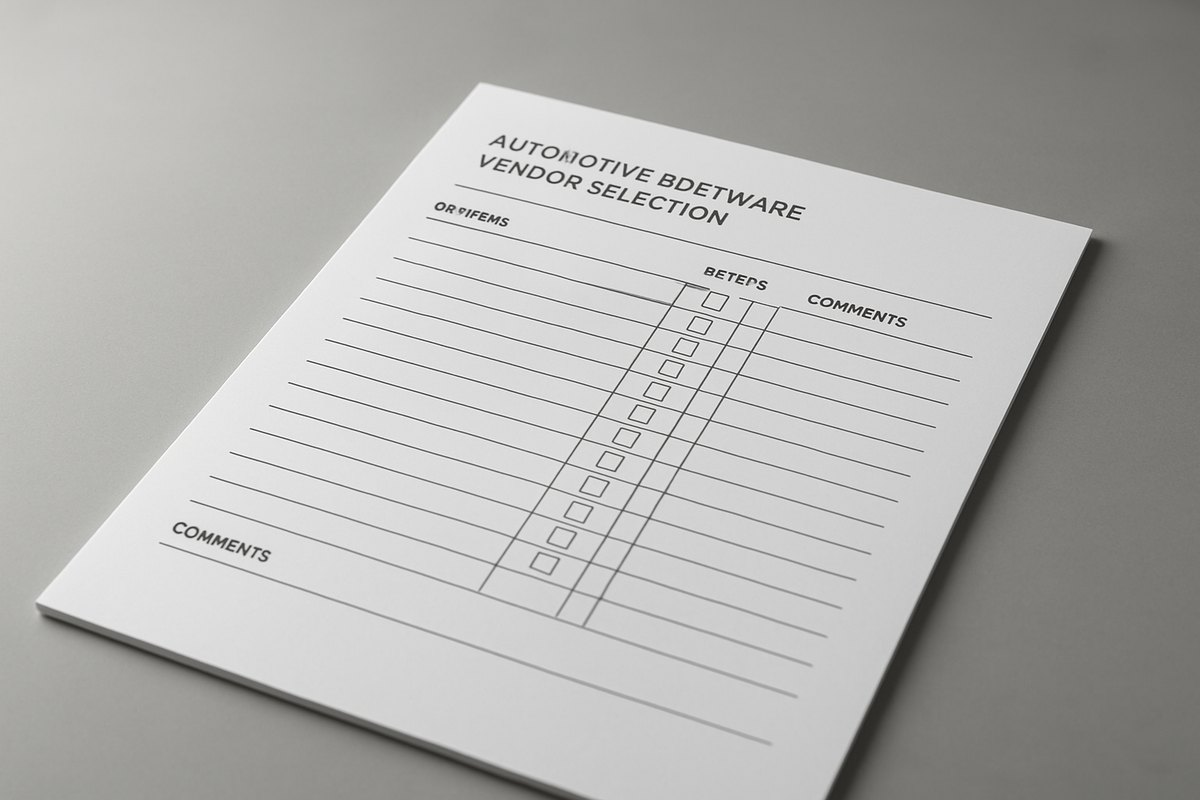
Vendor scorecard
| Criterion | Suggested weight | Evidence to request |
|---|---|---|
| Relevant system-class experience | 20% | Similar vehicle/cloud/mobile/enterprise boundary and production role |
| Safety and cybersecurity capability | 20% | Named leaders, plans, sample evidence, assessment history |
| Architecture and integration depth | 15% | Timing/resource design, vehicle protocols, cloud boundary, failure handling |
| Verification infrastructure | 15% | Automated test pyramid, SIL/HIL access, fault injection, traceability |
| Process and configuration management | 10% | ASPICE scope, baselines, change control, release reproducibility |
| Team quality and continuity | 10% | Proposed leads, interviews, availability, replacement and knowledge plan |
| Commercial and IP model | 5% | Background/foreground IP, tooling, licenses, source and artifact access |
| Field support and exit | 5% | Vulnerability response, update support, documentation, transition plan |
Red flags
- claiming compliance before completing applicability and scope analysis;
- treating a dealer portal and safety-related ECU as equivalent portfolio evidence;
- no named safety or cybersecurity leadership for high-risk work;
- proposing cloud connectivity for a control loop that must operate offline;
- no plan for traceability, configuration variants, or supplier changes;
- security limited to penetration testing at the end;
- OTA discussed without compatibility, signing, rollback, or field monitoring;
- demos only on desktop simulation with no target-hardware plan;
- an attractive fixed price that excludes integration, benches, vehicles, evidence, and production support;
- unclear ownership of source, models, calibration, build environment, keys, data, and test assets.
Use a paid feasibility phase to exercise the real interface and target environment. A useful pilot proves one risky vertical slice — such as vehicle-to-cloud telemetry, secure command handling, or target-board timing — not merely a polished UI.
KPIs for automotive software programs
Delivery and process
- requirements volatility and unresolved ambiguity;
- bidirectional traceability completeness;
- build reproducibility and pipeline pass rate;
- escaped defects by origin and detection level;
- change lead time and integration frequency;
- open anomaly age and release waivers.
Product and quality
- function success and false-positive/negative rates;
- startup time, latency, CPU, memory, storage, network, and energy budgets;
- crash, reset, degraded-mode, and recovery rates;
- telemetry freshness and command completion by state;
- app completion, support, and customer complaint metrics.
Safety and cybersecurity
- verification status by safety requirement and ASIL;
- safety mechanism coverage and fault-injection results;
- open cybersecurity risks and treatment age;
- vulnerability remediation by severity and fleet exposure;
- signing, authentication, and authorization failures;
- incident detection and containment time.
OTA and field
- eligibility accuracy;
- download, installation, activation, and confirmation rates;
- failure and recovery rates by hardware/software variant;
- campaign stop-trigger frequency;
- support contacts and vehicle immobilization;
- percentage of fleet on supported configurations.
A target such as "99% update success" is incomplete unless the denominator, eligible population, observation window, recovery definition, and unacceptable failure modes are clear.
Common reasons automotive software projects fail
- The system class is never agreed. Enterprise-speed expectations collide with vehicle-grade assurance late in the project.
- Standards become paperwork. Teams produce templates without connecting risks, requirements, architecture, tests, and release decisions.
- Hardware arrives too late. Timing, memory, networks, sensors, and power behavior invalidate desktop assumptions.
- Interfaces are treated as stable. OEM and supplier changes propagate without impact analysis or compatibility tests.
- Cloud and vehicle state diverge. The product presents stale status or cannot explain an uncertain remote command.
- Variants are unmanaged. Software, calibration, ECU hardware, region, and options create combinations the test plan does not represent.
- Security stops at the vehicle boundary. Backend, mobile account, manufacturing, diagnostics, and signing systems remain exposed.
- OTA has no recovery design. A lab success becomes a fleet incident under interrupted power or connectivity.
- Simulation and physical testing are unbalanced. Teams either test too little in reproducible simulation or discover physical integration too late.
- Release is the finish line. No owner or budget exists for field monitoring, vulnerabilities, updates, and end-of-support.
First 90 days of an automotive software project
Days 1–30: define the boundary
- classify the system and potential consequences;
- identify target vehicles, hardware, markets, users, and suppliers;
- map vehicle, cloud, mobile, and enterprise interfaces;
- complete preliminary standards applicability;
- define measurable product, safety, security, and quality outcomes;
- secure access to specifications, representative data, hardware, and test assets.
Days 31–60: attack the unknowns
- prototype the highest-risk interface on a representative environment;
- measure timing, resource, connectivity, and data assumptions;
- perform preliminary hazard and threat analyses where applicable;
- define architecture, configuration model, traceability, and verification ladder;
- identify supplier evidence and contractual gaps;
- compare platform, middleware, build, and test options.
Days 61–90: establish an executable baseline
- baseline the first vertical slice and its acceptance criteria;
- establish automated build, analysis, test, artifact, and provenance flow;
- agree safety, cybersecurity, quality, and release responsibilities;
- schedule SIL, bench, HIL, vehicle, cloud, and mobile environments;
- create the cost and timeline forecast with explicit assumptions;
- approve the next phase based on measured feasibility rather than presentation confidence.
Frequently asked questions
What is automotive software development?
Automotive software development is the engineering of embedded vehicle functions, infotainment, connected cloud and mobile services, diagnostics and OTA systems, and business applications used by manufacturers, dealers, service providers, fleets, and mobility companies. Required controls depend on the software's effect on vehicle safety, security, compliance, and operations.
Is all automotive software safety-critical?
No. Brake, steering, powertrain, battery, and certain driver-assistance functions may be safety-related. A dealer inventory portal normally is not. However, software outside the vehicle can become part of a safety or cybersecurity chain if it controls configurations, updates, diagnostics, or remote vehicle commands.
What programming languages are used in automotive software?
Embedded systems commonly use C, C++, model-generated code, and increasingly Rust in selected contexts. High-performance vehicle applications may use C++ and platform-specific technologies. Cloud and enterprise systems use languages such as Java, C#, Go, Python, JavaScript, and TypeScript; mobile apps commonly use Swift, Kotlin, or cross-platform frameworks. Language selection follows platform, timing, safety, tooling, and team constraints.
What is the difference between AUTOSAR Classic and Adaptive?
AUTOSAR Classic targets deeply embedded, statically configured ECU software with a layered architecture. AUTOSAR Adaptive supports service-oriented applications on higher-performance POSIX-based computing platforms. They can coexist in one vehicle and neither replaces safety or cybersecurity engineering.
How long does automotive software development take?
An automotive enterprise MVP may take four to seven months, while a connected cloud/mobile product often takes six to ten months. Production OTA, telematics, or safety-related in-vehicle functions usually require 12–36 months or more because hardware, suppliers, verification, vehicle integration, and production gates shape the schedule.
How much does custom automotive software cost?
An enterprise MVP may cost roughly $150,000–$400,000. A connected cloud/mobile product may range from $300,000–$900,000. Production telematics, OTA, or safety-related vehicle functions can range from high six figures to several million dollars, depending on scope, hardware, assurance, test assets, variants, and lifecycle support.
Can automotive teams use Agile development?
Yes. Teams can plan and build in short increments while maintaining baselined requirements, traceability, risk controls, configuration management, verification, and formal release gates. Agile delivery does not mean eliminating the evidence needed for safety, cybersecurity, quality, or supplier acceptance.
What should an automotive software MVP include?
An MVP should prove the riskiest end-to-end behavior on representative hardware or interfaces. For a connected product, that may include real identity, vehicle telemetry, secure commands, mobile behavior, observability, and a test fleet. For an embedded function, it includes target execution, timing, fault handling, traceability, and an agreed verification subset — not just a simulation demo.
How do you select an automotive software development partner?
Match the vendor's evidence to the system class. Review relevant production work, named safety and cybersecurity leaders, architecture depth, target-hardware and SIL/HIL capability, process evidence, configuration control, supplier management, field support, and IP terms. Start with a feasibility phase that exercises a real high-risk interface.
What are the benefits of automotive software development over general enterprise software?
A well-classified automotive program returns a longer monetization window through OTA-delivered features, lower field-failure cost from traceable requirements and staged verification, reusable safety and cybersecurity evidence across model years, and data products built on the same telemetry pipeline used for diagnostics. It earns those advantages through a longer lifecycle, tighter hardware coupling, and heavier certification burden than typical enterprise software.
What automotive software trends should engineering leaders plan for in 2026?
Zonal architecture consolidation, OTA infrastructure spreading below the premium vehicle tier, widening regulatory scope under UN R155/R156, simulation-first validation using digital twins and virtual ECUs, growing AUTOSAR Adaptive adoption alongside Classic, and software-defined revenue models that push entitlement and billing logic into the same trust boundary as remote vehicle commands.
Start with the system boundary, not the technology list
Automotive software succeeds when product ambition, architecture, risk, and evidence agree. Classify the system, identify the vehicle-cloud-mobile boundaries, select standards by applicability, and prove the hardest interface early. That foundation makes schedules and budgets more credible — and prevents a polished prototype from hiding production risk.
Yusmp Group can support automotive companies and technology vendors through custom software development for connected cloud platforms, mobile applications, data products, enterprise systems, integrations, and carefully bounded vehicle-facing components. A useful first conversation should identify the target system class, vehicle or business interface, markets, standards, test assets, and measurable release outcome.
Last updated 26 August 2026. Timeline and cost figures are illustrative planning ranges, not quotes or commitments. Standards information reflects publicly available documentation as of the publication date; applicability to a specific program requires qualified specialist analysis. References to ISO, UNECE, SAE, AUTOSAR, and NHTSA documents link to the primary publishers.