Searching for the best software development company in Poland usually starts with a directory and ends with a spreadsheet of thirty names that all claim five stars, senior engineers and agile delivery. Poland is one of Europe’s most mature software markets, so there are many genuinely good vendors — and that is exactly why picking one is hard. This guide is written for CTOs, founders, VPs of engineering and procurement leads who need a defensible way to choose a Polish partner rather than another ranked list.
The best choice depends on what you are building. A fintech scale-up modernizing a core platform needs a different partner from a seed-stage startup shipping an MVP or a manufacturer extending an ERP. Whether you pick a Polish vendor or a broader custom software development company with Eastern European engineers, the same factors decide the outcome: domain experience, the seniority of the people who will really work on your product, delivery process, legal protection of your IP and the total cost of the engagement.
If you are still choosing a region, start with our ranking of the best country to outsource software development and our overview of software development companies in Europe; for a lower-cost EU alternative, see our guide to software development in Romania. This article goes deep on Poland: the 2026 market, rates, hubs, vendor types, a comparison with other destinations, an eight-step selection process with a weighted scorecard, the Polish legal details that belong in your contract, and the red flags that should remove a vendor from your list.
What makes the best software development company in Poland?
The best software development company in Poland is the one whose proven experience, team seniority and delivery model match your specific project, and whose contract fully protects your IP. Directory rankings measure review counts and marketing, not fit, so a vendor ranked first may be wrong for you while a vendor on page three is ideal.
In our experience of competing and partnering with Polish vendors, the companies that consistently deliver share seven traits:
- Relevant domain work. Case studies and references in your industry, such as fintech, healthtech, logistics or e-commerce, with problems similar to yours.
- Named, senior people. You meet the tech lead and engineers before signing, and the CVs match the people who join the project.
- A visible delivery process. Clear sprint rituals, a definition of done, code review, automated tests and CI/CD that they can show you, not only describe.
- Transparent pricing. Rate cards by role, an explanation of what is included and honest estimates with ranges and assumptions.
- Clean legal setup. Written IP assignments from every contributor, a GDPR data processing agreement and security practices that survive a due-diligence questionnaire.
- Stability. Low attrition, a bench to replace people quickly and a company that has been operating for years.
- Communication. Fluent English, proactive status reporting and a willingness to say no when a requirement is unrealistic.
Everything else in this guide is a way to test these seven traits before you commit money and roadmap time.
Poland’s software development market in 2026 at a glance
Poland’s software development market in 2026 is the largest in Central and Eastern Europe, with about 770,000 ICT specialists, tens of thousands of IT companies and a long track record of building products for global clients. The table summarizes the indicators buyers ask about most, with sources you can quote in a business case.
| Indicator | Value | Source |
|---|---|---|
| ICT specialists | ~770,000 (4.5% of total employment) | Polish Economic Institute, December 2025; Eurostat |
| Software developers | ~400,000–650,000 (estimates vary by definition) | Industry and directory estimates, 2026 |
| Largest hubs | Warsaw (90,000+), Kraków (80,000+), Wrocław (70,000+) developers | Techreviewer estimates, 2026 |
| IT market revenue | ~€30 billion (2025), growing about 6% a year | Industry estimates cited by Techreviewer |
| English proficiency | 15th of 116 countries, “high proficiency” band | EF English Proficiency Index |
| Time zone | CET, UTC+1 (winter) / UTC+2 (summer) | EU daylight-saving rules |
| Data protection | GDPR applies directly; enforced by UODO | Regulation (EU) 2016/679 |
| EU and Schengen membership | EU since 2004, Schengen since 2007 | European Commission |
Three trends define the 2026 market. First, demand has shifted from individual developers to cross-functional product teams with cloud, data and AI skills. Second, rates have stabilized after the rapid growth of 2021–2023, which makes Polish quotes more predictable than a few years ago. Third, Poland’s tech workforce has absorbed many engineers who relocated from neighboring countries, which has deepened the senior talent pool in Warsaw, Kraków and Wrocław.
Why do companies outsource software development to Poland?
Companies outsource software development to Poland because it combines EU legal certainty, a very large senior talent pool and Central European working hours at rates well below Germany, the UK or the US. Few destinations can staff a 30-person team with experienced engineers while keeping GDPR as home law.
- Talent scale. With about 770,000 ICT specialists, Poland can staff large and fast-growing teams that smaller markets cannot.
- Strong engineering education. Universities such as Warsaw University of Technology, AGH in Kraków and Wrocław University of Science and Technology produce tens of thousands of ICT graduates a year, and Polish programmers have a long record in international competitions; a widely cited 2016 HackerRank study ranked Polish developers third in the world.
- EU membership. Contracts, data protection and dispute resolution follow EU rules, so European buyers need no data-transfer tools and US buyers deal with a familiar legal framework.
- Time zone. Poland shares Central European Time with Berlin, Paris and Milan, giving full-day overlap with continental Europe and about three hours with the US East Coast.
- Product track record. Poland is home to companies such as CD Projekt, Allegro, Docplanner and Booksy, and global firms including Google, Microsoft, Intel and Samsung run engineering or R&D centers there.
- Cost. Senior Polish engineers typically bill €55–85 per hour through vendors, roughly 30–50% less than comparable contractors in Germany or the US.
- Working culture. Polish teams are used to Scrum, written specifications and direct feedback, which keeps onboarding short for Western product owners.
Where are the best software developers in Poland?
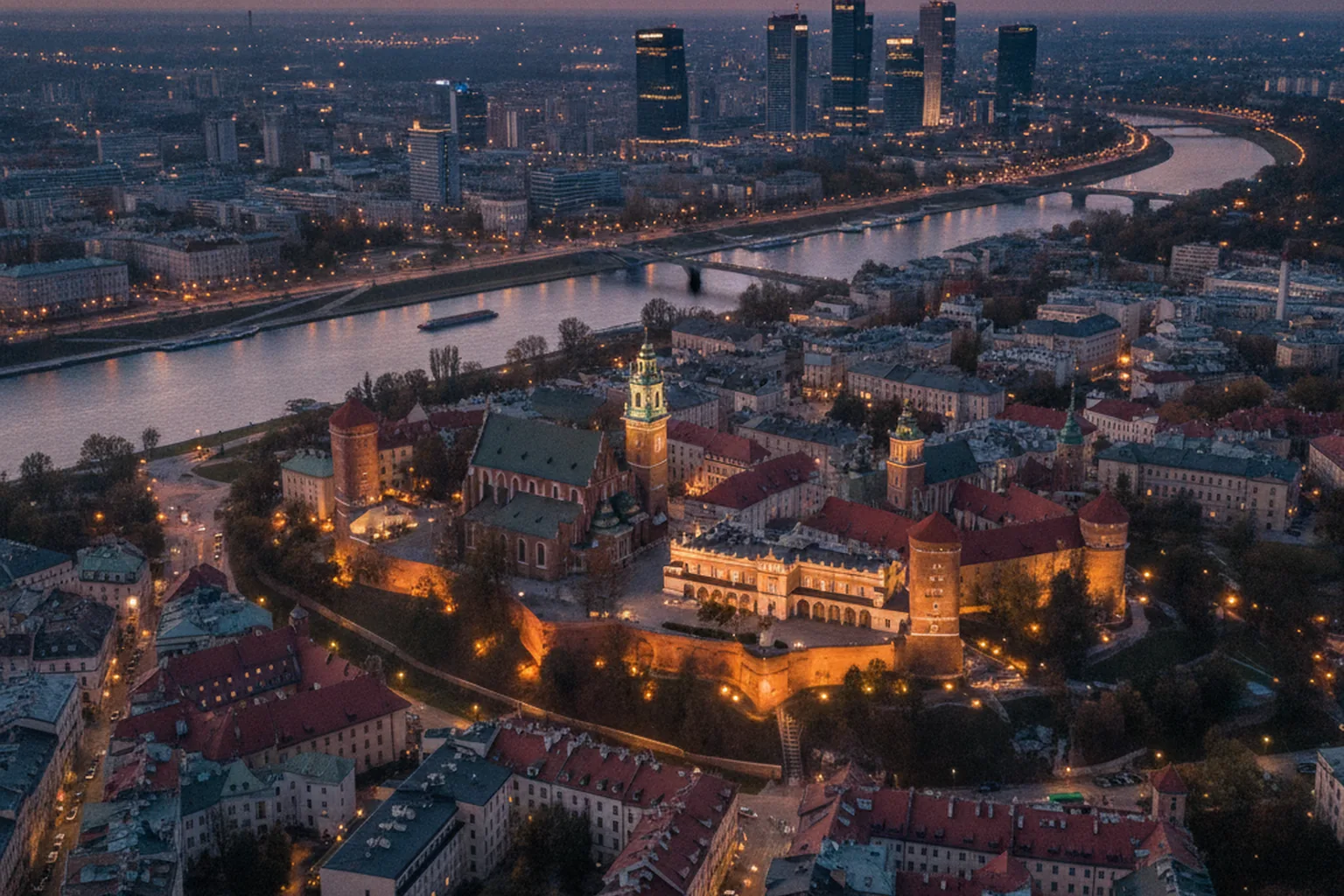
The best software developers in Poland are concentrated in seven cities, and the hub you hire in affects rates, specializations and how easy it is to scale. Warsaw, Kraków and Wrocław have the deepest senior pools and the highest prices, while Łódź, Lublin and Katowice often deliver similar seniority for less.
| City | Typical strengths | Cost tier |
|---|---|---|
| Warsaw | Largest pool (90,000+ developers); fintech, banking, insurance, gaming, enterprise IT, headquarters of many vendors | Highest |
| Kraków | About 80,000 developers; global R&D and shared-service centers, SaaS, enterprise Java and .NET, data | High |
| Wrocław | About 70,000 developers; product companies, embedded and automotive, medtech | High |
| Tricity (Gdańsk, Gdynia, Sopot) | Semiconductors and embedded, gaming, maritime and logistics software | Medium–high |
| Poznań | E-commerce, proptech and mid-size product studios | Medium |
| Katowice | About 30,000 developers; enterprise, industrial and energy software | Medium |
| Łódź and Lublin | Fast-growing secondary hubs; QA, web, mobile and support teams | Lower |
Developer counts are Techreviewer estimates for 2026. Many Polish vendors now hire remotely across the country, so ask where your team members will actually live: it affects pay expectations, attrition risk and how easily they can attend on-site workshops.
Strongest skill areas
Polish engineering is strongest where large international companies and local product champions have hired for decades. These are the areas where you are most likely to find senior people with production experience:
- Fintech and banking — core banking, payments, trading and regulatory reporting for EU banks and fintechs.
- Enterprise Java, .NET and C++ — large business systems, integrations and legacy modernization.
- Web and cloud — TypeScript, React, Node.js, Python and Go on AWS, Azure and Google Cloud.
- Mobile — native iOS and Android, React Native and Flutter.
- Gaming and graphics — a talent pool shaped by studios such as CD Projekt Red and Techland.
- Embedded and automotive — Wrocław, Kraków and Tricity host centers that build firmware and vehicle software.
- Data and AI — data engineering, analytics and machine learning, the fastest-growing and most expensive specialty.
Types of software development companies in Poland
Software development companies in Poland fall into five broad types, and choosing the right type narrows your shortlist faster than any ranking. Each type has a different sweet spot for project size, price and level of product ownership.
| Vendor type | Typical size | Best for | Watch-outs |
|---|---|---|---|
| Large IT services groups (for example Asseco, Comarch or Sii) | 1,000–10,000+ people | Enterprise programs, regulated industries, large staffing needs | Higher overhead, less senior attention for small accounts |
| Mid-size product studios | 50–500 people | Products, MVPs, platform rebuilds, long-term dedicated teams | Capacity limits for very large teams; check bench depth |
| Boutique specialists | 10–50 people | Narrow expertise such as a specific language, AI, security or design | Key-person risk, limited scaling |
| Global firms with Polish delivery centers | Polish office inside a larger group | Buyers who want a global contract with Polish engineering | You pay global overhead; confirm who actually staffs the team |
| Freelancers and micro-teams | 1–5 people | Small, well-specified tasks and short-term capacity | Continuity, security and IP risk sit with you |
For most product companies, the strongest candidates are mid-size product studios: big enough to replace people and scale, small enough that your project matters to senior management. Enterprises with strict procurement often need the stability of a large group, while a specialist boutique is the right answer when one technical skill decides success.
What about the “best agile software development company in Poland”?
Almost every Polish vendor describes itself as agile, so the label alone tells you nothing. Ask a vendor to show, not tell: an anonymized sprint report, a sample backlog with acceptance criteria, its definition of done, release frequency on a current project and how it handles a sprint that misses its goal. A genuinely agile company will answer with artifacts and numbers; a vendor that only uses the word will answer with slides. Our guide to offshore agile software development lists the rituals worth checking.
How much does software development in Poland cost?
Software development in Poland in 2026 typically costs €25–40 per hour for junior developers, €40–60 for mid-level and €55–85 for senior engineers when you hire through a vendor. Architects and AI or machine learning engineers usually cost €75–110 per hour, and Warsaw sits at the top of every range.
| Role | Typical vendor rate in Poland (2026) | Comparable German contractor (estimate) | Comparable US in-house, fully loaded (estimate) |
|---|---|---|---|
| Junior developer | €25–40/h | €45–60/h | $55–75/h |
| Mid-level developer | €40–60/h | €60–85/h | $75–100/h |
| Senior developer | €55–85/h | €85–120/h | $100–140/h |
| Tech lead / architect | €70–100/h | €110–150/h | $130–180/h |
| AI/ML and data engineer | €75–110/h | €100–150/h | $130–200/h |
Polish ranges are compiled from 2026 rate surveys by Techreviewer (which reports typical vendor rates of $50–99 per hour), Uvik and other public rate guides. Salaries explain the gap: Techreviewer reports gross monthly pay of about PLN 18,000–26,000 for senior developers in Warsaw on employment contracts, while many seniors earn more on B2B contracts. The German and US columns are YuSMP Group estimates that include benefits, payroll taxes, equipment and recruiting.
What drives Polish rates up or down?
Five factors explain most of the spread between Polish quotes. Knowing them helps you compare proposals that look very different at first glance.
- Seniority mix. Seniors cost about twice as much as juniors, so the composition of the team matters more than the headline rate.
- Technology. AI, data, security, blockchain and niche languages add 15–30% to the senior range.
- Vendor type. Large groups and global firms add overhead; freelancers are cheapest per hour but shift risk to you.
- Engagement model. Fixed-price projects include a risk premium of 10–25% compared with time and materials.
- City. Warsaw is the most expensive hub; Łódź, Lublin and Katowice are typically 5–15% cheaper.
Why the hourly rate is not the total cost
The total cost of working with a Polish software development company is usually 15–30% higher than rate × hours. Budget for these items before you compare Poland with other regions:
- Currency exposure. Engineers are paid in Polish złoty (PLN) while most contracts are in euros or dollars. Ask how rates are reviewed if the złoty moves sharply.
- Onboarding. Expect two to four weeks before a new engineer is fully productive on a complex codebase.
- Your own management time. Product ownership, architecture reviews and acceptance testing take internal hours that never appear on the invoice.
- Annual rate reviews. Many Polish vendors index rates once a year; agree on a cap in multi-year contracts.
- Attrition and replacement. Senior engineers in Warsaw and Kraków receive frequent offers, so contracts should set replacement timelines and knowledge-transfer rules.
- Travel and workshops. Poland is a short flight from most EU capitals, so quarterly planning sessions are cheap and noticeably improve results.
To see how these factors change by delivery model, read our comparison of offshore vs nearshore vs onshore cost, or estimate a budget with our custom software development cost guide.
Poland vs Romania, Ukraine, Germany and India
Poland is the premium option in Central and Eastern Europe: more expensive than Romania, Ukraine or India, much cheaper than Germany, and with the largest talent pool in the region. This compact comparison places Poland in context; our ranking of the best countries to outsource software development covers ten destinations in detail.
| Factor | Poland | Romania | Ukraine | Germany | India |
|---|---|---|---|---|---|
| Talent pool | Largest in CEE (~770,000 ICT specialists) | ~200,000 | Large, partly relocated | Large but very tight market | Very large |
| Typical senior vendor rate | €55–85/h | €50–75/h | $35–55/h | €85–120/h | $25–45/h |
| EU membership and GDPR as home law | Yes | Yes | No (candidate) | Yes | No |
| Overlap with Central Europe | 9 h (same time zone) | 8 h | 8 h | 9 h | 4–5 h |
| Overlap with US East Coast | ~3 h | 2–3 h | 2–3 h | ~3 h | 0–2 h |
| Ability to staff 50+ engineers quickly | Strong | Moderate | Moderate | Weak | Strong |
| Main risk | Highest CEE rates, senior competition | Smaller pool, rising costs | Wartime continuity | Cost and talent shortage | Quality variance, attrition |
Rate ranges are compiled from Techreviewer, Uvik, Devico and Lemon.io 2026 data and vary widely by vendor. In practice, buyers choose Poland when they need EU legal protection plus scale or deep senior expertise, and they choose Romania or another destination when the budget matters more than team size.
Time-zone overlap with US and European teams
Poland’s time zone suits European teams perfectly and US East Coast teams partly. A 9:00–17:00 Polish workday overlaps fully with Berlin, Paris and Milan, by seven to eight hours with London, and by about three hours with New York (Poland is six hours ahead for most of the year). Many Polish vendors offer a shifted 10:00–19:00 schedule that raises overlap with New York to four or five hours. For US West Coast teams, overlap is close to zero, so Poland works best for well-specified workstreams with written handoffs.
How to choose a software development company in Poland in 8 steps
The safest way to choose a software development company in Poland is a structured process that tests vendors on real work before you sign a large contract. These eight steps take most companies four to eight weeks from the first call to a running team.

- Write a one-page brief. Describe goals, first-release scope, stack, required skills, team size, budget range, timeline and preferred engagement model. A short brief makes vendor answers comparable; our software development RFP template helps for larger programs.
- Build a long list from several sources. Combine review platforms such as Clutch, GoodFirms and Techreviewer with referrals from peers, conference speakers and the authors of open-source projects you use. Directories rank partly by paid placement, so treat them as a starting point.
- Verify the company. Check the vendor in the National Court Register (KRS) for its legal form, registration date and board members, confirm its EU VAT number in the VIES system and, for larger contracts, review its published financial statements. A vendor registered two years ago with a decade of claimed history deserves questions.
- Shortlist three to five by fit. Keep vendors with proven projects in your domain, the stack you need, clients in your country and a team size that fits yours. Remove anyone who cannot show relevant work.
- Interview the real team. Meet the tech lead, engineers and delivery manager who will work on your product, not only sales staff. Ask for a short written technical proposal to see how they reason and document decisions.
- Score proposals consistently. Use the weighted scorecard in the next section so price does not crowd out quality, and so several stakeholders can rate vendors independently.
- Run a paid pilot. A two- to four-week pilot on a real, contained task reveals code quality, testing habits, velocity and how the team handles feedback better than any interview. Pay for it; free pilots attract the wrong behavior.
- Negotiate the contract and governance. Agree on IP assignment, a GDPR data processing agreement, security requirements, replacement SLAs, rate caps, overlap hours, KPIs and an exit and handover plan before the first sprint.
The same steps apply to any region; our guide on how to choose a software development company expands each step with interview questions, and our software development contract guide lists the clauses that matter most.
A weighted scorecard for comparing Polish vendors
A weighted scorecard is the most reliable way to compare software development companies in Poland, because it forces you to rate fit, quality and risk explicitly instead of defaulting to the lowest rate. Rate each vendor from 1 to 5 on every criterion, multiply by the weight and compare the totals.
| Criterion | Weight | What a 5 looks like |
|---|---|---|
| Domain and technical fit | 20% | Several comparable projects in your industry and stack, with references you can call |
| Team seniority and stability | 20% | Named seniors in the proposal, attrition under 15% a year, a bench for replacements |
| Delivery process and quality | 15% | Visible CI/CD, automated tests, code review, clear definition of done, strong pilot results |
| Communication and overlap | 10% | Fluent English, proactive reporting, agreed overlap hours and escalation path |
| Security and compliance | 10% | Documented security practices, GDPR DPA, ISO 27001 or SOC 2 evidence where relevant |
| Legal and IP terms | 10% | Written IP assignments from all contributors, fair liability, clean exit clause |
| Total cost of engagement | 15% | Transparent rate card, realistic estimate with assumptions, rate cap for multi-year work |
Adjust the weights to your situation: a regulated healthtech or fintech project should raise security and compliance to 15–20%, while a fast MVP can weight speed of staffing and product thinking higher. What matters is that every stakeholder scores against the same criteria before price is discussed.
Legal, tax and compliance checklist for working with a Polish vendor
Working with a Polish software development company is legally straightforward because EU law applies directly, but Polish copyright law has two formal requirements that foreign buyers often miss. Review data protection, IP ownership, how developers are engaged and invoicing in every contract.

GDPR and data transfers
If your company is in the EU or EEA, you need only a data processing agreement to work with a Polish vendor, not a transfer mechanism. Poland applies the GDPR directly, and its supervisory authority is the Personal Data Protection Office (UODO). The contract should define the vendor as a processor under Article 28, set security measures, list sub-processors and give you audit rights.
US companies receiving EU personal data from a Polish vendor need a transfer basis, such as certification under the EU-US Data Privacy Framework or the European Commission’s standard contractual clauses. US companies selling into Europe should also review the GDPR obligations for US companies selling in the EU.
IP ownership under the Polish Copyright Act
You own the code only if your contract says so and every contributor in the chain has validly transferred their rights. Under Article 74 of the Polish Act on Copyright and Related Rights of 4 February 1994, economic rights to a computer program created by an employee within their duties belong to the employer unless agreed otherwise. Rights created by B2B contractors do not pass automatically: under Article 53 the transfer must be made in writing, and under Article 41 it covers only the fields of exploitation that the contract expressly lists.
- Require an explicit, worldwide transfer of all economic rights to deliverables, including source code, documentation and designs, that lists the fields of exploitation in detail.
- Require the vendor to hold matching written transfers from every employee and B2B contractor who touches your code.
- Cover derivative rights so you can modify and extend the software without asking the original authors.
- Keep repositories, cloud accounts and CI/CD under your organization from day one; the vendor gets access, not ownership.
- List open-source components and licenses, and exclude copyleft licenses you cannot accept.
- Add confidentiality, non-solicitation and a clear exit and handover clause.
Confirm the final wording with Polish counsel; the field-of-exploitation rule is the clause most often missing from contracts drafted under US or UK templates.
B2B contracts and how Polish developers are engaged
A large share of Polish senior developers work on B2B contracts as self-employed businesses rather than as employees. This is legal and common because it lowers their tax and social-security burden, for example through the 12% lump-sum tax available for many IT services or the 5% IP Box rate on qualifying income from software. For you, it has two consequences: IP transfers must flow through each contractor’s agreement, and the risk that a contractor is requalified as an employee should sit with the vendor, not with you.
VAT, invoicing and e-invoicing
For a foreign business client, software services from a Polish vendor are usually invoiced without Polish VAT. Inside the EU, B2B services fall under the reverse-charge mechanism, so you account for VAT in your own country; for US clients, the place of supply is outside the EU. Poland’s standard VAT rate of 23% matters only for domestic sales. Since 2026 Poland has also been phasing in mandatory structured e-invoicing through the national KSeF system for domestic transactions, so ask your vendor which invoice format you will receive. This is not tax advice; confirm details with your adviser.
Red flags and common mistakes when choosing a Polish vendor
Most failed engagements with Polish vendors trace back to buyer decisions made during selection, not to weak engineering. Watch for these red flags and mistakes:
- Choosing from a directory’s top three. Rankings reward review volume and sponsorship. Use them for discovery, then score vendors yourself.
- A bait-and-switch team. Seniors appear in the pitch and juniors join the project. Name key people in the contract and approve replacements.
- No written IP transfer with fields of exploitation. Without it, rights from B2B contractors may never reach you. Require transfers down the whole chain.
- Estimates without assumptions. A single fixed number for a vague scope usually becomes change requests later. Ask for ranges and listed assumptions.
- Ignoring the Polish holiday calendar. Poland has 14 public holidays, including Easter Monday, 3 May, Corpus Christi, 15 August, 1 and 11 November and, since 2025, Christmas Eve. Put them in your release plan.
- Judging by hourly rate alone. The cheapest proposal often means the most junior team and the highest attrition. Compare total cost and pilot results.
- One engineer owning a critical module. In a market where seniors receive many offers, require pairing, documentation and shared code ownership.
Is software development in Poland right for your project?
Software development in Poland is right for your project if you need an EU-based team that can scale, with strong senior engineers and Central European working hours, and you are willing to pay the highest rates in Central and Eastern Europe for that depth. It is a weaker fit if the lowest possible rate is your main goal or your team works on US Pacific time.
| Scenario | Fit for Poland | Why |
|---|---|---|
| EU product handling personal data | ✔ Strong | GDPR as home law, same time zone as most of the EU |
| Scaling a team to 30–100 engineers | ✔ Strong | Largest talent pool and many vendors with large benches |
| Fintech, banking or enterprise modernization | ✔ Strong | Deep experience from Warsaw’s financial sector and global R&D centers |
| US East Coast SaaS company | ✔ Good with a shifted schedule | About 3 hours of overlap, 4–5 with a shifted day |
| Budget-driven MVP | ✗ Mixed | Good quality but Romania, Latin America or Asia may be cheaper |
| US West Coast team needing daily pairing | ✖ Weak | Almost no shared hours; Latin America fits better |
Frequently asked questions
How do I find the best software development company in Poland?
There is no single best software development company in Poland; there is a best fit for your project. Shortlist three to five vendors with proven work in your domain and stack, verify them in the Polish National Court Register (KRS) and on review platforms, interview the engineers who will actually work on your product, score them on a weighted scorecard and run a paid two- to four-week pilot before you sign a long contract.
How much does software development in Poland cost in 2026?
Based on 2026 rate data compiled from Techreviewer, Uvik and other rate surveys, Polish vendors typically charge about €25 to €40 per hour for junior developers, €40 to €60 for mid-level and €55 to €85 for senior engineers. Architects and AI or machine learning specialists usually cost €75 to €110 per hour. Warsaw and Kraków sit at the top of these ranges, and secondary cities such as Łódź or Lublin are usually 5 to 15 percent cheaper.
How many software developers are there in Poland?
Poland has the largest tech workforce in Central and Eastern Europe. The Polish Economic Institute estimated about 770,000 ICT specialists in December 2025, equal to 4.5 percent of total employment, and directory surveys estimate that roughly 400,000 to 650,000 of them work as software developers. Warsaw, Kraków and Wrocław each host tens of thousands of engineers.
Is Poland a good location for outsourcing software development?
Yes, especially for EU companies and for US companies with European customers. Poland combines EU membership and GDPR as home law, Central European Time with eight to nine hours of overlap with Western Europe, strong English, a deep senior talent pool and rates roughly 30 to 50 percent below Germany or the US. The trade-offs are the highest rates in Central and Eastern Europe and only about three shared hours with the US East Coast.
Who owns the code when I work with a Polish software development company?
Ownership depends on your contract. Under Article 74 of the Polish Copyright Act of 1994, economic rights to a computer program created by an employee within their duties belong to the employer unless agreed otherwise. Many Polish developers work on B2B contracts instead, and their rights pass only through a written assignment that lists the fields of exploitation, so require assignments from every contributor and confirm the wording with Polish counsel.
What is the best agile software development company in Poland for a startup?
For a startup, the best agile software development company in Poland is usually a mid-size product studio of 50 to 300 people that runs Scrum or Kanban with a cross-functional team, has shipped MVPs in your domain and lets you speak directly with the product owner and tech lead. Ask for sprint reports from a past project, a sample backlog and references from founders, and start with a short discovery phase or pilot.
Is Poland better than Romania or Ukraine for software development outsourcing?
It depends on scale and budget. Poland has the largest talent pool and the most vendors able to staff teams of 50 or more engineers, but it is usually 10 to 20 percent more expensive than Romania. Ukraine has strong engineers and lower rates but sits outside the EU and carries wartime continuity risk. Many buyers shortlist vendors in two of these countries and decide after a paid pilot.
Published 21 October 2026. Sources: Polish Economic Institute (PIE), ICT specialists estimate (December 2025); Eurostat, ICT specialists in employment; Techreviewer, software development market in Poland (2026: hub developer counts, salaries, vendor rates, market revenue); EF English Proficiency Index; HackerRank developer ranking (2016); Uvik developer rates by country (2026); Devico and Lemon.io rate data (2026); Act on Copyright and Related Rights of 4 February 1994 (Articles 41, 53 and 74); Regulation (EU) 2016/679 (GDPR). German and US cost ranges are YuSMP Group estimates. Company names are examples of vendor categories, not endorsements or rankings. This article is not legal or tax advice.