
Searching for software development companies in Europe returns thousands of agencies, ranking lists written by the agencies themselves and rate tables that rarely agree with each other. Behind the noise is a real opportunity: Europe has one of the largest and best-educated engineering workforces in the world, strong data-protection practice and time zones that work for both US and EU product teams.
The hard part is not finding a software development company in Europe but choosing the right one for your project, budget and risk profile. A ten-person boutique in Lisbon, a 1,500-engineer firm in Kraków and a Munich consultancy can all claim to be “the best”, and all three can be right for different buyers. Many teams therefore start with a European custom software development company that can show comparable products in production, a stable senior team and contracts that leave the code and accounts in the client’s hands.
This guide explains how the European market is structured, what each region and country is good at, what software development agencies in Europe charge in 2026 by role and project size, which engagement models they offer, which EU regulations they must handle for you, and how to shortlist, verify and test a vendor step by step. It is written for CTOs, founders, product owners and procurement teams in the US, UK and EU.
What are software development companies in Europe?
Software development companies in Europe are firms headquartered or delivering from European countries that design, build, test, integrate and maintain software for clients under service contracts. They range from global IT services groups with tens of thousands of engineers to boutique agencies of ten to fifty people, and most of them sell to clients outside their own country.
The European market is unusually broad because it combines two very different supply models. Western European firms in Germany, the UK, France, the Netherlands and the Nordics mostly serve their home markets at high rates, often with consultants on site. Central and Eastern European firms in Poland, Romania, the Czech Republic, Bulgaria, the Baltic states, Ukraine and the Western Balkans grew as export businesses: they work in English, sell to US, UK, DACH and Nordic clients and price below Western Europe while matching it on engineering quality.
How big is Europe’s software engineering talent pool?
Europe’s software engineering talent pool is large and still growing. In 2025, 10.45 million people worked as ICT specialists in the EU, 5.0% of all employment, and their number grew by 59.4% between 2015 and 2025 — more than six times faster than total employment (Eurostat, May 2026). The share varies sharply by country, from 8.9% in Sweden and 8.7% in Luxembourg to 2.7% in Romania and 2.5% in Greece, which is one reason why rates and availability differ so much across the continent. The EU’s Digital Decade target of 20 million ICT specialists by 2030 means demand will keep pressing on supply.
Why hire a software development company in Europe?
Companies hire software development companies in Europe for senior engineering talent at a lower total cost than US or Western European in-house teams, for working hours that overlap with both American and European business days, and for vendors that already operate under strict EU data-protection and security rules.
- Engineering depth. Strong technical universities, large computer science graduate cohorts and two decades of export delivery have produced many senior engineers in backend, cloud, data, mobile and embedded development.
- Cost efficiency without a quality trade-off. Central and Eastern European senior engineers typically cost 40–60% less than comparable US onshore staff once salaries, benefits, recruiting and churn are included.
- Time-zone fit. European teams share the full working day with EU and UK clients and two to five hours with the US East Coast, enough for daily stand-ups, reviews and decisions in real time.
- Regulatory maturity. EU vendors already work under GDPR, and many are adapting to NIS2, the Data Act and the EU AI Act — experience that is valuable when you sell into Europe yourself.
- English and cultural proximity. Several Central European and Nordic countries rank among the world’s strongest non-native English speakers, and business culture is direct and process-oriented.
- Legal predictability. EU and EEA companies operate under familiar contract, IP and company law, with public business registers and VAT systems that make due diligence straightforward.
If you are still deciding between in-house, onshore and offshore delivery, our comparison of offshore vs nearshore vs onshore cost puts these advantages into numbers.
Europe vs Latin America vs Asia: how do European vendors compare?
European software development companies sit between Latin America and Asia on price and lead both on data-protection maturity for EU-facing products. Latin America wins on working-hour overlap with the US, Asia wins on the lowest rates and the largest scale, and Europe wins when you need EU regulatory experience, full overlap with European stakeholders or senior engineering at a mid-range price.
| Factor | Europe (CEE and South) | Latin America | South and Southeast Asia |
|---|---|---|---|
| Senior rate (2026) | $35–$85/hr | $40–$75/hr | $20–$45/hr |
| Overlap with US East | 1–5 h | 6–8 h | 0–2 h |
| Overlap with EU | Full | 2–5 h | 3–5 h |
| GDPR position for EU personal data | Inside the EU, no transfer mechanism needed (non-EU Balkans and Ukraine need SCCs) | Transfer safeguards needed except adequacy countries such as Argentina and Uruguay | Transfer safeguards needed except adequacy countries such as Japan and South Korea |
| Typical strengths | Senior backend, fintech, enterprise, embedded, security | US-facing product teams, mobile, web, startups | Scale, QA, maintenance, well-specified delivery |
| Main risk to manage | Rising rates in top hubs, limited US overlap from the east | Currency swings, uneven senior depth outside big hubs | Communication gaps, turnover, need for very clear specs |
Many buyers combine regions: a European core team for architecture and EU-facing work plus a Latin American or Asian team for extra capacity. That works when one vendor or one internal lead owns architecture, quality standards and the backlog for both.
European regions compared at a glance
Europe splits into four practical sourcing regions — Western Europe and the Nordics, Southern Europe, Central Europe and Eastern Europe including the Baltics and the Balkans — and each offers a different balance of rate, overlap with your team and regulatory profile.
| Region | Example countries | Senior rate (2026) | Overlap with US East | Best for |
|---|---|---|---|---|
| Western Europe, Nordics, UK | Germany, Netherlands, France, Sweden, Denmark, UK | $90–$160/hr | 2–5 h | On-site consulting, local regulatory knowledge, enterprise transformation |
| Southern Europe | Portugal, Spain, Italy, Greece | $50–$85/hr | 3–5 h | US-facing product teams, startups, design-led products |
| Central Europe | Poland, Czech Republic, Hungary, Slovakia | $40–$80/hr | 2–3 h | Enterprise and fintech platforms, large dedicated teams |
| Eastern Europe, Baltics, Balkans | Romania, Bulgaria, Estonia, Lithuania, Latvia, Ukraine, Serbia | $35–$80/hr | 1–2 h | Best value per senior engineer, fintech, cybersecurity, telecom |
Rates are typical ranges for senior engineers at established vendors in 2026 and include the vendor’s margin; individual quotes vary with stack, seniority and contract length. For a global comparison that adds Latin America and Asia, see our guide to the best country to outsource software development.
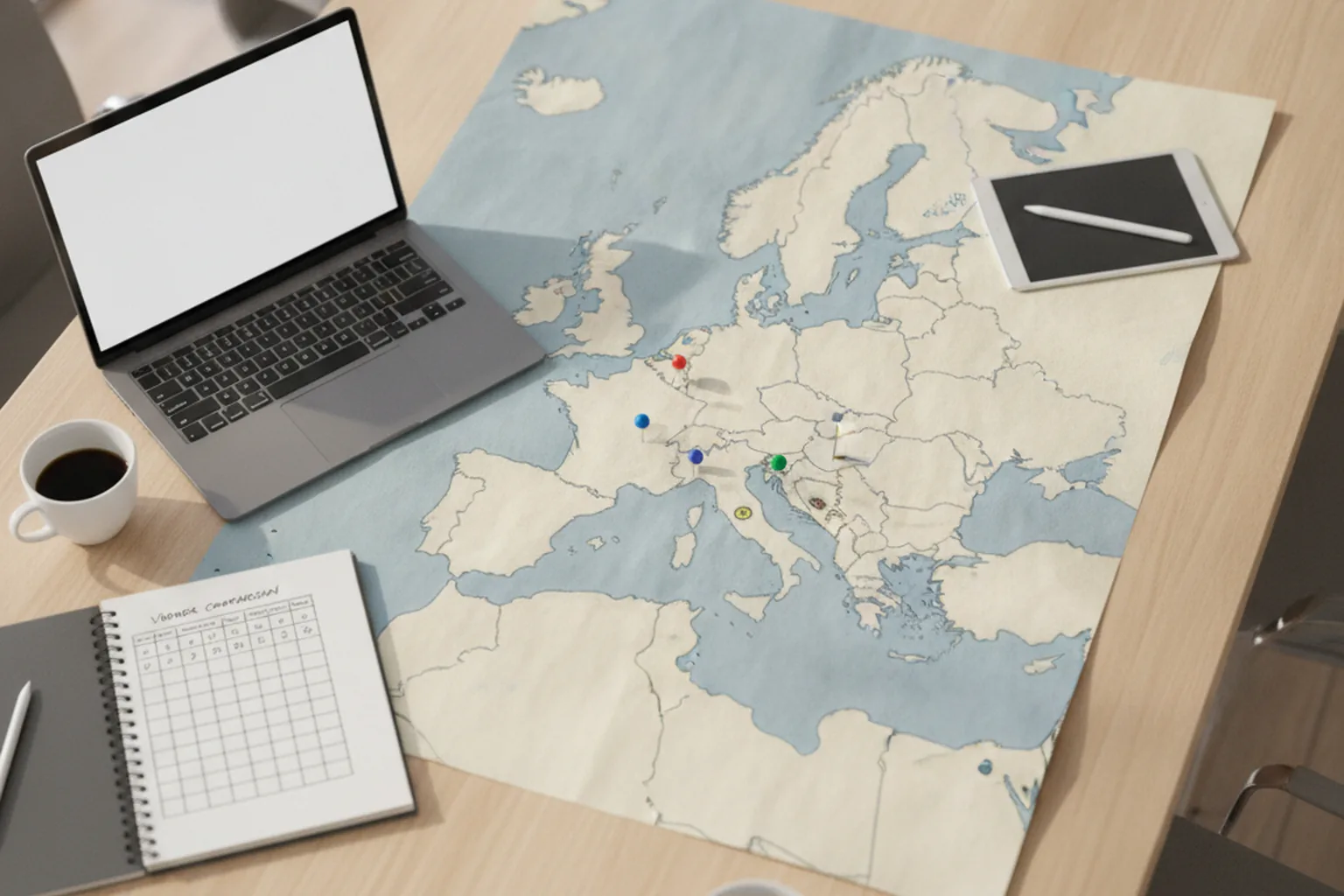
Which European countries have the strongest software development companies?
Poland, Romania, the Czech Republic, Bulgaria, the Baltic states, Ukraine, Portugal and Spain host the largest concentrations of export-oriented software development companies in Europe, while Germany, the Netherlands, the Nordics and the UK lead in high-end consulting and enterprise delivery for their home markets.
| Country | Senior rate (2026) | Time zone | EU / currency | Typical strengths |
|---|---|---|---|---|
| Poland | $45–$80/hr | CET (UTC+1) | EU / zloty | Largest CEE talent pool, fintech, enterprise, cloud, large teams |
| Romania | $40–$65/hr | EET (UTC+2) | EU / leu | Value for money, cybersecurity, telecom, automotive |
| Czech Republic | $45–$80/hr | CET | EU / koruna | Embedded and automotive, security, data engineering |
| Hungary | $40–$70/hr | CET | EU / forint | Automotive, enterprise systems, QA |
| Bulgaria | $35–$60/hr | EET | EU / euro since 2026 | Cost efficiency, enterprise Java and .NET, gaming |
| Estonia, Lithuania, Latvia | $45–$80/hr | EET | EU / euro | Fintech, e-government, startups, payments |
| Ukraine | $35–$60/hr | EET | Non-EU (candidate) / hryvnia | Deep senior talent, product engineering, R&D centers |
| Serbia and Western Balkans | $35–$60/hr | CET | Non-EU / dinar and others | Growing talent pool, competitive rates, gaming and fintech |
| Portugal and Spain | $50–$85/hr | WET / CET | EU / euro | Best US overlap, startups, product design, travel and retail tech |
| Germany, Netherlands, Nordics, UK | $90–$160/hr | GMT / CET | EU or UK / euro, krona, pound | Enterprise consulting, regulated industries, on-site work |
Poland
Poland has the largest pool of export-oriented software engineers in Central and Eastern Europe and is the default first stop for many US, UK and DACH buyers. Warsaw, Kraków, Wrocław, Gdańsk and Poznań each host dozens of mid-size engineering firms and the development centers of global banks and software vendors. Polish companies are particularly strong in fintech, enterprise platforms, cloud migration and large dedicated teams, and their rates sit at the upper end of the CEE range because demand is high.
Choose Poland if you need a team of 8–30 engineers, enterprise-grade process and EU contracting. Watch out for competition for senior talent in Warsaw and Kraków, which pushes rates up and makes key-person clauses important.
Romania
Romania offers one of the best value-to-quality ratios among EU members, with senior rates often 10–20% below Poland. Bucharest, Cluj-Napoca, Iași and Timișoara have strong technical universities, a long tradition in cybersecurity and telecom software and widespread English and French skills. The country’s low share of ICT specialists in total employment (2.7% in 2025) hides a concentrated, export-focused tech sector in these cities.
Choose Romania if you want EU membership and senior engineers at a lower rate than Poland, especially for security-sensitive or telecom work. Watch out for a smaller talent pool outside the four main cities and only one to two hours of overlap with the US East Coast in winter.
Czech Republic and Hungary
The Czech Republic and Hungary combine Central European time zones with deep industrial and automotive engineering traditions. Prague and Brno are known for security, embedded and data engineering, and Budapest for automotive software, enterprise systems and quality assurance. Both suit buyers that need engineering rigor and German-speaking or DACH-experienced teams.
Choose the Czech Republic or Hungary if your product is close to hardware, automotive or industrial systems, or if you sell mainly into Germany and Austria. Watch out for tight labor markets that make it harder to scale a team quickly beyond ten people.
Bulgaria
Bulgaria is among the most cost-efficient EU locations for software development, and its adoption of the euro on 1 January 2026 removed currency risk for eurozone clients. Sofia and Plovdiv have mature enterprise Java and .NET communities and a strong gaming and fintech scene.
The Baltic states
Estonia, Lithuania and Latvia are small markets with an outsized digital reputation. Estonia’s e-government and startup ecosystem, Lithuania’s fintech and payments licensing hub in Vilnius and Latvia’s growing engineering sector make the region a natural fit for payments, banking, identity and govtech products. Talent pools are smaller, so large teams take longer to assemble.
Choose the Baltic states if you build payments, banking, identity or public-sector software and value digital-first regulators and euro contracting. Watch out for senior rates close to Polish levels and limited capacity for very large teams.
Ukraine
Ukraine still has one of the deepest senior engineering talent pools in Europe and many vendors that have delivered without interruption since 2022 by distributing teams across cities and neighboring EU countries. Buyers should ask for written business continuity plans, backup staffing and contracting through an EU entity where data or insurance requirements demand it.
Serbia and the Western Balkans
Serbia, North Macedonia, Bosnia and Herzegovina and Montenegro are emerging sourcing locations with competitive rates and Central European working hours. Belgrade and Novi Sad host a fast-growing engineering community. Because these countries are outside the EU, transfers of EU personal data to them need GDPR transfer safeguards such as standard contractual clauses.
Portugal and Spain
Portugal and Spain give European delivery with the best working-hour overlap with the Americas: Lisbon and Porto are on UTC+0, five hours ahead of New York. Lisbon, Porto, Barcelona, Madrid, Valencia and Málaga have attracted product studios, startups and international engineering hubs, and their rates sit between Central Europe and Western Europe.
Choose Portugal or Spain if your product team is in the US or the UK and you want four to five hours of daily overlap with an EU vendor. Watch out for a smaller pool of export-oriented mid-size firms than in Central Europe, so compare more boutiques and studios.
Germany, the Netherlands, the Nordics and the UK
Western European software development companies are the right choice when you need consultants on site, deep local regulatory knowledge or a vendor that already sits on your corporate supplier list. They are also the most expensive, and many of them deliver part of the work through their own nearshore centers in Central and Eastern Europe — so ask where the engineers on your project will actually be located.
Types of software development companies in Europe
European software development companies fall into five practical types — global IT services groups, mid-size engineering firms, boutique agencies, product and design studios, and niche specialists — and the right type depends more on your project size and management capacity than on country.
| Type | Typical size | Strengths | Trade-offs | Best for |
|---|---|---|---|---|
| Global IT services groups | 5,000–50,000+ engineers | Scale, global delivery, enterprise procurement fit, broad certifications | Highest overhead, junior-heavy teams, slower decisions | Large transformation programs, multi-country rollouts |
| Mid-size engineering firms | 200–2,000 engineers | Senior teams, mature process, ISO 27001 or SOC 2, domain practices | Minimum team sizes, less flexibility for tiny scopes | Long-term dedicated teams, enterprise and fintech platforms |
| Boutique agencies | 10–200 people | Founder involvement, speed, close communication | Limited bench, key-person risk, fewer certifications | MVPs, startups, focused product streams |
| Product and design studios | 20–300 people | Discovery, UX and product strategy plus engineering | Higher rates, less suited to legacy integration | New digital products, consumer apps, redesigns |
| Niche specialists | 10–500 people | Deep expertise in one stack or domain (Salesforce, embedded, data, security) | Narrow scope, need another partner for the rest | Integrations, platform work, regulated components |
Freelance marketplaces and individual contractors are a sixth option, but for products that need continuity, security controls and accountability they rarely replace a company. Our general guide on how to choose a software development company covers how to weigh vendor size against project risk.
Which type of European company fits your scenario?
The right type of European software development company follows from your scenario: who manages the work, how fixed the scope is and how long the product will live. The matrix below matches the most common buying situations to the region and company type that usually fit them best.
| Your scenario | Company type | Region to start with | Engagement model |
|---|---|---|---|
| Startup needs an MVP in 3–6 months without an in-house team | Boutique agency or product studio | Portugal, Spain, Poland, Baltics | Fixed-price discovery, then time and materials |
| Scale-up needs 5–15 engineers for a growing product | Mid-size engineering firm | Poland, Romania, Czech Republic | Dedicated team |
| Existing team lacks 1–5 specialists (cloud, data, mobile) | Mid-size firm or niche specialist | Central and Eastern Europe | Staff augmentation or team extension |
| Enterprise modernizes a legacy platform | Mid-size firm or global IT services group | Poland, Czech Republic, Hungary, Romania | Dedicated team with milestone-based governance |
| Regulated product sold in the EU (fintech, health, energy) | Mid-size firm with domain practice and ISO 27001 | EU member states only | Dedicated team or time and materials with security exhibit |
| US product team needs maximum daily overlap | Boutique or mid-size firm | Portugal, Spain, Ireland | Dedicated team |
| Integration with Salesforce, SAP or another platform | Niche specialist | Any region with certified engineers | Fixed price per integration or time and materials |
How much do software development companies in Europe charge in 2026?
Software development companies in Europe charge about $90–$160 per hour for senior engineers in Western Europe, the Nordics and the UK, $50–$85 in Portugal and Spain and $35–$80 in Central and Eastern Europe in 2026; the region you choose changes the budget more than any other single decision.
| Role | Western Europe / UK | Southern Europe | Central & Eastern Europe |
|---|---|---|---|
| Junior developer | $50–$80/hr | $35–$50/hr | $25–$40/hr |
| Mid-level developer | $70–$110/hr | $45–$65/hr | $35–$55/hr |
| Senior developer | $90–$150/hr | $55–$85/hr | $45–$80/hr |
| Tech lead / architect | $110–$180/hr | $70–$100/hr | $60–$95/hr |
| QA engineer | $50–$90/hr | $35–$55/hr | $25–$50/hr |
| Project manager / business analyst | $70–$120/hr | $45–$70/hr | $35–$65/hr |
What does a typical project cost with a European vendor?
A typical project with a European software development company costs $60,000–$200,000 for an MVP, $200,000–$800,000 for a custom business platform and $800,000 or more for enterprise programs, with Central and Eastern European vendors at the lower end of each band. Integrations, compliance and the number of user roles move the price more than the number of screens.
| Project | Example | Typical cost with a European vendor (2026) | Timeline |
|---|---|---|---|
| MVP | Web or mobile app with core flows, one integration | $60,000–$200,000 | 3–6 months |
| Custom business platform | Customer portal, marketplace, internal ERP or CRM module | $200,000–$800,000 | 6–12 months |
| Enterprise program | Legacy modernization, multi-system integration, regulated platform | $800,000–$3,000,000+ | 12–24+ months |
| Dedicated team | 5–8 people, long-term product development | $35,000–$90,000 per month | Ongoing |
Why is the hourly rate not the real cost?
The hourly rate is not the real cost because productivity, rework, management time and turnover decide how much working software each euro buys. A senior team at $70 per hour that ships with few defects is cheaper than a junior-heavy team at $40 that needs twice the hours and constant supervision. Budget an extra 10–15% for your own product and vendor management, check whether rates include project management and QA, and remember that most Western European rates exclude VAT — for B2B services between EU countries the reverse-charge mechanism usually applies. For detailed budgets by project type, see our custom software development cost guide.
A simple total-cost model for comparing European vendors
The fairest way to compare European vendors is to estimate the total cost of delivering the same scope, not to compare rate cards. Add up four parts: the vendor’s hours multiplied by the blended rate, your own management time, onboarding and ramp-up, and expected rework and turnover.
| Cost element | Vendor A: Western Europe | Vendor B: Central Europe | Vendor C: low-cost bid |
|---|---|---|---|
| Blended rate | $120/hr | $60/hr | $35/hr |
| Estimated hours for the scope | 4,000 | 4,400 | 6,500 |
| Vendor cost | $480,000 | $264,000 | $227,500 |
| Your management time (10–20%) | $48,000 | $39,600 | $45,500 |
| Rework and turnover allowance | $24,000 | $26,400 | $68,250 |
| Total cost of delivery | $552,000 | $330,000 | $341,250 |
In this illustrative example the cheapest rate does not produce the cheapest project: more hours, heavier supervision and higher rework erase the rate advantage. Ask every shortlisted vendor to estimate the same scope with the same assumptions, and compare the totals together with the seniority of the proposed team.
Engagement models offered by European agencies
Software development agencies in Europe offer four main engagement models — dedicated teams, staff augmentation, fixed-price projects and time-and-materials projects — and a dedicated team or time-and-materials contract usually fits evolving products better than a fixed price.
| Model | How it works | Best for | Watch-outs |
|---|---|---|---|
| Dedicated team | A stable cross-functional team works only on your product; the vendor manages people and process | Long-term products, platforms, scale-ups | Needs a product owner on your side |
| Staff augmentation | Individual engineers join your in-house team under your management | Companies with strong engineering leadership | You carry delivery risk; check local labor-leasing rules |
| Fixed price | Defined scope, price and timeline | Small, stable scopes, prototypes, single integrations | Change requests are expensive; vendors add risk buffers |
| Time and materials | You pay for actual hours against a prioritized backlog | Products that will change with user feedback | Needs active backlog management and budget reviews |
One European detail matters for staff augmentation: several countries, Germany in particular, regulate labor leasing strictly, and integrating a vendor’s engineers into your own line management can create legal risk. A dedicated-team or project contract where the vendor directs its own people avoids most of it. Our comparison of time and materials vs fixed price vs dedicated team explains how to choose, and our dedicated development teams page shows how we staff long-term teams.
Which EU rules must a European software development company handle?
A European software development company must handle GDPR for any personal data it can access and, depending on your product, NIS2 supply-chain security, the EU Data Act, the Cyber Resilience Act and the EU AI Act; being based in the EU makes compliance easier but never automatic.

- GDPR. A vendor that can see or process personal data is a processor and needs an Article 28 data processing agreement, a list of approved subprocessors, appropriate security and breach notification duties. If your data stays inside the EU and EEA, no international transfer mechanism is needed; vendors in non-EU countries such as Serbia or Ukraine need standard contractual clauses and a transfer impact assessment.
- EU–US data flows. US companies that send EU personal data to US systems can rely on the EU–US Data Privacy Framework for certified recipients, which the EU General Court upheld in September 2025; standard contractual clauses remain the fallback.
- NIS2. Since the transposition deadline in October 2024, essential and important entities in sectors such as banking, health, energy, transport and digital infrastructure must manage supply-chain security — so their software vendors face security questionnaires, contractual controls and incident-reporting cooperation.
- EU Data Act. Applicable since 12 September 2025, it covers access to data from connected products and makes switching between cloud and data-processing services easier, which affects IoT and SaaS architecture.
- Cyber Resilience Act. Manufacturers of products with digital elements must report actively exploited vulnerabilities from 11 September 2026, and the full security requirements apply from 11 December 2027; vendors building such products need secure-by-design processes and SBOMs.
- EU AI Act. Prohibited practices apply since February 2025 and general-purpose AI obligations since August 2025, with most remaining obligations phasing in from August 2026; the timeline for some high-risk requirements is under review by EU lawmakers. Vendors that build AI features should document data, evaluation and human oversight.
For practical checklists, see our guides to GDPR for US founders selling to the EU and the EU AI Act checklist for SaaS.
Intellectual property under European law
Intellectual property needs explicit contract terms with a European vendor because copyright rules differ by country. In Germany and Austria, for example, copyright itself cannot be transferred, so contracts grant the client exclusive, unlimited and transferable rights of use instead; elsewhere a full assignment is possible. Make sure the contract covers source code, designs, documentation and pre-existing vendor components, and that repositories live in your own organization from the first commit. Our software development contract guide lists the clauses to negotiate.
Where to find software development companies in Europe
The most reliable places to find software development companies in Europe are peer referrals, independent B2B review platforms, national IT industry associations and the case studies of vendors that have solved a problem close to yours; paid ranking lists and agency-written “top 10” articles are a starting point at best.
- Peer referrals. CTOs, founders and investors in your network who have worked with a European vendor are the fastest source of honest feedback, including on what went wrong.
- B2B review platforms. Platforms such as Clutch, GoodFirms and G2 list verified client interviews, project sizes and rate bands; read the detailed reviews rather than the overall ranking, which vendors can influence through sponsorship.
- Industry associations. National IT and software associations in Poland, Romania, the Czech Republic, Bulgaria, the Baltic states, Portugal and other countries publish member directories and sector reports.
- Technology partner directories. Cloud and platform vendors such as AWS, Microsoft, Google Cloud, Salesforce and SAP list certified partners by country and specialization.
- Conferences and meetups. Regional tech conferences and stack-specific meetups show which companies contribute talks and open-source work — a useful signal of real engineering depth.
- Case studies and open source. Public repositories, technical blogs and detailed case studies reveal how a company actually builds software, not just how it markets itself.
How to choose a software development company in Europe in 8 steps
Choosing a software development company in Europe works best as an eight-step process that fixes your requirements and constraints first, narrows the market by region and company type, and ends with a paid pilot that tests the real team before you commit.
- Define scope, outcomes and constraints. Write down the problem, users, must-have features, integrations, budget range, target launch date and data-protection requirements. Decide what stays in-house: product ownership, architecture approval and security sign-off.
- Choose the engagement model. Match a dedicated team, staff augmentation, fixed price or time and materials to your management capacity and to how stable the scope is.
- Pick one or two regions. Use the region table above: overlap with your team, rate range, EU membership and the languages your users and stakeholders speak.
- Build a long list of 10–15 companies. Use review platforms, industry associations, referrals from peers and case studies in your domain. Ignore self-published “top 10” rankings as evidence on their own.
- Shortlist 4–6 with a short RFP. Ask for relevant case studies, proposed team composition, a high-level approach and an estimate split by phase. Our software development RFP guide includes a template.
- Run due diligence. Check the national business register and the EU VAT number in VIES, call two or three references, review ISO 27001 or SOC 2 evidence and interview the engineers who would actually join your project.
- Run a paid discovery or pilot. One to four weeks with your top one or two candidates shows communication, code quality and domain understanding better than any proposal.
- Negotiate the contract and onboard securely. Master services agreement, statement of work, data processing agreement, IP terms, service levels, key-person rules and an exit plan; then client-owned repositories, SSO and least-privilege access from day one.
How do you work with a European development team after signing?
Working well with a European development team after signing depends on three things: a fast, secure onboarding, a fixed rhythm of meetings and demos that fits the shared hours, and a small set of delivery and quality metrics that both sides review every month.
The first 30 days
The first 30 days decide whether a European team becomes productive quickly or drifts. Give the team access to client-owned repositories, cloud accounts and SSO on the first day, share architecture notes and the prioritized backlog, and plan a first release of something small but real within two to three weeks. Pair the vendor’s tech lead with your own architect for the first sprints so that coding standards, review rules and the definition of done are agreed early, not discovered later.
Meeting rhythm across time zones
A good meeting rhythm with a European team uses the overlap hours for decisions and leaves the rest of the day for focused work. A common pattern for US companies with Central European teams is a daily 15-minute stand-up at 9:00 Eastern (15:00 in Warsaw or Prague), backlog refinement twice a week, a sprint demo every two weeks and a monthly steering meeting with budget, risks and roadmap. Decisions made outside meetings should be written down in the ticket or a decision log, so the team in the next time zone can act on them without waiting.
Which metrics should you track?
Track a handful of metrics that show delivery, quality and team health rather than hours alone. These six cover most products:
- Delivery predictability — share of planned sprint scope that is actually completed.
- Lead time for changes — time from a merged change to production.
- Escaped defects — bugs found in production per release, by severity.
- Change failure rate — share of deployments that cause an incident or rollback.
- Team stability — turnover and replacements on your project per quarter.
- Budget burn vs plan — actual spend against the forecast for the current milestone.
Review the numbers together in the monthly steering meeting and agree corrective actions in writing. A vendor that shares these metrics openly, including the bad months, is usually a vendor worth keeping.
Questions to ask a software development agency in Europe
The questions that reveal most about a software development agency in Europe focus on who will do the work, where they sit, how the vendor proves quality and security, and what happens when people or plans change.
- Which engineers would work on our project, what is their seniority and can we interview them?
- In which countries and legal entities are the team members employed, and will any work be subcontracted?
- Which comparable projects have you shipped, and can we speak to those clients?
- How do you handle personal data in development and testing — do developers ever use production data?
- Which security certifications or audit reports can you share (ISO 27001, SOC 2, penetration tests)?
- How do you estimate, and how are change requests priced and approved?
- What is your staff turnover, and how do you replace a team member and transfer knowledge?
- How many hours a day will the team overlap with our working day, and who is our named delivery lead?
- How do you use AI coding tools, and how do you control code quality, licensing and data exposure when you do?
- What does handover look like if we end the contract or take development in-house?
What are the risks of hiring a software development company in Europe?
The main risks of hiring a software development company in Europe are rising rates and talent competition in popular hubs, limited overlap between Eastern Europe and the US West Coast, hidden subcontracting, geopolitical exposure in non-EU locations and IP or data gaps in contracts; each one has a concrete control.
| Risk | What goes wrong | How to control it |
|---|---|---|
| Rate growth and talent competition | Prices rise mid-contract, strong engineers leave for better offers | Annual rate-review clauses with caps, retention plans, key-person terms |
| Limited time-zone overlap | Slow decisions and blocked work for US West Coast teams | Agree fixed overlap hours, async written decisions, a delivery lead in a closer time zone |
| Hidden subcontracting | Work moves to unknown freelancers or other countries | Named team in the contract, prior approval of subcontractors and work locations |
| Geopolitical and continuity risk | Disruption to teams in non-EU or border regions | Written continuity plans, backup staffing, contracting via an EU entity, distributed teams |
| IP and data gaps | Unclear ownership of code, personal data processed without safeguards | IP clause adapted to local law, DPA, client-owned repositories and cloud accounts |
| Vendor lock-in | Knowledge and infrastructure you cannot take back | Documentation duties, infrastructure as code, exit and transition plan |
| Quality drift over time | Velocity and code quality fall after the first months | Definition of done, code review, quality metrics in monthly steering meetings |
Red flags when hiring a European development partner
The clearest red flags when hiring a European development partner are a team you cannot meet, vague answers about where engineers sit, a fixed price for a fuzzy scope and contracts that keep code, accounts or IP with the vendor.
- The sales team is senior, but the engineers you meet are juniors or are not named at all.
- The company claims an EU address but cannot say which entity employs the developers or which country they work from.
- Case studies show client logos without describing the architecture, integrations or the vendor’s actual role.
- The vendor offers a firm fixed price before any discovery for a scope with several integrations.
- Repositories, cloud accounts or domains are hosted under the vendor’s accounts with no transfer plan.
- The vendor resists a data processing agreement or wants to cap liability for data breaches at a few weeks of fees.
- Hourly rates are far below the regional range in the tables above — usually a sign of juniors, hidden subcontracting or high churn.
Software development in Europe: 2026 trends
Software development in Europe in 2026 is shaped by AI-assisted delivery, a shift from staff leasing to outcome-based contracts, tighter EU security and AI regulation and steady growth of nearshore demand from the US and UK.
- AI-assisted engineering as standard. Most established European vendors now use AI coding and testing tools in delivery; buyers increasingly ask how productivity gains are passed on and how code provenance and data exposure are controlled.
- Outcome ownership instead of headcount. Contracts tie more of the fee to delivery milestones, quality metrics or service levels rather than pure hours.
- Regulation as a selection criterion. NIS2, the Cyber Resilience Act and the AI Act push security evidence, SBOMs and AI documentation into vendor evaluation before price discussions.
- Vertical specialization. Mid-size firms position around industries — fintech, health, automotive, energy, logistics — rather than as generalists.
- Hybrid footprints. Western European and US firms keep client-facing leads locally and engineering cores in Central and Eastern Europe or Southern Europe, so the country on the website is not always the country of delivery.
- Talent competition. With the EU still short of its 20-million ICT specialist target for 2030, senior engineers remain scarce and rates in the most popular hubs keep rising faster than inflation.
US companies that compare Europe with Latin America can also read our guide to nearshore software development for US companies.
Frequently asked questions
How do you choose among software development companies in Europe?
Choose among software development companies in Europe by first fixing your scope, budget, engagement model and data rules, then picking one or two regions that fit your time zone and rate range, shortlisting five to eight firms with relevant case studies, checking references, security certifications and the seniority of the actual team, and finally running a paid discovery or pilot sprint with your top two candidates before signing a longer contract.
How much does a software development company in Europe cost in 2026?
In 2026 a software development company in Europe typically charges $90 to $160 per hour for senior engineers in Western Europe, the Nordics and the UK, $50 to $85 in Portugal and Spain, and $35 to $80 in Central and Eastern Europe. A typical MVP built by a European agency costs about $60,000 to $200,000, and a larger custom platform $200,000 to $800,000 or more, depending on scope, integrations and compliance work.
Which European country is best for software development outsourcing?
Poland is the most common choice for software development outsourcing in Europe because of its large senior talent pool, EU membership and strong fintech and enterprise experience. Romania and Bulgaria offer lower rates with EU membership, the Baltic states are strong in fintech and digital government, Portugal and Spain give the best working-hour overlap with the US, and Western Europe suits projects that need on-site presence or local regulatory knowledge.
Are software development agencies in Europe GDPR compliant by default?
No software development agency in Europe is GDPR compliant by default just because it is based in the EU. Location removes the need for an international data transfer mechanism when your data stays in the EU, but you still need an Article 28 data processing agreement, approved subprocessors, security measures, breach notification terms and evidence that developers work with minimized or test data rather than production personal data.
Can a US company hire a software development company in Europe?
Yes, a US company can hire a software development company in Europe under a standard services agreement. The key points are governing law and venue, an explicit assignment or exclusive license of intellectual property under the vendor’s local law, payment in US dollars or euros, export-control and sanctions checks, and a working-hour plan, since Central European teams overlap with US Eastern time for about two to three hours a day.
How do you verify a European software development company?
Verify a European software development company by checking its registration in the national business register and its EU VAT number in the VIES database, speaking with two or three client references from similar projects, reviewing independent reviews, asking for ISO 27001 or SOC 2 evidence, meeting the engineers who will actually work on your project and running a short paid pilot to test communication and code quality.
What is the time-zone overlap between European developers and the US?
European developers overlap with US Eastern time by roughly two to four hours a day: about four to five hours from Portugal and Ireland, two to three hours from Central European countries such as Poland, Germany and the Czech Republic, and one to two hours from Eastern European countries such as Romania, Bulgaria and the Baltic states. Overlap with the US West Coast is usually zero to one hour.
Published 19 October 2026. Sources: Eurostat, ICT specialists in employment (2026 release, 2025 data); European Commission, EU data protection rules and AI Act regulatory framework; European Commission, Cyber Resilience Act; Uvik, SCAND, Uptech, SumatoSoft and Intelvision European software development guides (2026). Rates and cost ranges are YuSMP Group estimates for 2026, cross-checked with published 2026 rate surveys.