
Real estate software development is the design, engineering, integration, and operation of digital systems for listing, leasing, buying, selling, financing, managing, valuing, and maintaining property. A custom PropTech product is justified when a company’s workflow, data, integrations, or customer experience creates a competitive advantage that standard software cannot support economically. The first decision should not be which framework to use—it should be whether to buy, configure, integrate, or build each capability, and which measurable business outcome the first release must improve.
Real estate software development is the design, engineering, integration, and operation of digital systems for listing, leasing, buying, selling, financing, managing, valuing, and maintaining property. It includes customer-facing websites and mobile apps, but also the less visible systems that make them work: property-data pipelines, agent CRM, tenant operations, document workflows, payments, accounting integrations, analytics, and administration.
A custom PropTech product is justified when a company’s workflow, data, integrations, or customer experience creates a competitive advantage that standard software cannot support economically. The first decision should not be which framework to use. It should be whether to buy, configure, integrate, or build each capability—and which measurable business outcome the first release must improve.
For planning purposes, a focused custom module or MVP commonly requires several months, while a multi-role property platform with data feeds, payments, mobile clients, and enterprise integrations can require six to twelve months or more. Public 2026 estimates from development providers vary widely—from about $30,000 for a narrow prototype to $500,000 or more for an enterprise ecosystem—because the phrase “real estate software” describes radically different products. A credible estimate therefore begins with workflows, data rights, integrations, roles, transaction volume, and compliance obligations. This requires a solid foundation in custom software development methodology.
What problems does custom real estate software solve?
Custom development is valuable when the business is constrained by the way information and work move between people. Typical signals include:
- agents re-enter listing and lead data in several systems;
- property managers coordinate maintenance through email and spreadsheets;
- investors cannot reconcile asset, lease, valuation, and financial data;
- regional teams use different definitions for the same property fields;
- customers cannot move smoothly from search to showing, application, offer, or lease;
- a legacy platform cannot support mobile workflows or modern APIs;
- per-seat or per-unit licensing grows faster than the value of a packaged product;
- the company needs a differentiated marketplace, underwriting model, or operating process.
The purpose of custom software is not to reproduce a popular property management suite feature for feature. It is to remove a specific operational bottleneck, enable a new digital product, or create a defensible data advantage.

When custom development is probably unnecessary
Buying is usually better when requirements are standard, the organization can adapt its workflow, and a mature product already handles the relevant region, asset class, accounting rules, and integrations. A small brokerage rarely needs to build authentication, contact management, email automation, and basic transaction tracking from scratch.
Custom development is also risky when no empowered product owner can make decisions, source data is unavailable, the business model has not been validated, or the budget covers the initial build but not operation. In these cases, a configured SaaS product, manual pilot, or focused integration may create evidence at lower risk.
Decide whether to buy, configure, integrate, or build
Most successful platforms are hybrids. They own the capabilities that differentiate the business and connect specialized products for commodity functions.
| Approach | Best fit | Advantages | Limitations |
|---|---|---|---|
| Buy a packaged platform | Standard property management, CRM, accounting, or leasing workflows | Fast start, predictable baseline, vendor support | Per-user/unit fees, workflow compromises, limited differentiation |
| Configure low-code/no-code | Internal workflow with modest complexity and controlled scale | Rapid validation, business-user participation | Governance, performance, portability, and complex integration limits |
| Integrate existing systems | Strong core products already exist but data is fragmented | Preserves prior investment and reduces replacement risk | Integration maintenance and inconsistent source data |
| Build a custom module | One workflow or data capability creates advantage | Focused investment and easier adoption | Must fit the surrounding system architecture |
| Build a custom platform | The product itself is the business or operations are highly distinctive | Full control of workflows, UX, data model, and roadmap | Highest delivery and operating responsibility |
Use a capability map to make the decision. List every required capability, label it differentiating or commodity, identify an existing system of record, and score available products against workflow fit, data access, integration quality, security, total cost, and exit options.
A common pattern is to build the marketplace experience, business rules, and analytics while buying identity, payment processing, e-signature, mapping, communications, and some screening or accounting functions. “Custom” should not mean “invent every component.”
Types of real estate software
The correct scope depends on the operating model. A leasing platform, an investment dashboard, and a consumer property portal may all contain a map, but they solve different problems.
Property listing portals and marketplaces
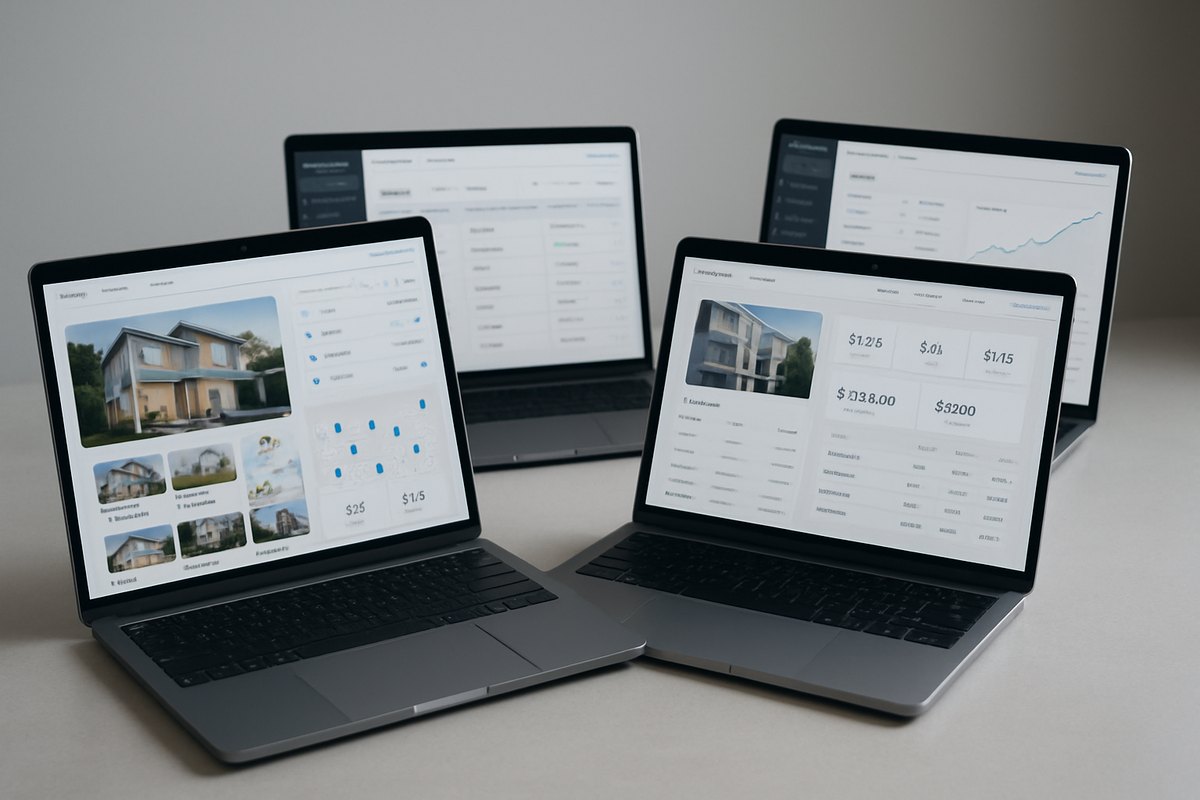
These products connect inventory with buyers or renters. Core capabilities include listing ingestion, normalization, search, maps, media, saved searches, alerts, lead capture, showing requests, agent routing, moderation, and administrative controls.
The difficult work is not drawing property cards. It is maintaining accurate, permitted, timely inventory across feeds; producing fast geographic search; controlling duplicates; handling status changes; and attributing leads correctly.
Property management systems
Property management software supports the operational lifecycle of a unit, building, or portfolio:
- onboarding owners, properties, units, leases, tenants, and vendors;
- applications and screening;
- rent, deposits, fees, reconciliation, and delinquencies;
- maintenance intake, triage, scheduling, evidence, and cost recovery;
- inspections, renewals, notices, and document retention;
- owner, tenant, vendor, and staff portals;
- portfolio reporting and integrations with accounting systems.
Residential, commercial, student, short-term, and community-association management need different data and workflows. Treating them as one generic PMS usually produces excessive configuration and poor reporting.
Real estate CRM and brokerage platforms
A real estate CRM software development project must reflect property and transaction relationships, not only contacts. It can support lead capture, source attribution, territory and round-robin routing, property matching, communication history, showing management, offers, transaction checklists, commission rules, referrals, and team performance.
The key question is whether to extend an established CRM or create a domain-specific layer around it. Building an entire CRM is rarely justified if differentiation lies only in one routing or reporting workflow.
Transaction and document platforms
These systems coordinate disclosures, offers, approvals, signatures, deadlines, title or settlement parties, audit trails, and status communication. Their value comes from reducing missed steps and making responsibility visible. Requirements change by jurisdiction and transaction type, so configurable rules and document versioning are often more important than a polished static workflow.
Investment and asset management platforms
Investment software consolidates opportunities, underwriting, comparable properties, capital structure, documents, approvals, portfolio performance, debt, leases, valuations, scenarios, and investor reporting. Data lineage is critical: users must know which source and date produced a figure, which assumptions were applied, and who changed them.
Development and construction sales systems
Developers need inventory, unit configuration, pricing, reservations, buyer communications, installment schedules, broker commissions, documents, change orders, progress reporting, and handover. The platform may integrate construction, ERP, CRM, and customer portals rather than replace them.
Field service and inspection applications
Mobile app development for appraisers, inspectors, leasing teams, maintenance staff, and property photographers requires offline work, location and time evidence, photos and video, forms, signatures, barcode or asset scanning, route planning, and reliable synchronization. A web dashboard alone will not solve a field workflow if connectivity is inconsistent.
Smart-building and IoT platforms
Smart-property systems connect access control, HVAC, energy, occupancy, security, water, elevators, and equipment telemetry. They need device identity, event ingestion, rules, alerting, tenant permissions, vendor access, retention policies, and operations dashboards. Hardware lifecycle and vendor protocols can dominate the scope.
Start with stakeholders and end-to-end journeys
Feature lists hide handoffs. Map the complete journey for every actor who creates, approves, consumes, or corrects data.
Typical actors include:
- buyer or renter;
- seller or landlord;
- agent, broker, or leasing specialist;
- property and facility manager;
- maintenance vendor;
- appraiser or inspector;
- asset manager, investor, or lender;
- finance, legal, compliance, and support staff;
- system administrator and integration partner.
For a rental application, for example, the journey is not “submit form.” It includes consent, identity, application completeness, supporting documents, screening, human review, applicant communication, adverse-action steps where applicable, deposit, lease execution, move-in tasks, and audit evidence. A design that optimizes only the applicant screen can still fail operationally.
For each journey, record:
- trigger and desired outcome;
- actor and decision owner;
- source data and permission;
- business rules and exceptions;
- manual handoffs;
- notifications and deadlines;
- compliance evidence;
- success metric.
This creates a reliable backlog and reveals where custom development actually adds value.
Prioritize features by product outcome
Do not put every fashionable PropTech feature into the first release. Use a feature matrix tied to the operating model.
| Capability | Marketplace | Property mgmt | Brokerage CRM | Investment | Field app |
|---|---|---|---|---|---|
| Property/listing master data | Essential | Essential | Important | Essential | Important |
| Geospatial search and maps | Essential | Useful | Useful | Important | Essential |
| Lead and communication workflow | Essential | Useful | Essential | Optional | Optional |
| Lease/tenant lifecycle | Optional | Essential | Optional | Important | Useful |
| Documents and e-signature | Important | Essential | Essential | Essential | Important |
| Payments and accounting | Optional | Essential | Useful | Important | Optional |
| Analytics and reporting | Important | Essential | Essential | Essential | Useful |
| Mobile/offline capture | Useful | Important | Useful | Optional | Essential |
| Multi-entity permissions | Important | Essential | Essential | Essential | Important |
| Data feeds and integrations | Essential | Essential | Essential | Essential | Important |
High-value marketplace features
- fast faceted search and map bounds;
- normalized listing detail and media;
- saved properties, saved searches, and alerts;
- showing or tour scheduling;
- lead qualification and routing;
- duplicate and stale-listing controls;
- SEO-friendly, indexable location and listing pages where permitted;
- analytics from acquisition through qualified inquiry.
High-value property operations features
- unit, lease, tenant, owner, and vendor records;
- service request triage and SLA tracking;
- recurring charges, payment status, and reconciliation;
- inspection and evidence workflows;
- configurable notices and approvals;
- document templates and audit history;
- owner and tenant self-service;
- operational dashboards by property and portfolio.
Features that should wait for evidence
AI recommendations, automated valuation, virtual staging, blockchain records, AR tours, and predictive maintenance can be valuable, but each needs a business case and trustworthy data. A basic search or maintenance workflow that users abandon will not be rescued by an AI feature.
MLS and IDX integration: the data problem behind the interface
In the United States, listing products often depend on one or more Multiple Listing Services. MLS access is obtained from the relevant MLS or its provider under its licensing and display rules; the Real Estate Standards Organization (RESO) defines standards but does not provide the property data or credentials.
RESO describes its Web API as the modern transport for real estate data and notes that the older RETS transport is deprecated. The standard improves interoperability, but it does not make every MLS identical. Local fields, permissions, payloads, refresh requirements, media handling, and business rules still vary.
Questions to resolve before estimating an MLS integration
- Which markets and MLS organizations are in scope?
- Does the business already have the required participant, broker, or vendor agreements?
- Which display, VOW, IDX, back-office, or other data use is permitted?
- Is live querying allowed, or should the platform replicate authorized data?
- How frequently must records and media refresh?
- Which local fields extend the RESO Data Dictionary?
- How are listing corrections, deletions, off-market states, and historical records handled?
- Which attribution, disclaimer, branding, and display rules apply?
- Can data be combined with public records, valuations, or third-party enrichment?
- What happens when credentials, policies, or provider endpoints change?
A robust ingestion pipeline
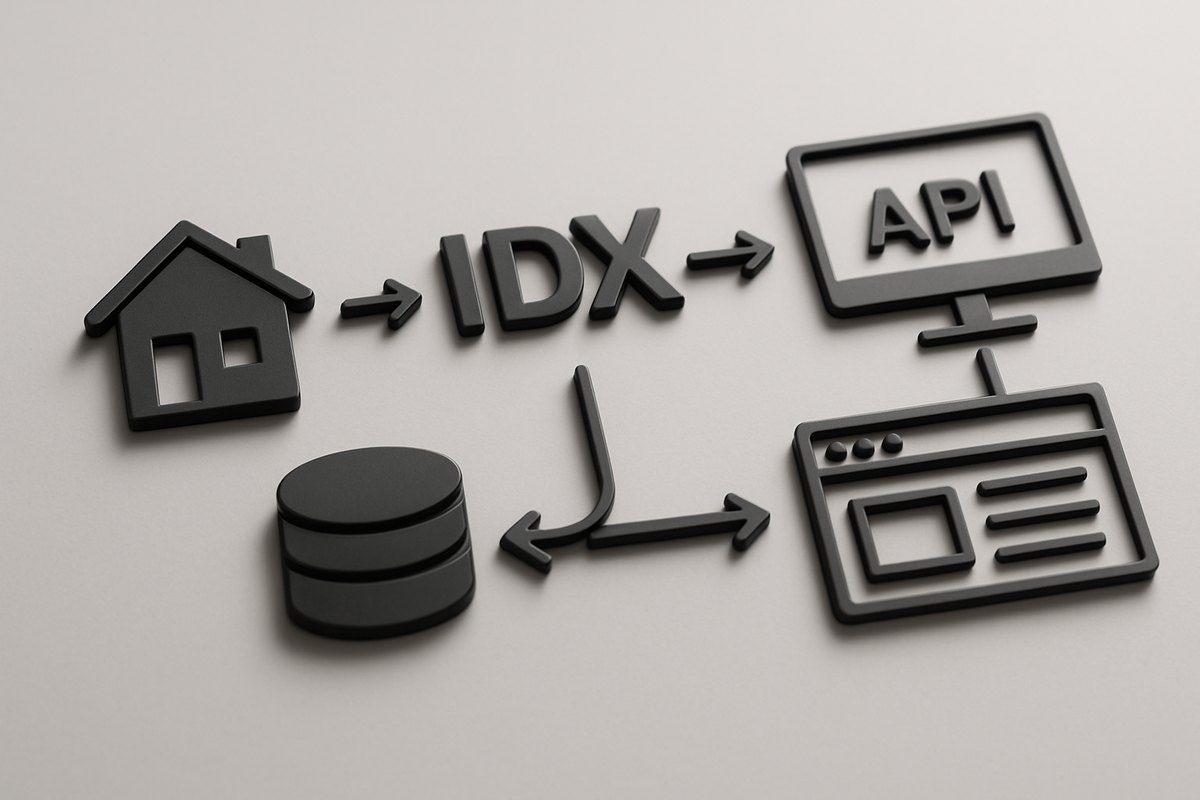
A production design usually separates the source feed from the customer interface:
- authenticated connectors retrieve permitted changes;
- raw payloads are retained temporarily for traceability where licensing allows;
- data is validated and mapped to a canonical property and listing model;
- duplicates and entity relationships are resolved;
- search indexes and derived views are updated;
- media is processed under source rules;
- failures, lag, and coverage are monitored;
- downstream APIs serve web, mobile, CRM, and analytics clients.
Track freshness by source and record. A green server dashboard is not enough if 12% of listings stopped updating yesterday.
Property identity is harder than listing identity
A listing represents a market event; a property persists through many listings, owners, tenants, valuations, and transactions. Addresses can be incomplete or formatted differently, parcel identifiers vary, and multi-unit buildings create ambiguity. Define separate property, unit, listing, party, organization, event, document, and transaction entities instead of forcing everything into one listing table.
Architecture for a scalable real estate platform
Architecture should follow workload and ownership, not a trend.

Start modular, not necessarily with microservices
A modular monolith is often appropriate for an MVP: it enables fast iteration while maintaining boundaries among identity, inventory, search, leads, transactions, documents, payments, and reporting. Extract services when independent scaling, reliability, security, or team ownership justifies the operational cost.
Premature microservices create distributed transactions, observability needs, deployment overhead, and failure modes before the product has stable boundaries. Conversely, a single undifferentiated codebase becomes costly when feeds, search, media, analytics, and transactions grow at different rates. Document module contracts early so extraction remains possible.
Separate systems of record from search and analytics
Use a transactional database for authoritative workflow state. Build a search index for text, filters, geospatial queries, and ranking. Send events or controlled extracts to an analytics platform rather than running complex portfolio reports against the transactional database.
This separation supports different consistency requirements. A payment or lease status requires strong correctness. Search can often tolerate seconds of delay if freshness is visible and monitored.
Design multi-tenancy explicitly
A PropTech SaaS product may serve companies, portfolios, offices, teams, properties, and vendors. Decide how data is isolated, how administrators delegate access, how configurations inherit, and whether enterprise customers require a dedicated environment or regional data location.
Test permissions at the data layer, not only in the interface. A hidden button is not an authorization control. Include cross-tenant isolation tests in every release.
Treat documents and media as first-class data
Property products handle large images, videos, floor plans, IDs, leases, disclosures, inspection evidence, and financial files. Define ownership, malware scanning, retention, access links, redaction, versioning, and deletion. Store metadata and audit events so the platform can explain what document was viewed or signed and when.
Build for web and mobile roles intentionally
Consumers may discover inventory on mobile web and return on desktop. Field staff may need an installed app with offline data, camera access, and background synchronization. Managers may need dense web dashboards. A single responsive UI does not automatically serve all three contexts.
Typical technology choices by product type
There is no single “real estate tech stack.” The right choice follows the workload described above, not a trend list. These are common, defensible starting points—not the only correct answer:
| Product type | Common stack | Why |
|---|---|---|
| Listing marketplace | Next.js/React front end, Node.js or NestJS API, PostgreSQL system of record, Elasticsearch for facets and geo search, Redis for hot-filter caching | Server-rendered pages for SEO, sub-100ms facet response at scale, clean separation of transactional and search state |
| Property management | Same API/database core, plus accounting-system integration, document storage (S3-class), and a mobile client for maintenance staff | Charges, ledgers, and reconciliation need strong consistency; field work needs offline-capable mobile |
| Brokerage CRM layer | Domain-specific layer on top of an existing CRM (Salesforce, HubSpot) or a custom service that syncs via webhooks/API | Rebuilding a whole CRM is rarely justified when only routing or reporting logic is proprietary |
| Investment/asset management | Python-based data pipeline, warehouse (e.g., BigQuery/Snowflake-class), BI layer for portfolio and valuation reporting | Data lineage, scenario modeling, and reporting matter more than transactional throughput |
| Field service/inspection app | React Native or Flutter with a local database and background sync queue | Inspectors and maintenance staff need reliable offline capture and later synchronization |
Real example: architecture and cost of a production PropTech marketplace

The patterns above are easier to evaluate against a real build. YuSMP’s ANT PropTech marketplace case study documents a custom real-estate marketplace built for developers and brokers operating across the United States and the European Union: a Next.js front end, a NestJS API, PostgreSQL as the system of record, and an Elasticsearch search tier kept in sync through an event-sourced indexer—the same buy/build separation and search-versus-transactional split described earlier in this guide.
Three details from that build are worth calling out because they recur across serious marketplace projects: an apartment-level inventory grid (building → floor → unit, rather than one flat listing table) so hundreds of units in a single development remain navigable; a Redis-cached facet layer that keeps filtered search responses under 100 ms even as aggregation counts update live; and a multi-role admin console (system admin, developer back-office, broker, read-only city operator) with a per-role audit log, aligned with GDPR in the EU and CCPA/CPRA and related state laws in the US through region-partitioned data storage.
For planning purposes, that project’s own published ranges track the cost table above: a focused marketplace MVP (public listings, search and filters, a developer-facing listing CMS, and a basic admin console) around $140,000–$320,000, and a full platform with the inventory grid, map search, CRM-integrated lead capture, and a multi-role admin with audit logs around $320,000–$750,000, delivered over roughly 14–22 weeks. These figures are illustrative of one delivered project, not a universal quote.
Security, privacy, accessibility, and compliance
Real estate software can process identity data, financial records, screening information, access credentials, location, contracts, and payment events. Security and compliance must be scoped by product, jurisdiction, role, and data flow. The following is product-planning guidance, not legal advice.

Security controls to include from discovery
- individual accounts, MFA, and least-privilege roles;
- tenant and portfolio isolation;
- encryption in transit and at rest;
- secret management and key rotation;
- audit trails for sensitive reads, exports, decisions, and permission changes;
- secure document upload, malware scanning, and signed download links;
- tokenized payment integration rather than storing card data unnecessarily;
- backup, restore, disaster recovery, and tested incident response;
- dependency, infrastructure, and application vulnerability management;
- data retention, legal hold, export, and deletion workflows;
- monitoring for unusual downloads, scraping, account takeover, and privilege escalation.
Threat-model the highest-risk journeys: tenant application, screening, payment, property access, document signing, admin impersonation, mass export, and API integration.
Fair housing and automated decisions
The Fair Housing Act prohibits housing discrimination based on protected characteristics including race, color, national origin, religion, sex, familial status, and disability. Software does not remove this responsibility. Search ranking, ad targeting, lead scoring, tenant screening, recommendations, and pricing models can produce discriminatory outcomes even when protected fields are not explicit inputs.
Use legal and domain review, documented feature selection, representative evaluation data, outcome testing, human review, user explanations, appeal or correction paths, and ongoing monitoring. Do not deploy a black-box score simply because a vendor labels it “AI-powered.”
Tenant screening and consumer reports
The FTC states that tenant background checks can be consumer reports and that landlords using them must comply with the Fair Credit Reporting Act. If the product obtains or provides screening information, map permissible purpose, consent, required notices, source accuracy, dispute handling, adverse action, data retention, and vendor responsibility with counsel.
Settlement and mortgage workflows
The Consumer Financial Protection Bureau maintains RESPA and Regulation X resources covering federally related mortgage loans, including provisions on applications, kickbacks and unearned fees, escrow accounts, counseling, and servicing. A platform that routes referrals, handles mortgage or settlement workflows, or automates disclosures needs product-specific legal analysis. Do not convert a manual practice into software before confirming that the practice and its incentives are compliant.
Accessibility
Target the current WCAG 2.2 standard and test with both automated tools and people using assistive technology. W3C recommends using the latest WCAG version; in 2025, WCAG 2.2 was also approved as ISO/IEC 40500:2025.
Prioritize keyboard operation, focus order, screen-reader labels, form errors, contrast, text resizing, accessible maps and alternatives, captions and transcripts, touch target size, and documents. Accessibility belongs in design-system components and acceptance criteria, not in a final audit alone.
Practical AI use cases for PropTech
AI creates value when it reduces a measurable decision or workflow cost and the platform can verify its output. For a broader perspective on AI integration in enterprise software, the principles of evaluation, human oversight, and fallback apply equally in PropTech contexts.

Document intake and extraction
Models can classify leases, invoices, inspection reports, and applications; extract fields; compare versions; and route exceptions. Keep the original document, extraction confidence, validation status, model version, and human correction. High-impact fields should not silently enter a system of record.
Property matching and search
Semantic search can interpret natural-language needs and combine them with structured filters. Recommendations can learn from saved properties and inquiries. Preserve explicit user controls and test whether results systematically reduce visibility for protected groups or neighborhoods.
Lead triage and communication assistance
AI can summarize conversations, draft replies, identify unanswered inquiries, and suggest next actions. It should not invent property facts, availability, fees, or legal promises. Retrieve facts from approved sources, display them separately from generated language, and log material changes.
Valuation, underwriting, and forecasting
Automated valuation and investment models can combine comparables, market, property, and operating data. Users need ranges, assumptions, data dates, comparable selection, limitations, and override history—not only one authoritative-looking number.
Maintenance and building operations
AI can classify requests, detect duplicate incidents, suggest vendors, analyze sensor trends, and forecast equipment failure. Emergency and safety categories need deterministic escalation and human oversight.
A production AI checklist
- Define the decision and cost of an incorrect output.
- Establish a non-AI baseline.
- Verify data rights and sensitive-data handling.
- Measure accuracy by relevant segment, property type, and geography.
- Add human review where consequences are material.
- Log source, model, prompt/configuration, output, and correction where appropriate.
- Monitor drift, complaints, bias indicators, latency, and cost.
- Provide a fallback when the model or provider is unavailable.
Real estate software development process
Phase 1: discovery and feasibility
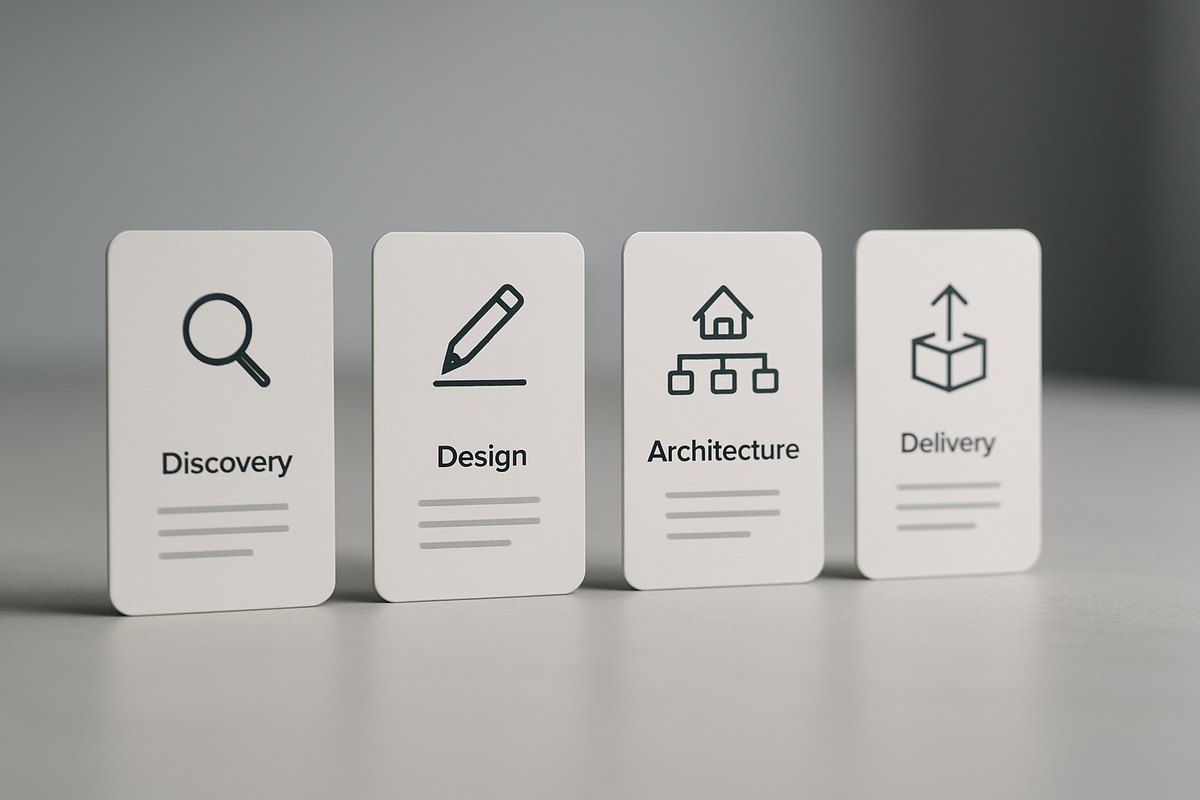
Interview users, map journeys, inventory systems and data rights, analyze regulations, define the business metric, and investigate the highest-risk integration. Deliverables should include a capability map, prioritized scope, integration diagram, risk register, release hypothesis, and estimate range.
For a listing product, obtain MLS documentation and commercial access assumptions during discovery. For a property management platform, model leases, charges, maintenance, accounting, and portfolio permissions before designing dashboards.
Phase 2: product and UX design
Prototype complete workflows across roles, including empty states, errors, exceptions, permission restrictions, and mobile use. Test concepts with representative users. Define the design system and accessibility rules. The objective is to remove workflow uncertainty before expensive implementation.
Phase 3: architecture and delivery foundation
Define the canonical data model, system boundaries, security model, integration contracts, environments, CI/CD, observability, test strategy, backup and recovery, and migration approach. Use short architecture decision records to capture consequential tradeoffs.
Phase 4: incremental development
Build vertical slices that connect interface, rules, data, integration, analytics, and operations. A “saved search” slice, for example, should include permissions, data validation, notifications, monitoring, and support behavior—not only a button.
Demonstrate working software frequently. Keep product, design, engineering, QA, security, and operations aligned through one definition of done.
Phase 5: validation and launch
Validate functional behavior, roles and permissions, data accuracy, integrations, accessibility, security, performance, and recovery. Rehearse migration and rollback. Train internal teams and prepare support runbooks.
Launch by tenant, market, portfolio, or user cohort when possible. Monitor business and technical signals together: data freshness, search success, payment failures, application completion, critical errors, and support volume.
Phase 6: operation and improvement
After launch, manage dependencies, data providers, OS/browser changes, security patches, support, model monitoring, analytics, and roadmap experiments. Software is an operating capability, not a one-time asset.
Typical timeline and team
Timelines depend on the riskiest dependency, not the number of screens.
| Scope | Illustrative timeline | Typical first outcome |
|---|---|---|
| Discovery or technical audit | 2–6 weeks | Scope, architecture, risks, roadmap and estimate |
| Focused custom module | 2–4 months | One production workflow integrated into the existing stack |
| MVP marketplace or operations product | 3–6 months | Narrow multi-role release in one market or portfolio |
| Growth platform | 6–12 months | Multiple workflows, integrations, mobile/web and automation |
| Enterprise modernization or multi-market ecosystem | 12–24+ months | Phased migration across business units and data sources |
A cross-functional core team often includes:
- product manager or product owner;
- business analyst with domain knowledge;
- product designer;
- technical lead or architect;
- two to five software engineers across web, mobile, backend, and data needs;
- QA automation engineer;
- DevOps/platform engineer part-time or full-time;
- security, data science, compliance, and integration specialists as required.
The client must provide decision makers and subject-matter experts. Outsourcing development does not outsource product accountability, data rights, or legal responsibility.
How much does real estate software development cost in 2026?
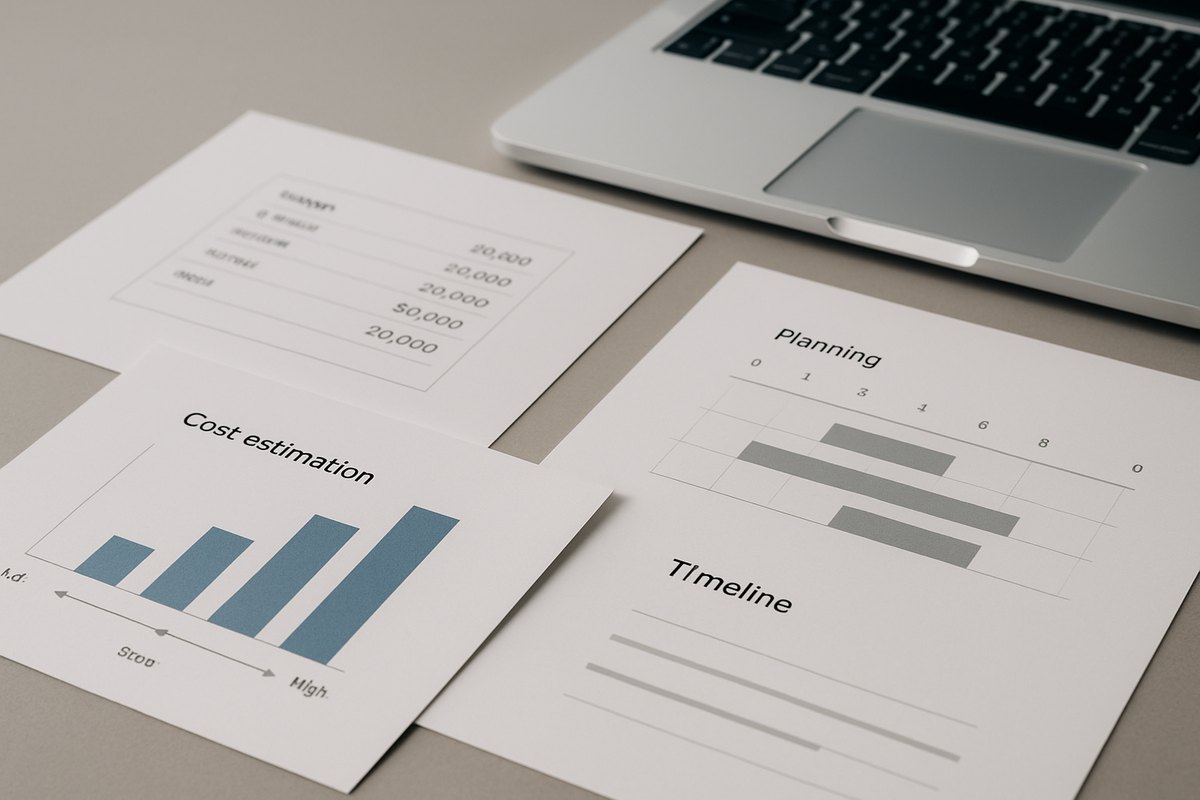
Published provider estimates observed in Google US vary considerably. One 2026 guide places a single module or MVP at approximately $50,000–$150,000 and a mid-size platform at $150,000–$450,000; another service page lists $30,000–$80,000 for an MVP and $80,000–$200,000 for a growth platform. App-specific estimates can start lower, while multi-market enterprise products can exceed $500,000 or reach seven figures.
Use these as planning bands, not quotations:
| Product scope | Illustrative build range | Usually includes |
|---|---|---|
| Discovery / proof of concept | $15,000–$50,000 | Research, workflow design, architecture, risky integration prototype |
| Focused module or lean MVP | $50,000–$150,000 | One primary journey, limited roles and integrations, admin basics |
| Growth platform | $150,000–$450,000 | Several roles, web/mobile, feeds, payments/documents, analytics |
| Enterprise ecosystem | $450,000–$1.5M+ | Multi-market or multi-tenant platform, migration, advanced data/AI/IoT |
Actual prices vary by region, team rate, scope, quality bar, data complexity, and what is already available. Very low estimates may exclude design, QA, data work, licensing, migration, security, administration, or post-launch operation.
Main cost drivers
- Roles and workflow depth. Three user types do not merely triple screens; they create permissions, handoffs, notifications, disputes, and audit requirements.
- MLS and external data. Every market can introduce agreements, local fields, mapping, synchronization, media, testing, and recurring fees.
- Search and geospatial scale. Ranking, polygons, commute queries, facets, media, and traffic peaks require specialized design.
- Payments and accounting. Charges, refunds, reconciliation, ledgers, payouts, tax and audit behavior add more than a checkout form.
- Documents and compliance. Templates, signatures, versioning, retention, evidence, accessibility, and jurisdiction rules add effort.
- Web plus mobile. Shared APIs help, but role-specific mobile workflows, offline behavior, device features, and store delivery remain real work.
- Migration. Poor legacy data, duplicates, missing relationships, and parallel operation can dominate the schedule.
- AI and analytics. Data preparation, evaluation, explanations, monitoring, and human review often cost more than the initial model call.
- Reliability and security. Enterprise access, audit, recovery, isolation, testing, and support requirements increase both build and run costs.
Estimate total cost of ownership
Use a three-year view:
TCO = discovery + design and build + data and API licenses + cloud and observability + security/compliance + support and maintenance + internal operations + planned improvements + migration and exit.
Maintenance is not just bug fixing. It includes dependency upgrades, data-provider changes, mobile releases, policy updates, performance work, incident response, and new requirements. Ask vendors to separate recurring data, infrastructure, support, and third-party fees from development.
How to modernize existing real estate software
Do not begin with a rewrite decision. Begin with an evidence-based system assessment.
Audit the current state
- map business-critical workflows and users;
- identify systems of record and integration ownership;
- profile data quality, duplicates, and undocumented local fields;
- review architecture, dependencies, security, tests, deployment, and incidents;
- measure performance and support burden;
- identify components that create competitive value;
- calculate the cost and risk of keeping, replacing, or wrapping each component.
Choose an incremental migration pattern
Options include:
- putting an API layer in front of the legacy system;
- replacing one workflow or module at a time;
- building a new read model and search experience while the old system remains authoritative;
- synchronizing old and new systems during a controlled transition;
- migrating one market, property portfolio, or customer cohort first;
- extracting high-change components from a stable core.
Define reconciliation, rollback, and source-of-truth rules before dual running. A new interface over unreliable data does not constitute modernization.
How to choose a real estate software development company
Select for evidence relevant to your riskiest work, not the longest list of technologies. Working with an enterprise software development team that has real estate domain experience reduces the most common failure modes.

Request comparable project evidence
For each case study, ask:
- What business model and property segment did it serve?
- Which workflows and integrations did the vendor own?
- Which named team members worked on it?
- How was data access obtained and normalized?
- What failed or changed during delivery?
- Which metric improved, and how was it measured?
- Who operates the system today?
A logo and a screenshot are not enough. Confidentiality may limit names, but the team should still explain decisions and artifacts.
Use a vendor scorecard
| Category | Weight | Evidence |
|---|---|---|
| Real estate workflow and data expertise | 20% | Comparable workflows, MLS/data experience, correct domain questions |
| Architecture and integration capability | 15% | Data model, API strategy, migration, search and reliability examples |
| Security, privacy, accessibility and compliance | 15% | Threat models, controls, testing, audit evidence and responsible escalation |
| Product discovery and UX | 10% | Research, journey maps, prototypes and measurable hypotheses |
| Engineering and quality system | 15% | Code review, automated tests, CI/CD, observability and incident learning |
| Team and communication | 10% | Named people, availability, overlap, reporting and continuity plan |
| Commercial transparency | 10% | Assumptions, exclusions, rates, recurring costs and change control |
| Ownership and exit | 5% | Client-controlled accounts, IP assignment, documentation and handover |
Score every provider from one to five using the same brief and evidence requests. Set minimum thresholds for security, data rights, and relevant integration experience so a low price cannot compensate for a critical weakness.
Ask for a paid discovery when uncertainty is material
A strong discovery should produce reusable assets even if you choose another implementation partner. Define ownership of research, designs, backlog, architecture, and prototypes before starting.
Measure ROI and product health
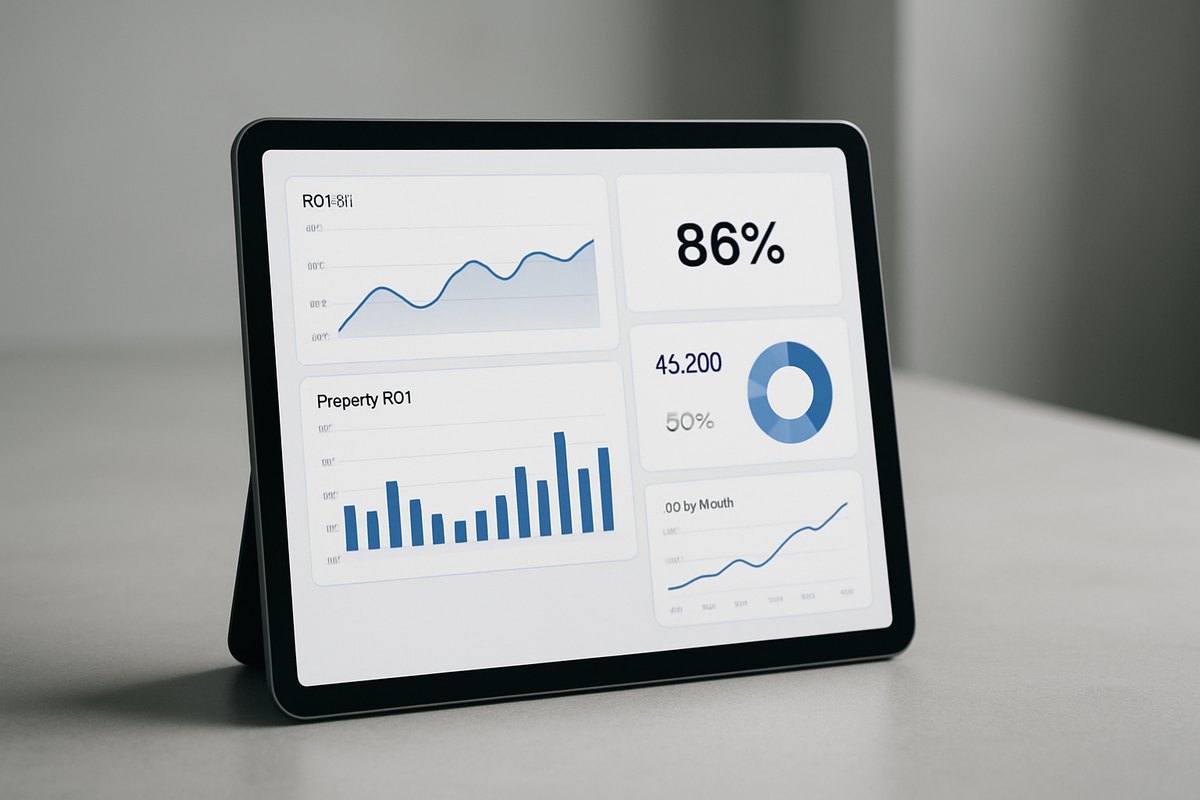
Choose metrics connected to the workflow the software changes.
Marketplace metrics
- search-to-detail and detail-to-inquiry conversion;
- percentage of searches with useful results;
- listing freshness and feed error rate;
- qualified lead rate and time to first response;
- showing conversion and customer acquisition cost.
Brokerage metrics
- speed-to-lead;
- lead assignment acceptance;
- follow-up completion;
- inquiry-to-showing and showing-to-offer conversion;
- transaction cycle time;
- agent adoption and duplicate data entry eliminated.
Property management metrics
- rent collection and delinquency rate;
- maintenance time to acknowledge and resolve;
- first-time fix rate;
- lease renewal and vacancy turnaround;
- cost per managed unit;
- portal adoption and avoidable support contacts.
Platform health metrics
- data freshness, completeness, and reconciliation failures;
- uptime and critical-journey availability;
- p95 search and API latency;
- security incidents and privileged-access anomalies;
- deployment frequency, change failure rate, and recovery time;
- accessibility defects in critical journeys;
- support volume and top root causes.
Baseline metrics before launch. Otherwise, a successful deployment may be mistaken for a successful product.
Common mistakes in PropTech development
Building a feature catalog instead of a workflow
Search, chat, documents, payments, and AI can all exist while users still copy information between systems. Prioritize the complete journey and exception handling.
Treating MLS as a generic API
Technical connection is only one part. Data licenses, local fields, attribution, permitted use, refresh, and operational monitoring determine whether the integration is viable.
Mixing properties, units, listings, and transactions
Weak entity modeling creates duplicates, broken history, and unreliable analytics. Establish canonical identities and relationships early.
Automating a discriminatory or non-compliant decision
Software can scale a flawed practice. Review housing, screening, referral, lending, payment, privacy, and accessibility requirements before automation.
Launching AI without evaluation
A polished demo does not prove production value. Define acceptable error, test representative segments, add human review and fallback, and monitor after launch.
Underfunding administration and operations
Every platform needs permissions, data corrections, reconciliation, monitoring, support tools, and incident processes. “Admin panel later” creates expensive manual work.
Rewriting everything at once
Big-bang replacement increases migration and adoption risk. Use phased boundaries and measurable cutovers unless the current system makes incremental change impossible.
Choosing a vendor by hourly rate
The lowest rate can create the highest total cost through weak discovery, rework, missing QA, and dependence on the client’s managers. Compare the same scope, assumptions, team, quality controls, and operating responsibilities.
Final planning checklist
Before approving real estate software development, confirm that:
- the business outcome and baseline metric are defined;
- buy, configure, integrate, and build options were compared by capability;
- users and end-to-end workflows include exceptions and handoffs;
- the first release is narrow enough to validate value;
- data sources, rights, quality, refresh, and costs are known;
- property, unit, listing, party, document, and transaction identities are modeled separately;
- systems of record and integration ownership are explicit;
- permissions, audit, retention, backup, and incident response are designed;
- applicable fair housing, FCRA, RESPA, privacy, payment, and accessibility questions have qualified owners;
- AI features have evaluation, human oversight, logging, and fallback;
- web, mobile, and offline needs are based on user context;
- migration includes reconciliation and rollback;
- the estimate exposes assumptions, exclusions, recurring fees, and post-launch work;
- client-controlled repositories, cloud, data, domains, and vendor accounts are written into the agreement;
- product and technical KPIs will be measured after launch.
FAQ
What is real estate software development?
Real estate software development is the creation and integration of digital systems for property listing, sales, leasing, management, investment, transactions, valuation, and building operations. Products can include web portals, mobile apps, CRM, property management systems, data pipelines, analytics, document workflows, and internal administration.
How much does custom real estate software cost?
A focused discovery or proof of concept may cost about $15,000–$50,000, a lean custom module or MVP $50,000–$150,000, a growth platform $150,000–$450,000, and a multi-market enterprise ecosystem $450,000–$1.5 million or more. These are planning ranges, not fixed prices. Data feeds, roles, payments, documents, migration, mobile apps, AI, and compliance can move the estimate substantially.
How long does it take to build a PropTech platform?
A discovery normally takes two to six weeks. A focused module may take two to four months, a marketplace or operations MVP three to six months, and a mature multi-role platform six to twelve months. Enterprise modernization and multi-market ecosystems are usually phased over 12–24 months or longer.
Should we build or buy property management software?
Buy when workflows are standard and a mature product supports your asset class, region, accounting, and integrations. Build when proprietary workflows, data, scale, customer experience, or economics create a defensible advantage. Many companies use a hybrid: buy commodity functions and build differentiated modules around them.
What is the difference between MLS and IDX?
An MLS is an organization and cooperative system through which authorized participants share listing data. IDX generally refers to policies and data use that allow eligible real estate professionals to display permitted listings online. Exact rights and rules come from the relevant MLS. RESO provides data standards but does not provide MLS credentials or property data.
What features should a real estate marketplace MVP include?
A focused MVP usually needs authorized listing ingestion, normalized property pages, fast search and filters, maps, media, saved properties or searches, inquiry or showing requests, lead routing, basic administration, analytics, and monitoring of data freshness. Add mortgage, valuation, 3D tours, and advanced AI only when the core journey has evidence of demand.
Can one platform serve buyers, agents, landlords, and property managers?
Yes, but each role requires its own permissions, workflow, interface, and success criteria. Multi-role scope increases complexity faster than screen count suggests. Start with the smallest connected set of roles required to complete one valuable end-to-end journey.
How should AI be used in real estate software?
High-value uses include document extraction, natural-language search, recommendations, communication assistance, valuation support, maintenance classification, and anomaly detection. Every production use should define acceptable error, data rights, evaluation segments, human review, explanation, monitoring, and fallback—especially when housing access or financial decisions can be affected.
What compliance requirements apply to U.S. real estate software?
Requirements depend on the exact product and jurisdiction. Relevant areas may include the Fair Housing Act, FCRA for consumer reports and tenant screening, RESPA and Regulation X for covered settlement or mortgage workflows, state privacy and licensing rules, payment requirements, electronic signatures, records retention, and accessibility. Engage qualified legal and compliance professionals during discovery.
How do we choose a real estate software development company?
Give vendors the same brief and score them on relevant domain and data experience, architecture, security and compliance practices, product discovery, engineering quality, named team, commercial transparency, and exit provisions. Validate case-study claims, interview the delivery lead, inspect example artifacts, and use a paid discovery when critical assumptions remain unresolved.
Last updated 26 August 2026. Cost and timeline figures reflect commonly reported 2026 provider estimates from public sources and are presented as planning ranges, not fixed prices or promises. Compliance references (Fair Housing Act, FCRA, RESPA, WCAG) are for product-planning orientation only and are not legal advice—engage qualified legal and compliance professionals during discovery for your specific product, jurisdiction, and workflows.