

Insurance software development covers the design, engineering, integration, and maintenance of systems that support insurance products and operations — quoting, underwriting, policy administration, billing, claims, portals, mobile apps, and analytics. The right approach depends on where differentiation is real, which system owns each record, and whether data migration risk is treated as the delivery constraint it actually is.
What is insurance software development?
Insurance software development is the design, engineering, integration, and maintenance of systems that support insurance products and operations. It covers core workflows such as quoting, underwriting, policy administration, billing, and claims, as well as portals, mobile apps, analytics, automation, and connections to third-party data. A successful program — whether delivered as custom software development or through a hybrid of commercial and bespoke components — improves a measurable business process while preserving auditability, security, and regulatory control.
Insurance software development turns insurance products, operating rules, and regulatory obligations into dependable digital workflows. The work can involve building a new product, extending a commercial core platform, replacing a legacy application, connecting fragmented systems, or creating a customer-facing layer over existing systems of record.
The users are broader than policyholders. Underwriters need risk context and exception queues. Adjusters need claim evidence and authority controls. Agents and brokers need quoting, commission, and servicing tools. Finance teams need accurate billing and reconciliation. Compliance teams need reconstructable decisions. Operations teams need workflows that handle routine cases quickly and route exceptions to the right person.
That breadth is why "an insurance app" is rarely one application. It is usually a set of channels, services, rules, records, and integrations with different owners and change rates. Our fintech software development work covers the full spectrum from carrier modernization to insurtech product delivery.
Who builds custom insurance software?
Common buyers include:
- Carriers modernizing policy, billing, claims, or digital distribution;
- managing general agents (MGAs) launching specialized products and delegated underwriting workflows;
- brokers and agencies improving quoting, customer management, commissions, and carrier connectivity;
- third-party administrators (TPAs) coordinating claims, benefits, documents, and service-level commitments;
- reinsurers managing treaties, exposure, bordereaux, and recoveries;
- insurtech companies creating software products, marketplaces, embedded-insurance services, or data tools;
- self-insured enterprises and risk managers tracking incidents, coverage, claims, reserves, and prevention programs.
Why the industry is investing now
US insurance technology spending reached approximately $173 billion in 2026, a 7.8% increase year-over-year, representing roughly 6% of total US technology budgets. Around 78% of insurance leaders are expanding technology investment; 84% prefer cloud-native deployments; and 75% of customers now expect self-service digital options across quoting, policy service, and claims. AI adoption is high — 92% of health insurers and 88% of auto insurers are piloting or deploying machine-learning in underwriting, claims, or fraud workflows. Carriers that modernized core systems have reduced claim handling cost by 30–50% through automation. The gap between modernized and legacy carriers is becoming a competitive moat, not a technical inconvenience.
Key takeaways
- Custom development makes the most sense where an insurer's product, workflow, data, or customer experience creates real differentiation. Commodity capabilities are often better bought or extended.
- The first architecture decision is not microservices versus a monolith. It is deciding which system owns policy, claim, billing, customer, producer, and document records.
- Integration and migration usually create more risk than the user interface. Budget for data profiling, mapping, reconciliation, parallel runs, and rollback.
- US insurance requirements vary by state, entity, product line, and data type. Compliance should become a traceable control matrix, not a generic badge.
- AI can accelerate document intake, triage, fraud analysis, and service, but consumer-impacting decisions need governance, validation, monitoring, explanations, and human escalation.
- A focused digital product may reach production in four to seven months. A multi-domain core modernization is a staged, multi-release program—not a single app project.
Types of insurance software and core capabilities
Start with the business capability, not a feature wish list. A policy administration system and a customer portal may both display coverage, but they serve different purposes and should not compete to own the same record.
| Solution | Primary users | Core capabilities | Critical connections |
|---|---|---|---|
| Quoting and rating | Agents, brokers, customers | Eligibility, questions, rate calculation, quote comparison, referrals | Product catalog, rating engine, third-party risk data, CRM |
| Underwriting workbench | Underwriters, assistants | Submission intake, risk view, rules, tasks, referrals, authority limits | Document intake, rating, policy, external data, model services |
| Policy administration | Operations, service teams | Bind, issue, endorse, renew, cancel, reinstate, product configuration | Rating, billing, documents, portals, data warehouse |
| Claims management | Adjusters, examiners, claimants | First notice of loss, coverage verification, triage, reserves, payments, recovery | Policy, documents, fraud tools, vendors, payments, litigation |
| Billing and payments | Finance, policyholders, agents | Invoices, installments, commissions, refunds, collections, reconciliation | Policy, payment gateway, general ledger, producer management |
| Agent or broker portal | Distribution partners | Quotes, submissions, documents, policy service, claim status, commissions | Identity, CRM, policy, claims, document management |
| Policyholder web or mobile app | Customers, members | Buy, pay, view coverage, upload evidence, file and track claims, support | Customer identity, policy, billing, claims, notifications |
| Document and correspondence platform | All operational teams | Generation, ingestion, OCR, classification, versioning, retention | Every core domain, e-signature, email, archive |
| Insurance CRM | Sales and service | Household or account view, interactions, leads, campaigns, service cases | Policy, claims, contact center, marketing automation |
| Analytics and actuarial platform | Actuaries, product, finance, risk | Performance, loss analysis, pricing, reserving, segmentation, reporting | Core data, external data, finance, model environment |
No single implementation needs every module. A useful roadmap identifies the constrained business journey and the systems it touches. For example, "reduce commercial submission-to-quote time" is a more actionable scope than "build an AI underwriting platform." For the CRM component, see our guide on CRM software development for insurance and financial services contexts.

Custom software, packaged platform, or hybrid extension?
The choice is not simply build or buy. Insurers can configure a core product, extend a platform, assemble specialized SaaS products, or build selected components around an existing core.
| Approach | Best when | Advantages | Main risks |
|---|---|---|---|
| Packaged SaaS | The process is standard and speed matters more than differentiation | Faster implementation, vendor upgrades, proven baseline controls | Workflow compromise, license growth, limited data or integration flexibility |
| Configured insurance platform | A carrier needs broad policy/claims/billing capability with product configuration | Insurance-specific domain model, ecosystem, mature operational functions | Complex implementation, upgrade constraints, specialist dependency |
| Custom application | The workflow, product, or experience creates competitive value | Exact fit, ownership of roadmap and IP, control over integrations | Higher delivery responsibility, maintenance burden, scope risk |
| Platform extension | The core works but a channel or workflow needs improvement | Preserves the system of record, narrows risk, supports phased change | Duplicate logic, brittle APIs, accidental second core |
| Composable hybrid | Different capabilities have clearly defined owners and stable contracts | Replaceable components, incremental modernization, best-fit tools | Architecture and vendor-management complexity |
A practical build-versus-buy test
Score the capability against five questions:
- Differentiation: Does it affect product speed, underwriting quality, distribution, or customer experience in a way competitors cannot easily copy?
- Fit: Can a product support at least 80% of the required workflow without damaging controls or forcing expensive workarounds?
- Change rate: Will rules, products, or integrations change frequently enough to justify direct roadmap control?
- Data control: Are ownership, portability, lineage, latency, or model needs strategic?
- Operating capacity: Can the organization fund product management, security, reliability, support, and upgrades after launch?
Build when the strategic benefit and fit gap outweigh lifetime ownership cost. Buy when the capability is mature, non-differentiating, and well served by the market. Use a hybrid when a stable core can remain authoritative while a custom layer improves a high-value journey. Our custom software development team can help you run this evaluation before committing to an approach.
Reference architecture for modern insurance software
A useful insurance architecture makes ownership explicit and isolates change. It does not require every component to be a microservice.
1. Experience layer
This layer includes policyholder apps, broker portals, employee workbenches, contact-center interfaces, and partner experiences. It should adapt information to each role without owning core policy or claim records. Accessibility, responsive design, session security, and clear exception handling matter as much as visual polish.
2. Experience APIs and orchestration
Backend-for-frontend APIs combine data for a specific journey: retrieve a policy summary, start a claim, produce a quote, or show an underwriter's work queue. Workflow services coordinate long-running processes, timeouts, human tasks, and compensation when a downstream action fails.
3. Insurance domain services
Domain boundaries commonly include product and rating, party and account, policy, billing, claims, producer, document, and notification capabilities. Boundaries should follow business ownership and transactional consistency—not an arbitrary target number of services.
Rules that affect premium, eligibility, coverage, reserves, or payment authority need versioning and effective dates. A decision must be reproducible using the rule, model, data, and authority in force at that time.
4. Systems of record
The architecture must name the authoritative owner for each major entity:
- product definition and rate version;
- customer or party identity;
- quote and submission;
- policy and coverage term;
- invoice, payment, and commission;
- claim, exposure, reserve, and transaction;
- document and correspondence;
- producer appointment and authority.
Without that map, teams create shadow records and reconciliation becomes permanent operational work.
5. Integration and event layer
An API gateway protects synchronous services. Events distribute important state changes such as PolicyBound, InvoiceIssued, or ClaimPaymentApproved. Batch and managed file transfer may remain appropriate for high-volume partner feeds, regulatory extracts, or legacy systems. The goal is not to eliminate batch; it is to make every interface owned, observable, versioned, and recoverable.
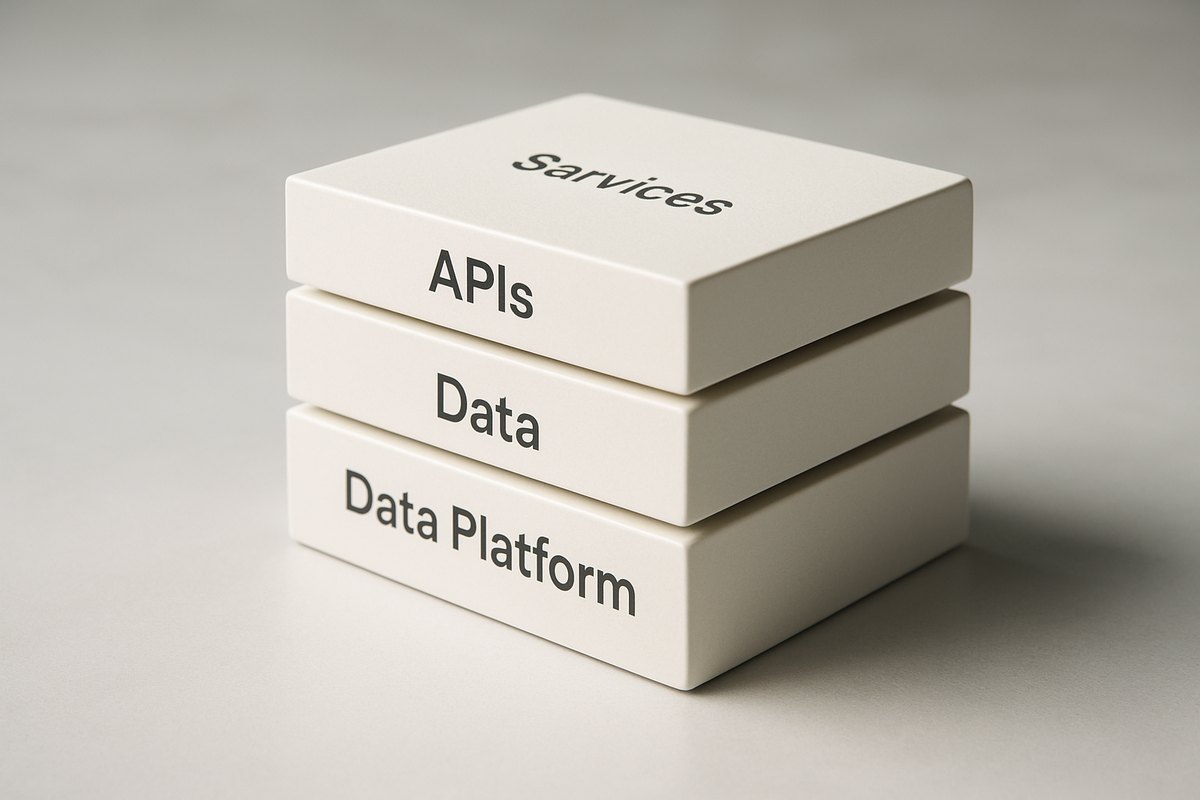
6. Data and analytics platform
Operational databases optimize transactions. Analytical stores support portfolio, actuarial, financial, service, and model workloads. A governed pipeline should preserve source identifiers, effective dates, transformations, quality checks, and lineage so users can trace a metric or model input back to origin.
7. Cross-cutting platform controls
Identity, secrets, encryption, audit, observability, configuration, feature flags, deployment pipelines, backup, disaster recovery, and cost monitoring apply across the stack. Treating them as a shared platform reduces inconsistent implementation across products.
8. Representative technology stack
The stack matters less than the ownership model above it, but a representative baseline helps with estimation and hiring. The right choice depends on existing team skills, cloud commitments, and integration partners — not on trend-chasing.
| Layer | Common choices | Notes |
|---|---|---|
| Experience layer | React, Next.js, native or cross-platform mobile | Server-side rendering helps SEO for public-facing quote and agent-recruiting pages |
| Domain services | Node.js, Java, .NET, Python | Choose for team depth and library support for rules engines, not novelty |
| Rules and rating | Business rules management systems, in-house effective-dated rule engines | Must support versioning, simulation, and audit — not just execution speed |
| Integration and events | API gateway, message broker, managed file transfer for legacy feeds | Every interface needs an owner, schema version, and replay strategy |
| Data and AI | Data warehouse or lakehouse, document intelligence/OCR, governed ML platform | Preserve lineage from source system to model input and back |
| Cloud and platform | AWS, Azure, or GCP with infrastructure as code | Multi-region resilience and cost monitoring are procurement criteria, not extras |
Integrations and insurance data standards
Insurance systems depend on external data and partners: identity and business verification, motor vehicle records, property data, telematics, medical networks, repair services, catastrophe data, e-signature, payments, accounting, CRM, and regulators. Each integration adds not just an endpoint but also commercial terms, data rights, availability limits, failure modes, and change management.
ACORD publishes insurance data standards for domains such as property and casualty, life, annuity, and reinsurance. Using the relevant standard can reduce semantic ambiguity between organizations. It does not remove the need for an internal canonical model: external versions and partner interpretations still vary.
Choose the right integration pattern
- Synchronous API: use when a user needs an immediate result, such as identity verification or a quote response. Set timeouts, rate limits, idempotency, and a graceful fallback.
- Event: use when other systems need to react to a completed business change without blocking it. Maintain schemas, ordering assumptions, replay strategy, and dead-letter handling.
- Asynchronous request and callback: use for work that takes seconds or minutes, such as document processing or third-party inspections.
- Batch or file exchange: use where a partner or legacy platform requires it, but add validation, acknowledgments, reconciliation, encryption, and replay controls.
- Human-in-the-loop task: use when the decision requires authority, judgment, missing evidence, or an exception that automation cannot safely resolve.
API controls that matter in insurance
Insurance APIs expose valuable personal and financial data. Object-level and function-level authorization must be tested explicitly: a valid customer should not be able to retrieve another customer's policy by changing an identifier, and an adjuster should not gain payment authority through a hidden endpoint. The OWASP API Security Top 10 is a useful threat checklist alongside the organization's secure development standard.
Use scoped tokens, service identities, fine-grained authorization, input and schema validation, idempotency keys for financial commands, rate limits, immutable audit events, and an inventory of every production API version. Verify data returned by third-party APIs rather than treating partner responses as trusted.

Data migration without a big-bang failure
Migration is a business program disguised as a technical task. Old systems often contain duplicated parties, undocumented codes, free-text exceptions, reversed transactions, missing attachments, and historical rules that no longer exist.
A defensible migration plan includes:
- Profile: measure completeness, uniqueness, format, referential integrity, and historical anomalies.
- Classify: decide what must be migrated, archived, transformed, corrected, or legally disposed of.
- Map: define source-to-target rules with business owners, not developers alone.
- Clean: resolve duplicates and invalid states using repeatable rules; preserve the original source.
- Rehearse: run migrations in production-like environments and measure duration and failure rates.
- Reconcile: compare counts and monetary totals by product, period, and transaction type.
- Validate journeys: test endorsements, renewals, cancellations, claim reopenings, refunds, and reports—not just record presence.
- Cut over safely: define freeze windows, delta migration, rollback thresholds, owners, and communications.
- Prove: retain evidence that records, balances, documents, and audit history arrived correctly.
For long-tail claims or multi-year policies, a staged coexistence model may be safer than migrating every historical transaction. New business can move first while selected legacy records remain accessible through a controlled read-only service.

Security, privacy, compliance, and resilience
"Compliance-ready" has no universal meaning. US insurance regulation is state-based, and obligations depend on jurisdiction, license, product line, customer, data type, channel, and third parties. The NAIC's state insurance charts illustrate why teams need a jurisdiction-specific assessment rather than one national checklist.
Build a requirements-to-controls matrix with four columns: obligation, affected workflow/data, technical or operational control, and evidence. Legal and compliance specialists should approve the interpretation; engineering should make the control testable.
Identity and access
- centralize workforce and customer identity where practical;
- require multi-factor authentication based on role and risk;
- enforce least privilege and separation of duties;
- apply payment and reserve authority limits server-side;
- time-limit elevated access and review it periodically;
- control non-human identities and rotate credentials;
- provide a rapid joiner, mover, and leaver process.
Data protection and privacy
Classify personal, health, financial, payment, and confidential business data. Minimize collection, document permitted use, encrypt data in transit and at rest, tokenize high-risk identifiers where appropriate, and define retention by record type and jurisdiction. Production data should not quietly become test data. Use masked or synthetic data and log exceptional access.
The NAIC Insurance Data Security Model Law topic page describes expectations around an information security program, cybersecurity-event investigation, and notification in adopting states. Confirm the actual law and regulator guidance for every applicable state.
Auditability
An audit record should answer who did what, when, through which channel, under which authority, using which rule or model version, and what changed. Store security logs and business audit events separately from editable operational notes. Protect integrity, synchronize time, restrict access, and test retrieval before an examination or incident demands it.
Secure delivery and resilience
Threat-model high-risk journeys such as account recovery, quote manipulation, claim evidence upload, beneficiary change, payment, producer access, and administrative actions. Automate dependency, code, secret, and infrastructure scanning; perform authorization and business-logic testing; patch within risk-based service levels.
Define recovery time and recovery point objectives per business capability. A marketing page and claim payment service should not inherit the same recovery design by accident. Test backups, failover, queue recovery, third-party outages, and degraded operations with business teams—not infrastructure teams alone.

AI in insurance software: useful cases and required controls
AI is most valuable when it removes information-handling friction while preserving accountable decisions. Practical use cases include:
- classifying submissions and extracting fields from documents;
- summarizing claim files for adjusters;
- prioritizing work based on completeness or urgency;
- identifying anomalies for fraud specialists;
- matching evidence to policy or claim records;
- assisting service agents with approved knowledge;
- predicting operational volume and staffing demand;
- supporting underwriting or pricing analysis with governed models.
Do not treat an AI output as inherently objective. Data can encode historical bias; documents can be incomplete; models drift; generative systems can produce unsupported statements; and a vendor can change a model without matching the insurer's release process.
The NAIC Model Bulletin on AI, adopted by the NAIC in December 2023 and implemented through state action, sets expectations for responsible use and governance of AI systems by insurers. The NIST AI Risk Management Framework provides a voluntary cross-sector structure organized around Govern, Map, Measure, and Manage.
Minimum AI control set
- Maintain an inventory of models and AI-enabled vendor services, their owners, purpose, data, users, and consumer impact.
- Classify risk by decision type and potential adverse outcome.
- Document training or reference data, limitations, evaluation criteria, and intended conditions of use.
- Validate accuracy, robustness, fairness, security, and operational fit before release.
- Require human review for exceptions and consequential decisions where law, policy, or risk demands it.
- Provide an escalation and correction path when a customer or employee challenges an outcome.
- Log inputs, outputs, model versions, prompts or policies, and downstream actions at an appropriate level without creating unnecessary privacy risk.
- Monitor performance, drift, overrides, complaints, and outcome disparities after release.
- Contract for vendor transparency, security, data-use limits, change notification, and exit.
- Disable or roll back a model safely without stopping the underlying insurance operation.
For generative AI, ground answers in approved content, require source references for high-risk responses, restrict tools and actions, filter sensitive data, test prompt injection, and keep deterministic systems authoritative for transactions.

Insurance software development process
1. Frame the business outcome
Choose one journey and baseline it. Examples include submission-to-quote time, straight-through renewal rate, claim intake completeness, adjuster handling time, or digital self-service completion. Identify the process owner and define guardrails such as complaint rate, leakage, manual overrides, or regulatory exceptions.
Output: problem statement, baseline, target metric, scope boundary, executive owner.
2. Discover workflows, rules, data, and constraints
Map the happy path and exceptions with the people who perform the work. Inventory rules, forms, reports, interfaces, data owners, states, products, vendors, and controls. Inspect real anonymized cases; process documentation rarely captures every operational variation.
Output: journey map, capability map, rule inventory, integration catalog, data assessment, control register.
3. Decide build, buy, or extend
Run the decision test for each capability rather than the program as a whole. A custom underwriter experience can coexist with a packaged policy core and third-party document service. Validate vendor APIs, data export, rate limits, tenancy, upgrade policy, and contractual exit before committing.
Output: option assessment, total-cost model, target ownership map, vendor shortlist.
4. Design the product and architecture
Prototype the highest-risk journeys. Define domains, systems of record, APIs, events, security boundaries, non-functional requirements, data migration, observability, and operating model. Resolve the most expensive uncertainty before expanding the backlog.
Output: tested prototype, architecture decisions, threat model, release plan, estimates.
5. Build a thin end-to-end slice
Deliver a real journey through the necessary layers rather than completing the entire front end before integration begins. A thin slice may accept a submission, retrieve risk data, route an exception, produce a quote, and record the result. It reveals interface and ownership problems early.
Output: integrated working increment, automated pipeline, initial runbooks, updated forecast.
6. Validate controls and operational readiness
Test business rules, authority, financial reconciliation, privacy, security, performance, accessibility, recovery, monitoring, support, and training. Complete control evidence as part of delivery rather than assembling it after code freeze.
Output: test evidence, control approvals, support model, cutover and rollback plan.
7. Pilot with bounded exposure
Release by product, state, partner, customer segment, or internal team. Use feature flags and explicit eligibility. Compare pilot outcomes with the baseline and review every severe exception. Do not scale because the system stayed online; scale because the business and control metrics are acceptable.
Output: pilot scorecard, defect and exception analysis, go/no-go decision.
8. Scale and improve
Expand gradually, retire replaced workflows, optimize costs, and monitor adoption and outcomes. Maintain rules, models, APIs, dependencies, and documentation as products with owners and service levels.
Output: rollout cadence, decommission plan, KPI review, prioritized improvement backlog.

Testing strategy for insurance systems
Functional tests alone cannot prove an insurance platform is safe to operate.
| Test area | What to verify |
|---|---|
| Product and rule testing | Effective dates, eligibility, rate versions, referrals, authority, endorsements, cancellations, renewals |
| Financial testing | Premium, fees, taxes, commissions, reserves, payments, refunds, rounding, ledger reconciliation |
| Workflow testing | Timeouts, reassignment, duplicate requests, manual exceptions, retries, compensation, reopened work |
| Data testing | Mapping, completeness, lineage, historical conversion, duplicate detection, reconciliation totals |
| Integration testing | Contract versions, partner errors, timeouts, rate limits, replay, idempotency, partial failure |
| Security testing | Authentication, object/function authorization, privilege escalation, upload handling, secrets, audit integrity |
| Performance testing | Peak quoting, catastrophe claim spikes, renewal batches, document loads, downstream saturation |
| Resilience testing | Dependency outage, queue backlog, region failure, restore, degraded mode, recovery objectives |
| Accessibility and usability | Keyboard and screen-reader operation, plain-language errors, interrupted journeys, mobile behavior |
| AI/model testing | Accuracy, calibration, fairness, drift, adversarial inputs, override, explanation, rollback |
Use production-like data distributions without exposing production personal data. Include edge cases from experienced underwriters, adjusters, service staff, finance teams, and compliance reviewers. Their exceptions are often where software fails.

Modernizing legacy insurance systems
A full core replacement can be necessary, but it should not be the default answer to every digital problem.
Pattern 1: Encapsulate
Put managed APIs around stable legacy functions. This improves access and observability but does not remove internal constraints. Use it as a deliberate bridge, not a permanent excuse to avoid ownership.
Pattern 2: Add a digital experience layer
Create modern portals or mobile app development experiences while the core remains authoritative. Keep rules and transactions in the correct domain; otherwise the channel becomes a second policy system.
Pattern 3: Extract a capability
Move a bounded capability—document generation, notifications, payment orchestration, or submission intake—behind a new interface. Reconcile during transition and remove the old path after proving stability.
Pattern 4: Replace by product or state
Route new business for a defined segment to the new platform while the legacy system continues servicing existing business. This reduces cutover size but requires clear coexistence and reporting.
Pattern 5: Replatform the core
Use when product speed, supportability, cost, or risk cannot be solved around the old core. Separate product configuration, data conversion, integration, operating change, and decommissioning into visible workstreams.
Avoid a "strangler" program that only adds new services while never retiring old code. Every extraction needs a retirement criterion, data owner, and target date.
How long does insurance software development take?
Timeline depends on scope, integration readiness, product and state variation, migration, assurance, and decision speed. Practical planning ranges are:
| Scope | Typical elapsed time | What may fit |
|---|---|---|
| Discovery and prototype | 4–8 weeks | Workflow mapping, option assessment, prototype, architecture, estimate |
| Focused portal or workflow MVP | 4–7 months | One role or journey, limited products/states, several integrations, controlled pilot |
| Integrated domain solution | 7–14 months | Underwriting, claims, or policy capability with migration and operational rollout |
| Multi-domain platform modernization | 18–36+ months | Multiple products/states, core replacement, broad migration, phased decommissioning |
These are planning ranges, not promises. Adding developers rarely shortens vendor contracting, data remediation, regulatory review, user acceptance, or cutover rehearsal.
How much does insurance software development cost?
There is no defensible universal price. For early portfolio planning—not a vendor quote—US-facing custom programs often fall into broad bands such as:
| Scope | Illustrative planning range |
|---|---|
| Discovery, architecture, and tested prototype | $25,000–$75,000 |
| Focused MVP with limited integrations | $150,000–$350,000 |
| Integrated operational product | $350,000–$900,000 |
| Multi-domain platform or core modernization | $900,000–$3 million+ across releases |
The important number is total ownership cost, including product management, cloud and licenses, vendor fees, security, support, model monitoring, data operations, compliance change, and eventual decommissioning.
Biggest cost drivers
- number and quality of integrations;
- legacy data condition and history depth;
- products, states, currencies, languages, and legal entities;
- complexity and change rate of rating and underwriting rules;
- financial transactions and reconciliation requirements;
- customer, broker, employee, and administrator experiences;
- availability, catastrophe-volume, and recovery targets;
- privacy, security, audit, and model-governance evidence;
- migration coexistence and decommissioning;
- unclear ownership and slow business decisions.
Estimate by capability and release. State assumptions, exclusions, dependencies, uncertainty, and contingency. Re-estimate after the thin end-to-end slice replaces guesses with evidence.
Team structure
A focused program usually needs:
- an executive sponsor accountable for the outcome;
- a product manager or product owner with decision authority;
- insurance subject-matter experts from affected operations;
- a business analyst for rules, data, and exceptions;
- a solution architect;
- UX and service design;
- backend, frontend, and mobile engineers as required;
- data and integration engineering;
- QA automation and specialist testing;
- security, privacy, compliance, and legal participation;
- DevOps or platform engineering;
- change, training, support, and operational readiness.
An insurance SME is not a substitute for a product owner, and developers should not be forced to interpret legal obligations. Create a decision forum with named owners, response times, and escalation paths.
How to choose an insurance software development company
Use evidence, not industry wording. A vendor that lists "claims, policy, underwriting" may still lack experience with effective-dated rules, financial reconciliation, state variation, or high-risk migrations.
Weighted vendor scorecard
| Criterion | Suggested weight | Evidence to request |
|---|---|---|
| Similar workflow and integration experience | 20% | Architecture and release examples; reference conversation |
| Delivery approach and estimation quality | 15% | Discovery plan, assumptions, risk register, sample reporting |
| Architecture and data capability | 15% | System ownership method, API/event practice, migration approach |
| Security and compliance engineering | 15% | Secure SDLC, threat model, test evidence, incident process |
| Team seniority and continuity | 10% | Named roles, availability, replacement policy, interview access |
| Quality, reliability, and operations | 10% | Automation strategy, SLOs, observability, recovery testing |
| Commercial and IP terms | 10% | Rate model, change control, IP ownership, repository and data access |
| Knowledge transfer and exit | 5% | Documentation, pairing, handover, transition assistance |
Red flags
- a fixed price before workflows, integrations, data, and controls are understood;
- claims of universal compliance without jurisdiction mapping;
- an architecture prescribed before system-of-record discovery;
- AI proposed for every problem without evaluation and fallback;
- no access to the proposed engineering leads;
- security postponed until penetration testing;
- migration described as simple field mapping;
- unclear ownership of code, infrastructure, documentation, and vendor accounts;
- success defined only as shipping features on time.
Consider a paid discovery or a bounded end-to-end pilot before awarding a multi-year modernization. It gives both parties real evidence about decision speed, technical depth, communication, and delivery discipline.

KPIs that show whether the software works
Choose a small balanced set. Speed without quality can increase leakage; automation without an exception path can damage customers.
Operational
- submission-to-quote time;
- straight-through processing rate;
- claim cycle time and touch time;
- backlog age and exception rate;
- first-contact resolution;
- manual rekeying and duplicate work.
Customer and distribution
- digital completion and abandonment;
- time to first meaningful status update;
- self-service completion;
- agent adoption;
- complaints and escalations;
- accessibility defects.
Financial and risk
- premium or payment reconciliation differences;
- leakage and recovery;
- cost per transaction;
- override rate;
- adverse outcome and fairness monitoring where relevant;
- audit findings and control exceptions.
Technology
- availability and latency by critical journey;
- change failure and rollback rate;
- mean time to detect and restore;
- integration error and replay rate;
- security remediation time;
- cloud and vendor cost per business transaction.
Define the baseline, owner, calculation, data source, review cadence, and guardrail for every KPI before launch.
Common reasons insurance software projects fail
- Starting with a broad transformation slogan. Teams cannot prioritize because the outcome and journey are undefined.
- Copying the legacy screen. The new system preserves waste instead of redesigning the service.
- Duplicating core logic in channels. Rules diverge across mobile, portal, and employee tools.
- Underestimating data and integration. The schedule assumes clean records and cooperative partners.
- Automating exceptions blindly. Rare cases carry disproportionate financial, legal, and customer risk.
- Treating controls as paperwork. Security and compliance arrive after architecture and code have hardened.
- Migrating everything. Low-value history inflates cost and risk without improving the target journey.
- Skipping operational change. Roles, authority, training, support, and performance measures remain designed for the old process.
- Scaling a technically successful pilot. The system runs, but business outcomes and adverse effects are not measured.
- Failing to decommission. The organization pays for both worlds and continues reconciling them indefinitely.
A practical first-90-days plan
Days 1–30: establish the case
- select one high-value journey and owner;
- baseline its speed, quality, cost, and risk;
- map users, exceptions, rules, systems, data, and controls;
- profile representative data;
- identify applicable states, products, entities, and vendors;
- define what must remain authoritative.
Days 31–60: reduce uncertainty
- prototype the hardest user and exception paths;
- test core and vendor APIs with real constraints;
- compare buy, build, and extension options;
- draft target architecture and migration approach;
- threat-model the journey;
- create the control matrix and AI risk classification if applicable.
Days 61–90: prepare an executable release
- define the thin end-to-end slice and pilot boundary;
- agree acceptance metrics and guardrails;
- estimate scope with assumptions and contingency;
- name the cross-functional team and decision forum;
- prepare test, cutover, rollback, support, and training plans;
- approve funding based on evidence gathered during discovery.
At day 90, leadership should have more than a presentation: a tested concept, known system boundaries, integration evidence, data findings, control requirements, a release plan, and a range-based forecast.
Business benefits of custom insurance software development
Custom insurance software programs succeed when they are evaluated against measurable operational outcomes rather than technology features. The benefits are real but require disciplined scope and a proper system-of-record design to materialize.
| Benefit area | Measurable outcome | Enabling capability |
|---|---|---|
| Faster processing | 30–70% reduction in submission-to-quote time; 40–60% faster claim cycle time for eligible claims | Rules engines, straight-through processing, automated triage |
| Operational cost reduction | 25–40% reduction in cost per policy or claim for automated workflows | Workflow automation, exception routing, reduced rekeying |
| Underwriter capacity | 40–60% more submissions handled per underwriter when AI pre-fills and triages work | Underwriting workbench, AI document extraction, authority routing |
| Customer self-service | 60–80% of routine requests (payments, documents, status) handled without agent involvement | Policyholder portals, mobile apps, automated notifications |
| Fraud reduction | 15–30% improvement in anomaly detection referral accuracy; leakage reduction of 30–90 basis points | Behavioral analytics, network analysis, model-assisted triage |
| Distribution speed | New product or state launches in weeks rather than months when product configuration is decoupled from core code | Product and rating configuration engine, rules versioning |
| Compliance auditability | Any decision reconstructed in <2 hours using rule version, data, and authority record; examination preparation time cut by 40–60% | Immutable audit log, effective-dated rules, model versioning |
| Roadmap control | Direct ownership of product release cadence; no waiting on vendor upgrade cycles for business-critical changes | Custom application, platform extension, or composable hybrid |
These figures reflect documented insurer implementations and industry benchmarks; actual results depend on scope, integration quality, data condition, and organizational change management. A focused MVP rarely unlocks the full range — benefits scale with proper integration into the system of record, not with additional features alone.
Future trends in insurance software development
Understanding where insurance technology is heading helps organizations make decisions that remain defensible in three to five years rather than solving today's problem with tomorrow's technical debt.
Embedded insurance and API-first distribution
Insurance is being distributed inside non-insurance products: car purchases, mortgage closings, e-commerce checkouts, travel bookings, and gig-economy platforms. This requires insurance systems to expose rating, quoting, bind, and policy issuance as real-time APIs consumable by partners with zero UI dependency. An insurance platform without a production-grade API layer cannot participate in this distribution model.
Agentic AI and autonomous claims handling
Beyond classification and summarization, AI agents are beginning to handle complete low-complexity claims — photo intake, coverage verification, reserve assignment, and payment — without human intervention, within hours of first notice of loss. Carriers testing these workflows are reporting clean-claim cycle times of 60–90 minutes for eligible losses. The governance requirement is commensurately higher: every autonomous decision must be logged, explainable, monitorable, and reversible without stopping operations.
Real-time data and telematics at underwriting time
Usage-based insurance, construction sensor data, IoT fleet telemetry, and weather event feeds are increasingly available at the underwriting moment rather than only at renewal. Platforms built on batch-only data pipelines cannot consume these signals competitively. The architecture shift requires event streaming, low-latency model inference, and effective-dated rating rules that can incorporate a new data source without a core system release.
Generative AI for document workflows and service
Large language models are being integrated into submission ingestion (extract structured fields from unstructured broker submissions), claims (summarize adjuster notes, draft reservation letters, answer status questions), and service (answer policy questions from approved content). The practical constraint is governance: every generative output that touches a consumer decision requires audit trails, human review thresholds, prompt injection testing, and an approved knowledge boundary.
Cloud-native and multi-region resilience
State insurance regulators and enterprise buyers are requiring documented recovery time and recovery point objectives with evidence of tested failover. Cloud-native deployments with active-active or active-passive multi-region designs are increasingly a procurement criterion. Insurers running on-premise monoliths face a growing cost gap as modern carriers deploy infrastructure-as-code and automated failover at lower operational overhead.
Low-code configuration for product and rules teams
Rate filing and product change cycles that require engineering involvement are being replaced by business-configured rule environments where product managers can change eligibility criteria, rating tiers, or coverage limits and promote them through a test-to-production pipeline without code changes. This reduces time-to-market for product innovation and removes IT as the bottleneck on regulatory filings — but requires the underlying architecture to expose stable, testable configuration surfaces rather than embedding rules in application code.
Frequently asked questions
What is insurance software development?
Insurance software development is the creation, integration, modernization, and maintenance of systems for quoting, underwriting, policies, billing, claims, distribution, customer service, analytics, and related controls. It includes both customer-facing applications and the operational platforms behind them.
What features should insurance software include?
Features depend on the target workflow. Common capabilities include product and rate configuration, quoting, underwriting rules, policy lifecycle management, billing, claims, documents, portals, mobile self-service, analytics, notifications, role-based access, audit history, and third-party integrations. Start with the business outcome rather than implementing the whole catalog.
Is custom insurance software better than off-the-shelf software?
Not automatically. Custom software is preferable when a differentiated product, workflow, data asset, or customer experience justifies ownership. Packaged software is usually better for mature, commodity capabilities. Many insurers use a hybrid: a commercial core with custom experiences, workflows, integrations, or analytics.
How long does it take to develop insurance software?
A focused portal or workflow MVP commonly takes four to seven months after scope is clear. An integrated domain solution may take seven to fourteen months. Multi-domain core modernization usually runs through phased releases over 18–36 months or longer. Integrations, data migration, regulatory variation, and operational readiness are major variables.
How much does custom insurance software cost?
A focused MVP may require roughly $150,000–$350,000, while an integrated operational product can range from $350,000–$900,000. Multi-domain modernization can exceed $1 million across releases. These are early planning bands, not quotes; actual cost depends on scope, integrations, data, controls, availability, and team model.
Can insurance software integrate with a legacy core?
Yes, if the legacy platform exposes usable interfaces or can be safely encapsulated. APIs, events, asynchronous workflows, and controlled batch exchanges can support coexistence. The design must specify which system owns each record, how failures are recovered, how data is reconciled, and when the legacy path will be retired.
How should an insurer use AI safely?
Use AI for a defined task with a named owner, documented data, risk classification, pre-release validation, monitoring, and a safe fallback. Consumer-impacting decisions may require explanations, human review, appeal or correction, and jurisdiction-specific controls. Maintain an inventory of internal and vendor AI systems and their versions.
What should an insurance software MVP include?
An MVP should complete one valuable journey end to end for a bounded group, product, or state. It needs the real integrations, authorization, audit, exception handling, monitoring, support, and control evidence required for a safe pilot. A clickable prototype or front end without operational integration is not an insurance MVP.
How do you choose an insurance software development partner?
Evaluate evidence of similar workflows and integrations, architecture and migration depth, secure delivery, team seniority, estimation transparency, operational readiness, commercial terms, and knowledge transfer. Interview proposed leads and test the relationship with paid discovery or a bounded pilot before committing to a large program.
What are the main business benefits of custom insurance software?
Documented outcomes from carrier implementations include 30–70% reductions in submission-to-quote or claim cycle time, 25–40% reduction in cost per transaction for automated workflows, 40–60% more underwriter capacity when AI assists with document intake and triage, and 60–80% of routine service requests handled digitally without agent involvement. Benefits require proper integration into the system of record and organizational change management — they do not follow automatically from building software.
What are the biggest future trends in insurance software development?
The most consequential trends in 2026 include: embedded insurance via API-first distribution at point of need; agentic AI for autonomous low-complexity claims handling within hours of FNOL; real-time telematics and IoT data consumed at underwriting time; generative AI for document ingestion, claims summarization, and service (governance is the binding constraint); cloud-native multi-region resilience as a procurement criterion; and low-code product configuration that removes engineering from routine rate filing cycles.
Build a roadmap around one measurable insurance journey
The strongest insurance software programs do not begin with a technology trend or a plan to replace everything. They begin with a measurable journey, establish data and system ownership, convert regulatory needs into controls, and deliver a thin but production-grade slice. From there, the organization can scale using evidence rather than assumptions.
YuSMP Group can help carriers, MGAs, brokers, and insurtech teams evaluate the build-versus-buy boundary, design an integration and migration strategy, and deliver secure web, mobile app development, and enterprise software in controlled releases. Start with the workflow, systems, states, and target metric; those inputs are enough to structure a useful discovery and estimation process.
Last updated 26 September 2026. Timeline and cost figures are early planning ranges, not guarantees or vendor quotes. Regulatory references reflect publicly available NAIC guidance and NIST frameworks; confirm current state adoption and regulator requirements before making compliance representations. OWASP and ACORD citations refer to publicly available standards documents.