
TL;DR
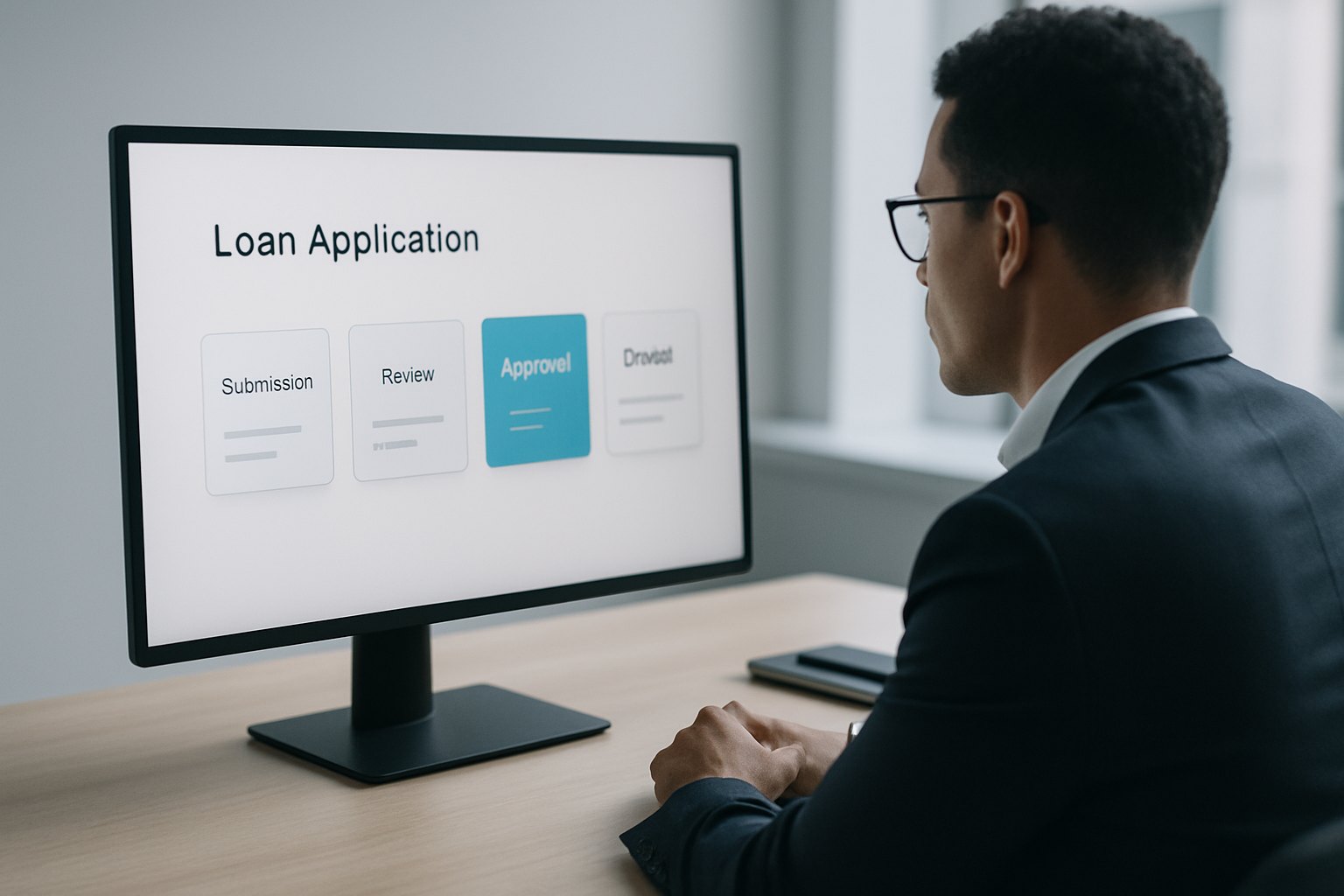
Lending software development produces the loan origination systems and digital lending platforms that automate the full credit life cycle — from borrower application through identity verification, credit scoring, underwriting, regulatory disclosure and disbursement. It is a compliance-first engineering discipline governed by ECOA, TILA, HMDA, FCRA and KYC/AML, where cutting corners on regulation is not a business risk but a legal one. A production LOS costs $120k–$210k to build in 2026; an MVP with core decisioning runs $70k–$110k.
What is lending software development?
Lending software development is the engineering discipline of building the applications that govern how credit is originated, underwritten, approved, disbursed and serviced. The primary output is a loan origination system (LOS) — the system of record that captures a borrower’s application, pulls credit data, runs decisioning logic and produces the disclosure and funding workflow. A broader digital lending platform extends the LOS to include a borrower-facing portal, a loan management system (LMS) for post-origination servicing, analytics and regulatory reporting.
What makes lending software fundamentally different from other business applications is its regulatory surface. Every field on an application form, every rule in a decisioning engine, every timing constraint in a disclosure has a legal counterpart in ECOA, TILA, HMDA or the Fair Credit Reporting Act. Teams that treat compliance as a post-launch add-on consistently find themselves rebuilding from scratch. The best lending software development companies approach it as a broader fintech software development problem — engineering for regulatory correctness from the first architecture diagram, not from the first regulator letter.
The distinction between an LOS and a loan management system matters: an LOS handles origination (decision to fund); an LMS handles servicing (statements, payments, collections, payoff). A full digital lending platform integrates both, with hand-off logic between them at loan funding. Most new lending platforms start with the LOS and extend into servicing as the portfolio grows.
The market context explains the urgency: the global digital lending platform market is estimated to grow from roughly $18.56 billion to $69.87 billion between 2026 and 2035 — a 16.73% CAGR — as lenders migrate origination off paper and legacy core-banking screens onto purpose-built platforms (source: Business Research Insights market-sizing estimate, 2026). That growth curve is why build-vs-buy and compliance-architecture decisions made today are hard to unwind later at volume.
Types of lending software
Lending software is not a single product category — the engineering and compliance requirements differ substantially by loan product. The most common types are:
- Mortgage origination software — highest regulatory density (TRID disclosure windows, RESPA, HMDA reporting); integrates with title, appraisal and closing-agent workflows; typically the most expensive to build custom.
- Consumer and personal loan platforms — unsecured installment lending; emphasis on automated decisioning speed, ECOA adverse-action notices and FCRA permissible-purpose compliance; common for fintech challengers.
- SME and commercial lending — CFPB Section 1071 data collection (small-business lending), covenant tracking, collateral management; longer underwriting cycle than consumer products.
- Auto lending — dealer integration (route-one / DealerSocket APIs), GAP and ancillary product compliance, title lien tracking.
- BNPL (Buy Now Pay Later) — fast decisioning (sub-second for POS integration), Regulation Z disclosure applicability, Reg B considerations for repeated adverse actions.
- P2P and marketplace lending — investor-side waterfall and note issuance in addition to the borrower-side LOS; SEC registration considerations if investor notes are securities.
- Embedded lending — lending capability woven into a non-financial product (e-commerce checkout, B2B SaaS, property management); borrower UX is invisible but compliance obligations are identical.
Core modules of a loan origination system (LOS)
A production LOS is a composite system. The table below lists the core modules, what each does and why it is non-negotiable in a compliant build.
| Module | Function | Compliance driver |
|---|---|---|
| Application intake | Borrower-facing form; captures personal, income and collateral data; validates completeness | ECOA Reg B: cannot ask prohibited basis questions (race, religion, etc.) |
| Document management | Upload, classification, version control and e-signature for pay stubs, tax returns, IDs | ESIGN Act compliance; document retention schedules per FCRA / TILA |
| Credit decisioning / underwriting engine | Pulls bureau data; runs rules-based or ML scoring; renders approve / counter-offer / deny | ECOA / FCRA: adverse-action notice required within 30–60 days of denial |
| Pricing and offer engine | Calculates rate, APR, term, origination fee; generates counter-offers by tier | TILA / TRID: APR disclosure accuracy within 1/8 of 1%; Good Faith Estimate timing |
| Compliance and audit trail | Immutable log of every decision, timestamp and user action; generates required disclosures | ECOA, FCRA, HMDA: exam-ready evidence; CFPB Section 1071 data collection |
| Disbursement | Triggers ACH / wire / check at loan funding; coordinates with core banking or ledger | OFAC screening before any fund transfer; Nacha ACH rules |
| Servicing hand-off | Packages loan tape to LMS; sets payment schedule; initiates welcome disclosure | TILA periodic statement rules; RESPA servicing transfer notices for mortgage |
| Reporting and analytics | HMDA LAR file, fair-lending disparity analysis, portfolio performance dashboards | HMDA annual submission; CFPB Section 1071 data from 2026 compliance date; IFRS 9 provisioning for EU-adjacent lenders |
The loan origination workflow, step by step
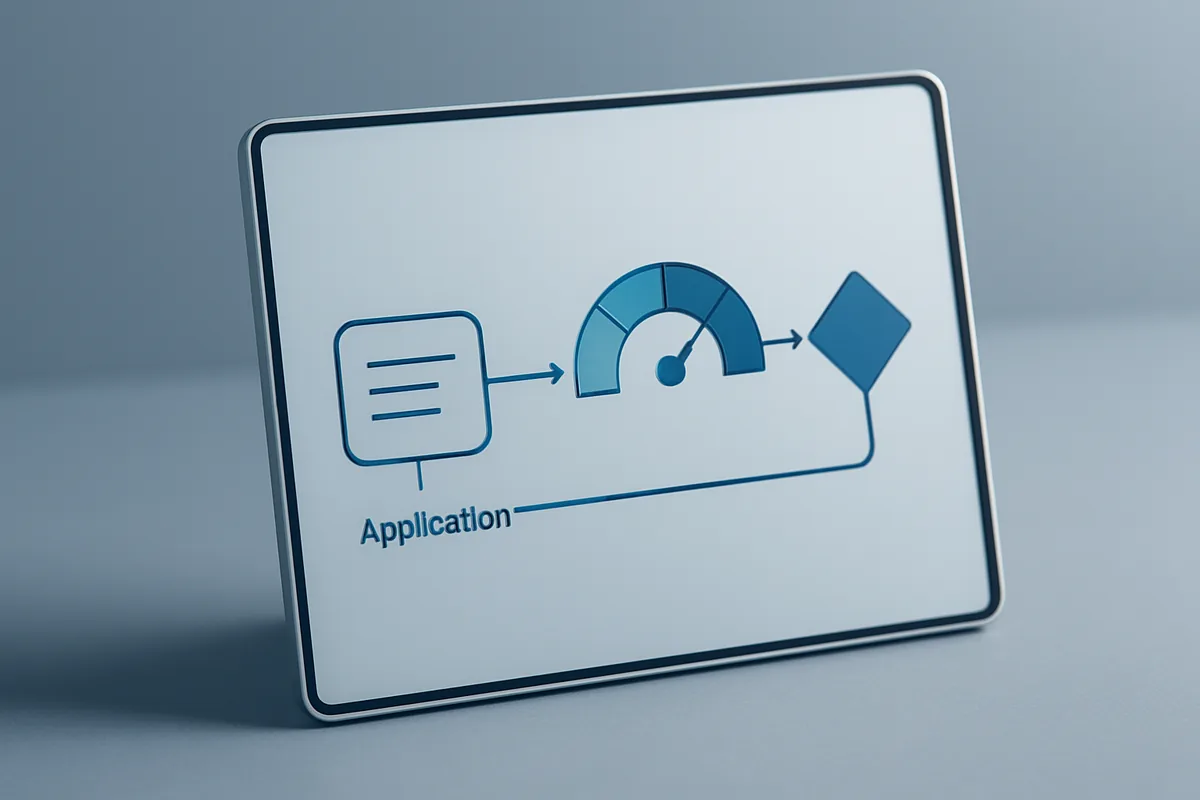
A compliant loan origination workflow is a sequence of gated stages. Each gate must complete before the next opens, and each produces a time-stamped artifact the audit trail must preserve.
- Application submission — Borrower completes the digital form (name, SSN, income, employment, collateral for secured products). The system validates completeness, assigns an application ID and timestamps submission. ECOA “notice of incompleteness” triggers if the file stays open without key information.
- Identity and income verification — KYC checks run against government ID and watchlists (OFAC SDN, FinCEN); open-banking or payroll-API income verification (e.g., Plaid, Argyle) replaces or supplements paper documents. BSA CIP (Customer Identification Program) requirements must be satisfied before credit is offered.
- Credit pull and scoring — Tri-merge or single-bureau credit report (Experian, Equifax, TransUnion); FICO or VantageScore extracted; custom ML model layered on top if the lender has proprietary data. FCRA requires a permissible purpose for every hard pull and disclosure of the report used in any adverse-action notice.
- Underwriting and decisioning — Rules engine applies DTI, LTV, minimum score, program overlays and investor guidelines; ML model produces a probability-of-default score; human underwriter review for edge-case applications. The decision record must capture every input variable used, for fair-lending disparity analysis later.
- Offer generation and disclosures — Approved application generates a Loan Estimate (mortgage, TRID-governed) or Truth-in-Lending disclosure; disclosure must reach the borrower within TILA timing windows (three business days for most mortgage LE). Counter-offers are fair-lending-sensitive: the same counter-offer logic must apply regardless of protected class.
- Acceptance, closing and disbursement — Borrower accepts via e-signature; closing disclosure issued (mortgage: three-day waiting period); funds disbursed via ACH or wire. Final OFAC check runs immediately before disbursement.
- Servicing hand-off — Funded loan packaged to the LMS; payment schedule created; welcome letter with servicer contact details issued per TILA periodic-statement rules. For mortgage products, RESPA §6 governs servicing-transfer notice timing if the servicer differs from the originator.
What compliance does lending software need?
US lending regulation is not optional, and it is not a layer you add at the end — it is the architecture. The table below maps each major regulation to what the software must actually do.

| Regulation | What lending software must do |
|---|---|
| ECOA / Regulation B | Prohibit adverse action based on protected class; generate written adverse-action notice within 30 days (60 for incomplete applications); never ask for race, religion, national origin, sex, marital status or age as decisioning inputs |
| TILA / TRID | Generate Loan Estimate within 3 business days of application; Closing Disclosure 3 business days before consummation; APR disclosure accurate to 1/8 of 1%; TRID applies to most residential mortgage loans |
| HMDA | Collect 48 data fields per covered application (race, sex, income, census tract, etc.); submit annual LAR to the CFPB; data is public, so errors are visible; applies to most mortgage applications |
| CFPB Section 1071 | Collect demographic and pricing data for small-business credit applications; compliance date phased in from 2026 based on origination volume; data submitted to CFPB annually |
| FCRA | Pull credit only with permissible purpose; include credit-score disclosure in adverse-action notices; retain records of credit inquiries; dispute-handling process for consumer corrections |
| KYC / AML / OFAC (BSA) | Customer Identification Program (CIP) before extending credit; OFAC SDN screening on every applicant and on both sides of disbursement; file Suspicious Activity Reports (SAR) within 30 days of detection; FinCEN beneficial-ownership for business lending |
| RESPA | Mortgage-specific: prohibit referral fees; provide Servicing Transfer Disclosure to borrower; handle servicing-transfer notices within RESPA timing windows; applies to federally related mortgage loans |
Note: the above covers US federal law. State-level lending licenses, usury caps, mini-CFPB laws and data-privacy statutes (CCPA in California, GLBA safeguards rules) layer on top. Confirm your full regulatory footprint with qualified legal counsel before architecture decisions.
Security requirements for lending software
Lending platforms collect Social Security numbers, bank-account numbers and income history in one place — a concentrated target that makes security an engineering requirement, not a checklist item. The GLBA Safeguards Rule makes this explicit for financial institutions and their service providers, and most state breach-notification laws treat this data class as high-severity by default.

- Encryption everywhere — AES-256 at rest and TLS 1.3 in transit for every field that touches PII, income data or bank-account numbers, including internal service-to-service calls, not just the borrower-facing form.
- Multi-factor authentication — required for underwriters, compliance reviewers and admin roles; SSO with hardware-key support for staff who can view or export borrower data.
- Field-level tokenization — SSNs and bank-account numbers are tokenized so raw values never appear in application logs, error traces or analytics pipelines.
- Role-based access control scoped to workflow stage — an underwriter reviewing a pending file needs different access than a compliance officer running a fair-lending audit; RBAC should follow the loan through its stages, not just the user's job title.
- Immutable audit logging — every view, edit, export and decision is timestamped and tamper-evident, feeding directly into the compliance and audit-trail module described above.
- Secure API design — signed requests, short-lived tokens and rate limiting on every credit-bureau, KYC and payment-rail integration endpoint, since these are the most common third-party attack surface.
- Documented data retention and deletion — a written policy aligned with FCRA record-retention requirements and state breach-notification law, covering both production data and backups.
These controls have to be designed in from the architecture phase; see common challenges & mistakes below for what happens when security is bolted on after the decisioning engine and integrations are already built.
Key integrations
No lending platform is an island. A production LOS integrates with at minimum five or six external systems, each with its own credentialing, rate limits and data-handling obligations.
Credit bureaus — Experian, Equifax and TransUnion as categories; a tri-merge pulls a single merged report from all three. FICO and VantageScore are provided as add-on scores. Bureau access requires a data-use agreement and FCRA permissible purpose on every call. For a guide to how open-banking data can supplement bureau data for affordability checks, see our open banking API integration guide.
KYC / AML and identity verification — Document scan and liveness check (Jumio, Onfido, Socure as categories), watchlist screening (OFAC SDN, PEP, adverse media). These are API-per-check services; costs run $0.30–$2.50 per verification, which compounds fast at volume.
Core banking / ledger system — If you are a bank or credit union, the LOS must write the funded loan to the core (Fiserv, FIS, Jack Henry) as a booked asset. For fintech lenders operating off a third-party bank’s balance sheet, the integration is to the partner bank’s API.
Payment and disbursement rails — ACH for consumer disbursement and payment collection (Nacha rules); wire for commercial; push-to-debit for same-day consumer credit. For a deep dive on payment API integration patterns, see payment gateway integration guide.
E-signature — DocuSign, Adobe Sign or equivalent; ESIGN Act compliance requires specific borrower consent flows and record retention. Must produce a compliant audit trail of each signature event.
Open banking and income data — Plaid, MX, Finicity (now part of Mastercard) and similar providers give read access to bank transaction history for income and cash-flow underwriting. This supplements or replaces paper pay stubs. Regulatory treatment is evolving under the CFPB’s open banking rulemaking (CFPB 1033).
Technology stack for lending software development
Stack choice in lending software is not just a developer-experience preference: it determines whether the audit trail survives a service failure and how fast a new bureau or KYC integration can go live.

- Backend — Node.js or Python for the decisioning-engine services, rules-engine microservice and bureau/KYC integration adapters; both have mature libraries for the XML and fixed-width formats bureaus still use.
- Frontend — React or Next.js for the borrower-facing application portal and the internal underwriter console, which have different accessibility and data-density requirements and are usually built as separate apps sharing a design system.
- Infrastructure — AWS (or a GovCloud region for federal-adjacent contracts) for encryption-at-rest, VPC isolation between decisioning and public-facing services, and multi-region disaster recovery.
- Event streaming — Kafka or a managed equivalent (AWS Kinesis) to keep the audit trail append-only and durable even if a downstream service fails mid-decision.
- Database — a relational database (PostgreSQL is the common default) as the system of record for applications and decisions, with a document or time-series store for archiving raw bureau and KYC responses.
- Container orchestration — Kubernetes or ECS to scale document-processing and ML-inference workloads independently from the transactional decisioning path.
AI and automation in credit decisioning (2026)
Automated credit decisioning has matured significantly: most lending platforms now blend a deterministic rules engine with an ML-based probability-of-default model, rather than relying on either alone.
Rules engines set hard floors and ceilings — minimum credit score, maximum DTI, LTV caps, program overlays required by investors or insurers. Rules engines are transparent, auditable and regulatorily defensible. They also catch the obvious declines and approvals without consuming expensive ML inference.
ML credit scoring trains on internal loan-performance history plus alternative data (bank transactions, rent payments, utility history) to score borrowers who thin-file or new-to-credit. In 2026, gradient-boosted models (XGBoost, LightGBM) remain the industry standard for production credit scoring, with neural-network architectures gaining traction for large portfolios with dense transaction data (sources: industry estimates based on published lender case studies, 2026).
The ECOA explainability constraint is the key architectural boundary: every adverse action must include principal reasons, in plain language, that the applicant can actually act on. Black-box models that cannot produce human-readable factor codes are non-compliant in the US regardless of accuracy. Most production systems address this with post-hoc SHAP values or a parallel logistic model trained to approximate the ML score — but neither approach has been fully tested in CFPB enforcement, so legal review is required before deployment. Fraud detection models, which are not credit-denial decisions, carry less explainability risk but still require bias testing.
Build vs buy: custom lending software or off-the-shelf LOS?
The right answer depends on how differentiated your risk model and loan product actually are. Here is a structured comparison:
| Dimension | Buy (off-the-shelf LOS) | Build (custom lending software) |
|---|---|---|
| Time to first loan | 2–4 months (configuration) | 5–10+ months (build) |
| Upfront cost | Lower ($20k–$100k implementation) | Higher ($70k–$300k+) |
| Long-term cost | Per-loan SaaS fee scales with volume; vendor dependency | Higher upfront, lower marginal cost at scale; you own the IP |
| Risk-model flexibility | Limited to vendor’s rule engine and supported model formats | Full control; proprietary scoring, alternative data, novel products |
| Embedded lending | Usually requires custom integration layer; UX constraints | Native API-first design; invisible UX possible |
| Best for | Traditional bank / CU; standard mortgage / auto / personal; fast market entry | Fintech challenger; BNPL; P2P marketplace; embedded lending; proprietary data advantage |
How to build lending software: development process
Lending software development follows a compliance-first sequence. Discovery and regulatory mapping must precede architecture; skipping them forces expensive late-stage rewrites.
- Discovery and compliance mapping — Define loan product, target borrower, origination volume and jurisdictions. Map the regulatory stack (federal + state + investor guidelines). Identify which modules are in scope: LOS only, or LOS + LMS + borrower portal? Output: compliance architecture document signed off by legal counsel.
- Architecture design — Event-driven microservices for audit-trail durability; encryption at rest and in transit (AES-256, TLS 1.3); role-based access control for underwriters, reviewers, compliance officers; multi-region database replication for disaster recovery. Data residency decisions matter if serving US states with specific consumer-data laws.
- Decisioning engine build — Rules engine first (transparent, auditable, regulator-friendly); ML model integration second (with explainability layer and bias-testing suite). Deploy as internal API: decision changes without redeployment are a future requirement.
- Integration development — Credit bureau connections, KYC/AML vendor APIs, core banking or ledger, payment rails, e-signature. Each integration requires data-use agreements, credentialing and sandbox testing before production. Budget one to three months per complex integration.
- Security and compliance audit — Penetration test; SOC 2 readiness assessment; FCRA / ECOA compliance review of all adverse-action flows and notice copy; fair-lending regression test over synthetic population. This phase cannot be cut.
- UAT and regulatory review — Underwriter and compliance-officer user-acceptance testing; dry-run HMDA LAR submission; end-to-end disclosure timing verification (TRID windows, adverse-action timing). Legal sign-off on all consumer-facing copy.
- Launch and monitoring — Phased rollout (limited beta, then full); real-time monitoring on decision rates, decline rates, adverse-action timing; fair-lending dashboard watching for disparity by protected class. Alert thresholds set before go-live.
- Iteration and regulatory updates — Regulation changes (CFPB Section 1071 phased dates, state law amendments) require planned dev cycles. Budget $15k–$80k per regulatory-change sprint, recurring.
How much does lending software development cost in 2026?
The table below uses directional 2026 ranges drawn from industry estimates (sources: lendfoundry.com, ideausher.com, acquaintsoft.com cost analyses, 2026). Actual cost varies by scope, team geography and regulatory footprint — these are planning ranges, not fixed quotes.
| Tier | What’s included | 2026 range |
|---|---|---|
| MVP LOS | Application intake, single-bureau credit pull, rules-based decisioning, compliant adverse-action notice, basic disclosure generation, ACH disbursement | $70k–$110k |
| Production platform | Full document management, multi-bureau tri-merge, ML-assisted decisioning, TRID/HMDA reporting, e-signature, borrower portal, audit trail | $120k–$210k |
| Enterprise custom | Proprietary ML risk model, multi-product (mortgage + consumer + commercial), servicing module, investor reporting, fair-lending analytics, SOC 2 Type II scope | $300k–$500k+ |
| Compliance and security | Legal review of adverse-action flows, penetration test, ECOA/FCRA compliance audit, fair-lending regression | $10k–$60k+ |
| Per integration | Credit bureau, KYC/AML vendor, core banking, payment rail, open-banking data provider — each | $5k–$40k each |
Running costs add 20–30% of build cost per year: per-loan SaaS API fees (bureau pulls, identity checks, e-sign), infrastructure, compliance monitoring and regulatory-change dev cycles. A fully-loaded US engineering team building enterprise lending software can run $1.5M–$2.5M per year all-in.
These are third-party industry estimates, not fixed quotes from YuSMP Group. Your actual cost depends on product scope, team location, regulatory jurisdiction and integration count.
Common challenges & mistakes
Most lending platform failures are predictable. These five are the most consistently underestimated:
- Under-scoping compliance from the start. Teams build the application flow and decisioning engine, then discover that adverse-action notices, HMDA data collection and TRID timing windows each require significant engineering. Adding them late means rebuilding data models, disclosure templates and workflow logic — typically doubling the original timeline.
- Credit bureau integration complexity. Bureau APIs are not RESTful JSON — they return dense XML with thousands of possible attribute codes, metro-2 format quirks and bureau-specific field variations. Plan four to six weeks for a single-bureau integration, tested against full edge cases, before you can rely on it in production decisioning.
- Fair-lending and model bias risk. A decisioning model that uses features correlated with protected class (ZIP code as a proxy for race; income patterns correlated with national origin) can create ECOA liability even with no discriminatory intent. Fair-lending regression testing against synthetic protected-class populations is not optional — it must be built into the CI pipeline before launch.
- Data security and PCI-adjacent risk. Lending platforms collect SSNs, income data and bank-account numbers. While not directly in PCI scope, these data types trigger GLBA safeguards rules, state data-breach notification laws and, increasingly, FTC oversight. Encryption, tokenization and access logging must be designed in, not bolted on.
- Scaling servicing independently of origination. Many platforms nail the origination flow and then discover that servicing — payment processing, delinquency management, statements, payoffs — is a different engineering surface of similar complexity. Building origination-only and deferring servicing to manual processes works at low volume but breaks above a few hundred active loans.
Last updated 26 September 2026. Cost and timeline figures are 2026 planning ranges drawn from industry estimates (lendfoundry.com, ideausher.com, acquaintsoft.com) and are offered as general guidance, not fixed quotes. Regulatory references (ECOA, TILA, TRID, HMDA, CFPB Section 1071, FCRA, KYC/AML/OFAC, BSA, RESPA, IFRS 9) are for orientation and are not legal advice — confirm your obligations with qualified legal counsel before making architecture or product decisions. Your actual regulatory footprint depends on loan product, borrower type, volume and jurisdiction.
FAQ
What is lending software development?
Lending software development is the process of designing and building the applications that manage the full credit life cycle — from borrower application intake through identity verification, credit decisioning, underwriting, regulatory disclosure, disbursement and loan servicing. It produces loan origination systems (LOS), loan management systems (LMS) and end-to-end digital lending platforms. Unlike general business software, lending software must be built compliance-first: every screen, data field and decision rule can carry legal weight under ECOA, TILA, HMDA, FCRA, KYC/AML and other regulations that apply to regulated credit products.
How much does it cost to build a loan origination system in 2026?
A minimum viable LOS covering application intake, basic credit decisioning and a compliant disclosure workflow typically costs $70,000–$110,000 to build. A full production lending platform with document management, automated underwriting, reporting and API integrations runs approximately $120,000–$210,000. Enterprise custom lending software with proprietary risk models, multi-product support and regulatory audit trails can reach $300,000 and above. Add $10,000–$60,000 for compliance and security assessments, and $5,000–$40,000 per third-party integration. These are 2026 industry estimates and vary by scope.
What compliance is required for lending software in the US?
US lending software must address: ECOA / Regulation B (adverse-action notices, non-discrimination), TILA / TRID (disclosure timing for residential loans), HMDA (annual mortgage-application data reporting), CFPB Section 1071 (small-business lending data), FCRA (permissible credit-report use and adverse-action requirements), KYC / AML / OFAC under the Bank Secrecy Act, and RESPA for mortgage products. The software must generate, time and retain required notices automatically.
Should I build custom lending software or buy an off-the-shelf LOS?
Buy an off-the-shelf LOS if you are a traditional lender with standard products (mortgage, auto, personal loan) and you need to go live quickly on proven compliance rails. Build custom lending software if you have a differentiated risk model, a novel product (BNPL, embedded lending, P2P marketplace), or you need to embed lending into a non-financial product where a vendor LOS cannot integrate cleanly. Custom also makes sense when lender economics require owning the decisioning IP rather than paying per-loan SaaS fees at scale.
How long does it take to develop a lending platform?
A focused MVP lending platform — application intake, credit pull, basic decisioning and compliant adverse-action flow — typically takes three to five months. A full production LOS with document management, automated underwriting, multi-bureau integration and reporting takes six to ten months. An enterprise digital lending platform with proprietary ML scoring, multi-product support and servicing takes ten to sixteen months or more. Compliance review and UAT add one to two months that cannot be compressed.
What does a lending software development company do?
A lending software development company designs, builds and integrates the full technical stack of a digital lending platform or loan origination system — compliance architecture (ECOA, TILA, HMDA, FCRA, KYC/AML), credit bureau and identity integrations, underwriting and decisioning engine, document management, e-signature, disbursement and payment rails, and the borrower-facing application flow. Lending software development services from a specialist partner include regulatory mapping before coding starts, fair-lending testing in CI, and UAT against actual adverse-action and disclosure scenarios.