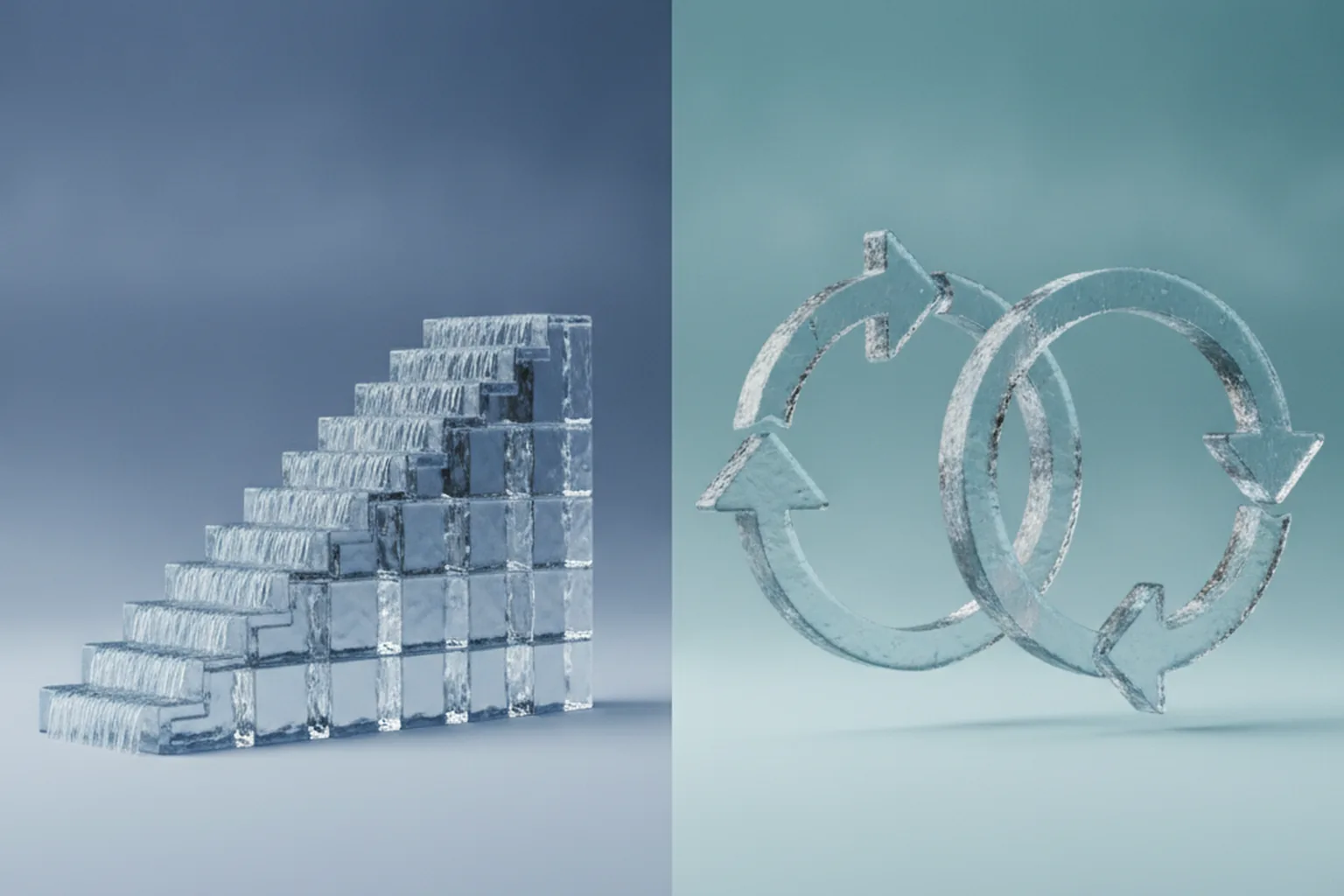

Agile is better when requirements will change and you can ship and learn in increments; Waterfall is better when scope, regulation or contracts are fixed upfront and change is expensive. Most software teams in 2026 run a hybrid: a short plan-driven phase to fix goals, budget and architecture, then iterative delivery with regular demos.
That makes the Agile vs Waterfall question less academic than it looks. The methodology you pick shapes the contract, budget and release plan of any custom software development project: who carries the risk of change, when you first see working software and how much a late idea will cost you.
This guide is written for founders, CTOs and product owners who are buying or commissioning software, not for project management exam candidates. It covers a quick answer, a 12-point comparison table, pros and cons, use cases for each approach, contracts and budgets, cost and timeline shape, risk, hybrid models, working with an outsourced team and a 7-question scorecard you can fill in for your own project.
Agile vs Waterfall: the quick answer
Waterfall plans everything first and delivers once; Agile plans a little, delivers often and re-plans as it learns. Neither is better in general. The right choice depends on how stable your requirements are, how your contract is priced and how often your stakeholders can review working software.
- Agile — iterative and incremental, working software every 1–4 weeks, scope evolves through a prioritised backlog. Choose Agile if you are building a new product, the market or users are not fully understood and someone on your side can make product decisions every sprint.
- Waterfall — linear and sequential, requirements signed off before design and build, one major release at the end. Choose Waterfall if scope is fixed by regulation, a tender or a hardware schedule, and change after sign-off is genuinely expensive.
- Hybrid — predictive planning and governance around agile delivery. Choose a hybrid if you need a fixed budget and milestone plan for the board or the client, but still want to learn from working software during the build.
What is Agile software development?
Agile software development is an iterative, incremental way of building software. Instead of specifying the whole system upfront, the team keeps a prioritised backlog of features and works through it in short cycles — in Scrum these are called sprints and usually last one to four weeks. Each cycle ends with working, tested software that stakeholders can see and use, and the plan for the next cycle is adjusted based on what everyone learned. A product owner on the client side owns the backlog and decides what is most valuable to build next.
The term comes from the Manifesto for Agile Software Development, written in 2001 by 17 software developers who met in Snowbird, Utah. It sets out four values:
Individuals and interactions over processes and tools
Working software over comprehensive documentation
Customer collaboration over contract negotiation
Responding to change over following a plan
The authors added a qualifier that is often forgotten: while there is value in the items on the right, they value the items on the left more. Agile is not “no plan and no documentation”; it is a preference for feedback over prediction. Scrum and Kanban are the most common frameworks for putting these values into practice. For the full picture of roles, ceremonies and practices, see our Agile software development guide and our deep dive into Scrum in software development.
What is the Waterfall model?
The Waterfall model is a linear, sequential approach in which each phase is completed and signed off before the next one starts: requirements, then design, then implementation, then testing, then deployment and maintenance. Work flows in one direction, like water down a series of steps. Project management calls this a predictive approach, because cost, scope and schedule are planned at the beginning and progress is measured against that baseline, typically with milestones and a Gantt chart.
Waterfall’s strengths are clarity and control. Everyone knows what will be delivered and when, documentation is produced as a matter of course, and stage gates give sponsors formal points to approve or stop the project. Its weakness is the mirror image: users see working software late, and any requirement that turns out to be wrong is discovered after much of the budget has been spent. The V-model, common in regulated and safety-critical work, is a variant that pairs each development phase with a matching test phase. For the phase-by-phase detail, see our guide to Waterfall software development.
The waterfall myth: its “inventor” argued for iteration
The Waterfall model is usually traced to Winston W. Royce’s paper “Managing the Development of Large Software Systems”, presented at IEEE WESCON in August 1970. The irony is that Royce never used the word “waterfall” — the label was applied later, and is commonly credited to Bell and Thayer in 1976.
More importantly, Royce did not recommend a single pass through the phases. He described that simple sequence as “risky and invites failure”, because testing comes at the end, when problems are most expensive to fix. His proposed remedy included feedback between phases, early prototyping and building the system twice — “do it twice” — so the first version could expose problems before the real one was built. As David A. Wheeler’s essay on the waterfall myth points out, the strict sequential model was taken from the diagram Royce used to illustrate what not to do.
The practical lesson for buyers: even the “father of waterfall” wanted iteration and early risk discovery. A modern predictive project that builds in prototypes and early integration tests is closer to Royce’s intent than one that saves all testing for the end.
Agile vs Waterfall: head-to-head comparison
The table compares the two approaches on the twelve criteria that most often decide software projects. The sections below explain the commercial and risk rows in more depth.
| Criterion | Agile | Waterfall |
|---|---|---|
| Approach | Iterative and incremental | Linear and sequential |
| Requirements | Evolving, prioritised backlog; detail added just in time | Complete requirements specification signed off upfront |
| Planning horizon | Detailed for the next sprint or two; roadmap level beyond that | Detailed for the whole project from the start |
| Handling change | Welcomed; reprioritised at every sprint boundary | Formal change request, impact analysis and re-approval |
| Delivery | Working increments every 1–4 weeks | Single major release near the end |
| Testing | Continuous, inside every iteration | Dedicated test phase after the build |
| Customer involvement | Ongoing: product owner decisions, sprint reviews and demos | Heavy at the start (requirements) and end (UAT); light in between |
| Documentation | Lightweight and living; enough to build and maintain | Comprehensive; produced and approved at each phase |
| Contract model | Time and materials, or fixed budget with flexible scope | Fixed price with fixed scope |
| Budget predictability | Spend per sprint is predictable; final scope is not fixed in advance | Total price is known upfront; change requests add to it |
| Risk profile | Technical and market risk surfaced early; risk of scope drift | Low ambiguity early; risk of late discovery at integration and testing |
| Best-fit projects | New products, MVPs, SaaS, UX-heavy apps, evolving roadmaps | Regulated builds, fixed tenders, well-understood migrations, hardware-linked work |
In one sentence, the difference between Agile and Waterfall is when you decide: Waterfall decides scope early and pays for change later, while Agile decides scope continuously and pays for that flexibility with less certainty about the final feature list. Every other row in the table follows from that trade-off.
What are the pros and cons of Agile and Waterfall?
Both approaches solve real problems and create others. The lists below are deliberately neutral: an advantage in one context is a drawback in another.
Agile: advantages
- Early, visible progress. Working software every sprint lets you see, test and demo the product long before the end of the budget.
- Change is cheap at the boundary. New insights go into the backlog and can be built in the next sprint without renegotiating the whole project.
- Earlier return. Valuable features can be released to users while the rest is still in development.
- Risk surfaces early. Integration problems, performance limits and usability issues show up in the first iterations, not in the final test phase.
- Client control over priorities. The product owner decides what gets built next, sprint by sprint.
Agile: disadvantages
- Final scope is uncertain. You know what you will spend per sprint, but not exactly which features the budget will cover.
- Demands client time. Without a product owner who is available and empowered, the team stalls or guesses.
- Scope drift. A backlog that grows faster than it is pruned can push budgets and timelines out.
- Thin documentation risk. Teams that misread the Manifesto may leave too little for auditors, new developers or support.
- Harder to fit into fixed-price procurement without a contract designed for it.
Waterfall: advantages
- Predictable scope, price and schedule once requirements are signed off — easy to budget and to approve.
- Strong documentation and traceability, which auditors, regulators and future maintainers value.
- Lower demand on client time during the build phase.
- Clear stage gates and milestones that fit corporate governance and public procurement.
- Works well for well-understood problems where requirements are genuinely stable.
Waterfall: disadvantages
- Late feedback. Users see working software near the end, when change is most expensive.
- Late discovery of defects. Integration and testing happen after the build, so systemic problems surface late.
- Change requests are slow and costly, which can freeze a product that the market has moved past.
- Requirements risk. A specification can be complete, approved and still wrong.
- All-or-nothing value. Little or no business value is delivered until the final release.
When should you choose Agile?
Choose Agile when uncertainty is high and fast feedback is worth more than a fixed feature list. These are the situations where it usually fits best:
A new product or MVP with an unvalidated market
You need to learn what users actually want. Short cycles let you ship a first version, measure and change direction. See our guide to MVP software development.
SaaS with continuous releases
The product is never “done”. Sprints and continuous delivery match a business that ships improvements every week or two.
Stakeholders available every week
Someone on your side can review demos, answer questions and reprioritise the backlog at every sprint boundary.
UX-heavy consumer apps
Success depends on how real users behave, not on a specification. Iterations let you test flows with users and refine them before scaling.
A long-running product with an evolving roadmap
Priorities will shift with the market, competitors and customer requests over months or years. A backlog absorbs that change by design.
When should you choose Waterfall?
Choose Waterfall, or a strongly predictive approach, when scope is fixed by forces outside the team and change after sign-off is genuinely expensive:
Regulated and compliance-driven builds
Medical, financial or government systems where auditors expect documented requirements, design records, traceability and formal approvals.
Fixed-price public tenders
The procurement rules require a defined scope, a fixed price and a milestone plan before the contract is awarded.
Well-understood replatforming or migration
The system’s behaviour is known and the scope is frozen: move it to a new platform without changing what it does.
Hardware or embedded dependencies
Software has to integrate with devices, factories or partners on fixed dates, so the plan must be locked to those milestones.
Small, short projects with complete specs
When the work fits in a few weeks and the requirements are clear and stable, an iterative overhead adds little value.
How does the methodology change your contract and budget?
The methodology decides the contract model, and the contract model decides who carries the risk of change. This is the part of the Agile vs Waterfall decision that most comparisons skip, and the one that matters most when you are buying software from a vendor.
Fixed price, fixed scope is the natural partner of Waterfall. The vendor estimates a detailed specification and commits to a price and a date. That gives you budget certainty, but it has two side effects. First, the vendor prices uncertainty into the quote, because it carries the risk of underestimating. Second, anything outside the signed specification becomes a change request with its own estimate and approval cycle. The quality of the specification is therefore critical; a clear product requirements document (PRD) is the foundation of any fixed-scope deal.
Time and materials (T&M) is the natural partner of Agile. You pay for the team’s actual time, and you decide what they work on every sprint. You carry more of the scope risk, but you get full control of priorities and no change-request overhead. Fixed budget, flexible scope is the middle ground: the total budget or the number of sprints is capped, and the backlog is reprioritised so that the most valuable features are delivered within that cap. Acceptance is tied to agreed criteria for each increment rather than one big handover; see our guide to user acceptance testing (UAT) for how that works in practice.
| Contract model | Fits | Who carries the risk | What to watch |
|---|---|---|---|
| Fixed price, fixed scope | Waterfall; tenders; frozen-scope migrations | Vendor carries estimation risk; client carries the risk of a wrong spec | Risk premium in the quote; change-request rates and process; acceptance criteria |
| Time and materials | Agile; evolving products; long-running teams | Client carries scope and budget risk | Velocity and burn reporting; backlog discipline; an empowered product owner |
| Fixed budget, flexible scope | Agile or hybrid; MVPs; funded roadmaps | Shared: budget is capped, scope adjusts | A clear must-have list; rules for swapping features; review at each sprint |
A practical rule: if your organisation can only approve a fixed number, ask for a fixed budget with flexible scope rather than forcing an agile team into a fixed-scope contract. If the scope really is fixed, accept the predictive model and invest in the specification.
Agile vs Waterfall: cost and timeline comparison
Neither methodology is inherently cheaper. A well-run Waterfall project and a well-run Agile project can cost the same; what differs is the shape of the spend and the moment you get something usable. Four structural differences matter for budgeting:
- When spend happens. Waterfall front-loads analysis and design: a significant part of the budget goes into requirements and architecture before any code is written. Agile spends at a steady rate per sprint from the start, with a shorter discovery phase up front.
- When usable software appears. In Waterfall, the first usable release typically comes after build and test are complete. In Agile, the first increments are usable within the first few sprints, and a release can follow as soon as the minimum valuable set is ready.
- The cost of late changes. In Waterfall, a change after sign-off can ripple back through design, build and test, so the later it comes, the more it costs. In Agile, a change is just a new backlog item; it competes for priority rather than reopening completed phases, though changes to core architecture are expensive in any model.
- Time to market for an MVP. Agile is built for this. In our MVP cost guide we note that a lean MVP is 6–8 weeks and a standard MVP is 10–14 weeks — timelines that assume iterative delivery and active scope control.
The hidden cost in Waterfall is rework discovered late; the hidden cost in Agile is a backlog nobody prunes. Both are management problems more than methodology problems. For a phase-by-phase view of where time goes in a typical build, see our overview of the custom software development process.
Which is less risky, Agile or Waterfall?
Neither is risk-free; they carry different risks at different times. Waterfall lowers ambiguity early and concentrates risk late. Agile spreads risk across the project and exposes it early, but introduces commercial risks of its own.
Waterfall’s main risk is late discovery. Because integration and testing happen after the build, wrong assumptions, integration problems and performance issues tend to appear when most of the budget has gone. This is exactly the problem Royce warned about in 1970. Mitigations:
- Prototype the riskiest parts during design, before the main build.
- Integrate and test critical interfaces early, not only in the final test phase.
- Write testable requirements with explicit acceptance criteria.
- Add intermediate demos at milestones, even if the plan is sequential.
Agile’s main risks are scope drift, budget creep and thin documentation, especially without a strong product owner. Mitigations:
- Name one empowered product owner who owns and prunes the backlog.
- Agree on a release goal and a must-have list, and track burn against the budget every sprint.
- Include documentation, tests and security work in the definition of done.
- Hold real sprint reviews with working software, not slide decks.
For most new software, the risk that hurts most is building the wrong thing. That is why iterative delivery is the default for products, and why predictive models are kept for work where the “right thing” is already defined.
Can you combine Agile and Waterfall? Hybrid models in 2026
Yes — and many organisations already do. According to PMI’s Pulse of the Profession 2024, predictive (waterfall-style) approaches are still the most used at 44% of projects, with hybrid second at 32%. PMI also reports that hybrid use grew from 20% in 2020 to 31% in 2023, a 57% increase, and that 73% of respondents expect hybrid use to increase over the next five years. The “waterfall vs agile” framing is increasingly a question of how to mix the two.
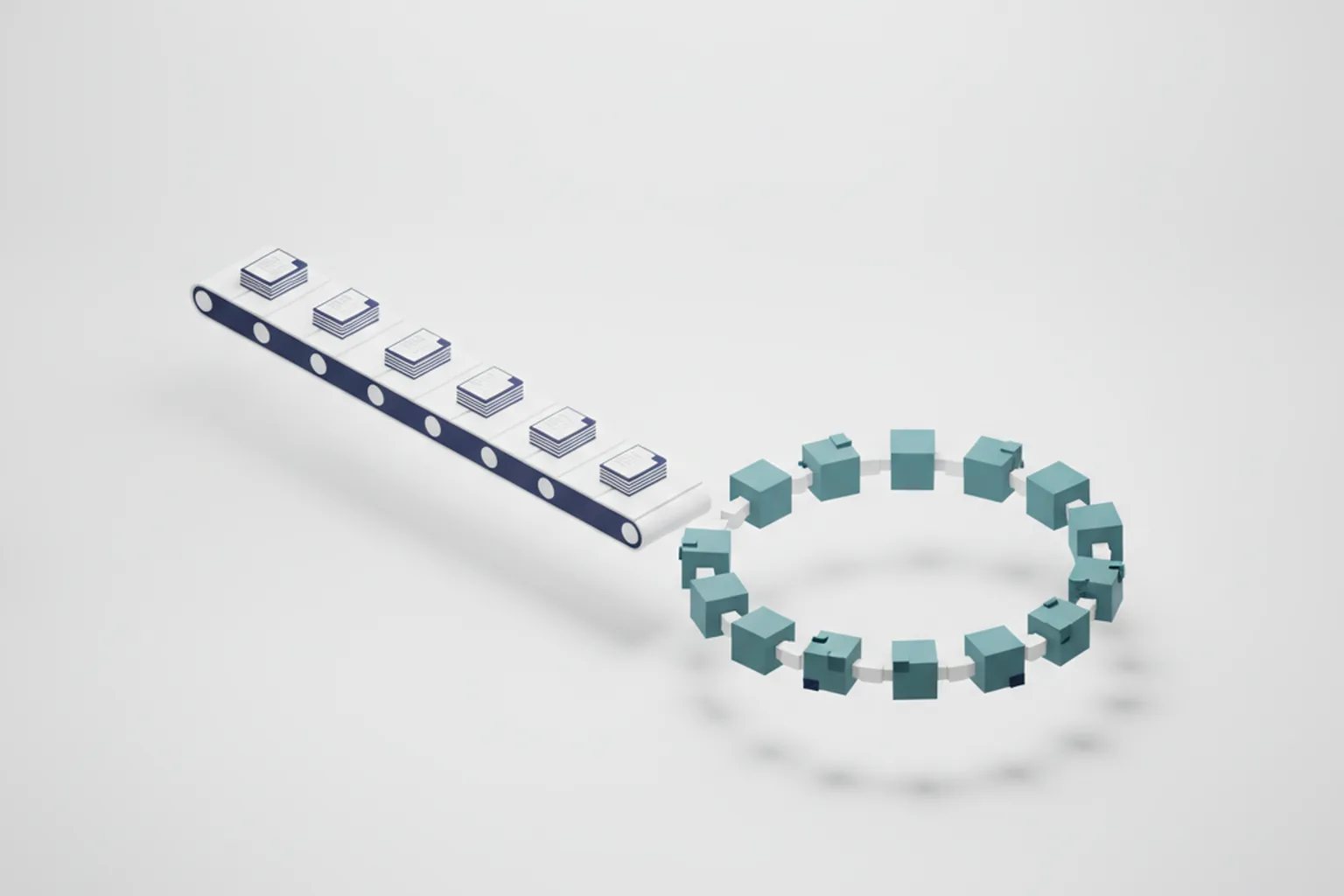
Three hybrid patterns are common in software projects:
- Water-Scrum-Fall. Requirements, architecture and budget are defined upfront (water), the software is built in Scrum sprints (scrum), and release, rollout or certification follows a staged, plan-driven process (fall). It suits enterprises whose governance and operations are predictive but whose engineering is agile.
- Agile delivery inside fixed-milestone governance. The board or client sees a milestone plan with dates and budgets; the team delivers each milestone through sprints and demos. Milestones fix outcomes, sprints decide how to reach them.
- Agile build, predictive rollout. The product is built iteratively, but go-live is planned in detail: data migration, training, cut-over, support. This is common when replacing a system that people use every day.
The risk with any hybrid is getting the worst of both: upfront specification that nobody revisits plus sprints that are just mini-waterfalls. A hybrid works when it is designed on purpose — with clear rules about what is fixed (budget, compliance, release dates) and what is allowed to change (feature priorities, UX details).
Agile vs Waterfall with an outsourced development team
When an external vendor builds your software, the methodology is also your management interface. The same word — “agile” or “waterfall” — can describe very different working arrangements, so ask concrete questions before you sign:
- Sprint demos: how often will we see working software, and can we use it ourselves, not just watch a screen share?
- Backlog ownership: who owns and prioritises the backlog — our product owner or the vendor’s project manager? Can we see it at any time?
- Definition of done: does “done” include code review, automated tests, documentation, security checks and deployment to a test environment?
- Change-request process: for fixed-scope work, how are changes estimated, priced and approved, and how fast?
- Reporting: what do we get each sprint or milestone — burn against budget, velocity, open risks, defects?
- Exit and handover: what documentation and access do we keep if we change vendors or bring the work in-house?
Time zones and communication overhead raise the stakes. An agile engagement with an offshore or nearshore team works when the product owner has regular overlap hours with the team and demos happen on a fixed rhythm. For practical arrangements that make this work, see our guide to offshore agile software development.
Agile or Waterfall? A 7-question decision scorecard
Answer each question for your project. Each answer is either A (points to Agile) or B (points to Waterfall).
- Are the requirements stable and fully known today? No → A. Yes → B.
- Does a regulator or auditor require complete upfront documentation and formal sign-offs? No → A. Yes → B.
- Is a fixed-price, fixed-scope contract mandatory? No → A. Yes → B.
- Can stakeholders review working software and make decisions every 1–2 weeks? Yes → A. No → B.
- Is there real value in releasing part of the product early? Yes → A. No → B.
- Does the project depend on integrations or hardware with fixed external dates? No → A. Yes → B.
- Is the team (yours or the vendor’s) experienced with Scrum or Kanban? Yes → A. No → B.
Scoring: mostly A (5–7) → Agile. Mostly B (5–7) → Waterfall or a strongly predictive approach. A mix (3–4 of each) → a hybrid: fix what the B answers say must be fixed, and run the rest iteratively. Pay extra attention to questions 2 and 3; a firm “yes” to either usually means at least part of the project must be predictive.
Common pitfalls with each methodology
Most failed projects do not fail because the methodology was wrong, but because it was applied badly. The pitfalls we see most often:
- Agile without a product owner. The team is asked to “be agile”, but nobody on the client side has time or authority to set priorities, so decisions are delayed or guessed.
- Waterfall with untestable specs. Requirements like “fast” or “user-friendly” are signed off without acceptance criteria, and disputes start at UAT.
- Fake agile: waterfall in sprints. The work is cut into two-week slices, but nothing is demoed, released or reprioritised. You get the overhead of Agile and the late feedback of Waterfall.
- Skipping documentation entirely. “Working software over comprehensive documentation” does not mean none. Architecture decisions, APIs and operations runbooks still need to exist.
- Choosing by fashion. Picking Agile because it is modern, or Waterfall because procurement prefers it, without checking the project’s actual constraints.
If neither model fits, look at alternatives: flow-based work with Kanban suits support and continuous-improvement teams, and our overview of software development methodologies compares the wider family, including Lean, XP and Spiral.
How YuSMP Group approaches delivery methodology
We don’t start projects with a default methodology. We choose it per project after discovery, based on how stable the requirements are, what the contract and governance require and how much time the client’s product owner can give. In practice, many of our builds combine both: a short, fixed-scope discovery phase that produces the requirements, architecture and a costed plan, followed by agile sprints with regular demos and a backlog the client owns.
For regulated work we keep the documentation and traceability that auditors expect inside the sprint workflow rather than in a separate phase. For new products, including those built through our MVP development service, we keep the scope deliberately flexible so the first release reaches real users as early as possible.
FAQ
What is the main difference between Agile and Waterfall?
Waterfall is a linear, sequential model: requirements are fixed and signed off first, then design, build, testing and release follow one after another, and working software appears near the end. Agile is iterative and incremental: the team works from a prioritised backlog in short cycles of one to four weeks, delivers working software every cycle and adjusts the plan based on feedback. The difference shows up in how change is handled, when risk is discovered and how contracts are priced.
Is Agile always better than Waterfall?
No. Agile is usually the better fit when requirements are uncertain, users need to see software early and a product owner is available every week or two. Waterfall is often the better fit when scope is fixed by regulation or contract, extensive upfront documentation is required, or the project depends on external dates that cannot move. Many teams use a hybrid of the two.
Is Scrum the same as Agile?
No. Agile is a set of values and principles described in the Agile Manifesto of 2001. Scrum is one specific framework for applying them, with fixed-length sprints, a product owner, a Scrum Master and defined events such as sprint planning, reviews and retrospectives. Kanban, Extreme Programming and other approaches are also agile without being Scrum.
Can a fixed-price project be Agile?
Yes, but something else has to flex. The common pattern is a fixed budget with a flexible scope: the price and time box are agreed, and the client reprioritises the backlog every sprint so the most valuable features are built first. A fixed price with a fixed, detailed scope and an agile process tends to fail, because every change becomes a negotiation.
Which methodology is better for an MVP?
Agile is usually better for an MVP, because the purpose of an MVP is to learn from real users quickly and change course based on what you learn. A short, fixed-scope discovery phase to define the first release, followed by agile sprints with regular demos, is a common and effective combination.
Which is better for regulated industries like healthcare or banking?
Regulated projects often need predictive elements: documented requirements, design records, traceability and formal sign-offs, which fit a Waterfall or V-model structure. That does not rule out Agile. Many regulated teams build in sprints and keep compliance documentation, traceability and validation as part of the definition of done, with formal stage gates for audits and releases.
What is a hybrid Agile-Waterfall model (Water-Scrum-Fall)?
A hybrid model combines predictive planning with agile delivery. In the Water-Scrum-Fall pattern, requirements, architecture and budget are defined upfront, the software is built in Scrum sprints, and the release, rollout or certification follows a staged, plan-driven process. PMI's Pulse of the Profession 2024 reports hybrid as the second most used approach after predictive.
Who invented the Waterfall model?
The model is usually traced to Winston W. Royce's 1970 paper Managing the Development of Large Software Systems, presented at IEEE WESCON. Royce never used the word waterfall; the label was applied later, commonly credited to Bell and Thayer in 1976. Royce actually warned that a single pass through the phases is risky and invites failure, and recommended iteration and doing the work twice.
Can you switch from Waterfall to Agile mid-project?
Yes, and it is often the right move when a waterfall project starts to slip or requirements change. Turn the remaining specification into a prioritised backlog, agree on a product owner, start delivering in short iterations with demos, and update the contract so scope can be reprioritised. Expect a transition period of a few sprints while the team and stakeholders adjust.
Verdict: Agile vs Waterfall
The Agile vs Waterfall decision is not about which method is modern or proven. It is about matching the delivery model to the constraints of your project — how fixed the scope is, how the contract is priced and how quickly you need to learn from real users.
- Choose Waterfall if scope is fixed, compliance requires upfront documentation and formal sign-offs, and a fixed-price contract is mandatory.
- Choose Agile if the problem is uncertain, early feedback from users is valuable and a product owner is available to make decisions every sprint.
- Choose a hybrid if you need fixed budgets and milestones for governance but want to learn from working software during the build — the pragmatic default for most custom builds.
If you are unsure, fill in the 7-question scorecard above with your stakeholders. Disagreement on the answers is itself a useful signal: it usually means the requirements are less stable than the plan assumes.