Cross-platform RN apps
React Native 0.76+ with the New Architecture (Fabric renderer, TurboModules, JSI, Bridgeless mode). iOS 15.1+, Android API 24+, with proper adaptive layouts for tablets and foldables.

Services
Senior React Native engineering for funded mobile teams: React Native 0.76 with the New Architecture (Fabric + TurboModules + Bridgeless) enabled by default, Expo SDK 52 where it earns its place and bare workflow where it does not, TypeScript strict, Reanimated 3 + Gesture Handler 2 for 120 fps interactions, native modules in Swift / Kotlin when the JS bridge is the wrong tool, and EAS Build or self-hosted CI shipping TestFlight and Play internal on every merge. We ship React Native that survives the long tail of iOS / Android updates — not demoware. Fixed-scope project tiers, all-in and quoted in USD: an MVP from $3,500 in 4–8 weeks, a production app from $5,800, a full product from $9,200 and a complex app from $11,500. Evaluating the stack first? See our React Native capabilities and when to choose it.

React Native wins when your team already writes TypeScript on the web, when you need to ship iOS and Android from one codebase without compromising on access to native APIs, and when over-the-air updates (OTA) materially change how fast you can fix and ship. We use it for B2C consumer apps that share design systems with a Next.js or React web app, fintech and SaaS mobile companions where 80% of the UI is screens-on-top-of-APIs, and B2B field apps where Bluetooth, BLE, camera, and barcode scanning need real native depth. Our React Native engineers average 7+ years in the React ecosystem, 5+ years in RN specifically, have shipped apps with 10M+ downloads, and have written production TurboModules. We are GDPR-aligned · ISO 27001 ready · SOC 2 Type II in progress. See it in practice in our Grocery Delivery case study.
React Native 0.76+ with the New Architecture (Fabric renderer, TurboModules, JSI, Bridgeless mode). iOS 15.1+, Android API 24+, with proper adaptive layouts for tablets and foldables.
Zustand or Redux Toolkit + RTK Query for state, React Query for server state, React Navigation 7 with native-stack and bottom-tabs, type-safe navigation params via TypeScript strict.
Custom native modules in Swift and Kotlin, JSI-based TurboModules for performance-critical paths, Codegen for type-safe spec files, integration with native iOS / Android SDKs (BLE, NFC, Vision, MLKit).
Auth0, Clerk, Firebase Auth, Cognito, custom OIDC. react-native-keychain backed by Keychain / Keystore, biometric prompts, certificate pinning via react-native-ssl-pinning for high-trust contexts.
WatermelonDB or RxDB for local persistence, MMKV for key-value, custom sync layer or PowerSync, background sync via expo-background-fetch / native BGTaskScheduler, conflict resolution patterns for collaborative data.
Migrating RN 0.65–0.72 onto 0.76 New Architecture, JS bridge onto Bridgeless mode, untyped JS onto TypeScript strict, Expo SDK 47/48 onto SDK 52, bare workflow onto EAS Build, deprecated native modules onto maintained replacements.
1–2 weeks: audit existing repo, decide Expo managed vs bare vs prebuild, decide Zustand vs Redux Toolkit, decide React Navigation vs Expo Router, identify native module dependencies and their RN 0.76 compatibility, write the ADR.
Sprint 1–2: TypeScript strict, ESLint + Prettier + sort-imports, monorepo with pnpm workspaces or Nx if there is a web app sharing code, EAS Build or self-hosted CI on GitHub Actions, Sentry from day one, Fastlane for store release.
Two-week sprints, trunk-based, EAS Update or CodePush for OTA, feature flags via PostHog / LaunchDarkly / ConfigCat, Detox e2e for critical flows + Maestro for smoke tests, Storybook RN for design-system review, OTA updates gated by remote config.
TestFlight and Play internal track on every merge, weekly external beta, OTA hotfix path with audit trail, Sentry triage on-call, monthly review of JS crash-free rate + native ANR + Hermes startup time, quarterly RN SDK upgrade.
Default for React Native work. Fixed scope, fixed budget, all-in USD: an MVP from $3,500 up to a complex app from $11,500. Scope and price signed off before any code is written. Best for a defined app with a clear launch target.
Post-launch growth on the same squad, no recontracting — ship weekly against a rolling backlog toward the next tier. Best for a live app that keeps adding features, roles and integrations after the first release.
One or two senior React Native engineers slotted into your existing squad, your stand-up, your process. Best for filling a known capability gap without disturbing team structure. See staff augmentation.
NDA, DPA, and IP assignment signed before kickoff. CET workday with a 9 AM–1 PM ET overlap for US clients.
React Native work is fixed-scope and all-in, quoted in USD across four project tiers by how far you take the app. We name the exact quote after a free scope assessment — no recruitment markup, no tool surcharges and no hidden fees. You see the line-item budget before any code is written and sign off on it.
MVP
from $3,500
4–8 weeks · first working app
One React Native codebase, the first working app. A single core flow, iOS and Android from one codebase, and a store release. See MVP development.
Normal
from $5,800
production app
Several features, backend integration, offline persistence, product analytics and a store release. The version real users sign up for and use daily.
Optimum
from $9,200
full product
Multiple modules, roles, external integrations, CI/CD pipelines and real-device QA. A complete product with an operator or admin surface.
Advanced
from $11,500
complex app
Native modules, payments, offline-first sync, scale and A/B experiments. Deep native depth in Swift / Kotlin where the JS bridge is the wrong tool.
What moves the number: native-module depth (Swift / Kotlin TurboModules, BLE / NFC / hardware SDKs); the integration count (backends, auth, payments, third-party APIs); offline and sync requirements (offline-first persistence, conflict resolution, background sync); New-Architecture or Old-to-New migration work; and the compliance surface (GDPR data residency, App Store Privacy Manifests, Play Data Safety). NDA, DPA and IP assignment are signed before kickoff at no extra cost. Prices are indicative and are fixed in a written quote for your specific scope. Building for both platforms broadly? Compare mobile app development.
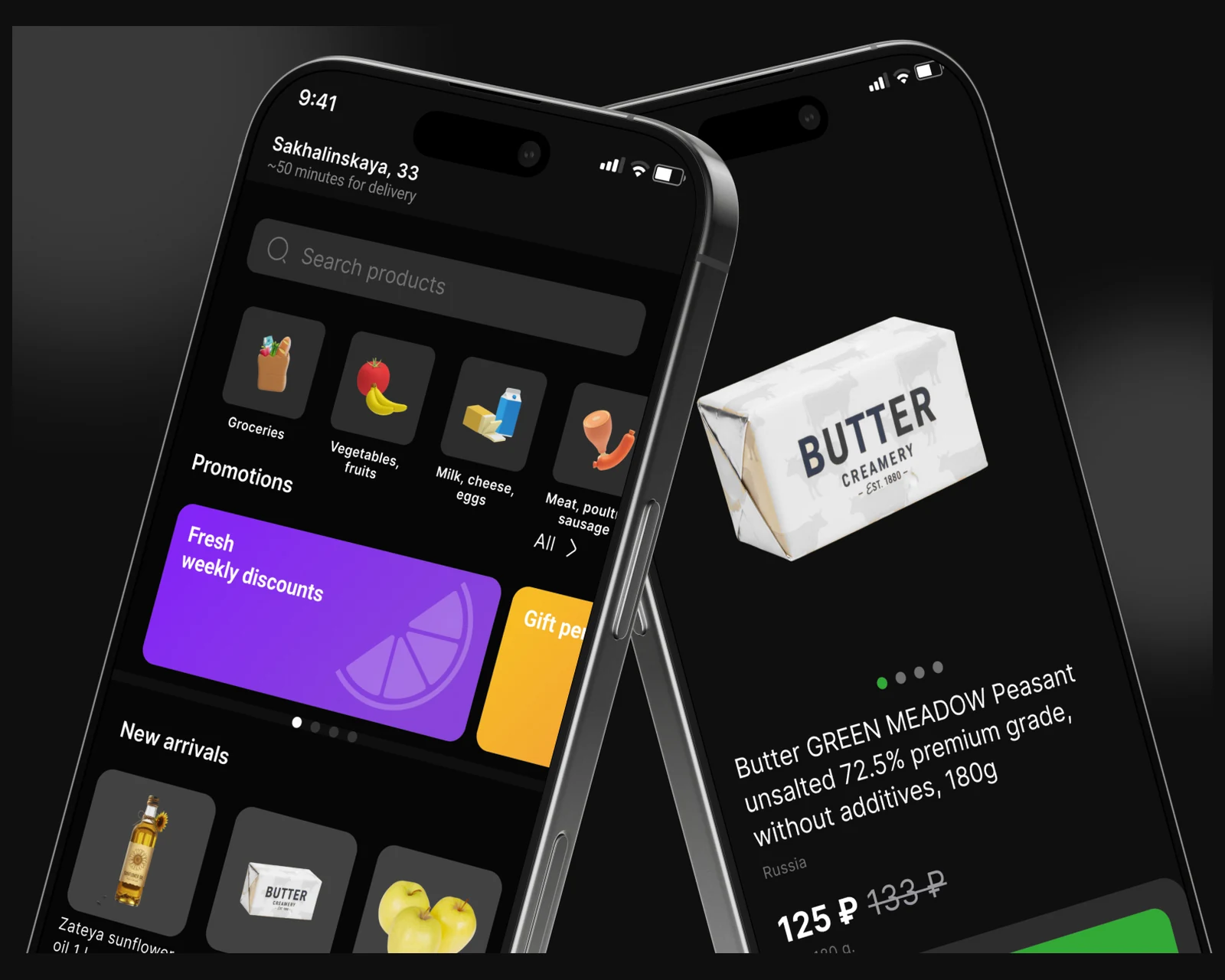
Four coordinated products on one Laravel backend — customer app, picker app, admin panel — with designed-from-scratch logistics.
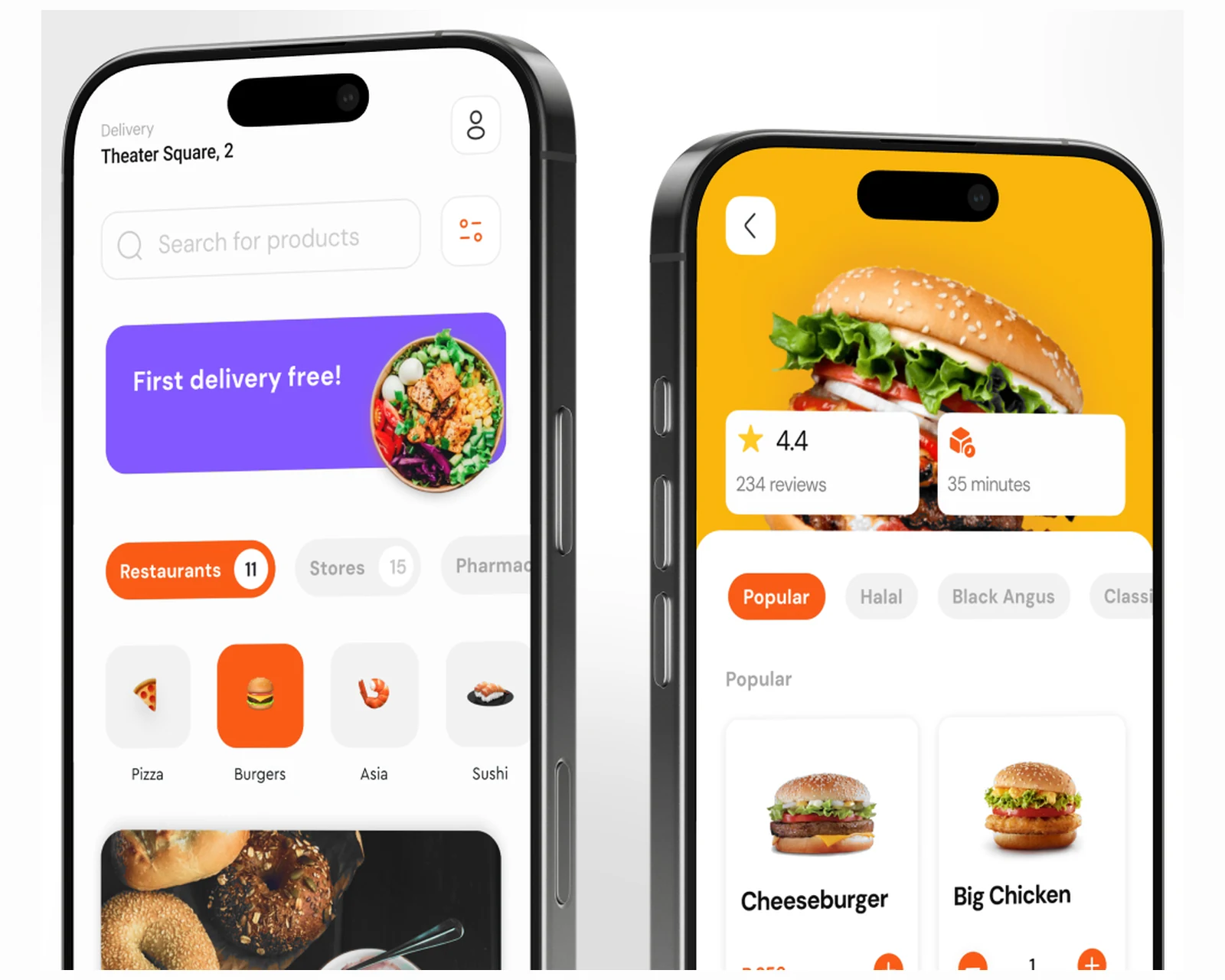
iOS & Android apps, a courier-routing engine, and a multi-role ops panel on a shared Laravel backend — multi-vendor ordering for the US & EU.
GDPR-aligned · ISO 27001 ready · SOC 2 Type II in progress · HIPAA-capable · CCPA-acknowledged
Every engineer on your account has 5+ years of production React Native experience and has shipped on both Old and New Architecture. No bait-and-switch from the senior who sold the deal.
CET-aligned squads with a guaranteed 9 AM–1 PM ET overlap for US clients — four hours of synchronous work per day, async docs for the rest. No 3 AM standups for anyone.
GDPR DPAs, SOC 2 Type I/II readiness, HIPAA controls for US healthtech, CCPA notices, App Store Privacy Manifests, Play Data Safety. The compliance work is built into the sprint, not bolted on before submission.
For regulated workloads we work directly with your auditor or fund's technical advisor and prepare evidence to the standard the reviewer expects — not the standard a generalist consultant assumes.
Our iOS and Android apps had diverged over years of separate development. YuSMP rebuilt a single unified solution with live camera feeds, smart-home device control, and role-based multi-user access. Zero critical defects in the first six months post-launch.
The legacy Android app had years of accumulated debt and no iOS counterpart. YuSMP refactored the existing code, shipped the iOS version, and added live driver tracking and in-app invoicing — all without stopping daily operations for our drivers.
React Native’s shared JavaScript layer and OTA update capability make it a strong choice across industries where fast iteration and team reuse matter. We pair RN engineering with sector-specific compliance and integration knowledge for US & EU clients.
React Native banking and payment apps with react-native-keychain for secure credential storage, biometric unlock via react-native-biometrics, PSD2-compliant Strong Customer Authentication flows, and Stripe React Native SDK integrated in a PCI-scoped data flow. Privacy Manifests (iOS, mandatory May 2024) and Play Data Safety forms are filled against the actual npm package inventory, not a template.
OTA updates via EAS Update let you push critical security fixes to 100% of active users within hours, bypassing the 24–48 hour App Store review window for non-binary changes. For DeFi and crypto products we implement on-device key custody patterns using platform-native Secure Enclave (iOS) and hardware-backed Keystore (Android) via bridged native modules.
FinTech apps →Two-sided marketplaces, loyalty apps, and omnichannel retail platforms where a shared React/React Native design system across web and mobile halves the design and front-end engineering cost. In-app purchases use StoreKit 2 (iOS) and Play Billing Library 7 (Android) through react-native-iap with the new base-plan/offer model for subscriptions. Deep links from push and email campaigns are routed via Universal Links and App Links.
Offline product catalogue caching uses MMKV or SQLite (via op-sqlite) as the local store, with a background sync engine that reconciles with the backend when connectivity returns. Push via APNs/FCM through react-native-notifications drives re-engagement without IDFA-dependent cross-app tracking. We have shipped two-sided marketplace apps in automotive retail (ZipIt), food delivery, and grocery delivery on the same RN codebase.
E-commerce apps →Driver and courier apps where the shared RN codebase across iOS and Android cuts QA effort in half on a device matrix that often spans 50+ Android OEM variants. Background location via react-native-background-geolocation with configurable accuracy/battery trade-offs handles continuous position streaming under Doze mode and OEM power savers. Offline-first with SQLite ensures delivery confirmations are queued and synced when connectivity returns.
Dispatch dashboards use React Native Web alongside the mobile app for a shared component library across mobile and tablet views. ELD/eFTI integrations for hours-of-service regulatory compliance are handled by the same team building the mobile layer. Proof-of-delivery flows capture signatures and photos that sync to the backend the moment connectivity is restored, with GDPR-aligned location data retention policies designed before go-live.
Logistics apps →HIPAA-capable React Native apps integrating HealthKit (iOS) and Health Connect (Android) via native modules written in Swift and Kotlin, since the React Native JS layer cannot call these APIs directly. PHI never enters Sentry, Crashlytics, or Amplitude without scrubbing; EU-region backends default to eu-central-1 or europe-west3 with KMS keys held in the customer account.
ResearchKit-equivalent consent flows are built for clinical study apps, with IRB-ready e-consent screens in TestFlight before first-submission. App Store health-category review guidelines and Play Families policy (for patient-facing apps with under-16 users) are treated as a pre-flight checklist. OTA updates let us push non-binary hotfixes to patient-facing apps faster than a full review cycle when a critical data-display bug is found post-launch.
HealthTech apps →Learning apps where the shared React and React Native design system means the same component library renders on web and mobile, keeping course layouts consistent across student devices. Offline-first content with SQLite caches lesson packs; xAPI and SCORM events fire when connectivity returns. Video playback via react-native-video with adaptive bitrate keeps bandwidth costs low on mobile data plans.
Under-13 (COPPA) and under-16 (GDPR-K) parental-consent flows are built before the first TestFlight build, with no advertising SDKs, no cross-device tracking, and age-gated onboarding that satisfies both app-store platform requirements and GDPR Article 8. OTA update cadence lets teachers receive curriculum updates mid-semester without waiting for an App Store review cycle.
EdTech apps →Mobile companions for SaaS platforms where most engineering already lives in React on the web: sharing hooks, context, validators, and utilities across web and mobile removes the biggest hidden cost of adding a mobile presence. We integrate with Salesforce, HubSpot, Jira, and custom REST/GraphQL backends, with the same team owning client and API so there is no hand-off friction between mobile and backend work.
White-label deployments use React Native config plugins (Expo prebuild) and environment-based builds so one codebase powers multiple branded clients with different app icons, colour schemes, and API endpoints. Push notification strategy for enterprise SaaS is designed for low fatigue: role-based routing, granular opt-in controls per notification type, and an in-app notification centre so critical alerts survive Do Not Disturb settings.
SaaS apps →React Native wins when your team already lives in TypeScript and React on the web (massive code, design-system and engineer reuse), when over-the-air JS updates materially change your release cadence, and when most of your app is screens-on-top-of-APIs rather than custom rendering. Flutter wins for pixel-perfect cross-platform UI parity with custom design systems. Native Swift/Kotlin wins for deep OS integration, AR/VR, and platform-specific premium UX. Kotlin Multiplatform wins for sharing business logic between existing native teams without committing to one UI framework. We run all four practices and recommend honestly during discovery.
React Native 0.76+ is our default and the New Architecture (Fabric + TurboModules + Bridgeless mode) is enabled by default since 0.76 (October 2024) and is production-ready in 2026. We have shipped New-Architecture apps with 2M+ MAU on iOS and Android. Hermes is mandatory (default since 0.70). TypeScript 5 strict. Minimum supported iOS 15.1, Android API 24. We pin RN version per-project, hold one minor release behind latest stable in production, and upgrade quarterly with a dedicated upgrade sprint — never let an RN version sit unsupported.
Yes. Backend defaults to EU regions (AWS eu-central-1, GCP europe-west3, Supabase eu-central-1) with KMS keys held in the customer account. App Store Privacy Manifests (mandatory from May 2024) shipped with every required-reason API and SDK data collection declared — React Native and common RN libraries all need this and we keep an internal compatibility matrix. Play Data Safety section completed against the actual SDK inventory. GDPR consent via UMP or custom CMP, Apple ATT prompt where IDFA is needed. We ship CCPA notices for US consumer products.
Default starting point: Expo prebuild (formerly bare with config plugins). It gives you Expo SDK ergonomics (EAS Build, EAS Update, expo-router) plus the freedom to write native modules in Swift / Kotlin without ejecting. Pure managed when you have zero native module needs and want absolute minimum infra (early MVP, internal tools). Pure bare when you have deep native integrations from the start (custom BLE protocols, hardware SDKs, large existing native codebase to integrate). 80% of our 2026 engagements start as prebuild.
Yes, this is a common engagement. We use the official RN Upgrade Helper and the per-version migration guides as the spine, but each app is bespoke because of native modules. Step 1: audit every native module for New Architecture compatibility — replace unmaintained ones. Step 2: stepwise upgrade 0.68 → 0.71 → 0.73 → 0.76 with green tests at each step. Step 3: enable New Architecture per-platform behind a flag, ship to internal beta, monitor JS crash rate and ANR for two weeks. Typical 60k-LOC app takes 2 to 4 months without a feature freeze.
React Native work is fixed-scope and all-in, quoted in USD across four project tiers. An MVP runs from $3,500 (4–8 weeks): one RN codebase, a first working app with a core flow, iOS and Android, and a store release. A production app starts from $5,800: several features, backend integration, offline persistence, analytics and a store release. A full product starts from $9,200: multiple modules, roles, external integrations, CI/CD and real-device QA. A complex app starts from $11,500: native modules, payments, offline-first sync, scale and A/B. The exact number depends on native-module depth, integration count, offline and sync requirements and compliance surface. You see the line-item budget before any code is written. All engagements include a CET workday with a 9 AM–1 PM ET overlap for US clients and NDA, DPA and IP assignment signed before kickoff.
Push via react-native-notifications (Wix) or @notifee/react-native for rich media, action buttons, and background handlers. APNs certificate and FCM server key are managed through EAS Credentials or the project’s own keystore — we never hold production push credentials. Deep links use Universal Links (iOS, apple-app-site-association on HTTPS server) and Android App Links (assetlinks.json) for secure verified linking, with react-navigation URI-scheme routing for internal navigation. Campaign attribution uses AppsFlyer or Adjust with ATT-prompt timing designed to maximise opt-in rate before ATT is shown (not the first screen the user sees).
Three-layer testing: Jest for pure JS business logic and hook testing with react-native-testing-library for component unit tests (fast, no device required); Detox for end-to-end flows on simulators and real devices (covers navigation, form submission, deep link handling, and permission dialogs); and EAS Build cloud builds run against the Expo / React Native device matrix for real-device crash detection. Detox tests run in CI on every PR. For regulated industries (HealthTech, FinTech) we add a security pass: OWASP MSTG checks for data-at-rest encryption, certificate pinning verification, and network traffic analysis via Proxyman.
Default stack in 2026: Zustand for global UI state (lightweight, no boilerplate), TanStack Query (React Query) for server state with automatic caching, revalidation, and optimistic updates, and MMKV or SQLite (op-sqlite) for persisted offline state. Redux Toolkit is used on existing codebases where a migration would exceed the benefit. Context API is fine for low-frequency global values (theme, user session) but not for high-frequency state that causes full-tree re-renders. We avoid prop drilling past two levels and use Zustand slices to keep domain logic isolated. The state architecture is documented and reviewed in the discovery phase, not decided during sprint 2.
Yes, that is the primary value proposition. One JavaScript and TypeScript codebase produces an iOS IPA and an Android APK/AAB, both submitted from the same repo. EAS Build handles the native build process, code signing (Fastlane Match or EAS Credentials for iOS, Keystore for Android), and can submit directly to App Store Connect and Google Play via EAS Submit. The main per-platform work is in native module bridging, permission handling (iOS purpose strings vs Android permissions manifest), and store-specific UI conventions (Human Interface Guidelines vs Material 3). We test on both platforms every sprint to catch platform divergence early, not at submission time.
Payment processing: Stripe React Native SDK, Adyen Drop-In, Apple Pay and Google Pay via react-native-payments. Maps and location: react-native-maps (Google Maps / Apple Maps), Mapbox GL, react-native-background-geolocation. Auth: react-native-app-auth (OAuth 2.0 / OIDC), Sign in with Apple, Google Sign-In, Firebase Auth. Analytics: Firebase Analytics, Amplitude, Mixpanel, AppsFlyer. Real-time: WebSocket clients, Socket.io, and Pusher for live data flows. Media: react-native-video, ExoPlayer bridge (Android), AVPlayer bridge (iOS), expo-image-picker, react-native-camera. Enterprise: Salesforce Mobile SDK, SAP BTP, Microsoft Authentication Library (MSAL).
With the New Architecture (Fabric + TurboModules + Bridgeless, default since RN 0.76), the synchronous bridge that was the main source of JS-thread jank is replaced with JSI — native calls from JS are direct and synchronous where needed. For animations and gestures we use react-native-reanimated (worklets that run on the UI thread, never cross the bridge) and react-native-gesture-handler (recognisers on the native side). Heavy computation (image processing, cryptography, large JSON transforms) moves to a worklet or a native module. FlatList virtualization, React.memo, and useMemo/useCallback are applied at the component level. We profile with Flipper, Reactotron, and the React DevTools Profiler, and gate every PR on a Detox performance benchmark on a mid-range Android device.
Practical guides on React Native, Flutter, and cross-platform mobile development.



Share a few details and a senior consultant will reply within one business day.