

Choosing a Ruby on Rails software development company is a decision about the engine room of a web product: the application, APIs, data model and background jobs that your users actually touch every day. Rails has spent nearly two decades earning a reputation as the fastest way to turn an idea into a working, database-backed web app — it is the framework behind Shopify, GitHub, Basecamp and a long tail of profitable SaaS businesses. The right partner brings genuine framework depth, disciplined delivery and an engagement model that fits how your team works, whether you are shipping a first MVP or modernizing a five-year-old codebase. If you are scoping a Rails partner for custom web application development, the questions below are the ones that separate a specialist from a generalist who happens to know some Ruby.
This guide is deliberately not another "top 12 vendors" list. Instead it gives you the decision framework: what a Ruby on Rails development company delivers, why Rails is still a smart default for a large class of web products in 2026, when it is the wrong tool, honest cost ranges by region, how Rails compares to Node.js, Python and PHP, and how to run the selection. By the end you should be able to scope a build, brief a shortlist and read a proposal critically — whether you engage YuSMP or anyone else.
One clarification up front, because it shapes everything below: Rails is opinionated by design. Its guiding philosophy — convention over configuration — means the framework makes the boring decisions for you, so a small team can move remarkably fast without reinventing project structure, database access or routing on every job. That speed is why founders reach for Rails, and it is exactly what you are evaluating when you assess a Ruby on Rails software development firm's depth.
TL;DR — hiring a Ruby on Rails software development company in 2026
A Ruby on Rails software development company designs, builds and maintains web apps, APIs and SaaS platforms in Ruby on Rails (RoR), using convention over configuration, the Active Record ORM and the mature gem ecosystem. In 2026 Rails remains a top choice for CRUD-heavy web products, SaaS and MVPs that need speed to market. Choose a partner on Rails 8 and SaaS depth, not price alone; expect blended rates of roughly $25–$200/hour by region and a typical mid-size build of $75k–$200k.
What is a Ruby on Rails software development company?
A Ruby on Rails software development company designs, builds, integrates and maintains web applications, APIs and SaaS platforms written in Ruby on Rails — often abbreviated RoR. Beyond writing code, a good Rails partner owns architecture, performance, security, testing and cloud deployment, delivering a production system rather than a prototype. Rails is a full-stack web framework built on the Ruby language and the model-view-controller (MVC) pattern; it bundles an object-relational mapper (Active Record), routing, templating and testing into one coherent whole, so the company you hire is buying into a set of proven conventions rather than assembling a stack from scratch.
The value a specialist adds over a generalist agency is concentrated in Rails' conventions and ecosystem. A dedicated Ruby on Rails development firm knows how to model a database cleanly with Active Record, when to reach for a gem versus writing bespoke code, how to structure background jobs so they don't melt under load, and how to ship and upgrade Rails safely — knowledge that is expensive to acquire and easy to fake in a sales call. Because Rails is so opinionated, the gap between a team that follows its grain and one that fights it shows up quickly as either fast, maintainable delivery or a tangled codebase your own engineers dread inheriting.
How Rails is structured: MVC, Active Record and gems
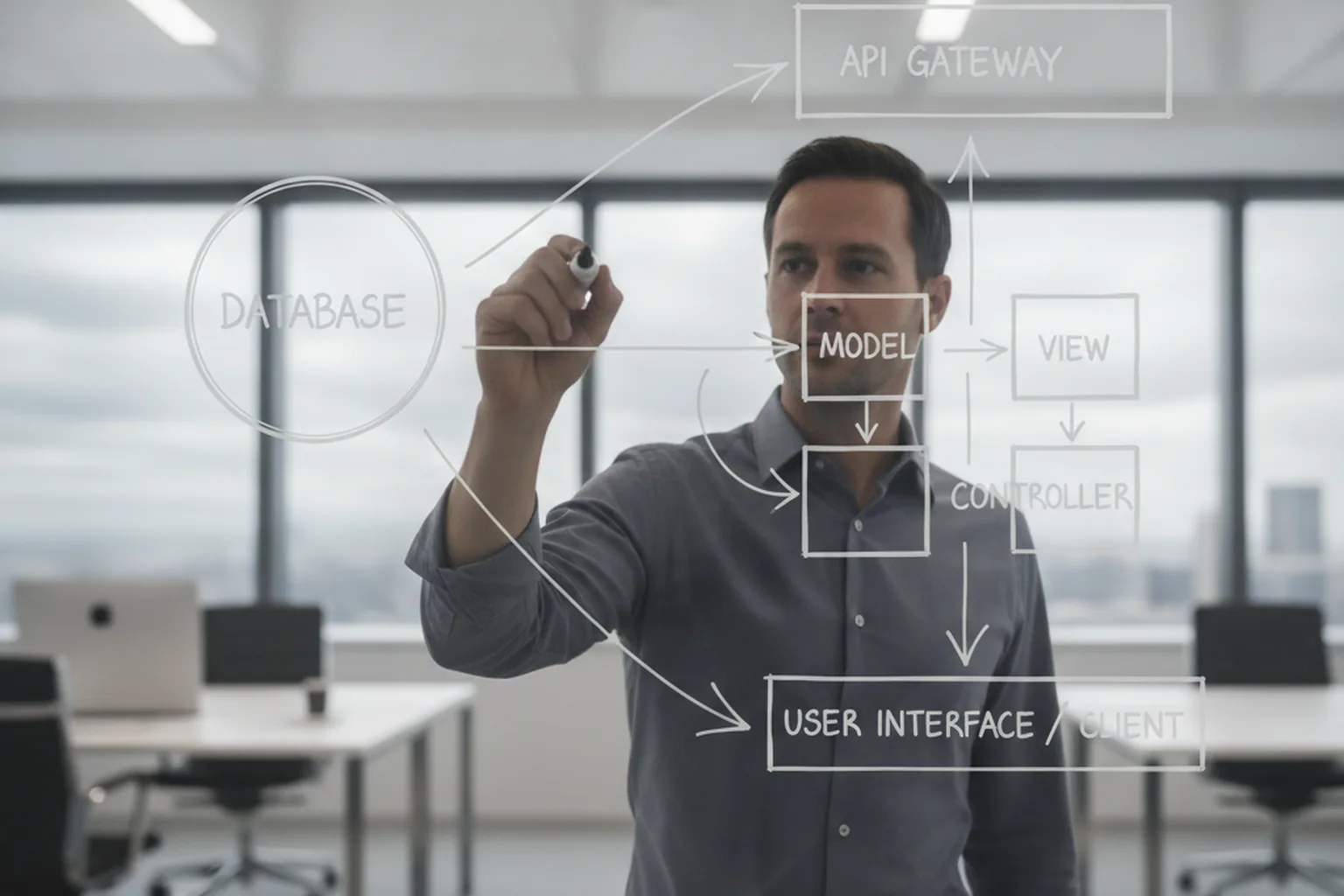
Rails organizes an application around the model-view-controller pattern, which keeps data, presentation and request-handling logic in clearly separated layers. Models (via Active Record) map database tables to Ruby objects and hold business logic; controllers handle incoming requests and orchestrate responses; views render the HTML, JSON or Turbo frames the user sees. On top of this sits the gem ecosystem — thousands of reusable libraries (RubyGems) for authentication, payments, background processing, admin panels and more — which is the practical reason Rails teams ship features so quickly. Understanding this structure matters when you hire, because a strong partner uses conventions and battle-tested gems where they fit and writes custom code only where your product is genuinely different.
What does a Ruby on Rails development company do? (core services)
A Ruby on Rails development company typically offers a spread of services covering new product builds, backend engineering, modernization and maintenance — all on the Rails stack. The categories below are the Ruby on Rails software development services you will see on most credible partners' menus; a strong company can explain how it delivers each one, not just list it. These are also the ROR software development services buyers most commonly scope.
- New product & MVP development. Standing up a Rails application from a blank repository — data model, auth, payments, core workflows — and shipping something investors and early users can touch in weeks, not months.
- API & backend engineering. Rails API-only applications, REST and GraphQL endpoints, and integration layers that power web front ends, mobile apps and third-party systems.
- Legacy Rails modernization & upgrades. Migrating older Rails 4/5/6 apps to Rails 7 or Rails 8, replacing unmaintained gems, upgrading Ruby versions, and re-platforming onto modern deployment tooling.
- Maintenance, code audit & performance tuning. Ongoing support, dependency and CVE patching, database and query optimization, and health audits of an inherited codebase.
- SaaS & multi-tenancy engineering. Subscription billing (Stripe), tenant isolation, role-based access control and the recurring-revenue plumbing that B2B SaaS products depend on.
- Front-end integration with Hotwire. Modern, reactive interfaces using Hotwire (Turbo and Stimulus) that deliver a single-page feel without a heavy separate JavaScript framework.
The strongest firms deliver these as full-cycle work — discovery, architecture, build, QA, deployment and long-term support under one roof — which matters most on SaaS and modernization projects, where the hand-offs between "who built it" and "who runs it" are exactly where products fail. For a language-agnostic view of the layer Rails sits in, see our primer on back-end development.
Why choose Ruby on Rails in 2026?
Choose Ruby on Rails in 2026 when your project is a database-backed web application or SaaS product that needs to reach the market fast without a large team — it is one of the most productivity-optimized frameworks available. Rails' strengths compound: strong conventions remove decision fatigue, a vast ecosystem means most plumbing already exists, and secure defaults ship in the box. The reasons below are why founders and product teams keep reaching for it.
- Convention over configuration. Rails makes the routine decisions — file layout, naming, database access, routing — so engineers spend their time on your product, not on boilerplate. This is the single biggest driver of Rails' speed.
- Speed to market. Rails teams routinely ship a working MVP substantially faster than lower-level stacks; industry write-ups in 2026 commonly cite development-time savings on the order of 25–40% for CRUD-heavy web apps versus assembling an equivalent stack from scratch (developer-productivity comparisons, 2026 — treat as directional, not a guarantee).
- A mature gem ecosystem. Authentication, payments, background jobs, admin dashboards, search and more are available as well-maintained gems, so you buy proven building blocks instead of writing them.
- Built-in security defaults. Rails ships protections against SQL injection, cross-site scripting and CSRF, plus encrypted credentials and strong parameters — sane defaults that a good team builds on rather than bolts on.
- SaaS-ready out of the box. Between Stripe gems, multi-tenancy patterns and role-based access control, Rails is an unusually direct path from idea to a billable, multi-tenant SaaS platform.
- Cost-effective for startups. Because a small team delivers more per sprint, Rails lowers the total engineering cost of getting to a real, revenue-generating product — which is why so many funded startups still choose it.
Rails 8 and what's new for 2026
Rails 8, released in late 2024, is the most relevant recent release because it doubled down on the framework's "one person can build it" ethos and simplified production deployment. It ships Solid Queue, Solid Cache and Solid Cable — database-backed replacements that let many apps run background jobs, caching and websockets without a separate Redis instance — and it makes Kamal the default tool for deploying a containerized Rails app to your own servers. The practical takeaway for buyers is that a current Rails 8 team can stand up and operate a production app with less moving infrastructure than a few years ago; asking a prospective partner how they use Rails 8's deployment and Solid stack is a quick, honest test of whether they are current.
When is Rails the right (and wrong) choice?
Rails is the right choice for CRUD-heavy, database-backed products — SaaS, marketplaces, internal tools and MVPs — where third-party integrations and background jobs matter more than raw compute; it is the wrong choice for CPU-bound number-crunching or heavy real-time streaming. Being honest about this trade-off is itself a mark of a good partner, so weigh both sides before you commit.
Rails shines when your product is a web application with a rich data model, forms and workflows, subscription billing, and integrations with payment, email and CRM services. It rewards teams that value speed of iteration and a conventional structure any Rails engineer can pick up. It is a natural fit for startups and scale-ups that need to validate and grow a product quickly.
Rails is a weaker fit when your core workload is CPU-bound (heavy data crunching, large-scale numerical computing), demands microsecond latency, or is dominated by highly concurrent real-time connections such as live chat or collaborative editing — areas where an event-driven runtime like Node.js is a more natural fit. The other honest cons: Ruby's runtime speed and memory footprint trail compiled languages, the talent pool is smaller than JavaScript's, and Rails' conventions, if abused, can produce tightly coupled "fat models" that are hard to untangle. None of these are dealbreakers for the products Rails targets — but if your system lives at those edges, a specialist should tell you so rather than force-fit the framework.
What is Ruby on Rails used for? (use cases)
Ruby on Rails is used for database-backed web applications and SaaS platforms across almost every industry — anywhere a team needs to ship a data-rich product quickly and iterate. The list below covers the domains where a specialist Ruby on Rails software development company is most often worth the premium.
- Multi-tenant B2B SaaS. Subscription products with tenant isolation, billing and RBAC — Rails' sweet spot. Our guide to multi-tenant SaaS architecture covers the patterns Rails teams use.
- Marketplaces & booking platforms. Two-sided marketplaces, rentals and reservation systems that are heavy on listings, search, payments and notifications.
- E-commerce. Custom storefronts and commerce back ends (Rails powers Shopify's origins and the Solidus/Spree ecosystems) where bespoke workflows outgrow off-the-shelf platforms.
- Social & community apps. Feeds, profiles, messaging and moderation — CRUD-rich products where Rails' conventions accelerate delivery.
- Internal business tools & dashboards. Admin platforms, operations tooling and complex-database line-of-business apps that benefit from Rails' admin gems and Active Record.
- Startup MVPs. First versions of funded products that need to reach real users fast and then scale into the production system without a rewrite.
Ruby on Rails vs Node.js, Python/Django & PHP/Laravel
Ruby on Rails competes most directly with Node.js, Python's Django and PHP's Laravel — and the honest verdict is that all four can build a great web app, so the right choice is about workload fit and team, not a universal winner. Rails leads on convention-driven speed for CRUD-heavy products; Node leads on real-time concurrency; Django leans into data and AI/ML adjacency; Laravel dominates cost-sensitive PHP hosting. The table below summarizes the trade-offs.
| Framework | Best for | Performance profile | Dev speed | Talent pool |
|---|---|---|---|---|
| Ruby on Rails | CRUD-heavy web apps, SaaS, marketplaces, MVPs | Great for I/O-bound web work; weaker at raw compute | Very fast (convention over configuration) | Smaller but senior-heavy |
| Node.js (Express/Nest) | Real-time, streaming, high-concurrency apps | Excellent concurrency; event-driven, non-blocking | Fast; less opinionated, more assembly | Very large (JavaScript) |
| Python / Django | Data-heavy apps, AI/ML-adjacent products | Comparable to Rails; strong data stack | Fast; batteries-included like Rails | Very large |
| PHP / Laravel | Cost-sensitive web apps, content sites, SMB SaaS | Good; cheapest, most ubiquitous hosting | Fast; elegant, Rails-inspired | Largest of all |
In practice, teams often mix stacks: Rails for the core application and a small Node service for real-time features, for example. If you are weighing the alternatives seriously, our guides to hiring a Python software development company and evaluating .NET development cover those ecosystems in the same buyer's-guide depth, so you can compare like with like.
Ruby on Rails development cost & rates in 2026
In 2026, hiring a Ruby on Rails software development company costs roughly $25–$200 per hour depending on region and seniority, with a typical mid-size application landing between $75,000 and $200,000. The single biggest variable is where the team sits; the second is how much custom, integration-heavy work your product needs. Treat every figure here as a 2026 market estimate for planning, not a quote — actual pricing depends on scope, seniority mix and engagement model.
| Region | Typical 2026 hourly rate (Rails) | Notes |
|---|---|---|
| North America (onshore) | $100–$200 | Highest rates; maximum time-zone overlap for US clients |
| Western Europe | $80–$150 | Strong overlap with EU clients; deep senior Rails talent |
| Eastern Europe / nearshore | $40–$75 (senior) | Strong engineering pool; staff augmentation saves ~40–60% vs US |
| Offshore (Asia / LatAm) | $25–$50 | Lowest cost; manage for overlap, seniority and code quality |
On a whole-project basis, budgets cluster into three bands:
- MVP or single service: $25,000–$75,000 — a focused Rails application with a clear, bounded scope, auth, payments and a core workflow.
- Mid-size application: $75,000–$200,000 — multiple features, real integrations, subscription billing, a data layer and a production-grade cloud deployment.
- Large or enterprise platform: $200,000+ — multi-team, multi-year systems with complex data, high availability and compliance requirements.
Pricing models also move the number. Fixed-price suits well-specified projects with stable requirements; time-and-materials fits exploratory or evolving scope; a dedicated team or retainer amortizes onboarding over months and is the usual choice for ongoing SaaS work. Nearshore and offshore staff augmentation can cut the hourly rate by 40–60% versus US onshore hiring while keeping strong engineering quality — provided you manage for seniority and time-zone overlap. For a language-agnostic breakdown of the drivers behind these numbers, see our software development cost benchmarks for 2026.

How to choose the right Ruby on Rails company (checklist)
Choose a Ruby on Rails software development company on demonstrated depth in your kind of product — SaaS, marketplace or modernization — backed by relevant case studies, not on the lowest hourly rate. The wrong partner shows up as missed deadlines, fragile background jobs and a codebase your own team dreads inheriting; the right one behaves like an extension of your engineering org. Work through this checklist when you evaluate a Rails software development company or firm.
- Seniority & code discipline. Confirm senior Rails engineers lead the work, and ask to see how they structure models and services — a team that avoids "fat models" and writes tests is one whose code you can maintain.
- Domain experience. Look for delivered Rails systems in your domain — SaaS, marketplace, fintech, e-commerce — at similar scale, and ask for references you can call.
- Rails 8 & Hotwire currency. Ask how they use Rails 8's Solid stack and Kamal, and whether they build reactive UIs with Hotwire; currency here signals a team that keeps learning.
- Security track record. Confirm secure coding, dependency and CVE scanning, encrypted credentials and clear intellectual-property and data-ownership terms.
- Engagement models. A capable partner offers time-and-materials, fixed-price and dedicated-team options and can switch as your needs change; rigid commercials are a warning sign. Our guide on how to hire a dedicated software development team covers the operating model in depth.
- Testing & delivery process. A team that can walk you through its test suite (RSpec/Minitest), CI/CD and how it handles Rails upgrades will hand you a maintainable system.
- Red flags. No automated tests, no senior on the call, vague IP terms, a price far below regional norms, or a partner who never says "Rails isn't the right fit here" — treat any two or more as a reason to keep looking.
Is Ruby on Rails still worth it in 2026?
Yes — Ruby on Rails is still worth it in 2026 for the right product profile, and reports of its death are marketing, not engineering. Rails powers Shopify, GitHub, Basecamp and thousands of profitable SaaS businesses, and Rails 8 shows a framework that is actively investing in developer productivity and simpler operations, not coasting. The active community, mature gem ecosystem and a senior-heavy talent pool mean you can staff, ship and maintain a Rails product with confidence.
The honest caveat is fit. Rails' talent pool is smaller than JavaScript's, and it is not the tool for CPU-bound compute or heavy real-time streaming — so choosing Rails should be a deliberate, fit-for-purpose decision rather than a default. For the database-backed web apps, SaaS platforms and MVPs that make up the bulk of real-world web software, though, Rails remains one of the fastest, most cost-effective ways to build and grow a product. If that describes your build, a specialist Ruby on Rails software development company is a very sound bet — and a good one will tell you honestly when it is not.
FAQ
What is a Ruby on Rails software development company?
A Ruby on Rails software development company designs, builds, integrates and maintains web applications, APIs and SaaS platforms written in Ruby on Rails (often abbreviated RoR). In practice that means new product and MVP development, API and backend engineering, legacy Rails upgrades and modernization, and ongoing maintenance, code audits and performance tuning. A specialist firm brings deep framework, convention-over-configuration and deployment expertise across the Ruby gem ecosystem that a generalist agency typically cannot match, and usually offers dedicated teams, staff augmentation or fixed-price projects.
How much does Ruby on Rails development cost in 2026?
In 2026, Ruby on Rails developer hourly rates vary widely by region: North America runs roughly $100–$200/hour, Western Europe about $80–$150, Eastern Europe and nearshore around $40–$75, and offshore roughly $25–$50 (2026 market estimates). On a project basis, a Rails MVP or single service usually runs $25,000–$75,000, a mid-size application $75,000–$200,000, and a large or enterprise platform $200,000 and up. These are 2026 market estimates for planning, not fixed quotes; actual pricing depends on scope, seniority mix and engagement model.
Is Ruby on Rails still worth using in 2026, or is Rails dead?
Ruby on Rails is not dead and remains a strong choice in 2026 for the right product profile — CRUD-heavy web apps, SaaS platforms, marketplaces and MVPs that need to reach the market fast. Rails 8 (released late 2024) doubled down on developer productivity with tools like Solid Queue, Solid Cache and the Kamal deployment system, and the framework still powers Shopify, GitHub, Basecamp and thousands of profitable SaaS businesses. Its talent pool is smaller than JavaScript's, so Rails is a deliberate fit-for-purpose decision rather than a default, but for data-backed web products it is very much alive.
Ruby on Rails vs Node.js — which should I choose?
Choose Ruby on Rails for fast delivery of CRUD-heavy, database-backed web apps and SaaS products where convention over configuration and a mature ecosystem shorten time-to-market; choose Node.js for real-time, highly concurrent or streaming workloads (chat, live dashboards, collaborative editing) and when you want one JavaScript language across front and back end. Rails gives you more out of the box and a more opinionated structure; Node gives you raw concurrency and a larger talent pool. Many teams use both — Rails for the core application and Node services for real-time features.
What is Ruby on Rails best used for?
Ruby on Rails is best used for database-backed web applications and SaaS platforms: multi-tenant B2B SaaS, marketplaces and booking systems, e-commerce, social and community apps, internal business tools, and startup MVPs. Its convention-over-configuration design, Active Record ORM and vast gem ecosystem make it ideal for products that are heavy on CRUD operations, third-party integrations and background jobs. It is a weaker fit for CPU-bound compute, heavy real-time streaming, or systems that need microsecond latency.
How do I choose a reliable Ruby on Rails development firm?
Choose a Ruby on Rails development firm on demonstrated depth — relevant SaaS or marketplace case studies, senior engineers with code discipline, current Rails 8 and Hotwire experience, and a clear security and testing track record — rather than the lowest hourly rate. Confirm their engagement models (time-and-materials, fixed-price or dedicated team), ask to speak with the engineers who will build the system, and check how they handle Rails upgrades and background jobs. Red flags include no automated tests, vague IP terms, no senior on the call and a price far below regional norms.
Last updated 24 September 2026. Rails 8 feature details (Solid Queue, Solid Cache, Kamal) are drawn from the official Rails 8 release announcement (rubyonrails.org, late 2024). Cost figures and development-time savings are 2026 market estimates for planning, drawn from public 2026 developer-rate research and framework productivity comparisons; actual pricing depends on scope, seniority, region and engagement model.