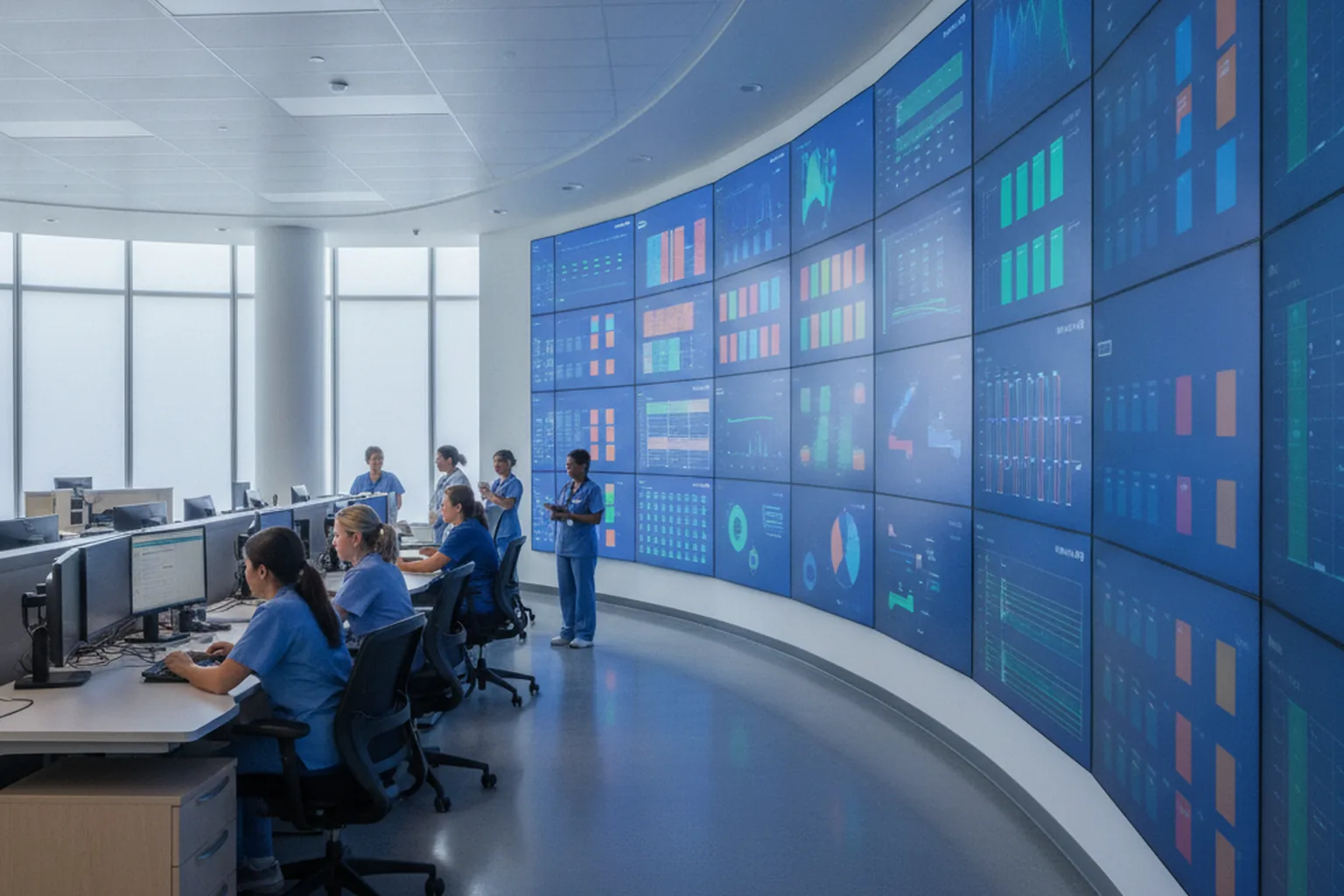

Hospital management software development services cover everything needed to put a working hospital management system (HMS) into a real hospital: workflow analysis, design, engineering, integration with clinical and financial systems, security and compliance, data migration, training and long-term support. The HMS is the operational backbone of a hospital. It knows who is admitted, which bed is free, which surgeon is booked, what the pharmacy has in stock and which claims are still unpaid.
Few hospitals start from a blank page. Most already run a commercial EHR and a patchwork of departmental systems, and what they need from healthtech software development services for hospitals is a set of custom modules, integrations and dashboards that remove manual work between those systems. Others, such as private hospital groups, specialty hospitals and fast-growing clinic networks in the US and Europe, need a complete platform they own and can adapt as they grow.
This guide explains what a hospital management system is and how it differs from an EHR, when building beats buying, the modules and integrations that matter, HIPAA and other 2026 compliance requirements, architecture and tech stack, a step-by-step development process, team and timeline, realistic costs and the mistakes that most often sink hospital software projects. If you are planning a clinical record system rather than an operational one, read our guide to EHR software development first.
What is hospital management software?
Hospital management software is an integrated system that manages the administrative, operational and financial workflows of a hospital, from patient registration to discharge and billing. It connects departments that otherwise work in separate tools, so a patient’s admission, bed, orders, medications, tests, charges and follow-up all live in one consistent flow.
The terms used in the market overlap, which causes confusion in procurement and in project scoping. The table below shows how the most common system types relate to each other.
| System | Main purpose | Typical users | Relation to HMS |
|---|---|---|---|
| Hospital management system (HMS) | Runs hospital operations: registration, ADT, beds, scheduling, billing, inventory, staff | Front desk, nursing, administration, finance, management | The operational core |
| Hospital information system (HIS) | Umbrella term for all hospital software, clinical and administrative | Everyone in the hospital | Often used as a synonym for a full HMS |
| EHR / EMR | Clinical record: notes, orders, results, medications, problem lists | Physicians, nurses, clinicians | Integrated with or embedded in the HMS |
| LIS / RIS / PACS | Laboratory workflow, radiology workflow, image storage | Lab and imaging departments | Departmental systems connected to the HMS |
| RCM / billing | Charges, coding, claims, payments, denials | Billing and finance teams | A module of the HMS or a separate system |
In practice, “hospital management software development” usually means one of three projects: a full HMS for a hospital that does not use a large EHR suite, operational modules (bed management, scheduling, inventory, analytics) around an existing EHR, or a commercial HMS product built by a HealthTech company for sale to many hospitals.
Why hospitals invest in custom HMS software in 2026
Hospitals invest in custom HMS software in 2026 because staffing shortages, thin margins and rising patient volumes make manual coordination too expensive, while large vendor suites still leave gaps between departments. Custom software closes those gaps for the specific workflows that cost the most time and money.
- Operational pressure. Bed shortages, emergency department boarding and discharge delays are now board-level problems. Real-time capacity tools pay off quickly when every saved bed-day is worth thousands of dollars.
- Vendor concentration. According to KLAS Research data reported for 2025, Epic held about 43.7% of US acute care hospitals and Oracle Health about 21.9%. Hospitals on these platforms still need custom modules, integrations and analytics their EHR does not cover well.
- Interoperability rules. The ONC HTI-1 rule moved certified health IT to USCDI v3 as the baseline from 1 January 2026, and FHIR APIs are now the expected way to exchange data. New software can be built on these standards from the start.
- Revenue cycle pressure. Claim denials and prior authorisation workload keep growing, which makes automated eligibility checks, coding support and denial analytics some of the fastest-payback modules.
- AI readiness. Ambient clinical documentation, bed demand forecasting and staffing optimisation all need clean, connected operational data that fragmented systems cannot provide.
Market research firms put the hospital management software market at roughly $31 billion in 2025 with mid-single-digit to double-digit annual growth, depending on the source and definition. The exact figure matters less than the trend: hospitals are moving budget from new EHR purchases to integration, automation and analytics around the systems they already have.
Custom vs off-the-shelf hospital management software
Off-the-shelf hospital management software is faster and cheaper to start, while custom software fits complex workflows better, avoids per-user licence growth and gives the hospital full ownership of its data and roadmap. For most mid-size and large hospitals the answer is a hybrid: keep the core EHR, buy commodity tools and build custom modules where they create a measurable advantage.
| Criterion | Off-the-shelf HMS | Custom HMS or custom modules |
|---|---|---|
| Time to first go-live | Weeks to a few months | 4–12 months, phased |
| Upfront cost | Low to medium (setup and licences) | Medium to high (development) |
| Running cost | Per-user or per-bed subscription that grows with you | Hosting and support, usually 15–25% of build cost per year |
| Workflow fit | Standard workflows; you adapt to the product | Built around your departments and rules |
| Integrations | Limited to vendor connectors | Any system with an API, HL7 interface or database |
| Data ownership and analytics | Export limits and vendor-defined reports | Full access to all data for analytics and AI |
| Vendor risk | Price rises, roadmap changes, lock-in | Depends on code quality and documentation |
A useful rule: if a workflow is the same in every hospital, such as payroll or general ledger, buy it. If a workflow is where your hospital differs from others, such as how you route patients between sites, manage specialty beds or coordinate surgical capacity, consider building it. Our article on custom software vs off-the-shelf walks through the full decision framework.
Types of hospital management systems
Hospital management systems differ by deployment model and by scope. The right type depends on the size of the organisation, its IT team, its regulatory environment and how much it needs to customise.
By deployment model
- Cloud-based HMS. Hosted on AWS, Azure or Google Cloud under a business associate agreement. Faster to scale, easier to update, the default choice for new builds in 2026.
- On-premises HMS. Runs in the hospital’s own data centre. Still common where connectivity is unreliable or local rules require data to stay on site.
- Hybrid HMS. Core records on premises or in a private cloud, with patient portals, analytics and integrations in the public cloud.
- Open-source based HMS. Built on platforms such as OpenMRS or Bahmni and extended with custom modules. Lower licence cost, but the hospital takes on more engineering and support responsibility.
By scope
| Scope | Typical client | Modules |
|---|---|---|
| Basic HMS | Clinic, day surgery centre, small private hospital | Registration, scheduling, billing, simple records, reports |
| Mid-level HMS | Single hospital with 100–400 beds | ADT, wards and beds, pharmacy, lab and imaging integration, RCM, inventory, portal |
| Enterprise HMS | Hospital network or health system | All of the above plus multi-facility operations, command center, data platform, AI and advanced interoperability |
Core modules of hospital management software
The core modules of hospital management software are patient registration and ADT, scheduling, outpatient and inpatient management, bed management, clinical records or EHR integration, pharmacy, laboratory, radiology, billing and revenue cycle, inventory, staff management, patient portal and reporting. Each module should share one patient identity and one data model, otherwise the hospital simply recreates its old silos inside the new system.
Patient registration and ADT
Registration creates the patient record, verifies identity and insurance, and assigns a medical record number through a master patient index that prevents duplicates. ADT (admission, discharge, transfer) tracks every movement of a patient through the hospital and is the event stream that most other systems listen to, usually as HL7 v2 ADT messages.
Appointment scheduling and outpatient management
Scheduling manages physician calendars, rooms, equipment and procedure slots, with online booking, reminders and waitlists. The outpatient module handles check-in, queues, consultations, referrals and follow-ups, and is where patient wait times are won or lost.
Inpatient, ward and bed management
Inpatient management covers ward rounds, nursing tasks, care plans, vitals and handovers. Bed management shows real-time occupancy, cleaning status and expected discharges, so admissions from the emergency department and operating theatres can be placed without phone calls between units.
Emergency department and operating theatres
Larger hospitals add an emergency department module for triage, tracking boards, waiting times and handover to inpatient wards, and a theatre module for surgical scheduling, case carts, anaesthesia records and turnaround times. Both are time-critical: the screens must be fast, readable at a distance and resilient to network issues, and they depend on real-time data from ADT and bed management. Connecting theatre schedules with bed management lets the hospital see in advance whether post-operative beds will be available, which is one of the most common causes of cancelled elective procedures.
Clinical records and EHR integration
Hospitals without a large EHR suite need a clinical record module for notes, orders, problem lists and results. Hospitals that already run Epic, Oracle Health or Meditech connect the HMS to the EHR instead, so clinicians document in one place and operational modules receive the data they need.
Pharmacy and medication management
The pharmacy module handles formularies, prescriptions, dispensing, stock, expiry dates and controlled substances, with drug interaction checks and barcode medication administration at the bedside. For pharmacy-specific workflows, see our guide to pharmacy management software development.
Laboratory and radiology
Lab and imaging modules send orders to the laboratory information system (LIS) and radiology information system (RIS), receive results, and link to images stored in PACS through DICOM. Critical results should trigger alerts to the ordering clinician rather than wait in an inbox.
Billing and revenue cycle management
The billing module captures charges from every department, applies coding, checks eligibility, generates claims (X12 837 in the US), posts payments from remittances (835) and tracks denials. In many hospitals this is the module with the clearest return on investment.
Inventory, supply chain and assets
Inventory management tracks consumables, implants, linen and equipment across stores and wards, with par levels, automatic reordering, lot tracking and recalls. Asset tracking with barcodes or RTLS tags reduces time nurses spend looking for pumps and wheelchairs. Our inventory management software development guide covers the underlying patterns.
Staff, HR and rostering
Staff modules handle credentials, rosters, shift swaps, time and attendance, and skill-mix rules. Linking rosters to patient acuity and bed occupancy is one of the most valuable custom features, because generic HR tools do not understand clinical staffing ratios.
Patient portal and mobile apps
A patient portal and mobile app let patients book appointments, complete pre-admission forms, see results, pay bills and message their care team. Staff apps give nurses and doctors task lists, alerts and secure messaging on the ward.
Reporting and analytics
Dashboards show occupancy, length of stay, theatre utilisation, waiting times, revenue, denials and quality indicators. A proper data layer behind them allows regulatory reporting and later AI use cases without new integration work.
Advanced features hospitals add in 2026
The advanced features hospitals add to HMS platforms in 2026 focus on capacity, automation and AI: command centers, predictive bed and staffing models, ambient documentation, telehealth and remote monitoring, and real-time location tracking. They deliver value only when the core modules already produce reliable data.
- Capacity command center. A single view of beds, transfers, discharges and staffing across one or several hospitals, with escalation rules.
- Predictive analytics. Forecasts of admissions, discharges and emergency department arrivals that help plan beds and staff hours or days ahead.
- AI documentation and coding support. Ambient listening, note summarisation and coding suggestions, always with clinician review. Our generative AI integration services cover how to deploy them safely.
- Telehealth and remote patient monitoring. Virtual visits, virtual wards and device data for post-discharge follow-up.
- RTLS and IoT. Location tracking of equipment and patients, temperature monitoring of fridges and automated alerts.
- Patient flow automation. Automated discharge checklists, transport requests and cleaning tasks triggered by ADT events.
What are the benefits of hospital management software?
The main benefits of hospital management software are shorter waiting times and length of stay, fewer billing errors and denials, better use of beds, staff and equipment, safer medication processes and reliable data for decisions. The size of each benefit depends on how well the system fits real workflows, so it is worth defining target metrics before development starts.
| Area | What improves | Metric to track |
|---|---|---|
| Patient flow | Faster admissions, transfers and discharges | Average length of stay, discharge-before-noon rate, ED boarding time |
| Capacity | Beds and theatres used more evenly | Bed occupancy, theatre utilisation, cancelled procedures |
| Revenue cycle | Cleaner claims, faster payment | First-pass claim acceptance, denial rate, days in accounts receivable |
| Patient safety | Fewer medication and identification errors | Barcode scanning compliance, adverse drug events |
| Staff time | Less double entry and phone coordination | Minutes of documentation per shift, overtime hours |
| Patient experience | Online booking, fewer repeated questions | Waiting time, no-show rate, satisfaction scores |
A practical approach is to pick two or three of these metrics per release, measure a baseline during discovery and report the change after each pilot. This turns the HMS from an IT project into an operational improvement program that management can follow and fund.
Interoperability: HL7, FHIR, DICOM and claims standards
Interoperability is the hardest and most important part of hospital management software development, because the HMS must exchange data reliably with the EHR, lab, imaging, pharmacy, payers and public health systems. In 2026 that means supporting HL7 v2 for internal hospital messaging and FHIR R4 APIs for modern integrations, plus DICOM for images and X12 for US claims.
| Standard | Used for | What to plan |
|---|---|---|
| HL7 v2 | ADT events, orders, results, scheduling inside the hospital | Interface engine, message mapping, monitoring and replay |
| FHIR R4 / US Core | Modern APIs, apps, patient access, data exchange with EHRs | USCDI v3 data elements, SMART on FHIR authorisation |
| DICOM | Medical images and imaging workflow | PACS and viewer integration, storage and retention |
| X12 (270/271, 837, 835) | Eligibility, claims, remittance in the US | Clearinghouse integration, denial handling |
| IHE profiles, TEFCA | Document sharing and national exchange | Connection through a qualified health information network |
Integration with Epic or Oracle Health usually runs through the vendor’s app programs and FHIR APIs plus HL7 v2 feeds from the hospital’s interface engine. Budget time for vendor approvals and test environments, which often take longer than the code itself. Our EHR integration guide for HL7 and FHIR explains the options in detail.
How do you keep hospital management software HIPAA-compliant?
You keep hospital management software HIPAA-compliant by designing security into the data model and infrastructure from the first sprint: encryption, role-based access, multi-factor authentication, audit logs, business associate agreements, risk analysis and tested backups. Retrofitting these controls after launch is far more expensive than building them in.

United States
- HIPAA Privacy and Security Rules. Safeguards for protected health information (PHI), minimum necessary access and patient rights. Civil penalties can exceed $2 million per violation category per year after inflation adjustments.
- Proposed HIPAA Security Rule update. HHS published a proposed rule in January 2025 that would make encryption, MFA, asset inventories, network maps, vulnerability scans every six months and annual penetration tests explicitly mandatory. As of October 2026 it has not been finalised, but building to it now avoids rework.
- HITECH and breach notification. Breaches affecting 500 or more people must be reported to HHS and the media.
- 21st Century Cures Act and ONC rules. Information blocking rules, certified API requirements and USCDI data standards affect how patient data must be shared.
- 42 CFR Part 2. Additional protection for substance use disorder records.
European Union and United Kingdom
- GDPR. Health data is special category data that needs a legal basis, data protection impact assessments and strict access control.
- European Health Data Space (EHDS). The regulation entered into force in 2025 and will phase in requirements for EHR systems and data exchange over the coming years.
- NIS2. Hospitals are essential entities with cybersecurity risk management and incident reporting obligations.
- Medical device rules. If an HMS feature diagnoses or recommends treatment, it may qualify as software as a medical device under EU MDR or FDA rules.
Independent attestations such as SOC 2 Type II or HITRUST help when selling an HMS product to hospitals. For a practical control list, use our HIPAA software development checklist or work with a team that offers HIPAA-compliant software development as a standard practice.
Architecture and tech stack for a hospital management system
A modern hospital management system is best built as a modular platform: well-separated domain services (patients, scheduling, ADT, pharmacy, billing), an integration layer with an interface engine and FHIR API, a shared data platform for reporting, and a cloud infrastructure designed for high availability. A modular monolith is often the right start; split into microservices only where scale or team structure demands it.
| Layer | Common choices in 2026 | Why it matters |
|---|---|---|
| Front end | React or Angular with TypeScript; accessible design system | Fast, consistent screens for busy staff; WCAG accessibility |
| Mobile | Native iOS/Android, Flutter or React Native | Ward apps, scanning, offline tolerance, patient apps |
| Back end | Java/Spring, .NET, Node.js or Python services | Mature ecosystems with healthcare libraries and long support |
| Data | PostgreSQL, event streaming (Kafka), FHIR server, data warehouse | Transactions, audit trail, analytics without loading production |
| Integration | Interface engine (Mirth/NextGen Connect, Rhapsody, Azure Health Data Services) | HL7 v2 routing, mapping, monitoring, replay |
| Security | SSO with SAML/OIDC, MFA, KMS encryption, SIEM | HIPAA controls, access logging and breach detection |
| Infrastructure | AWS, Azure or GCP under a BAA; Kubernetes or managed services; multi-zone | High availability, disaster recovery, scalable environments |
Two architecture decisions deserve special attention. First, the patient identity and master data model: a single, well-governed patient and encounter model prevents duplicate records and broken reports. Second, downtime procedures: hospitals operate around the clock, so the system needs read-only fallbacks, printable downtime reports and a tested recovery plan with clear recovery time and recovery point objectives.
Building an HMS product for many hospitals
If you are a HealthTech company building a hospital management system to sell to many hospitals rather than for one, the architecture must support multi-tenancy, configuration instead of custom code per client, and repeatable onboarding. These requirements change the design from the first sprint, so decide early which model you are building.
- Tenant isolation. Separate databases or strictly enforced row-level security per hospital, with tenant-aware encryption keys and audit logs.
- Configuration over customisation. Departments, roles, forms, price lists and workflows should be configurable, so new clients do not fork the code base.
- Integration toolkit. Reusable HL7 and FHIR adapters and mapping templates for the EHRs and lab systems your clients use most.
- Onboarding and migration tools. Import pipelines, validation reports and sandbox environments shorten each implementation.
- Commercial model. Per-bed, per-facility or per-module subscriptions, with optional implementation and support fees; analytics and AI add-ons can be priced separately.
- Certifications. SOC 2 Type II, HITRUST or ISO 27001 and, where relevant, ONC certification make hospital procurement much easier.
Our guide on how to build a multi-tenant SaaS architecture explains the isolation patterns in more depth.
How to develop hospital management software step by step
Developing hospital management software works best as a phased program: discover and map workflows, design with clinicians, build an MVP for one department or site, integrate and validate, migrate data, train staff and then roll out module by module. Each phase should end with a working, measurable result rather than a document.
- Discovery and workflow mapping (4–8 weeks). Shadow staff in each department, map current workflows and systems, define goals such as shorter discharge times or fewer denials, and agree on scope. See our guide to the discovery phase in software development.
- Compliance and architecture design. Run a risk analysis, define the data model, integration map, security controls and hosting, and document decisions for auditors.
- UX design with clinicians. Prototype the busiest screens, such as admission, bed board and medication administration, and test them with nurses and front-desk staff before coding.
- MVP development. Build the first 3–5 modules in two-week sprints, with demos to department leads and continuous security testing.
- Integration and testing. Connect the EHR, lab, imaging and billing systems in test environments, then run end-to-end scenarios, performance tests and penetration tests.
- Data migration. Clean, map and migrate patient, scheduling and financial data in rehearsals before the real cut-over.
- Training and pilot. Train super-users, go live in one department or site, collect feedback and fix issues fast.
- Phased rollout and support. Extend to other departments and sites, monitor uptime and adoption, and keep a backlog of improvements.
Timeline and team for an HMS project
A typical hospital management system project takes 4–6 months for an MVP, 8–12 months for a full single-hospital HMS and 12–24 months for an enterprise platform, delivered by a cross-functional team of 6–15 people. The timeline is driven more by integrations, approvals and rollout than by coding speed.
| Scope | Timeline | Typical team |
|---|---|---|
| MVP (3–5 modules, one site) | 4–6 months | PM/BA, designer, 3–4 engineers, QA |
| Full HMS for one hospital | 8–12 months | PM, BA, designer, 5–8 engineers, integration engineer, QA, DevOps |
| Enterprise multi-facility platform | 12–24 months, phased | Several squads, architect, security lead, data engineers |
On the hospital side, plan for a clinical lead, an IT or integration lead, department champions and a compliance officer. Without their time, even the best development team ends up guessing how wards really work.
How much does hospital management software development cost?
Hospital management software development costs about $50K–$120K for a basic system, $150K–$400K for a full HMS for a mid-size hospital and $400K–$1M or more for an enterprise multi-facility platform in 2026. Integrations, compliance and data migration typically account for a third or more of the budget.
| Scope | Estimated cost (2026) | What is included |
|---|---|---|
| Basic HMS / MVP | $50K–$120K | Registration, scheduling, billing, simple records, reports, web app |
| Mid-size hospital HMS | $150K–$400K | ADT, beds, pharmacy, lab and imaging integration, RCM, inventory, portal, mobile |
| Enterprise platform | $400K–$1M+ | Multi-facility, command center, data platform, AI features, advanced interoperability |
| Single custom module around an EHR | $40K–$150K | For example bed management, scheduling or denial analytics with FHIR/HL7 integration |
These ranges are YuSMP Group estimates for 2026 and are consistent with figures published by other healthcare software vendors. Treat them as orders of magnitude, not quotes.
What drives the cost of an HMS?
- Number of modules and departments. Each module adds workflows, roles, reports and tests.
- Integrations. Every EHR, lab, imaging, pharmacy or payer connection adds mapping, testing and monitoring.
- Compliance and security. Risk analysis, audits, penetration tests and certifications add 10–20% to a project.
- Data migration. Old systems with duplicate patients and inconsistent codes can take months to clean.
- Mobile and offline. Ward and patient apps with offline support add design and engineering effort.
- AI and analytics. Forecasting, documentation support and dashboards need data engineering, not only models.
- Team location. Rates differ widely between US, Western European and nearshore teams.
Running costs include cloud hosting, interface engine licences, monitoring, security tools and support, usually 15–25% of the initial build per year. For a wider view of healthcare budgets, see our healthcare software development cost guide.
Common mistakes in hospital software projects
The most common mistakes in hospital software projects are ignoring frontline staff, underestimating data migration, treating security as a final step, replacing everything at once and forgetting support after go-live. Each one is cheaper to prevent than to fix.
| Mistake | What happens | How to avoid it |
|---|---|---|
| Designing without nurses and front-desk staff | Extra clicks, workarounds, paper comes back | Co-design and test the busiest screens with real users |
| Big-bang replacement | Long downtime, overwhelmed staff, high risk | Phased rollout by module or site, parallel running where needed |
| Underestimating data migration | Duplicate patients, missing history, billing errors | Early data audit, master patient index, migration rehearsals |
| Security added at the end | Failed audits, expensive rework | Risk analysis and controls from the first sprint |
| Fragile integrations | Silent message failures, lost results | Interface engine with monitoring, alerts and replay |
| Choosing the vendor only on price | Missed requirements, change requests, delays | Evaluate healthcare experience, process and ownership terms |
| No plan after launch | Slow fixes, outdated software | Support SLAs, monitoring and a funded improvement backlog |
How to choose a hospital management software development company
Choose a hospital management software development company that has shipped healthcare systems with real integrations, can show how it handles HIPAA and other regulations, runs a structured discovery phase and transfers full ownership of code, data and infrastructure. Ask for evidence, not promises.
- Healthcare projects with HL7 v2, FHIR, DICOM or payer integrations in production
- A documented security program: risk analysis, encryption, access control, logging, penetration tests
- Willingness to sign a business associate agreement and follow your policies
- A clear approach to discovery, clinician involvement, data migration and phased rollout
- Architecture and code reviews you can verify, plus documentation for your own IT team
- Transparent estimates, milestone-based contracts and full IP transfer
- Honest advice on when to extend your EHR or buy a product instead of building
For a general vendor checklist, read how to choose a software development company. If you need broader engineering capacity beyond healthcare, our custom software development services cover the full lifecycle from discovery to support.
FAQ
What are hospital management software development services?
Hospital management software development services cover the analysis, design, engineering, integration, validation and support of a hospital management system (HMS): the software that runs patient registration, admissions and discharges, scheduling, wards, pharmacy, laboratory, billing, inventory, staff and reporting. A development partner builds the modules a hospital needs, connects them to the EHR, lab, imaging and payer systems, and keeps the platform secure and compliant.
How much does it cost to develop hospital management software in 2026?
In 2026 a focused hospital management system for a clinic or small hospital typically costs $50K–$120K, a multi-module HMS for a mid-size hospital $150K–$400K, and an enterprise platform for a hospital network $400K–$1M or more. Integrations with the EHR, lab, imaging and billing systems, compliance work and data migration are the biggest cost drivers. Plan 15–25% of the build cost per year for support, hosting and updates.
How long does hospital management system development take?
A hospital management system MVP with 3–5 core modules takes about 4–6 months, a full HMS for a single hospital 8–12 months and a multi-facility enterprise platform 12–24 months, usually released in phases. Integration testing, data migration and staff training often take as long as coding, so they need their own milestones.
What is the difference between a hospital management system and an EHR?
An EHR (electronic health record) stores the clinical record of a patient: diagnoses, notes, orders, medications and results. A hospital management system runs the operations of the hospital around that record: registration, admissions, bed management, scheduling, billing, pharmacy and inventory, staff and reporting. Many hospitals use a commercial EHR such as Epic or Oracle Health and build custom HMS modules that integrate with it through HL7 v2 and FHIR APIs.
Should a hospital build custom HMS software or buy an off-the-shelf system?
Buy an off-the-shelf system when your workflows are standard and you need to go live quickly with a limited budget. Build custom HMS software, or custom modules around an existing EHR, when you have unusual workflows, several facilities with different processes, integration needs a vendor cannot meet, high per-user licence costs or a plan to use your operational data for analytics and AI. A hybrid approach is the most common choice for mid-size and large hospitals.
Which modules should a hospital management system include?
A hospital management system should include patient registration and ADT (admission, discharge, transfer), appointment scheduling, outpatient and inpatient management, bed and ward management, a clinical record or EHR integration, pharmacy, laboratory and radiology integration, billing and revenue cycle management, inventory and supply chain, staff and HR management, a patient portal and reporting dashboards. Emergency department, operating theatre and telehealth modules are added for larger hospitals.
How do you make hospital management software HIPAA compliant?
To make hospital management software HIPAA compliant, encrypt protected health information at rest and in transit, enforce role-based access and multi-factor authentication, log every access to patient data, sign business associate agreements with every vendor that handles PHI, run regular risk analyses, vulnerability scans and penetration tests, and keep tested backups and an incident response plan. The proposed update to the HIPAA Security Rule would make most of these controls explicitly mandatory.
Published 29 October 2026. Sources: HHS, HIPAA Security Rule NPRM fact sheet; ONC, HTI-1 final rule; HL7, FHIR R4; European Commission, European Health Data Space; KLAS Research, US hospital EHR market share 2025 (as reported by Becker’s Hospital Review). Cost ranges are YuSMP Group estimates for 2026.