

The short answer
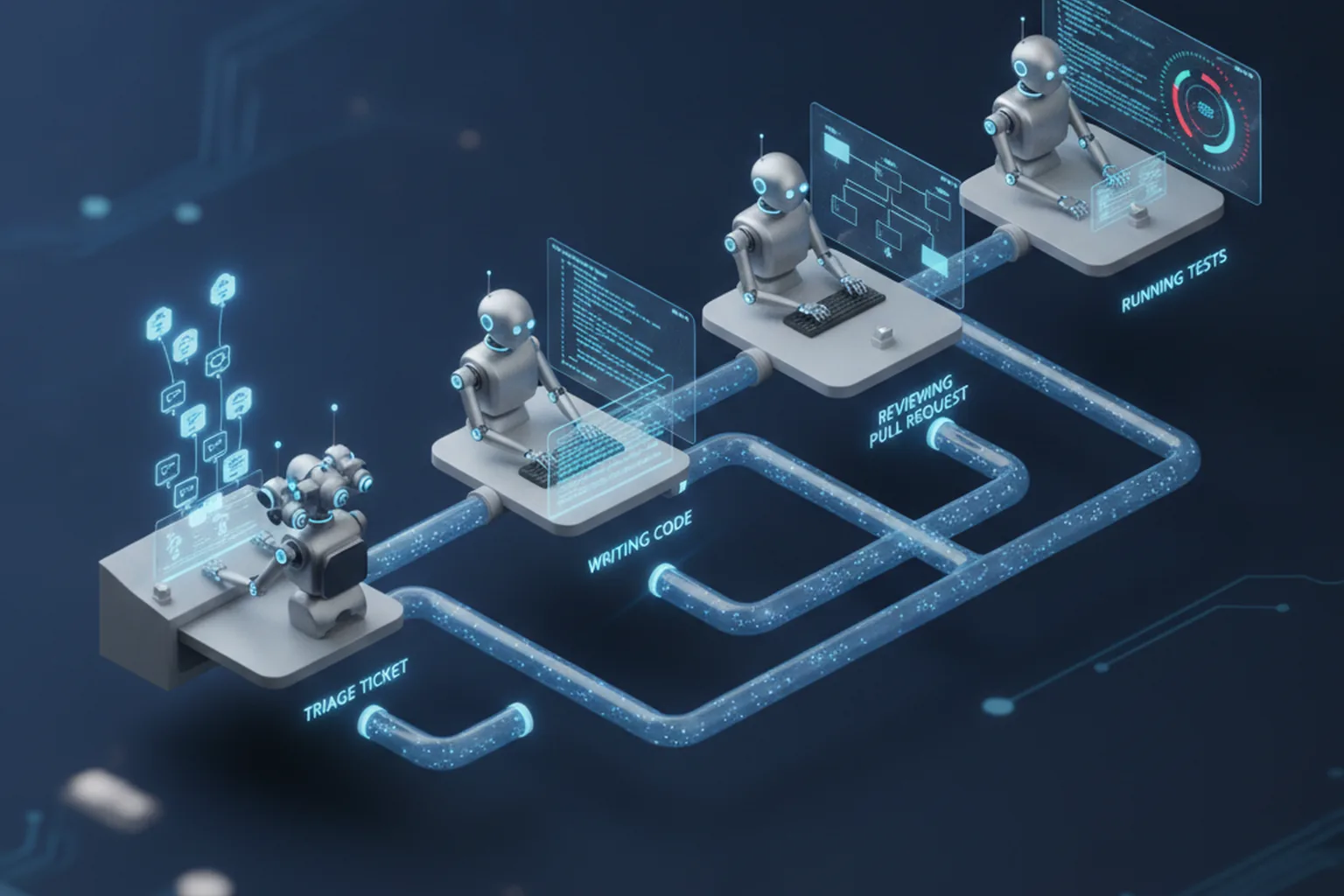
Warp launched Warp Factories in closed beta on August 18, 2026. It is cloud infrastructure for running a “software factory” — a repeatable pipeline where AI coding agents triage a ticket, write a spec, implement the change, review the pull request, and verify the result. The system is model-agnostic (Claude Code, Codex, Cursor, open-weight models), defined as version-controlled configuration files, billed per agent run, and gives teams a dashboard for cost-per-PR and code quality. Warp CEO Zach Lloyd said automating these stages currently handles 30–35% of weekly tasks on Warp’s own codebase.
What Warp Factories is
For most engineering teams, adding AI to the development workflow means adding a coding assistant to individual developer desks. Work still moves ticket-by-ticket through human sprints. Warp Factories targets the layer above that: rather than augmenting each developer, it deploys a structured set of AI development agents that run the pipeline themselves, with human approval at the checkpoints the team configures.
The system defines a factory as version-controlled configuration files — choosing models, harnesses, evaluation criteria, and approval gates, then committing that definition to a repository. A change to the factory configuration goes through the same review process as any code change. Each pipeline stage can independently pick its model: a lighter, cheaper model for triage and spec, a more capable one for implementation and code review.
Warp frames this as “AI sovereignty”: customers bring their own inference provider and hosting if they choose, and all data exhaust — agent conversations, evaluation outputs, memory logs — stays with the deploying organisation. Zero-data-retention options are available for regulated environments.
How the pipeline works
Work enters a Warp factory through any of the standard surfaces engineering teams already use: Slack, Microsoft Teams, Linear, Jira, GitHub, GitLab, a terminal, or an IDE via the Factory MCP protocol. The foreman agent receives the work item and routes it through the assembly line:
| Stage | What the agent does | Output |
|---|---|---|
| Triage | Classifies the work item: implement now, request a spec first, or hold pending more context | Routing decision and priority tag |
| Spec | Converses with a human for complex requirements; drafts a written specification for approval | Approved spec document |
| Implementation | Writes or modifies code; uses computer-use capabilities on Linux and Mac to reproduce issues locally | Pull request or diff |
| Review | Evaluates code quality against the team’s configured criteria; flags problems or approves | Review comments or approval |
| Verification | Runs automated tests and end-to-end checks; confirms the change meets acceptance criteria | Verification report or failure log |
Results flow back to the originating tool: a pull request on GitHub or GitLab, a status update on a Jira ticket, a message in Slack. Teams can also define time-based triggers for recurring factory runs — periodic dead-code removal, automated dependency updates, or regular refactoring passes on a specified module.
The control room is a web dashboard showing all agent runs, work item status, active automations, and current factory configuration. Engineers can interact with running agents via the web interface on desktop or mobile, stepping in at any approval gate without breaking the pipeline.
Governance, measurement, and data sovereignty
One of the harder problems with AI coding tools at scale is measuring whether they are actually adding value. Warp Factories tracks cost per pull request and code quality metrics across runs, and lets teams define custom evaluation scorers tied to their own acceptance criteria. A self-improvement loop enables observer agents to analyse factory performance and suggest optimisations to the factory configuration itself.
The governance story is relevant for regulated industries. An enterprise building custom software in financial services or healthcare needs to know which model handled which part of which change, what the approval decisions were, and where the data went. Warp Factories provides an audit trail of all factory activity, and the data-sovereignty controls mean that conversation logs and evaluation outputs do not leave the organisation’s infrastructure if it chooses to bring its own compute.
Factories are defined as code, so they are versionable, reviewable, and rollback-able. A factory configuration that introduced unexpected behaviour can be reverted the same way a bad application commit is reverted.
What it means for US & EU software teams
The build-vs-buy question for AI infrastructure has arrived. Until now, teams building agentic coding workflows had to assemble the orchestration, memory, evaluation, and observability layers themselves. Warp Factories is an attempt to make that a solved problem. The trade-off is the same as any platform decision: faster start, less control over the internals; slower start with a custom build, full control. Warp’s model-agnostic and bring-your-own-compute approach reduces lock-in risk compared with a fully proprietary stack.
30–35% of weekly tasks automated is a concrete benchmark, not a marketing number. Zach Lloyd’s figure comes from Warp running Factories on its own codebase. That is a useful anchor. Teams evaluating whether to join the closed beta should measure their own baseline (what fraction of tickets are well-scoped implementation tasks?) before projecting impact. Tickets requiring cross-cutting architectural decisions or novel problem-solving are not the factory’s target; clearly-scoped implementation tickets, dependency updates, and refactoring tasks are.
The engineering organisation changes shape. Lloyd’s framing — “every engineer on your team will eventually be responsible for improving your factories” — describes a shift in the job. Instead of writing every line of code, engineers configure, evaluate, and improve the systems that write code. That requires different skills: writing good evaluation criteria, analysing factory performance dashboards, deciding where to place human approval gates. Teams that start building that muscle now will have an advantage when factory-style workflows become standard.
For EU teams, the data-sovereignty controls matter. The EU AI Act and GDPR both create obligations around automated decision-making systems that touch personal or regulated data. A factory that processes customer data during implementation or testing phases needs clear documentation of what models processed that data and under what terms. Warp’s bring-your-own-compute option and audit trail give regulated organisations a path to compliance; teams should verify that the specific inference provider and data-residency configuration they choose meet their applicable requirements before scaling factory use into production workflows.
Building agentic workflows for your development team?
YuSMP Group designs and implements custom AI agent systems for US and EU engineering organisations — from agentic code review and test generation to full pipeline orchestration. We scope the architecture, integrate with your existing toolchain, and help your team build the evaluation and governance layer that makes agent output trustworthy in production.
Discuss your agentic workflowSources: TechCrunch — Warp’s new system is an out-of-the-box software factory for AI development (August 18, 2026); Warp Blog — Introducing Warp Factories: open, flexible infrastructure for building your software factory (August 18, 2026).
FAQ
What is a software factory in the context of Warp Factories?
A software factory is a repeatable, automated pipeline where AI coding agents handle the stages of software development in sequence: triage (classify and route the work item), spec (clarify requirements with a human if needed), implementation (write or change code), review (evaluate code quality against defined criteria), and verification (run tests and end-to-end checks). Warp Factories provides the cloud orchestration and control-plane infrastructure to deploy and monitor such a pipeline, rather than requiring teams to build that infrastructure themselves.
Which coding models and tools does Warp Factories support?
Warp Factories is model-agnostic. It currently supports Claude Code, OpenAI Codex, Cursor, and open-weight models. Each pipeline stage can independently select its model and harness — for example, a lighter model for triage and a more capable one for implementation and review. Factories are defined in version-controlled configuration files, so model selections are reviewable and auditable like any code change.
How does work enter a Warp Factories pipeline?
Work can enter through Slack, Microsoft Teams, Linear, Jira, GitHub, GitLab, a terminal, or an IDE via the Factory MCP protocol. Results flow back to the originating tool — a pull request to GitHub or GitLab, an update to a Jira ticket, and so on. Teams can also configure time-based triggers for recurring factory runs such as periodic dead-code removal or automated dependency updates.
How much does Warp Factories cost?
Warp Factories is billed by usage per agent run. Warp had not published per-run rates as of the August 18, 2026 closed-beta launch. Qualified organisations that join the closed beta receive $10,000 of factory use free to start. The Warp Terminal and Warp Agent CLI remain free to use independently of Factories.
Is Warp Factories available now and who is it aimed at?
Warp Factories launched in closed beta on August 18, 2026. Access is by application. Warp CEO Zach Lloyd described the primary audience as smaller engineering organisations that want the productivity benefits of an AI software factory without the months of infrastructure work required to build one from scratch. Larger teams that have already built internal factory tooling are a secondary audience — Warp positions Factories as a way to consolidate that effort onto a governed, measurable platform.