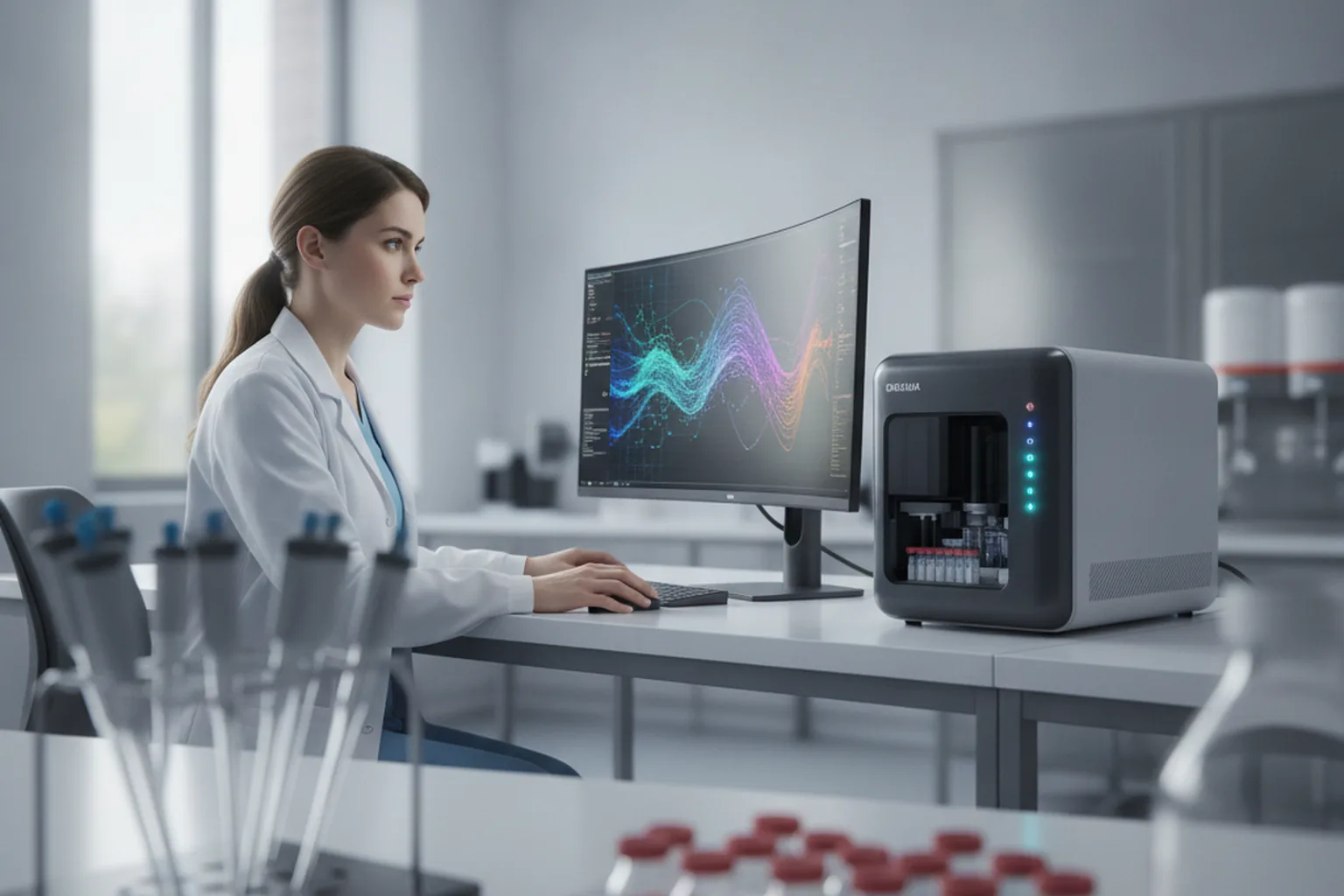

A biotech software development company designs, builds and maintains the software that research-driven biotech firms run on: systems that track samples, capture experiments, process sequencing data, drive lab robots and turn terabytes of biological data into decisions. In 2026 this work sits at the intersection of three disciplines — software engineering, data engineering and laboratory science — and the best partners speak all three.
Biotech teams usually look for an outside developer when off-the-shelf platforms stop fitting their science: a new assay that the LIMS cannot model, a sequencing pipeline that no longer scales, or an AI model that needs clean, connected training data. Because biotech software often touches patient-derived samples, regulated manufacturing or diagnostic claims, it also has to meet the same data-integrity bar as clinical systems. That is why we treat it as part of our healthtech and life sciences software development services rather than as generic web development.
This guide explains what biotech software development covers, how it differs from pharmaceutical software, the main types of biotech software built today, the features and compliance rules that matter, the technology stack, a step-by-step build process, realistic 2026 costs, and how to choose a biotech software development company. If your work is closer to drug manufacturing and clinical trials, start with our guide to pharmaceutical software development instead.
What does a biotech software development company do?
A biotech software development company builds custom software that supports biological research, development and production: lab data capture, sample and inventory management, scientific data processing, instrument integration, analytics and AI. Unlike a product vendor that sells one platform, it designs systems around a specific organisation’s science, data and workflows.
In practice, “biotech software development services” covers a wide range of engagements, from a three-month bioinformatics pipeline rebuild to a multi-year research data platform. Buyers searching for a biotechnology software development company usually meet four different kinds of provider:
| Provider type | What they deliver | Best for | Limitation |
|---|---|---|---|
| Platform vendors (LIMS/ELN products) | Licensed software configured to your lab | Standard workflows, fast start, vendor support | Rigid data models, per-seat costs, roadmap you do not control |
| Custom biotech software development companies | Bespoke applications, integrations, data platforms | Unique science, proprietary workflows, integration-heavy stacks | Requires clear product ownership on your side |
| Bioinformatics consultancies | Analysis pipelines, statistics, scientific interpretation | One-off analyses, method development | Often weaker on production engineering and long-term support |
| Systems integrators and validation firms | Platform rollout, CSV/CSA validation, IT operations | Regulated (GxP) deployments of existing products | Limited custom product development |
Most mature biotech organisations combine them: a commercial ELN or LIMS for standard work, a custom development partner for the data platform and integrations around it, and validation specialists for the regulated pieces.
How is biotech software different from pharmaceutical software?
Biotech software is built mainly for discovery and research — experiments, biological data and fast-changing methods — while pharmaceutical software is built mainly for the regulated later stages of the drug lifecycle: clinical trials, GMP manufacturing, quality and pharmacovigilance. The two overlap, but the priorities differ.
| Dimension | Biotech (research-driven) | Pharmaceutical (lifecycle-driven) |
|---|---|---|
| Main users | Bench scientists, bioinformaticians, data scientists, lab automation engineers | Clinical operations, QA/QC, manufacturing, regulatory affairs |
| Typical systems | ELN, research LIMS, NGS pipelines, multi-omics platforms, AI models | EDC, CTMS, QMS, MES, pharmacovigilance |
| Data | Very large, heterogeneous: sequences, images, plate reads, spectra | Structured clinical, batch and quality records |
| Rate of change | High — assays and methods change monthly | Low — changes go through formal change control |
| Regulation | Data integrity and FAIR principles; GLP/GMP once work enters regulated studies or production | GxP, 21 CFR Part 11 and computer system validation from day one |
| Main engineering challenge | Scaling compute and modelling evolving science | Validation, audit trails and controlled releases |
The practical consequence: a biotech software development company must be comfortable shipping fast in research while keeping a clean path to validation, because a discovery tool can become a regulated system the moment its data supports an IND filing, a diagnostic claim or a manufacturing release.
Which organisations need custom biotech software?
Custom biotech software pays off for organisations whose science, data volumes or partnerships outgrow standard tools: venture-backed biotech startups, platform biotechs, CROs and CDMOs, academic core facilities, diagnostic laboratories and industrial or agricultural biotech firms. Each group needs a different first system.
- Early-stage biotech startups. Usually start with a commercial ELN and add a lightweight registry, data lake and one or two automated pipelines as soon as sequencing or screening volumes grow.
- Platform biotechs. Companies whose platform is the product — antibody discovery, cell therapy, synthetic biology — invest early in a custom data platform, because their data model is their competitive edge.
- CROs and CDMOs. Need multi-client data segregation, sponsor portals, study tracking and validated systems that satisfy each client’s audits.
- Academic and institutional core facilities. Need sample intake, billing, instrument booking and result delivery for hundreds of internal users.
- Diagnostic and clinical genomics labs. Need test ordering, accessioning, interpretation workflows and EHR integration under CLIA or IVDR rules.
- Industrial, food and agricultural biotech. Need strain libraries, fermentation and bioprocess data, and scale-up analytics more than clinical features.
What types of biotech software are built in 2026?
The most common types of custom biotech software in 2026 are laboratory information management systems, electronic lab notebooks, bioinformatics and sequencing pipelines, multi-omics data platforms, lab automation and instrument integration, AI-driven discovery tools, bioprocess and biomanufacturing software, and diagnostics applications.
| Software type | What it does | Typical integrations |
|---|---|---|
| LIMS | Sample registration, chain of custody, tests, results, inventory | Instruments, ELN, ERP, freezer and barcode systems |
| Electronic lab notebook (ELN) | Protocols, observations, calculations, experimental context | LIMS, registries, file stores, analysis tools |
| Bioinformatics and NGS pipelines | Alignment, variant calling, expression analysis, QC | Sequencers, HPC or cloud compute, reference databases |
| Multi-omics data platform | Unified storage, metadata, search and analytics across data types | Pipelines, ELN/LIMS, notebooks, BI and ML tools |
| Lab automation and scheduling | Robot orchestration, plate maps, run scheduling, device control | Liquid handlers, readers, incubators via SiLA 2 or vendor APIs |
| AI-driven discovery tools | Target identification, protein and antibody design, hit triage | Assay data, structure databases, GPU compute |
| Bioprocess and biomanufacturing | Batch records, process analytics, scale-up data, MES links | Bioreactors, historians, QMS, ERP |
| Diagnostics and clinical genomics | Test ordering, result reporting, patient-facing portals | EHR via HL7/FHIR, payers, laboratory instruments |
LIMS and electronic lab notebooks
LIMS and ELN are the system of record for most biotech labs: a LIMS manages structured operations such as samples, tests and inventory, while an ELN captures the scientific context — protocols, observations and reasoning. Custom development is usually justified when a lab’s entities (constructs, cell lines, antibodies, strains) or workflows do not fit a commercial data model, or when the two systems need to share one registry instead of being re-keyed by hand.
Bioinformatics and sequencing pipelines
Bioinformatics software development turns raw instrument output into analysable results: demultiplexing, alignment, variant calling, single-cell and spatial analysis, and quality control. The engineering work is about reproducibility and scale — versioned workflows, containerised tools, automatic reruns and cost-controlled cloud or HPC execution — rather than about writing new algorithms.
Multi-omics and research data platforms
A research data platform connects genomics, proteomics, imaging and assay data with the sample and experiment metadata that gives them meaning. It is the foundation for every AI ambition: models trained on disconnected, poorly annotated data do not generalise. Good platforms follow the FAIR principles — findable, accessible, interoperable and reusable data.
Lab automation and instrument integration
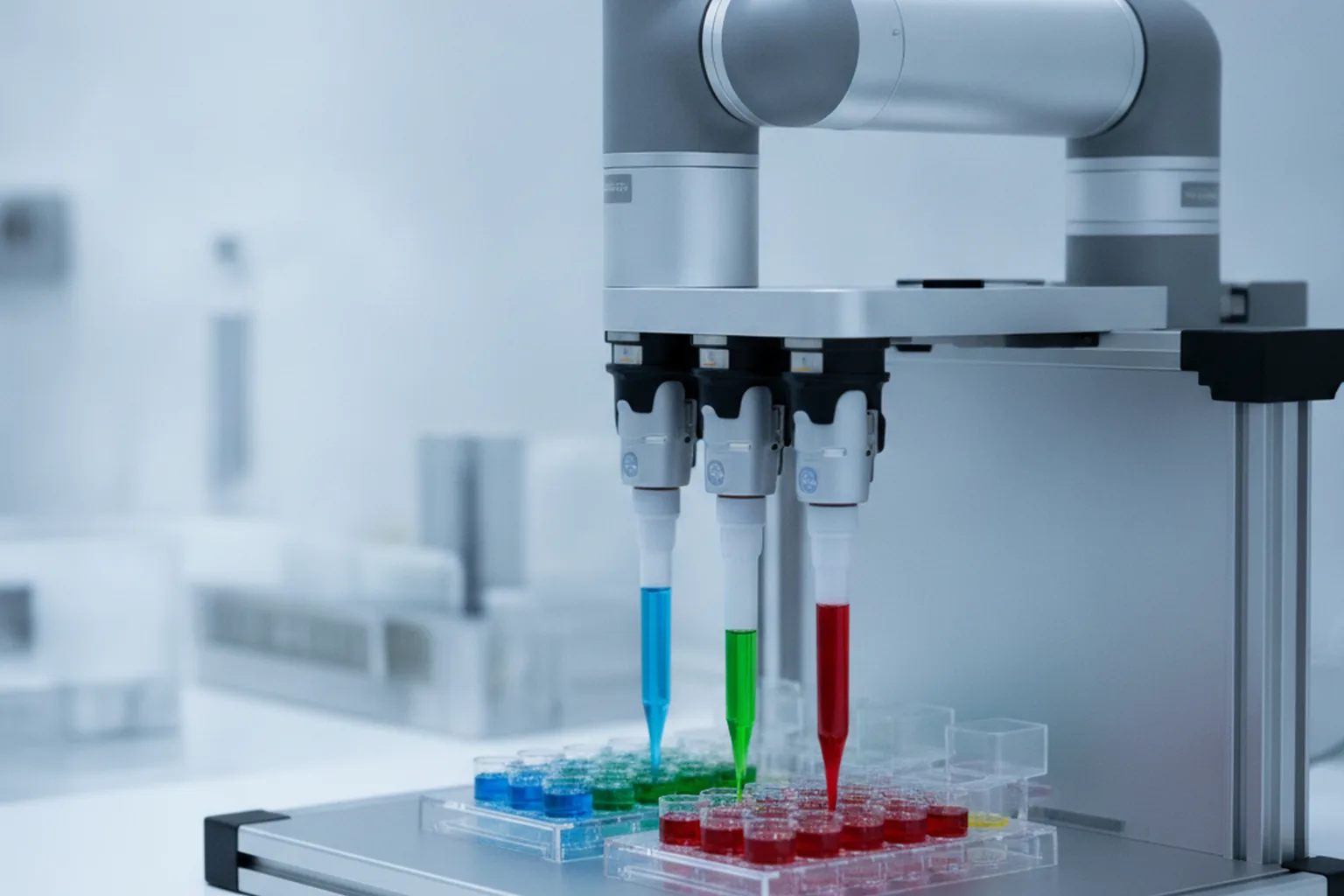
Lab automation software schedules and controls liquid handlers, plate readers, incubators and robotic arms, and moves their data into the LIMS or data platform without manual export. Standards such as SiLA 2 for device communication and the Allotrope Simple Model for analytical data reduce custom driver work, but most labs still run a mix of instruments that need bespoke connectors.
AI-driven discovery tools
AI-driven discovery tools apply machine learning to target identification, protein and antibody design, molecular property prediction and hit triage. The software challenge is less the model and more the loop around it: curated training data, experiment tracking, model versioning and a fast path from prediction to the next wet-lab experiment — the “lab-in-the-loop” pattern. Our guide to machine learning software development covers the MLOps side in more depth.
Bioprocess, biomanufacturing and diagnostics
As programmes move toward production and patients, software shifts from research tools to regulated systems: bioprocess analytics, electronic batch records, quality management and diagnostic reporting. These systems need validation, audit trails and controlled releases from the start, and diagnostic products may be regulated as medical devices — see our medical device software development guide.
What features does biotech software need?
Every serious biotech application needs a shared scientific data model, full traceability, instrument connectivity, scalable compute, granular access control and audit-ready records. These features decide whether the system can grow with the science or must be replaced in two years.
- A flexible entity registry. Samples, constructs, cell lines, reagents and batches modelled as linked entities with lineage, so any result can be traced back to its biological source.
- Configurable workflows. Assays and protocols defined as configuration, not code, so scientists can add a new method without a release cycle.
- Instrument and file ingestion. Automatic capture of instrument output, parsing into structured data and storage of raw files with checksums.
- Reproducible pipelines. Versioned workflows, containerised tools and recorded parameters, so an analysis can be rerun years later with the same result.
- Audit trails and e-signatures. Time-stamped, attributable records of who changed what and why, with electronic signatures where 21 CFR Part 11 applies.
- Role-based access and data segregation. Fine-grained permissions for internal teams, partners and CROs, plus de-identification for patient-derived data.
- APIs and analytics access. Documented APIs and direct notebook or BI access, so data scientists work on governed data instead of private copies.
Should you buy a platform or hire a biotech software development company?
Buy a commercial platform when your workflows are standard and speed matters most; hire a biotech software development company when your science, data model or integrations are a competitive advantage that a configurable product cannot express. Many organisations do both: buy the core, build the differentiating layer around it.
| Factor | Buy (commercial LIMS/ELN or R&D platform) | Build (custom development) |
|---|---|---|
| Time to first value | Weeks to a few months | Three to nine months for a first release |
| Fit to unique science | Limited by the vendor’s data model | Designed around your entities and workflows |
| Cost profile | Recurring licences that grow with users and data | Higher upfront investment, lower marginal cost |
| Integration depth | Depends on vendor APIs | Full control over integrations and data flows |
| Validation | Vendor documentation helps | You own the validation package |
| IP and data ownership | Data in the vendor’s system and format | Code, data model and data are yours |
A useful rule of thumb: if more than a third of the requirements need workarounds or vendor customisation, a hybrid architecture — commercial core plus custom data platform and integrations — is usually cheaper over five years. Our article on custom software vs off-the-shelf walks through the full calculation.
Which compliance rules apply to biotech software in 2026?
Biotech software must meet data-integrity expectations from the start and formal regulatory requirements once its data supports regulated decisions: 21 CFR Part 11 for electronic records and signatures, GLP and GMP for non-clinical studies and manufacturing, HIPAA and GDPR for patient-derived data, and device or diagnostic rules where software makes clinical claims.
- 21 CFR Part 11 and EU GMP Annex 11. Part 11 itself did not change in 2026, but the environment around it did. Audit trails, access control, e-signatures and record retention remain the core.
- Computer Software Assurance (CSA). The FDA’s amended Quality Management System Regulation took effect on 2 February 2026, incorporating ISO 13485:2016 by reference, and an updated final CSA guidance followed on 3 February 2026. It explicitly covers cloud services and AI/ML tools used for production or quality purposes and favours risk-based testing over exhaustive scripted validation.
- Data integrity (ALCOA+). Records must be attributable, legible, contemporaneous, original and accurate, plus complete, consistent, enduring and available — a design requirement, not a documentation exercise.
- HIPAA, GDPR and genetic privacy. Genomic data from patients or donors is health data. Expect de-identification, consent tracking, data-processing agreements and, for EU data, GDPR’s rules for special-category data.
- AI in drug development. The FDA’s January 2025 draft guidance proposes a seven-step, risk-based credibility framework for AI models used in regulatory decisions and was still in draft in autumn 2026. On 14 January 2026 the FDA and EMA published ten joint guiding principles of good AI practice in drug development.
- Diagnostics. Software that produces diagnostic results may fall under CLIA in the US, the EU IVDR, or medical device software rules such as IEC 62304.
For a deeper checklist on patient data, see our HIPAA software development checklist.
What technology stack is used for biotech software?
A modern biotech software stack combines a web application layer for scientists, a workflow engine for pipelines, elastic cloud or HPC compute, a governed data layer for large scientific files, and standard interfaces to instruments and clinical systems. The table below shows typical 2026 choices.
| Layer | Common technologies |
|---|---|
| Application and UI | React or Angular front ends; Python (Django, FastAPI), Java or .NET back ends |
| Workflow engines | Nextflow, Snakemake, WDL with Cromwell, Airflow or Prefect for data jobs |
| Scientific computing | Python (NumPy, pandas, scikit-learn), R and Bioconductor, containerised tools via Docker |
| Compute | AWS, Google Cloud or Azure batch and genomics services, Kubernetes, Slurm-managed HPC, GPUs for AI |
| Data storage | PostgreSQL for metadata; object storage with Parquet or Delta tables for large datasets; specialised formats such as BAM, CRAM and Zarr |
| Instrument and data standards | SiLA 2, Allotrope Simple Model, vendor SDKs |
| Clinical interoperability | HL7 v2 and FHIR for diagnostics and patient-facing systems |
| AI and MLOps | PyTorch, model registries, experiment tracking, vector search for literature and assay data |

The stack matters less than the architecture choices behind it: separate metadata from bulk files, keep pipelines declarative and versioned, and make every dataset addressable by ID. Teams moving large workloads to the cloud should also read our cloud software development guide.
How is biotech software built, step by step?
Biotech software is best built in short, science-led iterations: start with discovery inside the lab, model the data before the screens, deliver a thin working slice early, and add validation as the system moves toward regulated use. A typical process has seven steps.
- Lab discovery. Shadow scientists at the bench, map samples, instruments, files and hand-offs, and identify where data is re-keyed or lost.
- Data model and architecture. Define entities, lineage and metadata standards; decide what to buy, what to build and where data lives.
- Regulatory scoping. Classify each component by risk: research-only, GxP-relevant or diagnostic. This decides the validation effort.
- Thin vertical slice. Deliver one workflow end to end — for example, sample intake to sequencing results — within eight to twelve weeks.
- Integration and automation. Connect instruments, pipelines, ELN/LIMS and analytics; remove manual exports.
- Verification and validation. Automated testing for all components, plus risk-based CSA or CSV documentation for regulated ones.
- Rollout, training and support. Migrate historical data, train scientists, monitor usage and keep a backlog driven by the lab, not by the vendor.
The same logic underpins our broader custom healthcare software development guide, adapted here to research labs.
How much does biotech software development cost in 2026?
In 2026, custom biotech software development typically costs $40,000–$120,000 for a focused pipeline or data tool, $80,000–$200,000 for a custom LIMS or ELN module, $200,000–$600,000 for a multi-omics research data platform, and $300,000 to more than $1 million for a validated enterprise system. Scope, integrations and validation drive the range.
| Project type | Typical cost (2026) | Typical timeline |
|---|---|---|
| Bioinformatics pipeline rebuild or data tool | $40,000–$120,000 | 2–4 months |
| Custom LIMS or ELN module, or integration layer | $80,000–$200,000 | 4–7 months |
| Lab automation orchestration | $100,000–$300,000 | 4–9 months |
| Multi-omics research data platform | $200,000–$600,000 | 6–12 months |
| GxP-validated enterprise system | $300,000–$1,000,000+ | 9–18 months |
These ranges reflect our delivery experience and are consistent with published 2026 vendor guides, which quote roughly $50,000 for focused data tools up to $500,000+ for enterprise platforms. They exclude commercial licences, cloud compute and storage, which for sequencing-heavy organisations can rival development cost.
What drives the cost up or down
- Number of instruments and systems to integrate. Each non-standard instrument or legacy system adds connector, testing and maintenance work.
- Validation scope. GxP-relevant components add 20–40% for documentation, testing and change control.
- Data volume and compute. Petabyte-scale storage and GPU workloads require more architecture and cost-optimisation effort.
- Data migration. Moving years of spreadsheets and legacy LIMS data is often underestimated.
- Team model and location. Blended nearshore teams cost less than US-only teams at the same seniority; see healthcare software development cost for rate benchmarks.
Which engagement model works best for biotech software development?
A dedicated team is usually the best engagement model for biotech software, because research requirements change constantly; fixed-price projects work only for well-defined pieces such as a single pipeline migration or an instrument connector. Staff augmentation fits organisations that already have strong internal engineering leadership.
| Model | How it works | Best for |
|---|---|---|
| Dedicated team | A stable cross-functional team (tech lead, engineers, data engineer, QA) works on your backlog long term | Research data platforms, evolving LIMS/ELN, AI tooling |
| Fixed-price project | Agreed scope, timeline and price | Pipeline migrations, connectors, validated modules with stable requirements |
| Staff augmentation | Individual engineers join your in-house team | Organisations with an internal head of engineering or bioinformatics |
| Discovery sprint | Two to six weeks of workflow mapping, architecture and estimate | Any project before committing a large budget |
Whatever the model, insist on a scientist-facing product owner on your side and a shared backlog the lab can see. Our comparison of time and materials vs fixed price vs dedicated team explains the trade-offs in detail.
How do you choose a biotech software development company?
Choose a biotech software development company that has shipped scientific data systems before, can talk to your scientists in their language, designs for validation and FAIR data from day one, and will hand over code, data model and documentation that you fully own.
- Scientific domain fluency. Ask for examples involving sequencing, assays, registries or lab automation, and include a scientist in the interview.
- Data engineering depth. Look for experience with workflow engines, large files, metadata models and cloud cost control, not only web apps.
- Regulated delivery. Evidence of 21 CFR Part 11, CSA/CSV, ISO 13485 or HIPAA work, with sample validation artefacts.
- Integration track record. Instruments, commercial LIMS/ELN platforms and clinical systems they have connected before.
- Security posture. ISO 27001 or SOC 2 practices, secure SDLC, and clear handling of patient-derived data.
- Ownership and exit. Contractual IP assignment, documented architecture and no proprietary lock-in.
- Delivery model. A stable team with a tech lead, product owner support and time-zone overlap with your scientists.
Our general framework for choosing a software development company applies too; the points above are the biotech-specific layer on top.
What are the biotech software trends in 2026?
The defining biotech software trends of 2026 are AI moving from pilots into the discovery loop, rapid growth in bioinformatics and LIMS spending, cloud-native omics infrastructure, FAIR data as a prerequisite for AI, and tighter regulatory expectations for AI and cloud tools.
- Market growth. MarketsandMarkets estimates the bioinformatics market at $18.63 billion in 2026, growing to $34.41 billion by 2031 at a 13.1% CAGR, and the LIMS market at $3.26 billion in 2026, reaching $5.84 billion by 2031 at 12.4% CAGR.
- Lab-in-the-loop AI. Protein-design and property-prediction models are increasingly wired directly to automated experiments, so software must close the loop between prediction, experiment and retraining.
- Cloud-native omics. Managed genomics services and object-storage formats are replacing on-premise file servers for sequencing data.
- FAIR data and ontologies. Organisations invest in metadata standards and controlled vocabularies because AI models fail on inconsistent data.
- Regulatory focus on AI and cloud. CSA guidance now names cloud and AI/ML tools explicitly, and the FDA–EMA principles set expectations for model governance.
- Generative AI for scientists. Assistants that search literature, protocols and internal data are moving into ELNs; our generative AI software development guide covers how to build them safely.
FAQ
What does a biotech software development company do?
A biotech software development company designs and builds custom software for biotech firms and research labs, such as LIMS, electronic lab notebooks, bioinformatics and sequencing pipelines, multi-omics data platforms, lab automation software and AI discovery tools. It also integrates instruments and existing platforms, supports validation for regulated use and maintains the systems after launch.
How much does biotech software development cost?
In 2026, a focused bioinformatics pipeline or data tool typically costs $40,000 to $120,000, a custom LIMS or ELN module $80,000 to $200,000, a multi-omics research data platform $200,000 to $600,000, and a GxP-validated enterprise system $300,000 to more than $1 million. Integrations, validation scope and data volume drive the final figure.
What is the difference between biotech and pharmaceutical software?
Biotech software focuses on discovery and research: experiments, biological data, pipelines and fast-changing methods. Pharmaceutical software focuses on the regulated drug lifecycle: clinical trials, GMP manufacturing, quality and pharmacovigilance. Biotech systems prioritise flexibility and data scale, pharma systems prioritise validation and controlled change, and the two converge when research data supports regulatory decisions.
Should a biotech company build or buy a LIMS?
Buy a commercial LIMS when your workflows are standard and you need a fast start. Build, or build around a commercial core, when your entities, assays or integrations are unique and would require heavy customisation. If more than about a third of requirements need workarounds, a hybrid of commercial core plus custom data platform is usually cheaper over five years.
Does biotech software need 21 CFR Part 11 compliance?
Only when its electronic records support FDA-regulated activities, such as GLP studies, GMP manufacturing, clinical work or regulatory submissions. Pure research tools do not need formal Part 11 validation, but they should still be built with audit trails, access control and data-integrity practices so they can be validated later without a rewrite.
How long does it take to build biotech software?
A focused pipeline or data tool usually takes two to four months, a custom LIMS or ELN module four to seven months, a research data platform six to twelve months, and a validated enterprise system nine to eighteen months. A thin working slice of one workflow can usually be delivered within eight to twelve weeks.
What programming languages are used in bioinformatics software development?
Python and R dominate analysis and scientific computing, with Bioconductor for genomics statistics. Pipelines are written in workflow languages such as Nextflow, Snakemake or WDL, performance-critical tools often use C++, Rust or Java, and web applications for scientists typically use TypeScript with React or Angular on top of Python, Java or .NET back ends.
Published 26 October 2026. Sources: MarketsandMarkets, Bioinformatics Market 2026–2031; MarketsandMarkets, LIMS Market 2026–2031; eCFR, 21 CFR Part 11; FDA, Computer Software Assurance for Production and Quality Management System Software (February 2026); FDA, draft guidance on AI to support regulatory decision-making for drugs and biological products (January 2025); FDA–EMA, Guiding Principles of Good AI Practice in Drug Development (January 2026); published 2026 vendor cost guides. Costs are market ranges, not quotes. This article is general information, not regulatory advice.