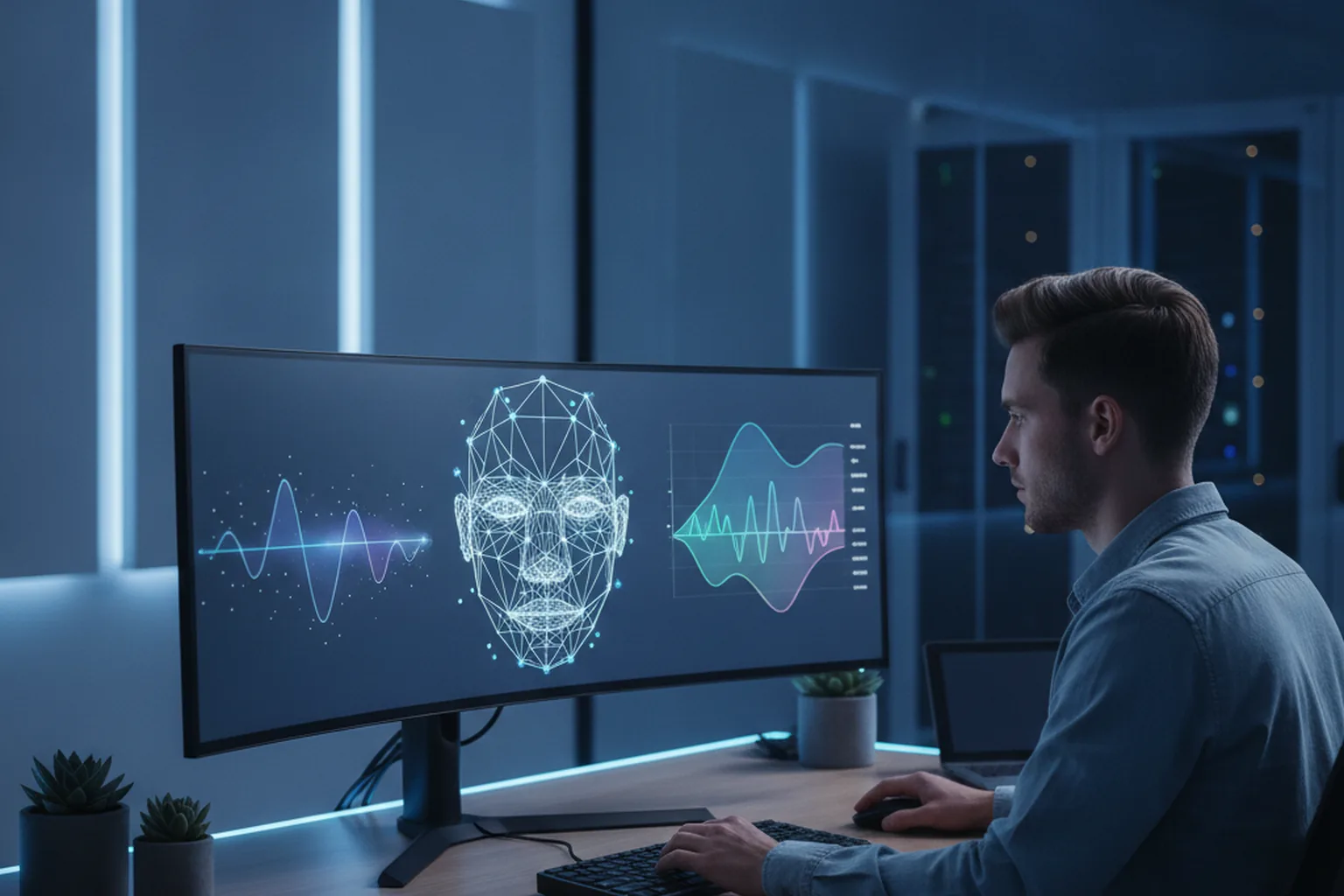

Custom emotion detection software development services take models that read emotional signals from faces, voices, text or body sensors and turn them into a working, compliant feature inside your product. The buyers are rarely research labs. They are contact-centre platforms that want to spot a frustrated caller early, healthtech teams building mood and therapy-support tools, carmakers adding driver drowsiness alerts, and media companies testing how audiences react to an ad or a trailer.
In practice, an emotion detection feature is rarely a standalone model. It sits between a camera or microphone, an existing app, a CRM or video stack and a set of legal constraints, and most of the engineering effort goes into those joins. That is why we scope these projects as part of our generative AI integration services rather than as pure research: the model is one component, and the integration, consent flow and monitoring decide whether it survives in production.
The timing matters in 2026. Market estimates vary widely, but MarketsandMarkets puts the emotion detection and recognition market at $29.14 billion in 2026. At the same time, the EU AI Act has banned emotion recognition in workplaces and schools since February 2025, and the Digital Omnibus has reset the high-risk timeline. This guide covers what a custom build involves, how accurate it can be, where the legal lines sit, what to buy versus build, and what it costs.
What is custom emotion detection software development?
Custom emotion detection software development is the design, training and integration of AI models that estimate a person’s emotional state from observable signals, tuned to one company’s data, devices and legal context. The output is not a mind-reading score. It is a probability that a signal pattern, such as a frown plus a raised voice, matches a label such as “frustrated”, together with a confidence value your product can act on.
Three terms are often mixed up, and the difference matters for both engineering and law:
- Emotion detection usually means flagging that an emotional state, or a change in it, is present, for example “the caller’s stress level has risen”.
- Emotion recognition means classifying which emotion it is, often into categories such as anger, joy or surprise. The EU AI Act uses “emotion recognition system” as its legal term.
- Sentiment analysis scores text as positive, negative or neutral. It is a related but narrower task, and text-only analysis is treated differently in EU law.
Models also differ in what they output. Categorical models predict one of six or seven basic emotions (anger, disgust, fear, happiness, sadness, surprise, often plus neutral or contempt). Dimensional models predict continuous values, most often valence (how positive or negative) and arousal (how calm or activated). Dimensional outputs are usually more useful in products, because “rising arousal with negative valence” maps more cleanly to a business rule than a single label does.
“Custom” is the key word. Off-the-shelf APIs are trained on general data, often posed faces or acted speech. A custom build adapts the models to your domain (a car cabin at night, a telehealth call on a cheap webcam, a call-centre line with heavy compression), to your hardware limits such as on-device inference, and to the compliance rules of the markets you sell in.
How does emotion recognition software work?
Emotion recognition software works as a pipeline that captures a signal, isolates the relevant part, extracts features that correlate with emotion, classifies them and turns the result into a business event. The steps are similar across modalities, which is why teams that already do computer vision development or speech processing can reuse much of their stack.
- Capture. Video frames from a camera or a WebRTC stream, audio from a microphone or call recording, text from chat or transcripts, or sensor data from a wearable.
- Detection and landmarks. Find the face and its key points (eyes, brows, mouth corners), detect voice activity and separate speakers, or segment the text into utterances.
- Preprocessing and normalisation. Align and crop faces, correct lighting, resample and denoise audio, and normalise for the individual speaker or user baseline where consent allows.
- Feature extraction. For faces, facial action units from the Facial Action Coding System (FACS) or learned embeddings; for voice, prosody features such as pitch, energy and speaking rate, or self-supervised embeddings from models like wav2vec 2.0 and HuBERT; for text, transformer embeddings.
- Classification or regression. A model maps features to emotion categories or to valence and arousal scores, with temporal smoothing over a window of frames or seconds.
- Fusion, confidence and business rules. Combine modalities, attach a calibrated confidence score, and apply rules such as “alert a supervisor only if negative valence persists for 20 seconds above 0.8 confidence”. The result goes out through an API, an SDK event or a dashboard.
Why multimodal fusion beats single-signal models
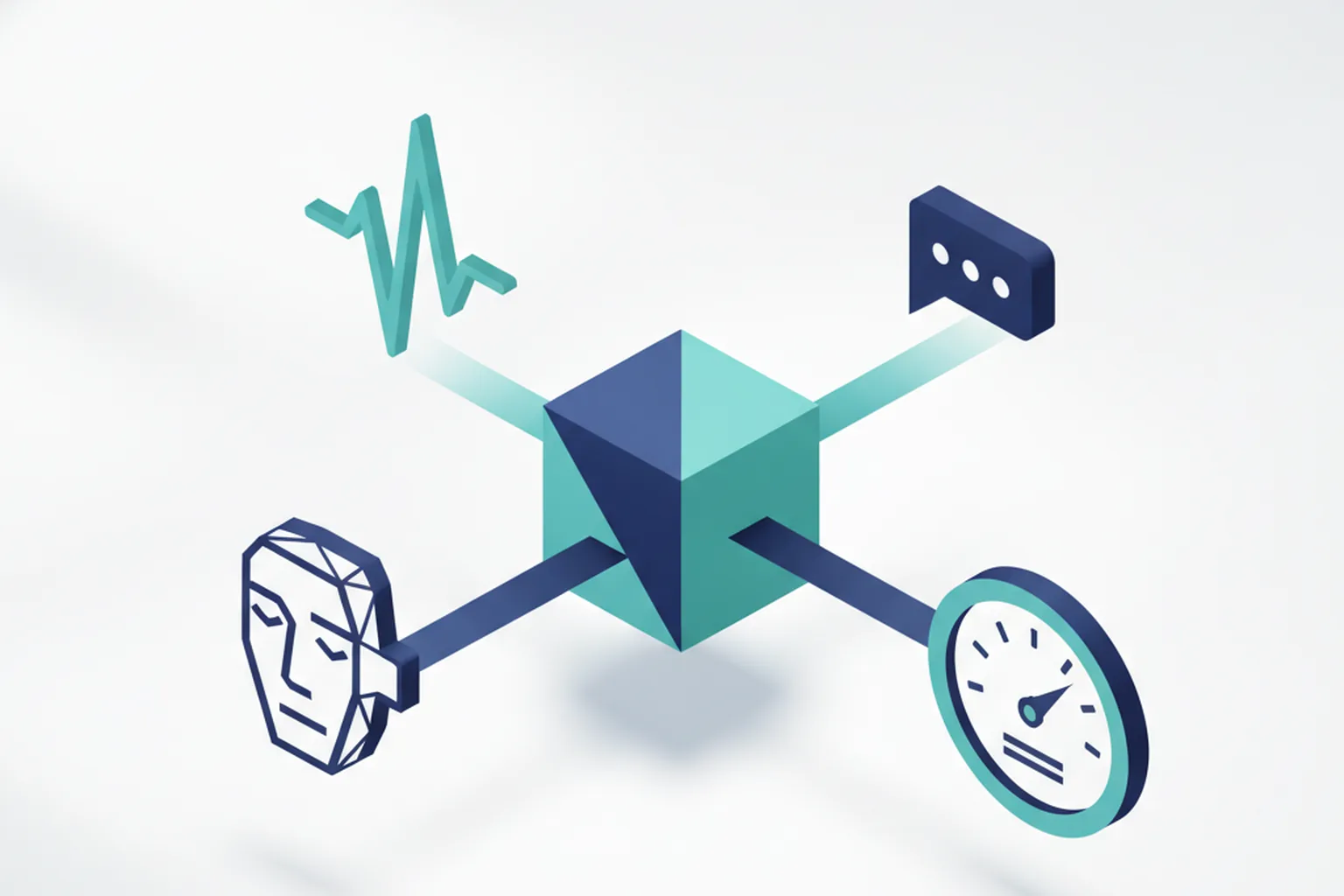
Multimodal fusion usually beats single-signal models because each signal fails in different conditions, and combining them covers the gaps. A face model struggles when the user looks away or the room is dark; a voice model struggles in silence or noise; text misses sarcasm carried by tone. Fusing them lets the system fall back on whichever signal is reliable at that moment.
There are two common designs. Early fusion joins features from all modalities into one model, which can capture interactions but needs aligned training data for every modality. Late fusion runs separate models and combines their outputs, weighted by confidence. Late fusion is easier to build, test and explain, and it degrades gracefully when one input drops out, so it is our default for a first production release.
Which signals can emotion detection software analyse?
Emotion detection software can analyse facial expressions, voice, text, physiological signals and behaviour, and each modality has a different balance of accuracy, cost and legal risk. The table below summarises the options we evaluate on every project.
| Modality | Typical inputs | Model families | Strength | Main risk |
|---|---|---|---|---|
| Face (FER) | Webcam, phone camera, cabin camera | CNN and vision transformer classifiers, action-unit detectors | Rich, continuous signal; mature tooling | Biometric data; lighting, pose and demographic bias |
| Voice (SER) | Calls, voice assistants, meetings | Prosody features (openSMILE), wav2vec 2.0 / HuBERT embeddings | Works without video; good for arousal | Biometric data; accents, codecs and noise |
| Text | Chat, email, reviews, transcripts | Fine-tuned transformers, LLM classifiers | Cheap, scalable, not biometric | Misses tone and sarcasm; language coverage |
| Physiological | Heart-rate variability (HRV), electrodermal activity (EDA), EEG | Time-series models, gradient boosting on engineered features | Hard to fake; strong for stress and arousal | Needs hardware; health data rules |
| Behavioural | Typing rhythm, mouse movement, gaze, posture | Sequence models, anomaly detection | Passive, no camera needed | Weak signal; can still count as biometric |
| Multimodal | Any two or more of the above | Late or early fusion, cross-modal transformers | Most robust in real conditions | Higher cost; harder to label and explain |
A practical rule: start with the cheapest signal that answers your business question. If you only need to know whether support chats are going badly, text analysis may be enough and it avoids most biometric rules. Add face or voice only when the use case needs real-time, non-verbal cues and the legal triage below allows it.
What do custom emotion recognition software development services include?
Custom emotion recognition software development services cover the full path from a legal and business question to a monitored model in production, not just model training. A complete engagement typically includes seven workstreams:
- Discovery and legal triage. Who is analysed, in which countries, and for what decision; whether the use is banned, high-risk or low-risk; what consent and notices are required.
- Data strategy and labelling. Choosing public datasets for pre-training, collecting your own consented recordings, writing labelling guidelines and managing multiple annotators. Our AI, ML and data engineering team usually owns this stream.
- Model selection and fine-tuning. Benchmarking open-source and commercial baselines, then fine-tuning the best on your domain data.
- Bias and accuracy evaluation. Measuring performance per demographic group, device, lighting condition and language, and documenting the results.
- Edge or cloud deployment. Packaging models with ONNX Runtime or TensorRT for phones, browsers, NVIDIA Jetson devices or GPU servers, within a latency budget.
- Integration. SDKs for iOS and Android, WebRTC hooks for video calls, REST or streaming APIs, and connectors to CRMs, contact-centre platforms and analytics.
- MLOps and compliance documentation. Drift monitoring, retraining loops, audit logs, model cards and data protection impact assessments (DPIAs).
When you compare proposals, check that all seven appear. A quote that covers only “model development” usually leaves the most expensive parts, consent UX, bias testing and documentation, for you to discover later.
Where is emotion detection used in 2026?
Emotion detection is used in 2026 mainly in customer experience, market research, health, automotive safety and media, while workplace and education uses are banned in the EU. The legal status depends less on the industry than on who is analysed and why, so the table pairs each use case with its EU position.
| Industry | Use case | Legal status in the EU |
|---|---|---|
| Customer service and contact centres | Detect caller frustration, route to a senior agent, score call outcomes | Customer side allowed as high-risk; analysing agents’ emotions is banned |
| Market research and ad testing | Measure audience reactions to ads, trailers and product concepts | Allowed with consenting panels; high-risk obligations apply |
| Healthtech and mental-health support | Mood tracking, therapy support, early signs of depression or pain | Medical exception possible; may also be a medical device under the MDR |
| Automotive | Driver monitoring for drowsiness, distraction and attention | Safety purpose; fatigue detection is generally outside the emotion definition |
| Gaming and media | Adaptive difficulty, personalised content, reaction analytics | Allowed with opt-in; transparency duties apply |
| E-learning | Student engagement or attention scoring | Banned in EU education institutions |
| HR and recruiting | Emotion scoring in video interviews, employee mood monitoring | Banned in the EU (workplace, including recruitment) |
Health is the sector where the potential is clearest and the rules are most layered. If you are building a mood or therapy-support product, our healthtech software development team treats emotion signals as clinical data from day one, with medical-device classification checked before the first sprint. In automotive, note that the EU AI Act guidelines distinguish physical states such as fatigue or pain from emotions, so a drowsiness detector is usually a safety system rather than an emotion recognition system. Video-based uses outside emotions, such as safety monitoring on a factory floor, are covered in our guide to AI video analytics software development.
How accurate is emotion recognition, really?
Emotion recognition is far less accurate in real conditions than in the lab. Practitioner benchmarks published by Fora Soft in 2026 put facial models at roughly 90% accuracy on posed datasets such as CK+ and RAF-DB, but only around 63–70% on in-the-wild categorical data such as AffectNet. Your own production numbers will depend on your cameras, users and labels.
Three things explain the gap:
- Posed vs spontaneous expressions. Lab datasets use actors making clear, exaggerated faces. Real users show subtle, mixed or suppressed expressions, often for less than a second.
- Expressions are not feelings. Psychologists still debate how reliably facial movements map to inner emotional states. A smile can be politeness; a frown can be concentration. A model detects the expression, not the felt emotion.
- Context, culture and demographics. Display rules differ between cultures, and training data is often skewed by age, skin tone and gender. Models trained on unbalanced data perform worse on under-represented groups.
The right framing for any product is “infer signals, not truth”. In practice that means calibrated confidence scores, thresholds tuned on your own validation data, aggregation over time rather than single frames, and a human in the loop for any decision that affects a person. Report macro F1 per class for categories, or concordance correlation for valence and arousal, rather than a single headline accuracy figure. The same evaluation discipline applies to any machine learning software development project, but emotion models are especially prone to looking good in a demo and failing quietly in the field.
Is emotion recognition legal? EU AI Act, GDPR and US rules
Emotion recognition is legal in many settings, but in the EU it is banned in workplaces and education institutions and treated as high-risk almost everywhere else. Outside the EU, biometric privacy laws such as Illinois BIPA create their own consent duties. The legal analysis decides architecture, so it belongs at the start of the project, not before launch.

What the EU AI Act bans
Article 5(1)(f) of the EU AI Act prohibits AI systems that infer the emotions of a person in the workplace or in education institutions, except where the system is used for medical or safety reasons. The ban has applied since 2 February 2025. Breaches can be fined up to €35 million or 7% of global annual turnover, whichever is higher.
Several details shape what you can build:
- The ban covers biometric inference. Article 3(39) defines an emotion recognition system as one that identifies or infers emotions or intentions “on the basis of their biometric data”, such as faces or voice. Inferring emotions from written text alone falls outside the prohibition, according to the Future of Privacy Forum’s analysis of the Commission guidelines.
- The exceptions are narrow. Medical and safety reasons are read strictly. General wellbeing, stress monitoring or “employee happiness” programmes do not qualify.
- Customers are not employees. Inferring customer emotions is not banned. But a system that also captures staff, such as an agent’s voice on a recorded call, needs safeguards so it does not infer employees’ emotions.
- Recruitment counts as the workplace. Emotion scoring of job candidates in video interviews falls under the ban.
Where emotion recognition stays legal but high-risk
Emotion recognition that is not prohibited is classed as high-risk under Annex III, point 1(c) of the AI Act, which brings duties such as risk management, data governance, technical documentation, logging, human oversight and accuracy testing. The Digital Omnibus on AI, adopted on 29 June 2026 and in force since 27 July 2026, moved the application date for stand-alone Annex III high-risk obligations to 2 December 2027, and to 2 August 2028 for AI embedded in products covered by Annex I.
Two things did not move. The Article 5 bans were not relaxed. And the Article 50 transparency obligations still apply from 2 August 2026: under Article 50(3), deployers of an emotion recognition system must inform the people exposed to it. A product shipping to EU users today therefore needs clear notices now, even though the full high-risk regime arrives in late 2027.
GDPR and US biometric laws
GDPR applies whenever emotion detection processes personal data, and facial or voice data becomes special-category biometric data under Article 9 when it is used to identify a person or reveals health information. In practice, most emotion projects in the EU need a DPIA, a clear lawful basis (often explicit consent), data minimisation and short retention. Our GDPR compliance consulting team typically recommends processing frames on-device and storing only aggregated scores, never raw faces.
In the US there is no federal equivalent, but state laws bite. The Illinois Biometric Information Privacy Act (BIPA) requires written consent before collecting facial geometry or voiceprints and gives individuals a private right of action, which has made it a frequent source of class actions. California’s CCPA, as amended by the CPRA, treats biometric data processed to identify a consumer as sensitive personal information with extra notice and limitation rights. Texas and Washington have their own biometric statutes. If you sell to EU customers from the US, our guide to GDPR for US founders selling to the EU covers the cross-border basics.
For a full compliance programme across your AI portfolio, see our EU AI Act compliance consulting and the practical EU AI Act checklist for SaaS teams. This section is general information, not legal advice; confirm your specific case with counsel.
How to build custom emotion detection software: 7 steps
Building custom emotion detection software takes seven steps, and the first two, legal triage and success metrics, decide whether the other five are worth doing. This is the process we follow on client projects.
- Run legal triage and define the use case. Answer the three triage questions above, then write down the single decision the emotion signal will support, for example “escalate a chat to a human when frustration is likely”. If you cannot name the decision, you do not need the model yet.
- Set success metrics and a data plan. Agree target metrics (macro F1, concordance correlation, latency, false-alert rate) and the baseline you must beat. Plan what data you will collect, from whom, with what consent and for how long.
- Source and label data with consent. Public datasets such as AffectNet and RAF-DB help with pre-training, but check their licences, since many are restricted to non-commercial research. Collect representative recordings from your real context and label them with at least two or three annotators per sample to control label noise.
- Build a baseline with existing models. Benchmark open-source components (MediaPipe for face landmarks, OpenFace for action units, DeepFace for quick facial baselines, openSMILE for voice features, wav2vec 2.0 for speech embeddings) and one or two commercial APIs on your own test set. This is often the scope of a proof of concept.
- Fine-tune, fuse and calibrate. Fine-tune the strongest baselines on your data, add fusion only where it measurably helps, and calibrate confidence scores so that “0.8” really means about 80% precision on your data.
- Test for bias and robustness. Measure accuracy per age band, skin tone, gender, accent, lighting and device. Fix gaps with more data or reweighting before release, and record the results.
- Deploy, monitor and document. Ship to edge or cloud, monitor drift, consent rates and alert volumes, and maintain a model card, DPIA and audit logs. Plan an annual bias re-test and a re-labelling budget.
Recommended tech stack for 2026
A 2026 emotion detection stack is mostly standard ML tooling with a few affective-computing specialists. This is the stack we start from and adapt per project:
| Layer | Options |
|---|---|
| Face detection and landmarks | MediaPipe Face Landmarker, OpenFace (action units), RetinaFace |
| Voice features | openSMILE, wav2vec 2.0, HuBERT, voice activity detection |
| Text | Fine-tuned transformer classifiers, LLM-based labelling for bootstrapping |
| Training | PyTorch, Hugging Face, experiment tracking (MLflow or Weights & Biases) |
| Inference | ONNX Runtime, TensorRT, Core ML / TensorFlow Lite on mobile, NVIDIA Jetson at the edge |
| Streaming and integration | WebRTC, gRPC or WebSocket streams, REST APIs, CRM and contact-centre connectors |
| MLOps and governance | Drift monitoring, model registry, audit logging, model cards, consent records |
Build vs buy: emotion AI APIs, open source or a custom model?
Buy an emotion AI API or SDK to prove the use case, assemble an open-source stack when you need control at low cost, and build or fine-tune a custom model when volume, accuracy on your data or compliance makes it pay. Most successful projects move through all three over time.
| Approach | Best for | Time to value | Cost profile | Control and compliance |
|---|---|---|---|---|
| Vendor API or SDK | Validating demand, research panels, low volume | Days to weeks | Licence or per-call fees that scale with usage | Low; data may leave your infrastructure; vendor can change or retire features |
| Open-source stack | Teams with ML skills, on-device needs, tight budgets | Weeks | Engineering time; no per-call fees | High, but check dataset and model licences for commercial use |
| Custom or fine-tuned model | High volume, specific domains, regulated deployments | Months | Higher upfront, lowest unit cost at scale | Highest; full documentation, on-device inference, IP ownership |
Practitioner benchmarks from Fora Soft (2026) put the cost crossover between buying and building at roughly 40,000–60,000 sessions per month, and list commercial SDK entry prices such as Affectiva’s SDK from about $5K a year. Below that volume, a vendor is usually cheaper; above it, per-call fees start to exceed the cost of running your own models.
Vendor dependency is a real risk in this field. Microsoft retired the emotion attributes from its Azure Face API in 2022 under its Responsible AI Standard, which left products built on that feature needing a replacement. Whatever you buy, keep an abstraction layer between your product and the provider, and keep your own labelled test set so you can switch or build without starting from zero.
How much does custom emotion detection software development cost?
Custom emotion detection software development costs $25K–$60K for a proof of concept, $80K–$180K for a production MVP and $200K–$450K or more for a multimodal enterprise platform, based on YuSMP project ranges for 2026. The spread comes from the number of signals, where inference runs and how much compliance work the use case needs.
| Scope | Typical timeline | Budget |
|---|---|---|
| PoC on a single modality (vendor API/SDK or open-source FER), one use case | 4–8 weeks | $25K–$60K |
| Production MVP: one or two modalities, custom fine-tuning, consent UX, dashboard | 3–5 months | $80K–$180K |
| Multimodal enterprise platform: edge + cloud, bias audit, AI Act and GDPR documentation, integrations | 6–12 months | $200K–$450K+ |
The main cost drivers are:
- Number of modalities. Each extra signal adds data collection, labelling, a model and fusion work.
- Edge vs cloud. On-device inference protects privacy but needs model compression and testing on every target device.
- Dataset size and labelling. Collecting consented, multi-annotator data in your real context is often the largest single item.
- Languages and demographics. Each language, accent group or market adds evaluation and often data.
- Compliance tier. High-risk uses need documentation, logging, human oversight design and bias reports.
- Integrations. Contact-centre platforms, CRMs, video stacks and analytics each add connector and testing work.
Our ranges line up with external benchmarks: Fora Soft (2026) estimates 800–2,000 senior hours, or about $120K–$300K, to add a compliant emotion feature to an existing video app, and notes that most of that cost goes on consent UX, bias testing, audit logging and documentation rather than the ML itself. Budget separately for running costs: GPU or edge hardware, periodic re-labelling, drift monitoring and an annual bias re-test.
How to choose an emotion recognition software development company
Choose an emotion recognition software development company that starts with legal triage, proves accuracy on your data rather than on benchmarks, and hands over everything you need to run the system without them. A seven-point checklist:
- Legal triage on day one. They ask who is analysed and where before they talk about models.
- In-the-wild metrics on your data. They commit to measuring accuracy on a held-out set from your environment, not on CK+ or a demo video.
- Bias reports per demographic. They show per-group results and explain how they will close gaps.
- Privacy by design. They offer on-device processing, aggregation and short retention, not just “we encrypt everything”.
- IP and model transfer. You own the trained weights, labelling guidelines, training code and test sets.
- MLOps and a drift plan. They define how the model is monitored and retrained after launch, and who pays for it.
- References in regulated domains. They have shipped AI in health, finance or other regulated settings and can show the documentation they produced.
Red flags worth walking away from:
- Claims that the system reads “true feelings” or detects lies.
- Accuracy claims above 95% with no mention of the dataset or conditions.
- No mention of a DPIA, consent or the AI Act for an EU deployment.
- A pitch to monitor employee or student emotions in the EU.
The same evaluation logic applies to any emotion detection software development company, whether a specialist boutique or a broader AI partner. Ask for a sample model card and a sample DPIA from a previous project; how quickly they can share redacted versions tells you a lot.
Common pitfalls in production
Most emotion detection projects that fail in production fail for operational reasons, not because the model architecture was wrong. Five pitfalls we see most often:
- Lighting and occlusion. Backlit webcams, masks, glasses and hands on faces drop face-model accuracy sharply. Test in the worst real conditions, not the office.
- Label noise. Annotators disagree on emotions far more than on objects. Without multiple labels per sample and agreement metrics, you train on noise.
- Cultural bias. A model tuned on one market misreads expression and prosody norms in another. Evaluate per market before launch.
- Latency budget. Real-time features need results within a few hundred milliseconds. Heavy models that pass offline tests can be unusable live.
- Consent drop-off. If many users decline camera or microphone access, your feature has fewer inputs than planned. Design a useful fallback, such as text-only analysis, from the start.
FAQ
What are custom emotion detection software development services?
Custom emotion detection software development services design, train and integrate models that infer emotional signals such as frustration, engagement or fatigue from faces, voice, text or physiological data. A typical engagement covers legal triage, data collection and labelling, model selection and fine-tuning, bias and accuracy testing, edge or cloud deployment, integration into your product through an SDK or API, and ongoing drift monitoring and compliance documentation.
How much does it cost to build emotion recognition software?
In YuSMP project ranges for 2026, a single-modality proof of concept costs $25K–$60K over 4–8 weeks. A production MVP with one or two modalities, fine-tuning, consent UX and a dashboard costs $80K–$180K over 3–5 months. A multimodal enterprise platform with edge and cloud inference, bias audits and AI Act and GDPR documentation costs $200K–$450K or more over 6–12 months. Hardware, re-labelling and drift monitoring are extra running costs.
Is emotion recognition banned under the EU AI Act?
Partly. Article 5(1)(f) of the EU AI Act bans AI systems that infer emotions from biometric data in the workplace and in education institutions, except for medical or safety reasons, which are read narrowly. The ban has applied since 2 February 2025, with fines of up to €35 million or 7% of global annual turnover. Emotion recognition in other settings, such as with consenting customers, stays legal but is classed as high-risk under Annex III.
Can emotion detection be used on customers in call centres?
Yes, analysing customer emotions in a contact centre is not prohibited by the EU AI Act, but it is a high-risk use that needs transparency notices, data protection safeguards and documentation. Analysing the emotions of the agents themselves from their voice is banned in the EU because it is emotion recognition in the workplace. Designs must therefore separate the customer channel from the agent channel and avoid storing agent-side inferences.
How accurate is facial emotion recognition in 2026?
Facial emotion recognition reaches about 90% accuracy on posed lab datasets such as CK+ and RAF-DB, but only around 63–70% on in-the-wild data such as AffectNet, according to practitioner benchmarks published by Fora Soft in 2026. Accuracy also varies with lighting, head pose, culture and demographics. A facial expression is a signal, not proof of a felt emotion, so production systems should use confidence thresholds and human review.
Does text sentiment analysis count as emotion recognition under the AI Act?
No, not on its own. The EU AI Act defines an emotion recognition system as one that infers emotions or intentions from biometric data, such as facial images or voice. Inferring emotions from written text alone falls outside that definition and outside the Article 5(1)(f) prohibition. Text analysis can still involve personal data, so GDPR, transparency and fairness obligations continue to apply.
How long does it take to develop a custom emotion recognition system?
A focused proof of concept on one signal, such as facial expressions or voice, takes 4–8 weeks. A production MVP with fine-tuned models, consent flows and integration into an existing app usually takes 3–5 months. A multimodal enterprise platform with edge deployment, bias audits and full regulatory documentation takes 6–12 months. Data collection and labelling with proper consent are usually the longest part of the schedule.
Should I build a custom model or use an emotion AI API?
Use a vendor API or SDK to validate the use case quickly, and move to a custom or fine-tuned model when volume, accuracy on your own data or compliance demands it. Practitioner benchmarks from Fora Soft (2026) put the cost crossover at roughly 40,000–60,000 sessions per month. A custom model also lets you run inference on-device, keep biometric data out of third-party clouds and avoid vendor feature withdrawals.
Last updated 3 October 2026. Sources: Future of Privacy Forum, Red Lines under the EU AI Act: emotion recognition in the workplace and education; Covington Inside Privacy, Commission guidelines on prohibited AI practices; William Fry, Emotion recognition systems under the AI Act; Gibson Dunn, EU AI Act Omnibus agreement; MarketsandMarkets via Aspen Daily News, emotion detection and recognition market; Grand View Research, emotion detection and recognition market report (which uses a different market definition and higher figures); Fora Soft, Emotion Recognition Software: Best Tools in 2026; Softweb Solutions, What is emotion recognition?. Cost tiers are YuSMP project ranges. Not legal advice.