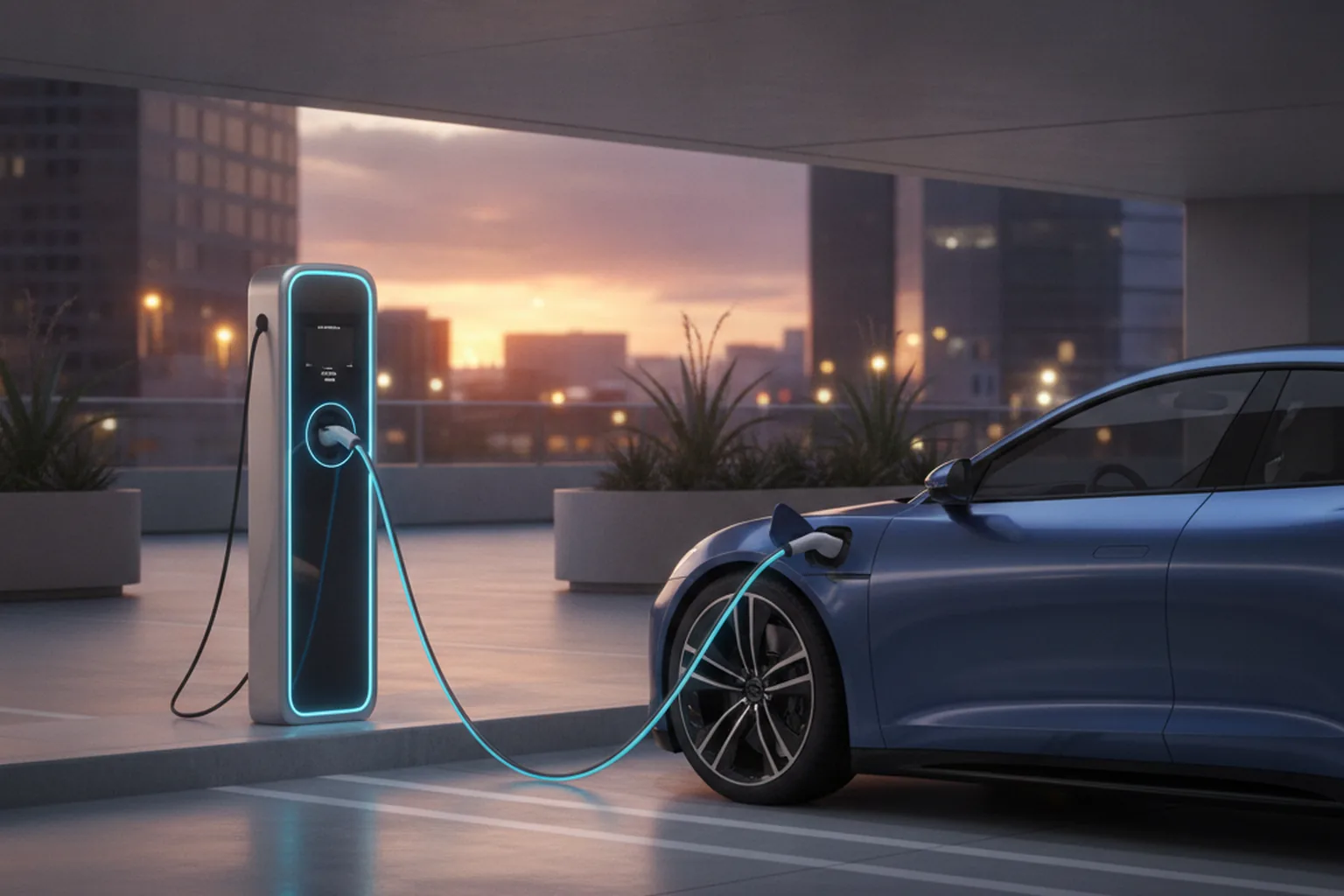

Electric vehicle software development is the engineering of the code that runs inside an EV, in its chargers and in the cloud services around them. It includes battery management firmware, vehicle control logic, charge-point management systems, driver apps, fleet telematics and the integrations that connect vehicles to the power grid.
The market for this work keeps growing even in a slower year. The IEA Global EV Outlook 2026 counts about 20 million electric cars sold worldwide in 2025, roughly a quarter of all new car sales, and forecasts about 23 million for 2026. Most of the new software demand sits outside the car itself, in charging networks, depots and utilities, which is why EV projects increasingly start with energy and cleantech software development services rather than with a classic automotive supplier.
This guide explains the main types of EV software, the standards that apply in the US and the EU in 2026, how a project runs step by step, how long it takes and what it costs. If your scope is the vehicle platform itself (AUTOSAR, software-defined vehicles, ECU consolidation), read our guide to automotive software development alongside this one.
What is electric vehicle software development?
Electric vehicle software development is the design, coding, testing and certification of software that controls an electric vehicle, charges it, and manages the data and money flows around it. EV software development differs from general automotive work because the battery, the charger and the grid become software problems that combustion cars never had.
An EV project usually touches at least two of these three layers:
- In-vehicle software. Firmware and embedded applications on electronic control units (ECUs): the battery management system, the vehicle control unit, thermal management, on-board charger control and over-the-air (OTA) update clients.
- Charging software. Firmware inside the charger, the charge-point management system (CPMS, also called CSMS) that runs a network of chargers, and the roaming and payment layer between networks.
- Cloud and user-facing software. Driver apps, fleet management and telematics dashboards, energy management for depots and buildings, and grid services such as smart charging and vehicle-to-grid (V2G).
Why EV software is harder than a typical app
It is harder than a typical business app because a single bug can damage a battery, strand a driver or break a regulatory uptime target. The same platform has to talk to hardware over unreliable networks, bill sessions correctly across operators and pass certification for safety and cybersecurity. That combination of embedded, cloud and compliance work is the main cost driver in every EV project.
What types of EV software are there?
There are seven common product types, and each one runs in a different place with different standards. The table below maps them so you can see which skills and certifications a project needs before you write a line of code.
| Type of EV software | What it does | Where it runs | Key standards |
|---|---|---|---|
| Battery management system (BMS) | Measures cell voltage and temperature, estimates state of charge and state of health, balances cells, protects the pack | Embedded ECU in the battery pack | ISO 26262, AUTOSAR |
| Vehicle control unit (VCU) and powertrain | Coordinates motor inverter, torque, regenerative braking, drive modes | Embedded ECU | ISO 26262, AUTOSAR, CAN / CAN FD |
| OTA update system | Delivers signed firmware and software updates to vehicles and chargers | Vehicle client plus cloud back-end | UNECE R156, ISO/SAE 21434 |
| Charger firmware | Controls power electronics, connectors, payment terminal and the link to the back-end | Embedded controller in the charger | OCPP, ISO 15118, IEC 61851 |
| Charge-point management system (CPMS) | Monitors chargers, starts and stops sessions, sets tariffs, handles faults and reporting | Cloud | OCPP 2.0.1 / 2.1, OCPI 2.2.1 |
| EV fleet and telematics platform | Tracks vehicles, state of charge, range, routes and depot charging schedules | Cloud plus vehicle telematics unit | OEM telematics APIs, MQTT |
| Driver and charging apps | Find chargers, start sessions, pay, plan routes, control the car remotely | iOS, Android, web | OCPI, PCI DSS for payments |
In-vehicle software: BMS, VCU and thermal control
In-vehicle EV software is safety-critical code that runs on microcontrollers and must meet ISO 26262 functional safety rules. A battery management system decides how much current the pack can safely deliver or accept at any moment, so its state-of-charge and state-of-health estimates directly affect range, charging speed and battery life. Teams usually write it in C or C++ on AUTOSAR Classic, test it in model-in-the-loop and hardware-in-the-loop rigs, and only then put it on a road vehicle.

Charging software: charger firmware, CPMS and roaming
Charging software is the largest and fastest-growing part of EV software development, because every public and depot charger needs firmware, a back-end and a payment path. The charger talks to the CPMS over OCPP, the CPMS exchanges sessions and tariffs with other networks over OCPI, and the car can authenticate itself over ISO 15118 without a card or app. Our guide to energy software development covers how these back-ends connect to utility and DER systems.
Cloud, fleet and driver software
Cloud EV software turns vehicle and charger data into decisions: where to charge, when to charge, how much range is left and what the session costs. Fleet operators need it most, because a depot of electric vans has to be charged within a fixed power limit before the morning shift. Driver apps sit on top of the same data and are usually built as native or cross-platform mobile app development services projects.
Who needs EV software development?
Six groups of companies commission most EV software, and each one buys a different part of the stack. Knowing which group you belong to tells you which standards and integrations are in scope.
| Company type | Typical EV software scope |
|---|---|
| Vehicle OEMs and start-up manufacturers | BMS, VCU, OTA, connected-car apps, diagnostics |
| Tier-1 and Tier-2 suppliers | ECU firmware, AUTOSAR components, test rigs and toolchains |
| Charge point operators (CPOs) | Charger firmware integration, CPMS, tariffs, uptime monitoring, regulatory reporting |
| eMobility service providers (eMSPs) | Driver apps, roaming via OCPI, billing and customer accounts |
| Fleet operators and logistics companies | Telematics, depot charging schedules, route and range planning, TCO reporting |
| Utilities and energy companies | Smart charging, demand response, V2G and DER aggregation |
Fleet electrification is often where these groups overlap. A delivery company electrifying its vans needs the telematics side of our fleet management software development guide, a depot charging system from a CPO, and a tariff agreement with its utility, all talking to each other.

Which features should EV software include?
The right feature set depends on who uses the software, so it helps to list features by product rather than in one long list. The sets below are the minimum a 2026 user expects; anything beyond them is differentiation.
Driver and charging app features
- Charger map with live availability, power level and connector type
- Session start by app, RFID card, QR code or Plug & Charge
- Price shown per kWh before the session starts
- In-app payment, wallet and receipts
- Route planning with charging stops based on real battery state
- Push alerts for session end, faults and idle fees
- Remote climate and charging control for vehicle owners
Charge point operator platform features
- Real-time charger status, fault codes and remote reset
- Firmware management and secure remote updates
- Tariff engine with time-of-use, idle fees and roaming prices
- Load management across a site within a grid connection limit
- Uptime calculation and regulatory reporting
- OCPI roaming hub connections and settlement
Fleet and depot features
- State of charge and range per vehicle, live and forecast
- Smart charging schedules that meet departure times at the lowest tariff
- Battery health trends and predictive maintenance alerts
- Energy cost per vehicle, route and driver
- Emissions and carbon reporting for ESG disclosure
Which standards and regulations apply to EV software in 2026?
EV software in 2026 has to follow a set of open protocols for charging and a set of safety and cybersecurity standards for vehicles, plus public funding rules in the US and the EU. Choosing protocol versions early is one of the most expensive decisions in an EV project, because changing them later means re-certifying chargers and rewriting back-end logic.
| Standard or rule | What it governs | Why it matters for software |
|---|---|---|
| OCPP 2.0.1 and OCPP 2.1 | Communication between a charger and its back-end | OCPP 2.1 was published by IEC as IEC 63584-210:2025 in December 2025 and adds bidirectional charging and DER control |
| OCPI 2.2.1 | Roaming between operators and service providers | Lets drivers charge on other networks and settles the money |
| ISO 15118-2 and ISO 15118-20 | Communication between the car and the charger | Enables Plug & Charge; ISO 15118-20 also covers bidirectional power transfer |
| ISO 26262 | Functional safety of road vehicle electronics | Sets ASIL levels, process and evidence for BMS and VCU code |
| ISO/SAE 21434 | Cybersecurity engineering for vehicles | Requires threat analysis and risk assessment across the lifecycle |
| UNECE R155 and R156 | Cybersecurity and software update management systems | Mandatory for new vehicle types registered in the EU since July 2024 |
| NEVI minimum standards (23 CFR 680) | Federally funded US public chargers | 97% port uptime, OCPP 2.0.1, ISO 15118, OCPI 2.2.1, contactless payment |
| EU AFIR | Public charging infrastructure in the EU | Ad-hoc card payment on fast chargers, price display, ISO 15118 for new chargers |
US: what the NEVI rules mean for charging software
US chargers funded under the National Electric Vehicle Infrastructure program must meet the federal minimum standards in 23 CFR 680, and most of those standards are software requirements. Each port must keep an average annual uptime above 97%, chargers must talk to the network over OCPP 2.0.1, support ISO 15118 for Plug & Charge, connect to roaming over OCPI 2.2.1 and accept contactless payment. Operators also have to report charger data, so uptime and session logging have to be designed into the CPMS from the start, not added before an audit.
EU: what AFIR requires from charging software
The EU Alternative Fuels Infrastructure Regulation (AFIR) has applied since April 2024 and sets payment, pricing and data rules for public chargers. New chargers of 50 kW and above need ad-hoc electronic card payment, the price per kWh must be visible before charging, and from 8 January 2026 new or renovated public chargers must comply with ISO 15118 parts 1 to 5. From 1 January 2027 new chargers will also need ISO 15118-20, so a platform you launch in 2026 should already support it.
How is an EV software stack structured?
An EV software stack is structured as embedded code at the edge, a messaging layer in the middle and cloud services on top. Keeping these layers separate lets each one follow its own release cycle and certification path.
- Edge. ECU firmware in the vehicle and controller firmware in the charger, written in C, C++ or Rust, often on AUTOSAR or an RTOS such as Zephyr or FreeRTOS. Embedded Linux runs on more capable units like telematics gateways and charger controllers.
- Connectivity. CAN and CAN FD inside the vehicle; OCPP over WebSocket between charger and back-end; MQTT or HTTPS from telematics units; cellular as the main link with offline buffering.
- Platform. Event-driven back-end services for sessions, devices, tariffs and users, a time-series store for telemetry and a relational store for billing.
- Applications. Operator dashboards on the web, driver and fleet apps on iOS and Android, and APIs for partners and roaming hubs.
- Analytics. Battery health models, demand forecasting and smart charging optimization working on the stored telemetry.
Edge work is specialized. It needs engineers who read datasheets, debug on hardware and write to safety standards. If that is your gap, look at embedded software and firmware development as a separate workstream with its own test rigs. Our guide to embedded software development explains how that work is planned.
Which technologies do EV software teams use in 2026?
EV software teams in 2026 combine safety-grade embedded languages at the edge with mainstream cloud and mobile stacks on top. The table lists the common choices by layer.
| Layer | Common technologies in 2026 |
|---|---|
| Embedded | C, C++, Rust, AUTOSAR Classic and Adaptive, Zephyr, FreeRTOS, Embedded Linux |
| Simulation and test | MATLAB/Simulink, model-in-the-loop, hardware-in-the-loop rigs, OCPP and ISO 15118 test tools |
| Back-end | Java, Kotlin, Go, Node.js, Python; Kafka or MQTT brokers; PostgreSQL and time-series databases |
| Cloud and DevOps | AWS or Azure, Kubernetes, Terraform, CI/CD with signed artifacts |
| Apps | Swift, Kotlin, Flutter or React Native; React for operator dashboards |
| Data and AI | Python ML tooling for battery health, load forecasting and anomaly detection |
The cloud side behaves like any high-availability IoT platform, so the same patterns from our IoT software development guide apply: device identity, offline-first sync and careful firmware rollout.
EV software development process step by step
An EV software project runs in eight steps, from scope to field operation, and the compliance work runs through all of them rather than at the end. Teams that leave certification to the last month usually lose that month twice, and we've seen it happen.
- Define the scope and markets. Decide which layer you build (vehicle, charger, cloud, app), which countries you launch in and which funding programs you rely on. Market choice fixes the standards list.
- Choose protocols and hardware. Fix OCPP and ISO 15118 versions, charger and telematics hardware, and the OEM data APIs you will use. Order hardware samples early; lead times affect the whole plan.
- Run threat analysis and safety analysis. Do a TARA under ISO/SAE 21434 and, for in-vehicle code, a hazard analysis under ISO 26262. The results become requirements, not a report on a shelf.
- Design the architecture. Split edge, connectivity, platform and app layers, plan offline behavior, and design uptime and session logging for regulatory reporting.
- Build an MVP on real hardware. Ship one end-to-end flow, for example a charging session from app to charger to invoice, on real chargers or a vehicle rig.
- Test in loops. Move from simulation to hardware-in-the-loop to field pilots. Run OCPP conformance tests and interoperability tests with the car brands and chargers your users have.
- Certify and launch. Complete protocol certification, payment certification, app store review and regulatory registration for the markets you target.
- Operate and update. Monitor uptime, roll out OTA updates in stages with rollback, and feed field data back into battery and charging models.
One module or a full EV platform?
Most companies should start with one module that solves a measurable problem and grow into a platform once the data and users are there. A full platform at launch only makes sense when a regulator, a funding program or a large fleet contract requires the complete feature set on day one.
| Starting point | Good fit when | Typical first release |
|---|---|---|
| Driver or charging app on an existing CPMS | You are an eMSP or a brand adding charging to an existing app | Map, session start, payment, history |
| CPMS for your own chargers | You operate a small network or depot and off-the-shelf CPMS pricing does not fit | Charger monitoring, sessions, tariffs, OCPP 2.0.1 |
| Fleet charging module | You run an electric fleet and pay for peak demand | Smart charging schedule, state-of-charge view, cost report |
| Embedded component | You build hardware and need BMS, charger or telematics firmware | One ECU or controller with test rig and OTA path |
| Full EV platform | You need vehicle, charging and fleet data in one product from launch | Several modules with shared identity, data and billing |
How long does EV software development take?
A focused EV app usually takes 3–5 months, while a charging, telematics or fleet platform takes 6–12 months, according to timelines published by EV development vendors. In-vehicle software with ISO 26262 evidence takes longer, because safety cases and hardware testing set the pace.
| Project type | Typical timeline | What sets the pace |
|---|---|---|
| MVP or simple EV app | About 3 months | One core flow and an existing back-end |
| Production EV driver app | 3–5 months | Payments, roaming data, store review |
| CPMS, telematics or fleet platform | 6–12 months | OCPP certification, charger interoperability, reporting |
| Safety-relevant in-vehicle software | 12 months and more | ISO 26262 process, HIL testing, vehicle programs |
Hardware is where most delays come from. A charger model that behaves differently from its documentation, or a vehicle brand that implements ISO 15118 in its own way, can add weeks of interoperability work that no estimate captures in advance.
How much does EV software development cost in 2026?
EV software development in 2026 costs from about $30,000 for a simple app to $300,000 and more for a multi-module platform, according to published ranges from EV app developers. The price doesn't depend much on screens; it depends on hardware integrations, protocol certification and the number of markets you launch in.
Market ranges quoted by vendors in 2026:
- EV app development: $30,000 to $300,000+ (Appinventiv)
- EV charging app development: $40,000 to $250,000 (Appinventiv)
- Broader EV software programs: $80,000 to $500,000 (Decipherzone)
At YuSMP, fixed-scope work starts lower because we quote modules, not whole platforms. Connected-device and firmware work follows the tiers on our embedded page: an IoT MVP from $3,500, device management with signed OTA from $5,800, telemetry with a dashboard from $9,200 and a full IoT platform from $11,500. Driver and fleet apps follow our mobile tiers: an MVP from $3,500, a production app from $5,800 and a full product from $9,200. A charging or fleet platform usually combines several of these modules.
| Cost driver | Why it raises the budget |
|---|---|
| Number of charger and vehicle models | Each model needs interoperability testing and edge-case handling |
| Protocol versions | OCPP 2.0.1 and 2.1 and ISO 15118-20 add security profiles and certificate handling |
| Safety level | ISO 26262 ASIL work multiplies documentation and test effort |
| Markets and funding programs | NEVI, AFIR and national rules add reporting, payment and pricing features |
| Payments and roaming | PCI DSS scope, OCPI hubs and settlement logic |
| Analytics and AI | Battery health and load forecasting need data pipelines and model operations |
How do you secure EV software and charging data?
You secure EV software by treating every vehicle, charger and app as an untrusted device that must prove its identity and accept only signed code. Attacks on chargers can stop a network, change prices or expose payment data, so security has to cover the whole chain.
- Device identity. Use certificates for chargers and vehicles; OCPP 2.0.1 security profiles and ISO 15118 Plug & Charge rely on a public key infrastructure.
- Signed updates. Sign every firmware and software package, verify it on the device and keep a rollback path, as UNECE R156 expects for vehicles.
- Encrypted transport. Use TLS for OCPP, OCPI and telematics traffic, and don't trust a charger on an open network.
- Payment isolation. Keep card data out of your own systems where possible and limit PCI DSS scope to a certified payment provider.
- Privacy by design. Location and charging history are personal data under GDPR and US state privacy laws; collect only what the product needs.
- Monitoring and testing. Log security events, watch for abnormal sessions and run regular penetration tests on chargers, back-ends and apps.
Which EV software trends matter in 2026?
The EV software trends that matter in 2026 are the ones that turn vehicles into flexible energy assets and make charging invisible to the driver. Each of them changes what a platform built today must be ready for.
- Bidirectional charging. OCPP 2.1 and ISO 15118-20 make vehicle-to-grid and vehicle-to-home possible in standard protocols, so V2G pilots can move from custom code to normal products.
- Plug & Charge as default. AFIR and NEVI both push ISO 15118, so card-free authentication becomes a baseline expectation.
- Grid-aware smart charging. Utilities want fleets and charging hubs to respond to price and demand signals, which turns a CPMS into a grid participant.
- AI battery analytics. Machine learning on telemetry predicts degradation and faults, and supports residual value estimates for used EVs and leasing.
- Software-defined vehicles. Central computers and frequent OTA updates move more EV features into software that ships after the car is sold.
How to choose an EV software development company
Choose an EV software development company by checking proven work on the exact layer you need, because a strong mobile team isn't automatically a strong embedded or OCPP team. Ask for evidence, not slides.
- Layer experience. Ask which of the layers (embedded, charging back-end, cloud, apps) the team has shipped to production, and who on the proposed team did it.
- Protocol depth. Ask how they handle OCPP 2.0.1 security profiles, ISO 15118 certificates and OCPI settlement. Vague answers are a warning sign.
- Test setup. Check whether they test on real chargers and hardware-in-the-loop rigs, not only on simulators.
- Compliance plan. Ask for the list of standards they would apply to your scope and how evidence is produced during the project.
- Operations model. Agree who monitors uptime, ships OTA updates and responds to incidents after launch.
- Commercial clarity. Prefer a fixed-scope first module with a clear price over an open-ended estimate for the whole platform.
FAQ
What is electric vehicle software development?
Electric vehicle software development is the creation of software that runs inside electric vehicles, in their chargers and in the cloud services around them. It covers battery management and vehicle control firmware, charge-point management systems, driver and fleet apps, and grid integrations such as smart charging and vehicle-to-grid.
What does EV software development include?
EV software development includes embedded work (BMS, VCU, OTA clients), charging software (charger firmware, CPMS, OCPI roaming, payments) and cloud applications (fleet telematics, energy management, driver apps). Most projects also include protocol certification, cybersecurity analysis and regulatory reporting.
What programming languages are used for EV software?
EV software uses C and C++ for most embedded code, with Rust growing for new firmware. Back-ends typically use Java, Kotlin, Go, Node.js or Python, and mobile apps use Swift, Kotlin, Flutter or React Native.
Which OCPP version should a new charging platform support in 2026?
A new charging platform in 2026 should support OCPP 2.0.1 as a baseline, because US NEVI rules require it, and plan for OCPP 2.1, which IEC published in December 2025 with bidirectional charging support. Support for OCPP 1.6 is still useful for existing chargers in the field.
How long does it take to build EV charging software?
A charging app on top of an existing back-end takes about 3–5 months. A charge-point management system with OCPP certification, roaming and regulatory reporting usually takes 6–12 months, depending on the number of charger models and markets.
How much does electric vehicle software development cost?
Published 2026 ranges from EV app developers run from about $30,000 for a simple app to $300,000 and more for a multi-module platform. At YuSMP, fixed-scope modules start from $3,500 for an IoT or mobile MVP, and a platform combines several modules.
What is the difference between automotive and EV software development?
Automotive software development covers all vehicle software, including engines, ADAS and infotainment. EV software development focuses on what is specific to electric vehicles: the battery, charging, energy management and grid integration, plus the charging networks and fleets outside the car.
Sources
- Electrek, IEA: Global EV sales headed for another record year despite the slowdown, May 2026 (IEA Global EV Outlook 2026)
- Open Charge Alliance, OCPP 2.1 Edition 1 published by IEC as IEC 63584-210:2025, December 2025
- eCFR, 23 CFR Part 680: National Electric Vehicle Infrastructure Standards and Requirements
- eDRV, NEVI minimum standards for EV charging infrastructure
- go-e, AFIR: what the EU regulation means for charging stations
- Automotive IQ, UNECE R155 and R156 explained
- Appinventiv, Electric Vehicle Software Development Services
- Concetto Labs, Electric Vehicle Software Development Company
- Decipherzone, EV Software Development: Complete Guide