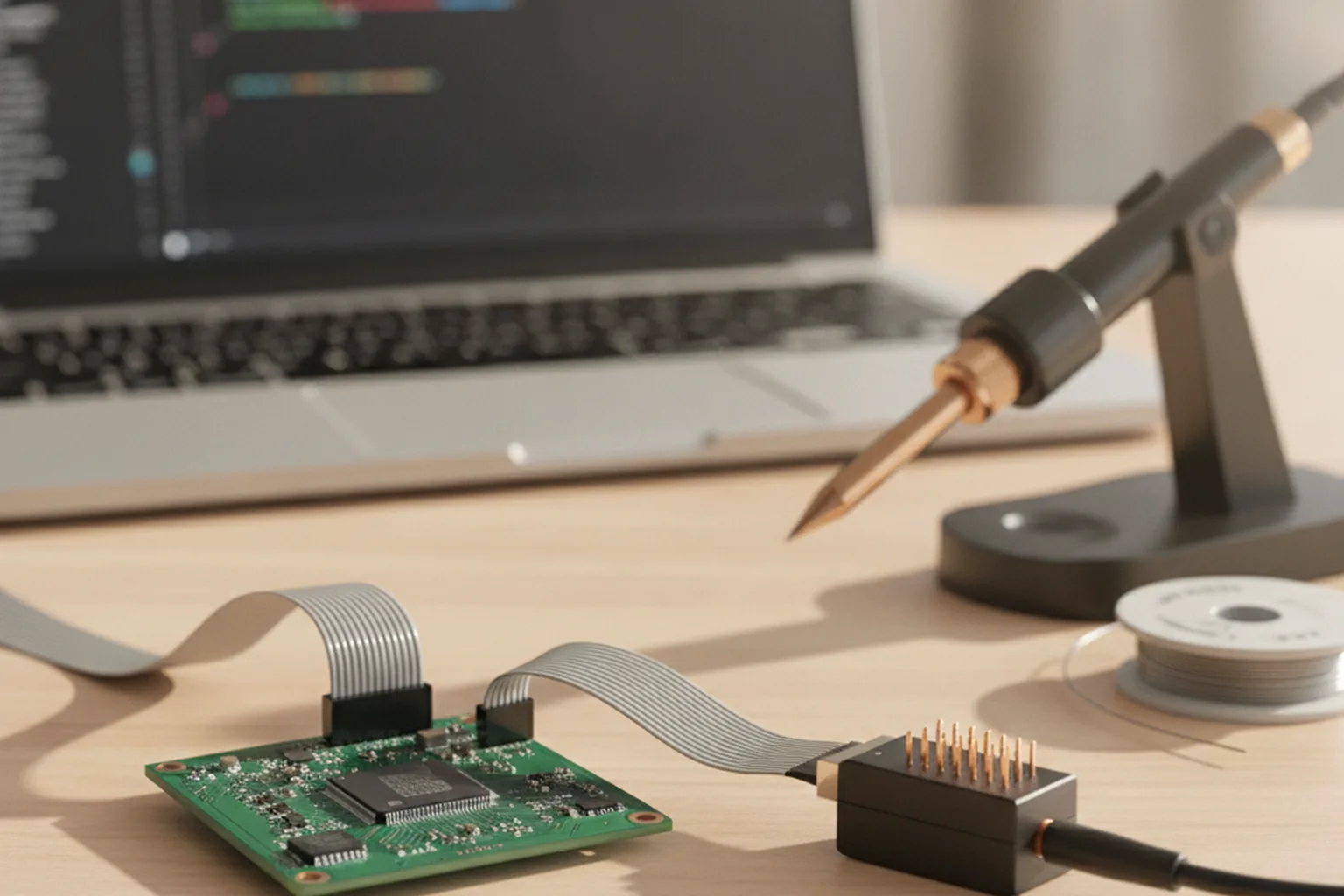

Embedded software development tools are the programs and hardware instruments engineers use to write, build, flash, debug, test and maintain software that runs on microcontrollers, SoCs and other dedicated hardware. Unlike a web stack, an embedded toolchain always spans two worlds: a desktop or CI environment where code is written and compiled, and a physical target board with limited memory, real-time deadlines and no screen to print errors on.
The right tools decide how fast a team can bring up a new board, how quickly it finds a timing bug and whether the product can pass a safety or cybersecurity audit later. That is why experienced teams that deliver embedded software and firmware development services treat the toolchain as an architecture decision made in the first weeks of a project, not as personal preference. Changing a compiler, RTOS or debug setup after certification evidence has been collected is expensive.
This list groups the most widely used embedded software development tools by category, explains what each category does in a real workflow, names free and commercial options, and shows which tools matter for regulated industries such as automotive and medical devices. If you need the bigger picture of the discipline itself, start with our embedded software development guide; this article focuses on the tools.
What are embedded software development tools?
Embedded software development tools are everything a firmware team needs to move code from an idea to a working, updatable device: editors and IDEs, cross-compilers, linkers, debuggers, hardware probes, operating systems, analyzers, test frameworks and delivery pipelines. They differ from general software tools because the code is compiled on one machine (the host) and runs on another (the target), usually with a different processor architecture.
A useful way to see the toolchain is to follow one change through a typical embedded workflow:
- Write. An engineer edits C, C++ or Rust in an IDE that understands the target’s registers and SDK.
- Build. A cross-compiler and build system produce a binary sized for the target’s flash and RAM.
- Check. Static analysis enforces a coding standard such as MISRA C and flags undefined behavior before anything runs.
- Test off-target. Unit tests and simulators run the logic on a PC or in CI without hardware.
- Flash and debug. A debug probe connected over JTAG or SWD loads the binary and lets the engineer step through code on the real chip.
- Measure. Trace tools, logic analyzers and oscilloscopes confirm timing, power draw and bus traffic.
- Test on hardware. Hardware-in-the-loop (HIL) rigs run automated tests on real boards for every release.
- Ship and update. CI/CD signs the image, generates a software bill of materials (SBOM) and delivers it over the air (OTA).
Every step has its own tool category, and gaps in any of them show up later as field failures, slow releases or failed audits.
Embedded software development tools at a glance
The table below is a compact embedded software development tools list: ten categories, what each does and representative free and commercial options in 2026. It is not exhaustive, but it covers the tools most teams evaluate first.
| Category | What it does | Free / open-source examples | Commercial examples |
|---|---|---|---|
| IDEs and editors | Write, navigate, build and debug code | VS Code + PlatformIO, Eclipse CDT, STM32CubeIDE, MPLAB X, Arduino IDE | IAR Embedded Workbench, Keil MDK, SEGGER Embedded Studio (commercial use) |
| Compilers and toolchains | Cross-compile and link for the target CPU | Arm GNU Toolchain (GCC), LLVM/Clang, RISC-V GCC, Rust | IAR C/C++ Compiler, Arm Compiler for Embedded, TASKING, Green Hills |
| Build systems | Reproducible builds and dependency management | CMake + Ninja, Make, west (Zephyr), Yocto, Buildroot | Usually bundled with commercial IDEs |
| Debug probes and debuggers | Flash, halt, step and inspect the target | CMSIS-DAP probes, OpenOCD, pyOCD, probe-rs, GDB | SEGGER J-Link, Lauterbach TRACE32, IAR I-jet, ST-LINK (low cost) |
| RTOS and embedded OS | Scheduling, drivers, networking, security | FreeRTOS, Zephyr, Eclipse ThreadX, NuttX, embedded Linux | VxWorks, QNX, SAFERTOS, INTEGRITY |
| Static analysis | Enforce MISRA/CERT, find defects without running code | Cppcheck, clang-tidy, Clang Static Analyzer | Polyspace, Parasoft C/C++test, PC-lint Plus, Coverity, Klocwork, LDRA |
| Unit and integration testing | Automated tests on host and target | Unity/CMock/Ceedling, CppUTest, GoogleTest | VectorCAST, Tessy, LDRA tool suite |
| Simulation and emulation | Run firmware without physical boards | QEMU, Renode, Wokwi (free tier) | MATLAB/Simulink + Embedded Coder, Proteus, vendor virtual platforms |
| Tracing, profiling, protocol analysis | Measure timing, CPU load, bus traffic | SEGGER SystemView (non-commercial), Wireshark, sigrok/PulseView | Percepio Tracealyzer, TRACE32, Saleae Logic, Total Phase, Vector CANoe |
| Version control, CI/CD, OTA | Collaboration, automated builds, secure updates | Git, GitLab CI, Jenkins, GitHub Actions, MCUboot, Mender (open source) | Memfault, Golioth, cloud IoT device management services |
Licensing changes often, so always check the current terms: several vendors offer free editions only for evaluation, education or non-commercial use.
Which IDEs do embedded developers use in 2026?
In 2026 most embedded developers use one of three IDE types: a silicon vendor’s free IDE, a commercial cross-platform IDE with a certified compiler, or VS Code with embedded extensions. The choice depends mainly on the chip family, the need for functional safety certification and how much the team wants one editor across many projects.
Vendor IDEs: STM32CubeIDE, MPLAB X, MCUXpresso, e² studio
Vendor IDEs are the fastest way to bring up a new board because they ship with pin and clock configuration tools, peripheral drivers and example projects for that manufacturer’s chips. STM32CubeIDE (STMicroelectronics), MPLAB X IDE (Microchip), MCUXpresso (NXP) and e² studio (Renesas) are free and most are built on Eclipse. Their weakness is lock-in: moving to another chip family usually means a different IDE, different project files and different habits. Many vendors now also publish VS Code extensions alongside their classic IDE, which reduces that friction.
Commercial IDEs: IAR Embedded Workbench, Keil MDK, SEGGER Embedded Studio
Commercial IDEs matter when code size, performance or certification is critical. IAR Embedded Workbench supports thousands of devices across Arm, RISC-V and other architectures and offers functional safety editions with a TÜV-certified compiler. Keil MDK from Arm is a long-standing choice for Cortex-M and comes with the Arm Compiler; Arm also provides a free community edition for non-commercial use. SEGGER Embedded Studio pairs closely with J-Link probes and is free for non-commercial use. These tools are licensed per seat or per user, with safety editions priced higher.
VS Code, PlatformIO and Eclipse
VS Code has become the default editor for a large share of embedded work because one editor covers many targets through extensions: PlatformIO, Cortex-Debug, CMake Tools, clangd, the Zephyr and vendor extensions, and Rust tooling. It suits teams that work across several chip families or want the same environment locally and in CI containers. Eclipse CDT remains the foundation of many vendor IDEs, and the Arduino IDE is still the simplest entry point for prototypes and education, though rarely the final choice for production firmware.
Compilers, toolchains and build systems
A cross-compiler toolchain turns source code into a binary for the target processor, and the build system makes that process repeatable on every laptop and CI runner. For most Arm Cortex-M and RISC-V projects in 2026, the realistic shortlist is the open-source GCC or LLVM toolchains versus a commercial compiler from IAR, Arm, TASKING or Green Hills.
- Arm GNU Toolchain (GCC). Free, widely supported by RTOS and vendor SDKs, the default in most open-source projects.
- LLVM/Clang. Modern diagnostics, strong tooling (clang-tidy, clangd) and growing embedded support, including Arm’s own LLVM-based toolchains.
- IAR and Arm Compiler for Embedded. Often produce smaller, faster code and come with safety certificates and long-term support for qualified versions.
- TASKING and Green Hills. Common in automotive and aerospace, especially for multicore safety microcontrollers.
- RISC-V toolchains. GCC and LLVM support RISC-V well; commercial vendors have added RISC-V targets as the architecture spreads.
- Rust. The embedded Rust ecosystem (cargo, probe-rs, embassy) is production-ready for many MCUs, and Ferrocene offers a qualified Rust compiler for ISO 26262 and IEC 61508 work.
On the build side, CMake with Ninja has become the common denominator because both IDEs and CI understand it. Zephyr projects use west on top of CMake; embedded Linux products use Yocto or Buildroot to produce the whole operating system image. Whatever you choose, pin exact toolchain versions (for example in a container image) so a build from two years ago can be reproduced bit-for-bit when a field issue or audit requires it.
Debug probes and hardware debugging tools
A debug probe is the hardware link between the host PC and the target chip; it flashes firmware and lets the debugger halt the CPU, set breakpoints and read memory over JTAG or the two-wire SWD interface. Choosing a fast, reliable probe saves hours every week, because flashing and stepping through code is the most repeated action in embedded development.
| Probe / debugger | Strengths | Best for |
|---|---|---|
| SEGGER J-Link | Very fast flashing, broad device support, RTT logging, works with most IDEs | Professional teams across many chip families |
| ST-LINK and on-board vendor probes | Low cost, included on most evaluation boards | Prototyping on a single vendor’s parts |
| CMSIS-DAP probes | Open Arm standard, cheap, supported by OpenOCD and pyOCD | Cost-sensitive teams, CI rigs, open-source toolchains |
| Lauterbach TRACE32 | Deep multicore debugging and full instruction trace | Automotive, aerospace, complex SoCs |
| IAR I-jet / Arm ULINK | Tight integration with their own IDEs, power debugging | Teams standardized on IAR or Keil |
On the software side, GDB remains the universal debugger, with OpenOCD, pyOCD or probe-rs acting as the bridge to the probe. Features worth asking for are real-time logging without halting the CPU (SEGGER RTT, ITM/SWO), live variable watch and fault analysis that decodes a HardFault into the exact line that caused it.
RTOS and embedded operating systems
A real-time operating system (RTOS) gives firmware deterministic task scheduling, timers, inter-task communication and, increasingly, networking, security and update frameworks. In 2026 the most common choices for microcontrollers are FreeRTOS and Zephyr, while devices with application processors run embedded Linux, and safety-certified products often use commercial kernels.
- FreeRTOS. Small, MIT-licensed, maintained by AWS, with a huge base of examples and vendor ports. Ideal when you want a lean kernel and pick other libraries yourself.
- Zephyr. A Linux Foundation project with a device tree, a large driver set, Bluetooth LE, networking and security built in. Ideal when you want a full platform and long-term vendor support across many chips.
- Eclipse ThreadX. Formerly Azure RTOS, moved to the Eclipse Foundation as open source; known for safety certifications.
- Apache NuttX. POSIX-style RTOS used in drones and consumer devices.
- VxWorks, QNX, INTEGRITY, SAFERTOS. Commercial kernels chosen for aerospace, automotive, industrial and medical products that need pre-certified evidence.
- Embedded Linux (Yocto, Buildroot). For gateways, HMIs and devices with Cortex-A class processors, often paired with an MCU running an RTOS for real-time tasks.
The RTOS decision drives many other tools: Zephyr implies west and CMake, a commercial kernel may dictate the compiler, and RTOS-aware debugging in your IDE or tracer becomes essential once you have more than a handful of tasks.
Static analysis and coding standards
Static analysis tools examine source code without running it and catch defects that tests miss: undefined behavior, buffer overruns, integer overflows, uninitialized variables and violations of coding standards such as MISRA C/C++ and CERT C. For safety-critical and connected devices they are not optional, because auditors expect evidence that a coding standard was enforced on every change.
- Free tools: Cppcheck, clang-tidy and the Clang Static Analyzer catch a useful share of defects and run easily in CI.
- MISRA compliance checkers: PC-lint Plus, Parasoft C/C++test, Polyspace Bug Finder, LDRA and Helix QAC produce the compliance reports and deviation records auditors ask for.
- Deep analyzers: Coverity, Klocwork and Polyspace Code Prover use data-flow or formal methods to prove the absence of certain run-time errors.
Testing, simulation and hardware-in-the-loop tools
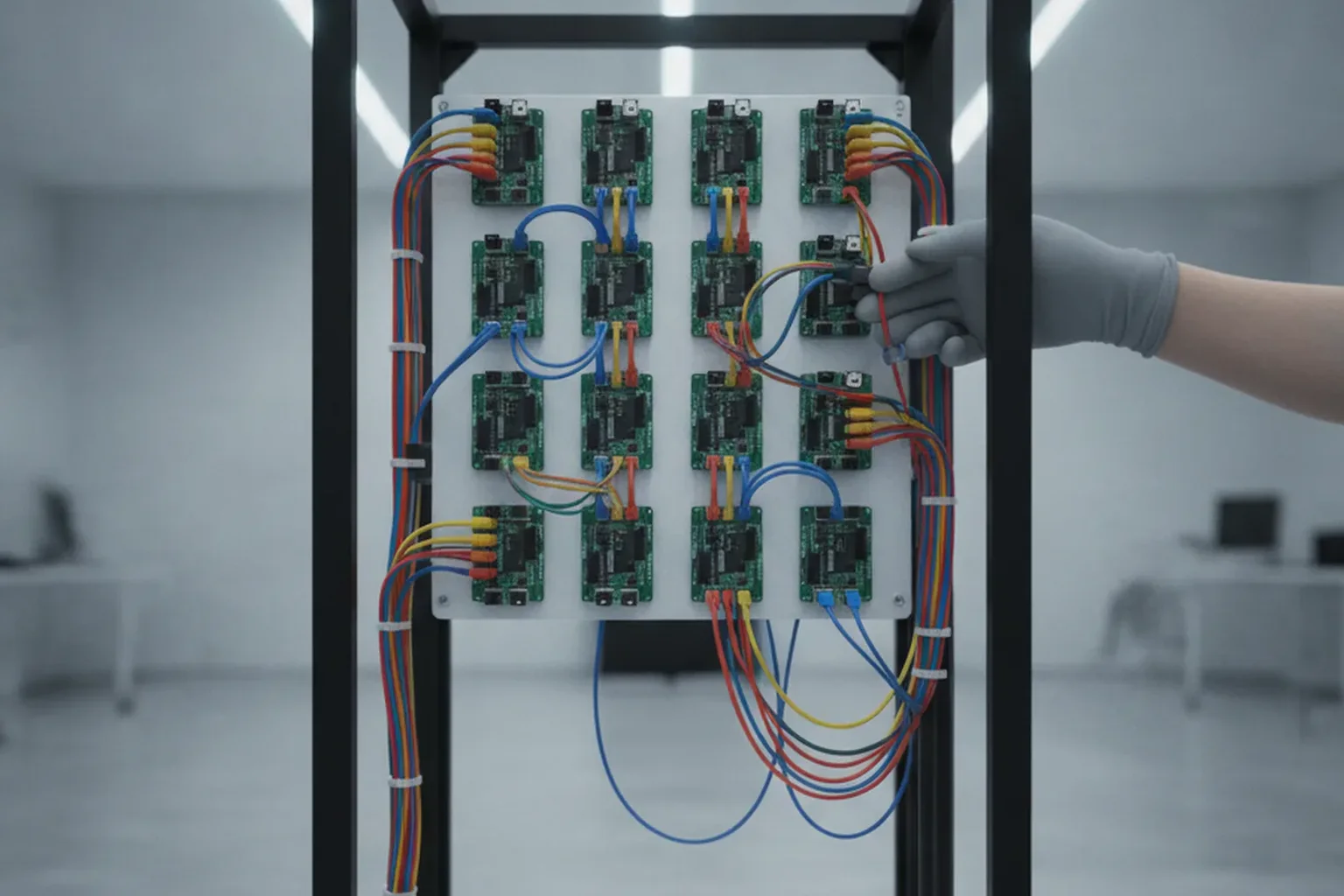
Embedded testing tools work at three levels: unit tests that run on the host PC, simulation that runs firmware on virtual hardware, and hardware-in-the-loop (HIL) tests that exercise real boards automatically. Mature teams use all three, because each one catches a different class of bug at a different cost.
Unit testing frameworks
Unit testing frameworks let developers test drivers and logic on a PC in seconds. Unity with CMock and Ceedling is the most popular pure-C option; CppUTest and GoogleTest serve C++ code bases. For regulated products, VectorCAST, Tessy and the LDRA suite add on-target execution, structural coverage (statement, branch, MC/DC) and qualification kits. Our guide to test-driven development explains how to make unit tests a daily habit rather than a pre-release chore.
Simulators and emulators
Simulators and emulators run firmware without the physical board, which helps when hardware is late, scarce or expensive. QEMU emulates many processors; Renode, an open-source framework from Antmicro, simulates whole systems with peripherals and multiple nodes and fits well into CI; Wokwi simulates popular boards in the browser. Model-based teams use MATLAB and Simulink with Embedded Coder to design control algorithms and generate production C code, while Proteus combines circuit simulation with firmware. Simulation never fully replaces hardware, but it moves a large share of testing earlier and into the pipeline.
Hardware-in-the-loop rigs
HIL rigs connect real target boards to a controller that powers them, flashes new builds, injects inputs and checks outputs on every commit or nightly build. They can be as simple as a Raspberry Pi with a USB relay board and a CMSIS-DAP probe or as complex as commercial HIL systems from dSPACE, NI or Vector for automotive ECUs. Test frameworks such as pytest with pyOCD or Robot Framework are commonly used to script the scenarios.
Tracing, profiling and protocol analyzers
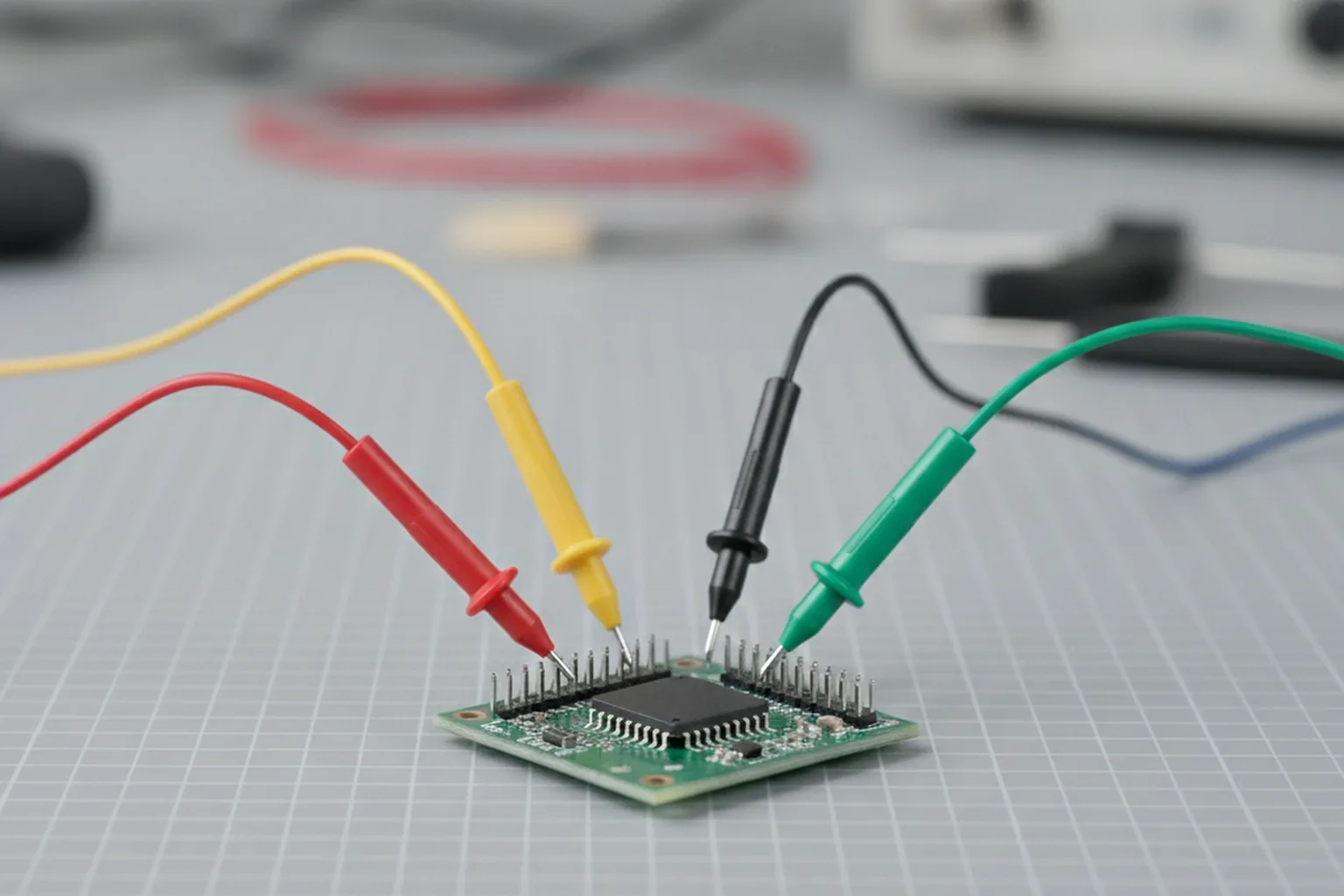
Tracing and measurement tools show what the firmware actually does in time: which task runs, how long an interrupt takes, how much CPU and power is used and what travels over the buses. They are how teams solve the hardest embedded bugs — race conditions, missed deadlines and intermittent communication failures that never appear in a debugger.
| Need | Typical tools | What you learn |
|---|---|---|
| RTOS behavior | Percepio Tracealyzer, SEGGER SystemView | Task timeline, CPU load, blocking and priority problems |
| Instruction trace and coverage | Lauterbach TRACE32, J-Trace (ETM) | Exact execution history, on-target code coverage |
| Digital buses (I²C, SPI, UART) | Saleae Logic, sigrok/PulseView, Total Phase | Decoded transactions, timing errors, glitches |
| Automotive and industrial buses | Vector CANoe/CANalyzer, PEAK PCAN tools | CAN, CAN FD, LIN and Ethernet traffic and diagnostics |
| Network protocols | Wireshark with protocol plugins | TCP/IP, MQTT, BLE (with sniffer) and TLS handshakes |
| Power consumption | Power profilers from Nordic, Joulescope, Otii | Current per firmware state, battery life estimates |
An oscilloscope stays on every embedded bench for analog signals and power rails. For battery-powered IoT products, a power profiler is often the single tool with the biggest effect on product quality, because a sleep mode that leaks a few hundred microamps can cut battery life from years to months.
Version control, CI/CD, OTA updates and SBOM
Embedded teams in 2026 use the same delivery practices as cloud teams — Git, code review, automated builds and tests on every change — plus two embedded-specific layers: secure over-the-air (OTA) updates and a software bill of materials for every firmware image. Without them, a connected product cannot be patched safely and will struggle to meet new cybersecurity rules.
- Version control and review: Git with GitLab, GitHub or Bitbucket; pull requests with static analysis and unit test results attached.
- CI/CD: GitLab CI, GitHub Actions or Jenkins running builds inside containers with pinned toolchains, then triggering HIL tests. See our guide to CI/CD in software development for pipeline patterns.
- Secure boot and OTA: MCUboot for MCUs, Mender, SWUpdate or RAUC for embedded Linux, and device management platforms such as Memfault or Golioth for crash reporting and staged rollouts.
- SBOM and vulnerability tracking: generators that output SPDX or CycloneDX for every release, linked to vulnerability monitoring of third-party libraries and the RTOS.
The SBOM layer is no longer optional for products sold in Europe. The EU Cyber Resilience Act entered into force in December 2024; its vulnerability and incident reporting obligations apply from 11 September 2026, and most remaining requirements, including security updates for the support period, apply from 11 December 2027. US federal buyers increasingly ask for SBOMs as well. Building the tooling now is far cheaper than retrofitting it before a deadline.
Tools for safety-critical embedded software
In regulated industries, the tools themselves must be justified: functional safety standards require teams to show that a compiler, analyzer or test tool cannot introduce or hide errors, or that its output is verified some other way. This is why automotive, medical, rail and aerospace teams often pay for certified tool versions with qualification kits.
| Industry | Standard | What it means for tools |
|---|---|---|
| Automotive | ISO 26262 (Part 8 tool confidence levels), ISO/SAE 21434 for cybersecurity | Classify each tool by tool confidence level; use certified compilers and analyzers or qualify them; prove MISRA compliance |
| Industrial | IEC 61508, IEC 62443 | Tool classes T1–T3; T3 tools such as compilers need evidence of suitability |
| Medical devices | IEC 62304, FDA cybersecurity guidance | Validated tools, documented software of unknown provenance (SOUP), SBOM in premarket submissions |
| Aerospace | DO-178C with DO-330 | Formal tool qualification for tools whose output is not verified |
| Rail | EN 50716 (successor to EN 50128) | Tool classification and validation evidence similar to IEC 61508 |
The practical rule: freeze qualified tool versions for the life of a safety program and keep the certificates, safety manuals and known-issue lists in your project records. For deeper context see our guides to automotive software development and medical device software development.
How to choose embedded software development tools
Choose embedded software development tools by starting from the hardware and regulatory constraints, then optimizing for team speed and long-term maintenance. Price matters less than it seems: a commercial license costs far less than a week of engineers chasing a bug a better tool would have shown in minutes.
- Start from the silicon. List the MCU or SoC families you use now and expect to use; check which IDEs, compilers and probes support them first-class.
- Decide on safety and security needs early. If ISO 26262, IEC 61508, IEC 62304 or DO-178C apply, shortlist only tools with certificates or qualification kits.
- Pick the RTOS before the IDE. The operating system shapes the build system, debugging and middleware more than the editor does.
- Make everything run in CI. Prefer tools with command-line interfaces and container-friendly licensing so builds, analysis and tests run without a GUI.
- Standardize the probe. One probe family across the team simplifies HIL rigs, scripts and onboarding.
- Check licensing models. Node-locked, floating, per-user and CI/build-server licenses differ in cost and flexibility; read the terms for free editions.
- Plan for ten years. Embedded products live long; prefer tools with long-term support and the ability to archive an exact version.
Embedded tools list by use case
The same categories lead to very different stacks depending on the product. These combinations are common starting points, not prescriptions:
| Use case | Typical toolchain |
|---|---|
| Prototype or proof of concept | Vendor IDE or VS Code + PlatformIO, GCC, on-board probe, FreeRTOS or bare metal, Wokwi or dev kit |
| Connected IoT product | VS Code + Zephyr (west, CMake), GCC/LLVM, J-Link, MCUboot OTA, Renode in CI, power profiler, SBOM generator |
| Industrial controller | IAR or Keil, FreeRTOS/ThreadX or commercial RTOS, MISRA checker, HIL rig, CAN/Modbus analyzers |
| Automotive ECU | Certified compiler (TASKING, Green Hills, IAR FuSa), AUTOSAR tooling, TRACE32, Vector CANoe, VectorCAST, Polyspace |
| Medical device | Certified or validated compiler, static analysis with MISRA, unit tests with coverage, SOUP and SBOM tracking, documented tool validation |
| Linux-based gateway or HMI | Yocto or Buildroot, GCC, GDB/gdbserver, Mender or RAUC, Wireshark, containerized CI |
For connected devices, the toolchain is only half of the picture; cloud ingestion, device management and dashboards matter just as much. Our IoT software development guide covers that side of the stack.
How much do embedded software development tools cost?
A capable embedded toolchain can be entirely free — VS Code, GCC or LLVM, a CMSIS-DAP probe, Zephyr or FreeRTOS, Cppcheck and Unity — and many successful products ship this way. Costs rise when you need certified compilers, MISRA compliance reports, instruction trace or qualified test tools. Commercial IDEs, analyzers and test suites are priced per seat or per user and usually quoted on request; functional safety editions and qualification kits cost noticeably more than standard editions, so budget them per engineer per year, not as a one-off.
Tools are a small part of a firmware budget compared with engineering time. As a reference point from our own pricing, fixed-scope embedded and IoT projects at YuSMP start from $3,500 for an IoT MVP (a first working connected device), $5,800 for device management with signed OTA, $9,200 for telemetry with a dashboard and $11,500 for a full IoT platform, all-in and quoted in USD. If you are still deciding whether to build the team or bring in specialists, our IoT consulting buyer’s guide walks through that decision.
Embedded software development tool trends in 2026
The biggest shifts in embedded software development tools in 2026 are the move to VS Code-based workflows, AI coding assistants adapted to embedded code, the rise of Rust and RISC-V, simulation-first CI and regulation-driven security tooling. Each of them changes what a modern toolchain looks like.
- VS Code everywhere. Silicon vendors increasingly ship VS Code extensions next to or instead of Eclipse-based IDEs, so one editor covers more of the hardware market.
- AI assistants with guardrails. Code assistants help with drivers, register setup and tests, but generated embedded code still needs static analysis, review against the datasheet and testing on hardware.
- Rust in production. Memory-safe Rust is moving from experiments into shipping firmware, supported by probe-rs, embassy and qualified compilers.
- RISC-V adoption. More MCUs and SoCs use RISC-V cores, and mainstream compilers, debuggers and RTOS now support them as first-class targets.
- Simulation-first CI. Renode, QEMU and vendor virtual platforms let pipelines test firmware on every commit before HIL rigs run the final checks.
- Security by regulation. The EU Cyber Resilience Act, FDA cybersecurity requirements and ISO/SAE 21434 push SBOM generation, vulnerability monitoring and signed updates into the standard toolchain.
Frequently asked questions
What are embedded software development tools?
Embedded software development tools are the software and hardware used to write, cross-compile, flash, debug, test and update firmware for microcontrollers and SoCs. They include IDEs, compilers and build systems, debug probes, real-time operating systems, static analyzers, unit testing frameworks, simulators, trace tools, protocol analyzers and CI/CD with OTA update tooling.
What is the best IDE for embedded software development?
There is no single best IDE for embedded software development. Vendor IDEs such as STM32CubeIDE or MPLAB X are best for quick bring-up on one chip family, IAR Embedded Workbench and Keil MDK are strong when code size or safety certification matters, and VS Code with PlatformIO or Zephyr extensions suits teams working across many targets.
Which tools are used in embedded systems software development?
Embedded systems software development typically uses a cross-compiler such as GCC, LLVM or IAR, a build system such as CMake, a debug probe such as J-Link or CMSIS-DAP with GDB, an RTOS such as FreeRTOS or Zephyr, static analysis for MISRA C, unit test frameworks such as Unity, plus oscilloscopes, logic analyzers and trace tools for measurement.
Are free embedded development tools good enough for commercial products?
Yes, free and open-source embedded development tools such as GCC, LLVM, VS Code, OpenOCD, Zephyr, FreeRTOS, Cppcheck and Unity are used in many commercial products. Commercial tools become necessary mainly for functional safety certification, MISRA compliance reporting, deep instruction trace or vendor support with guaranteed response times.
What is the difference between JTAG and SWD?
JTAG and SWD are both debug interfaces used by probes to program and debug a chip. JTAG is an older standard that uses four or five signals and can chain several devices, while SWD is an Arm-specific two-wire interface that needs fewer pins and offers similar debugging capabilities on Cortex-M microcontrollers.
Do safety-critical projects need certified compilers?
Safety-critical projects under ISO 26262, IEC 61508 or DO-178C must justify every tool that could introduce or hide errors. A certified compiler with a safety manual is the simplest way to do this, though teams can also qualify an open-source compiler themselves through validation testing, which usually costs more effort than buying a certified edition.
How do I set up CI/CD for embedded firmware?
Set up CI/CD for embedded firmware by containerizing a pinned toolchain, running builds, static analysis and host unit tests on every merge request, adding simulator tests with QEMU or Renode, then triggering hardware-in-the-loop tests on real boards. Release jobs should sign images, generate an SBOM and publish them to your OTA update service.