What we build
Smart contracts, ERC-20 and other tokens, custodial and non-custodial crypto wallets, token sale and exchange platforms, tokenization and NFT marketplaces, Web3 front ends and the back ends behind them.
We design, build and audit blockchain software: smart contracts, tokens, crypto wallets, tokenization platforms, NFT marketplaces and Web3 dApps, connected to the systems your business already runs. On-chain code is only part of a product, so our blockchain engineers work inside our custom software development practice and ship the back end, the apps and the integrations too.
GDPR-aligned · ISO 27001 ready · SOC 2 Type II in progress · HIPAA-capable · CCPA-acknowledged · CET workday with 9 AM–1 PM ET overlap
Blockchain development services cover the design, coding, testing, auditing and launch of software that runs on a distributed ledger. In practice that means smart contracts and tokens on Ethereum or another chain, plus the ordinary parts every product needs: a back end, an admin panel, web and mobile front ends, and integrations with payments, KYC providers and accounting.
A smart contract cannot be patched quietly after it is deployed, so we treat security as part of the build rather than a final checkbox. Every contract goes through internal review and testing, and we plan for independent security audits of the contracts and of the web and API layers around them.
If you are comparing a blockchain development company with a general software vendor, the difference that matters is whether one team can own both sides of the system. Ours can. Below we explain what we build, which platforms fit which use cases, how a project runs and what drives the cost.
Smart contracts, ERC-20 and other tokens, custodial and non-custodial crypto wallets, token sale and exchange platforms, tokenization and NFT marketplaces, Web3 front ends and the back ends behind them.
Discovery, architecture and chain selection, a testnet prototype, development in sprints, a security audit, a staged mainnet launch and ongoing support.
The chain and the number of chains, contract complexity, wallet and payment integrations, apps and admin panels, the scope of external audits and compliance needs.
A short discovery that tests whether you need a blockchain at all, fixes the scope and picks the platform. A senior engineer replies to every request within one business day.
Our blockchain development services span the full stack of a decentralized product: the on-chain logic, the wallets and keys, the platforms users interact with and the integrations that connect them to the rest of your business. Each block below describes what it is, what we deliver and the typical stack.
Custom blockchain development starts from the business process rather than from a chain. We work out which data and rules must live on-chain, which stay in a regular database, and how the two stay consistent. Deliverables include the smart contracts, a back-end API, admin tools, user-facing web or mobile apps and the deployment pipeline. This is the right service when you need blockchain software development as part of a wider product, for example a token-based loyalty program, a traceability ledger or an internal settlement system. Typical stack: Solidity, Node.js or PHP Laravel on the back end, React on the front end, PostgreSQL for off-chain data.
Smart contracts hold the money and the rules, so they get the most engineering attention. We write contracts in Solidity for Ethereum and EVM-compatible networks, build on audited OpenZeppelin libraries where they fit, and cover each function with unit and fuzz tests in Hardhat or Foundry. Work includes ERC-20, ERC-721 and ERC-1155 tokens, NFT smart contract development with EIP-2981 royalties, vesting and staking logic, gas optimization and an upgradeability strategy. Smart contract consulting covers code review of an existing contract, a second opinion on architecture and preparation for an external audit.
Crypto wallet development starts with one decision: who holds the keys. Custodial wallets keep keys on the operator's side and suit exchanges and fintech apps; non-custodial wallets keep them on the user's device; MPC and multisig setups split control between parties. We build mobile wallets for iOS and Android, browser wallet integrations with MetaMask and WalletConnect, and Bitcoin wallet functionality for payments and transfers. A typical scope covers sign-up and verification, a portfolio with live rates, P2P transfers, buying with bank cards and transaction history. Our digital wallet app development guide explains the trade-offs, and our mobile app development team builds the apps.
Cryptocurrency development solutions range from a single ERC-20 token to a token with vesting schedules, staking rewards and a purchase flow on the project's website. We handle crypto coin development on existing chains, which is how almost every modern token is issued: the contract, testing, a security review, deployment with verified source code and a web interface for buying or swapping the token through MetaMask. We also help model tokenomics as a technical exercise (supply, emission schedule, vesting, treasury controls). We do not make promises about token price, exchange listings or investment returns; those depend on the market and on your legal setup.
Tokenization turns rights to a real asset (real estate shares, fund units, invoices) into tokens that can be issued, transferred and tracked on a ledger. Security token offering development services involve permissioned token standards such as ERC-3643 or ERC-1400, investor whitelisting, transfer restrictions, integration with KYC and AML providers, cap-table views and investor dashboards. We build the technology; legal structuring and regulatory approval stay with your counsel and the relevant regulator. Our role is to make sure the platform enforces the rules your lawyers define and keeps an audit trail of every issuance and transfer.
An NFT marketplace needs more than a minting contract. Ethereum NFT marketplace development covers ERC-721 or ERC-1155 collections, lazy minting so creators do not pay gas up front, royalties under EIP-2981, listings and offers, and metadata storage on IPFS or Arweave. Around the contracts we build the catalog, search, creator profiles, a moderation panel and fiat checkout through a payment provider where the business model needs it. We can also build on EVM-compatible chains with lower fees when your users trade many low-value items.
Exchange-type products include token buy-and-sell platforms, centralized exchanges with order books, and decentralized exchange or lending interfaces on top of smart contracts. The hard parts are rarely the trading screen: they are the ledger of balances, deposit and withdrawal flows, rate management, transaction verification and operator controls. We built exactly that for a token platform where users buy and sell a token for USDT and the operator manages the rate and confirms every transaction. For budgets, see our breakdown of crypto exchange development cost.
A dApp is a web or mobile app whose core logic runs in smart contracts. We build the front end with React or Next.js, connect wallets through wagmi, viem or ethers.js, read chain data through indexers such as The Graph, and bring in external data with oracles. Blockchain integration also runs the other way: connecting on-chain events to your ERP, CRM, payment gateway or accounting so that finance teams see one picture. Our web development team builds the dApp front ends and admin panels.
Some projects need a ledger shared by known organizations rather than a public network. Permissioned platforms such as Hyperledger Fabric, Hyperledger Besu and R3 Corda let a consortium control who joins, who validates and who sees which data. The engineering work includes the network design, node setup, chaincode or contracts, identity management and a governance model that defines how members join, leave and approve changes. We are honest about the trade-off: a private chain only makes sense when several parties need a shared record that none of them should control alone.
Layer 2 networks such as Arbitrum, Optimism, Base and Polygon zkEVM cut fees for applications with many transactions. We deploy contracts to L2s, design flows that move assets between L1 and L2, and integrate existing bridges where a product must span several chains. Infrastructure work covers RPC providers or self-hosted nodes, indexers, monitoring and alerting. Bridges are among the most attacked components in crypto, so we prefer audited, widely used bridge protocols over custom ones.
Blockchain consulting answers three questions before money is spent: does this product need a blockchain, which platform fits, and what will the architecture look like. For existing projects we run technical due diligence: a review of the smart contracts and their tests, the key management setup, the off-chain services and the deployment process, with a written list of risks ranked by severity. Investors and acquirers use this before a deal; founders use it before a relaunch or an external audit.
AI and blockchain meet in a few practical places: AI agents that sign transactions within strict limits set by a smart contract, anomaly detection on transaction flows, and verifiable records of what data a model used. These projects combine our blockchain work with our AI engineering practice. We keep the on-chain part minimal and auditable, and the model logic off-chain.
A blockchain is worth its cost only when several parties need a shared, tamper-evident record and no single party should control it. If your project fails most of the checks below, a regular database will be cheaper, faster and easier to change.
If four or more statements are true, blockchain is likely a fit and the next question is which kind. If only one or two are true, you probably need a well-designed application with an audit log, role-based access and signed records. That is still a project we can deliver through custom software development, and it will cost less to build and run. We say this in discovery because a blockchain added for marketing reasons becomes an expensive component nobody wants to maintain.
Public blockchains are open to anyone and suit products for users and open markets; private blockchains are run by one organization and suit internal audit trails; consortium blockchains are governed by a group of known companies and suit shared industry processes. The table compares the three on the points that usually decide the choice.
| Criterion | Public blockchain | Private blockchain | Consortium blockchain |
|---|---|---|---|
| Who can join | Anyone | Only users the operator admits | Member organizations and their users |
| Who validates transactions | Open set of validators or miners | Nodes run by one organization | Nodes run by consortium members |
| Fees and throughput | Transaction fees vary with network load; L2s lower them | No public fees; throughput set by your infrastructure | No public fees; throughput agreed by members |
| Data privacy | Everything on-chain is visible; private data stays off-chain | Visible to admitted users only | Channels or private states per member group |
| Governance | Protocol rules and community upgrades | One organization decides | Members vote under an agreed charter |
| Typical use cases | Tokens, wallets, DeFi, NFT marketplaces, open dApps | Internal audit trails, inter-department settlement | Supply chain traceability, trade finance, shared registries |
| Example platforms | Ethereum, Polygon, Arbitrum, Base, Solana, BNB Chain | Hyperledger Besu, Hyperledger Fabric | Hyperledger Fabric, R3 Corda |
The takeaway: choose a public chain when outsiders must verify the record or hold the assets, and a permissioned network when the participants are known in advance and privacy matters more than openness. Hybrid designs, with private data off-chain and proofs anchored to a public chain, often give the best of both.
We choose the blockchain platform after discovery, based on your users, transaction volume, fee tolerance and privacy needs. Our delivered token and smart contract work runs on Ethereum with Solidity and EVM tooling; the table below is the selection guide we use with clients when comparing other networks.
| Platform | Type | Contract language | Strengths | Trade-offs | Typical use |
|---|---|---|---|---|---|
| Ethereum | Public L1 | Solidity, Vyper | Largest developer ecosystem, mature tooling and audited libraries | Mainnet fees can be high at peak load | Tokens, DeFi, high-value NFTs |
| Arbitrum, Optimism, Base | Public L2 (rollups) | Solidity | Ethereum security model with much lower fees | Withdrawal and bridging flows add complexity | Consumer dApps, games, frequent transactions |
| Polygon (PoS, zkEVM) | Public sidechain / L2 | Solidity | Low fees, EVM compatibility, broad wallet support | Different security assumptions per network | NFT marketplaces, loyalty, payments |
| Solana | Public L1 | Rust (Anchor) | High throughput and low fees for many small transactions | Non-EVM; separate tooling and audit specialists | Trading, payments, high-volume consumer apps |
| BNB Chain | Public L1 | Solidity | EVM-compatible, low fees, large retail user base | Smaller validator set than Ethereum | Retail tokens, games |
| Avalanche | Public L1 with subnets | Solidity | Custom subnets with their own rules | Running a subnet adds operational work | Institutional and app-specific chains |
| Hyperledger Fabric | Permissioned | Go, Java, JavaScript (chaincode) | Fine-grained privacy with channels, no public fees | You run and govern the network | Consortia, supply chain, registries |
| Bitcoin | Public L1 | Limited scripting | The most widely held crypto asset | Not built for complex smart contracts | Wallets, payments, treasury |
We deliberately leave transaction speed and fee figures out of this table: they change with network upgrades and market load, and we check current numbers during discovery for your expected volume.
Our blockchain development process has seven steps, from feasibility to post-launch support. Each step ends with a result you can review before the next one starts, and nothing reaches mainnet before it has passed testing and a security review.
We map the business model, the parties involved and the assets that move between them, run the "do you need a blockchain?" test and list compliance constraints your counsel has flagged. Deliverable: a feasibility summary and a recommendation on public, private or no chain at all.
We decide what lives on-chain and what stays off-chain, design the data model and contract interfaces, choose the platform and, if tokens are involved, model the supply and vesting logic. Deliverable: architecture document, contract specs and a fixed scope with an estimate.
A working proof of concept on a public testnet or a local network, with clickable screens for the main roles. This is where wrong assumptions about fees, wallet UX or speed show up cheaply. Deliverable: a demo you can click through and an agreed first-release scope.
Two-week sprints with a demo at the end of each. Contracts are written test-first, with unit, integration and fuzz tests; the back end, admin panel and apps are built in parallel against the testnet deployment. Deliverable: feature-complete release candidate on testnet.
Internal review of every contract against our audit checklist, then an independent third-party audit for contracts that hold value, plus penetration testing of the web and API layers. Findings are fixed and re-verified. Deliverable: audit reports and a fixed list of resolved issues.
Deployment from a multisig-controlled account, verified source code on the block explorer, a staged rollout with limits on early volumes and a rollback plan for the off-chain parts. Deliverable: live contracts, deployment records and an operations runbook.
Monitoring of contract events, balances and node health, incident response, regular dependency updates and governed upgrades through proxy patterns or contract migrations. Deliverable: an agreed support plan with response times.
Most blockchain applications we build follow the same layered architecture. Keeping the on-chain layer small makes it cheaper to audit and safer to run, while the off-chain layers stay as easy to change as any web product.
Smart contract security comes down to three layers: correct contract code, safe handling of private keys and a hardened off-chain system around them. Losses in crypto rarely come from broken cryptography; they come from logic bugs, leaked keys and weak web back ends. We test each layer separately.
Every contract we write is reviewed against this list before an external audit:
Deployment and admin keys are held in multisig wallets with signers on separate devices, and production secrets live in hardware security modules or managed key services rather than in code or on laptops. For products that hold user funds, we separate hot wallets with small working balances from cold storage, and use MPC where several parties must approve transfers. You own the code, the contracts and the keys; we document the setup so control never depends on us.
The web and API layers get the same scrutiny as any financial product: authentication, rate limits, audit logs and regular penetration tests. We integrate KYC and AML providers where your compliance program requires them and keep personal data off-chain, which matters for privacy laws because records on a public chain cannot be erased. Where users pay with cards to buy crypto, the fiat side follows our PCI DSS-compliant payment development practice. We build systems that support your compliance program; certifications and regulatory approvals remain with you and your advisers.
Blockchain development pays off in industries where several parties exchange value or records and need a shared source of truth. These are the use cases we see most often.
Token issuance and sale platforms, crypto wallets, stablecoin payouts and cross-border settlement. The typical build pairs smart contracts with a regulated fiat on-ramp, KYC and an operator console that confirms large transactions.
Traceability ledgers where producers, carriers and retailers record each handover of a batch. A permissioned network keeps commercial data private while giving auditors and customers a verifiable history.
Consent records, access logs and audit trails for data sharing between providers. Patient data itself stays off-chain; the ledger stores hashes and permissions, which keeps it compatible with privacy rules.
Fractional ownership of properties or funds, with whitelisted investors, transfer restrictions and automated distributions. Legal structuring happens outside the code; the platform enforces it.
In-game items as NFTs that players can trade, with royalties for creators. Games usually run on L2s or low-fee chains so players do not pay noticeable fees for every action.
Certificates of origin for renewable power and records of carbon credits that must not be counted twice. A shared ledger lets producers, buyers and registries see the same retirement history.
These projects cover smart contracts, token platforms and crypto wallets. Each case study describes the problem, what we built, the stack and the timeline.
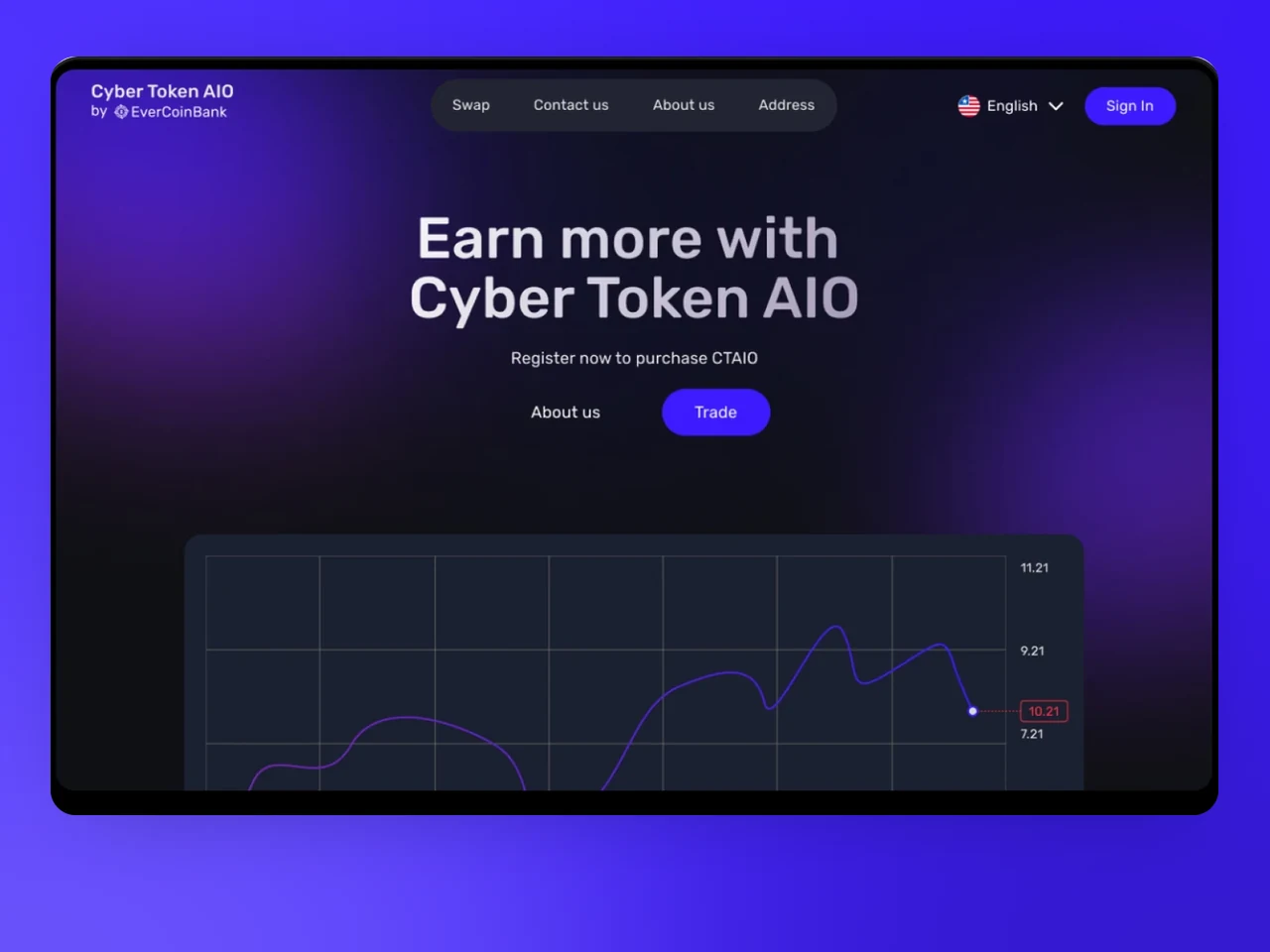
End-to-end ERC-20 token launch: Solidity contract development and testing, a pre-launch security audit and MetaMask checkout on the project site.
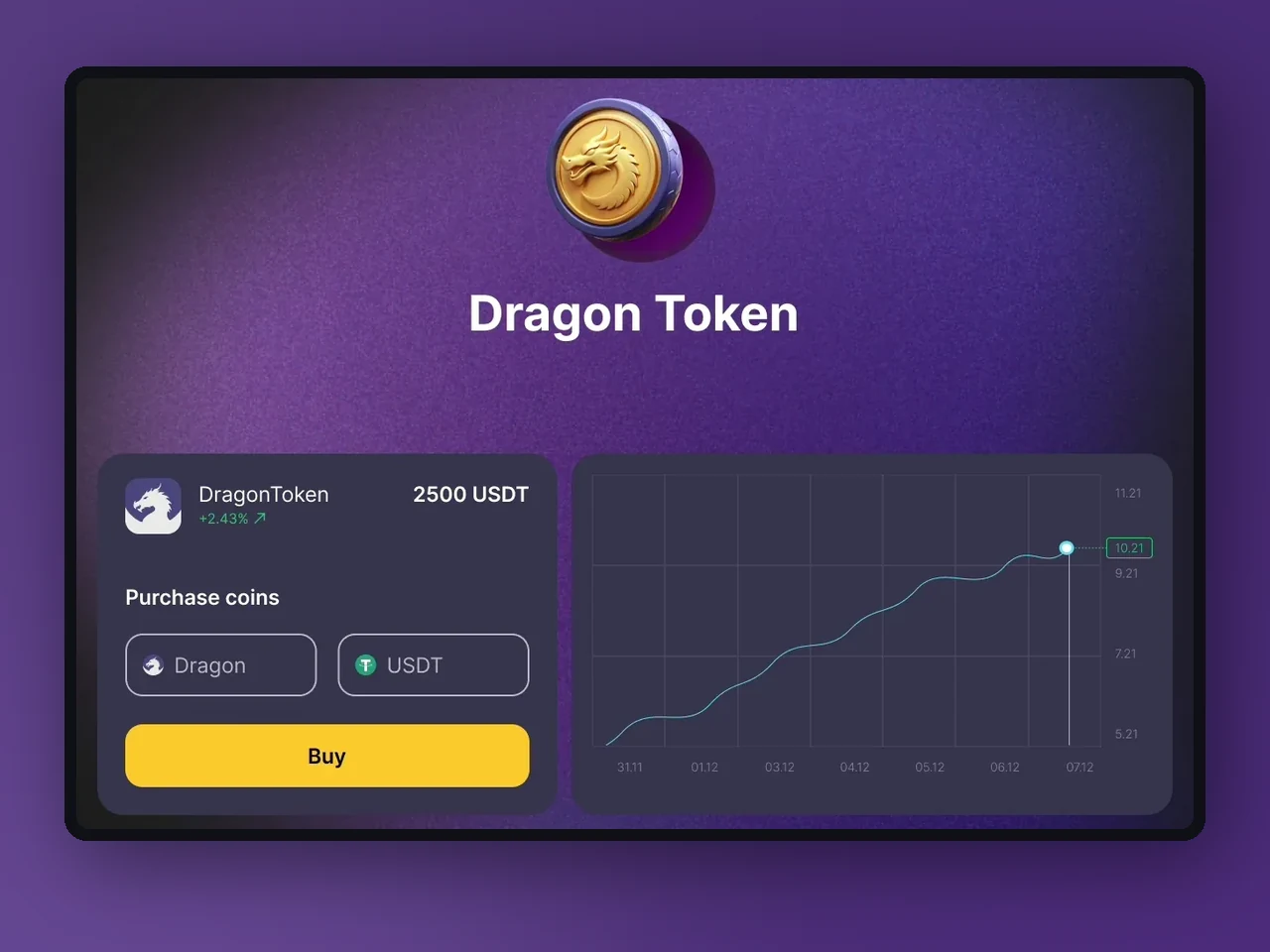
A client dashboard for buying and selling a token for USDT plus an admin CRM for rate management and transaction verification.
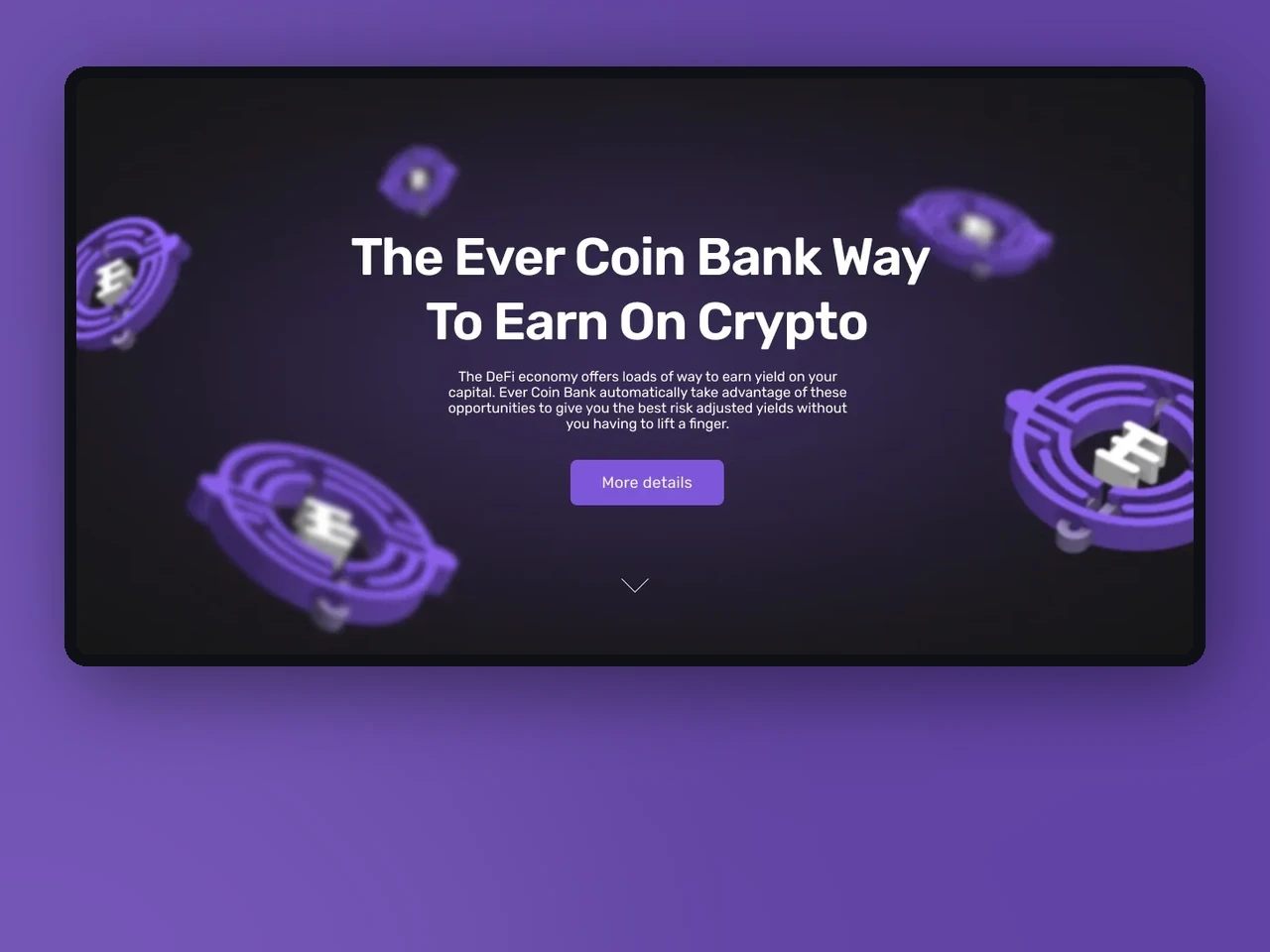
One entry point to a growing ecosystem of tokens, with live rate charts and market data from crypto exchange APIs.
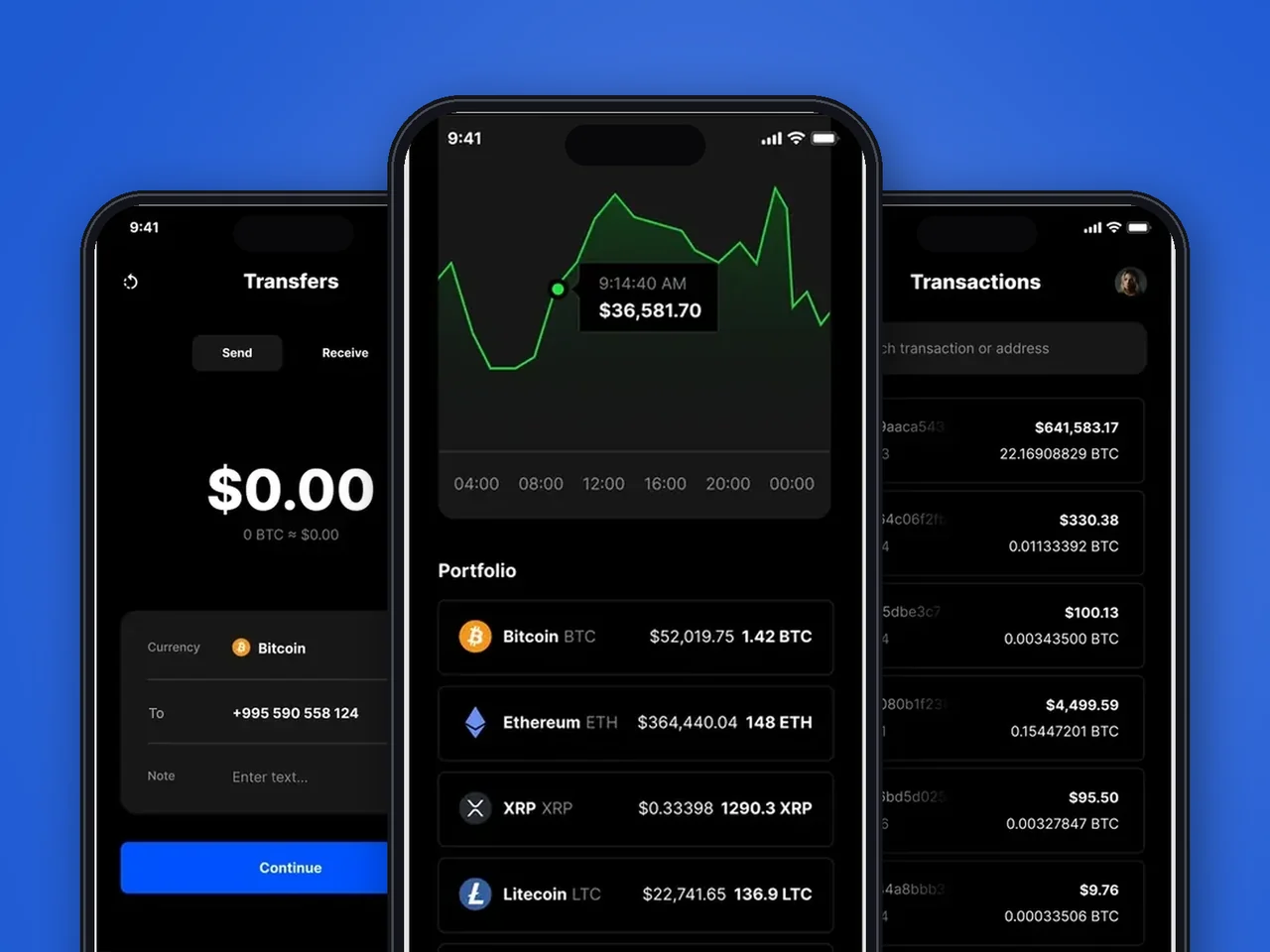
A mobile personal account for crypto assets: verified sign-up, live portfolio, P2P transfers, card purchases and a built-in exchange.
For Cyber Token we ran the full launch cycle of an ERC-20 token: Solidity contract development and testing, a pre-launch security audit and a page where users swap ETH for the token through MetaMask. The Dragon Token platform lets holders buy and sell a token for USDT while operators set the rate and confirm every transaction in an admin CRM. EverCoin Bank brings an ecosystem of tokens into one web hub with live rate charts from exchange APIs, and the Crypto Wallet project moved a full web trading feature set into iOS and Android apps. View all case studies →
Blockchain development cost depends far more on scope than on the word "blockchain". A single audited token with a purchase page is a small project; an exchange with custody, KYC and mobile apps is a large one. We quote a fixed price after discovery, once these drivers are clear:
The table shows timelines from our own blockchain projects, so you can compare like with like. For exchange-type products, our article on how much a crypto exchange costs to build goes into more detail.
| Project type | Main complexity drivers | Timeline in our projects |
|---|---|---|
| Token launch with audit and purchase page | Contract logic, audit, Web3 swap interface | 8–16 weeks (Cyber Token) |
| Token ecosystem web hub | Exchange data APIs, live charts, multiple tokens | 8–12 weeks (EverCoin Bank) |
| Token buy-and-sell platform with admin CRM | Balances ledger, rate management, transaction verification | 12–20 weeks (Dragon Token) |
| Mobile crypto wallet for iOS and Android | Secure sign-up, P2P transfers, card purchases, exchange | About 5 months (Crypto Wallet) |
You can work with us on a blockchain project in three ways, depending on how clear the scope is and how long the work will last.
| Model | Best for | How it is billed |
|---|---|---|
| Fixed-scope project | A token launch, an MVP or a platform with a scope fixed in discovery; MVPs usually run 8–16 weeks | Agreed price and timeline, milestone payments |
| Dedicated blockchain team | Ongoing product development, several releases in sequence, post-launch support | Monthly, via dedicated development teams from $6,900 per month |
| Staff augmentation | In-house teams that need extra Solidity, back-end or mobile engineers | Monthly, per engineer, via staff augmentation |
The best blockchain development company for your project is the one that can prove delivered, audited work on your target chain and will hand you full control of code and keys. Lists of top blockchain development companies are a starting point; this checklist helps you compare blockchain development firms on what actually matters.
YuSMP Group has built custom software since 2017, with more than 120 projects delivered for over 80 clients. Our blockchain work sits next to our fintech, payments and security practices, which is where most crypto products fail or succeed.
Smart contracts, back end, admin panels, web and mobile apps are built by the same team, so nothing gets lost between vendors.
We will tell you when a database does the job better than a blockchain, and we separate audit costs from development in every estimate.
Senior engineers on a CET workday with a 4-hour overlap with the US East Coast, and a reply to every request within one business day.
Blockchain development is the design, coding, testing and launch of software that records data or moves assets on a distributed ledger. It covers smart contracts and tokens on a chain such as Ethereum, and also the conventional parts of the product: the back end, admin panel, web and mobile apps and integrations with payments, KYC and accounting. Most of the code in a typical blockchain product actually runs off-chain.
It depends on scope. In our own projects, a token launch with a security audit and a purchase page took 8 to 16 weeks, a token ecosystem web hub took 8 to 12 weeks, a token trading platform with an admin CRM took 12 to 20 weeks and a mobile crypto wallet for iOS and Android took about five months. External audits add time that depends on the auditor's schedule.
Blockchain development cost is driven by the chain, the complexity of the smart contracts, the number of integrations, the apps and admin panels in scope, the external audit and compliance requirements. A single audited token is a small project; an exchange with custody, KYC and mobile apps is a large one. We fix the scope in discovery and then quote a fixed price, with the external audit shown as a separate line.
There is no single best platform. Ethereum and its Layer 2 networks suit tokens, DeFi and NFTs because of their mature tooling and wallet support; Solana suits high-volume, low-fee consumer apps; Hyperledger Fabric suits consortia of known companies that need private data. We recommend a platform after discovery, based on your users, transaction volume, fee tolerance and privacy needs.
A public blockchain is open to anyone: anybody can read it, transact and, depending on the network, validate blocks. A private blockchain is run by one organization that decides who can join and see data. Public chains suit products where outsiders must verify records or hold assets; private and consortium chains suit shared business processes where participants are known and privacy matters.
Yes, any smart contract that holds or moves user funds should be audited by an independent firm before mainnet launch. Deployed contracts are hard or impossible to change, and bugs can be exploited within minutes. We review every contract against our own checklist and test it thoroughly, but an external audit adds a second, independent set of eyes.
Yes. Blockchain integration connects on-chain events to the systems you already use: an indexer turns contract events into data, and a back-end service passes it to your ERP, CRM, payment gateway or accounting. In the other direction, your systems can trigger on-chain actions through a secured API. This is usually where most of the integration effort goes.
Yes, we can build the technology for an STO platform: permissioned tokens, investor whitelisting, transfer restrictions, KYC integration, investor dashboards and audit trails. Legal structuring, offering documents and regulatory approval are the responsibility of the issuer and its legal counsel. The platform enforces the rules your lawyers define; it does not replace them.
Guides from our engineers on crypto products, wallets and compliance.
Describe what you want to build, who your users are and which chain you are considering, if any. We reply within one business day with questions, a first view on feasibility and a suggested scope.
Share a few details and a senior consultant will reply within one business day.
Email: sales@yusmpgroup.com
Phone: +374 44 871 811
Offices: KAMAR Business Center, Vazgen Sargsyan St. 2, Yerevan, Armenia · Remote — East-Coast US overlap (9 AM–1 PM ET)