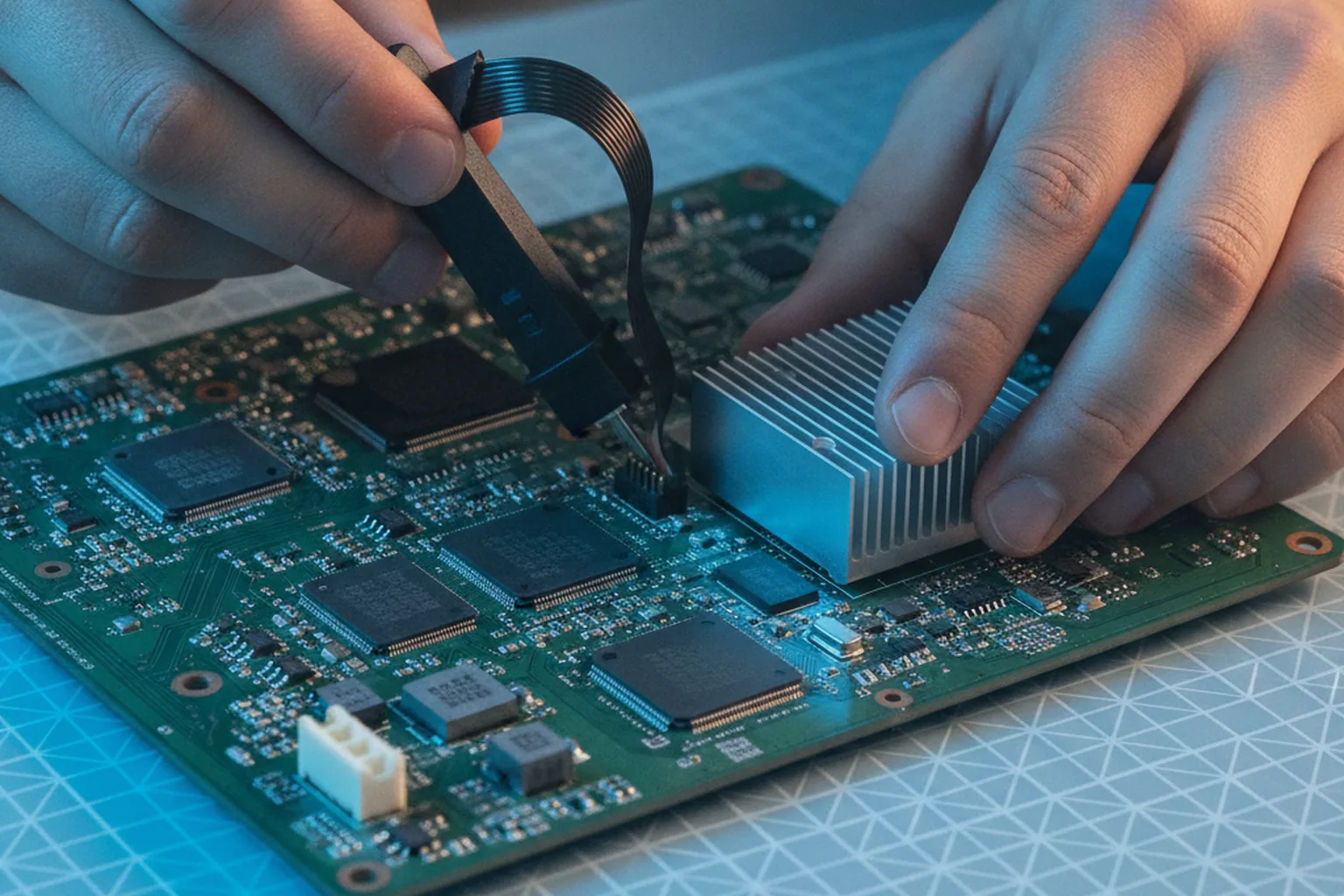

System software development is the discipline of building the software layer that sits between hardware and the applications people use. It includes operating system kernels, device drivers, firmware, bootloaders, hypervisors, compilers and the system services that keep a machine running. If application software is the part users see, system software is the part that decides whether the device boots, stays stable and stays secure.
Most companies meet this work when they build a hardware product, port an operating system to a new board or need a driver nobody sells off the shelf. That is the point where teams usually bring in system software and embedded firmware development specialists, because the skills differ sharply from web or mobile engineering: memory is managed by hand, timing matters to the microsecond and a single bug can halt the whole machine.
The rules are changing too. In December 2025 Rust stopped being an experiment in the Linux kernel, US agencies asked software makers to publish memory-safety roadmaps by January 2026, and the EU Cyber Resilience Act starts its vulnerability reporting duties in September 2026.
This guide explains what system software is, its main types, the languages and process behind it, how it is tested, what it costs and how to choose a development partner.
What is system software development?
System software development is the design, coding, testing and maintenance of programs that manage hardware resources and provide a platform for other software. Its users are usually not people but other programs: an app asks the operating system for memory, the operating system asks a driver to talk to a network card, and the driver relies on firmware inside the card.
Three properties define system software and set it apart from ordinary business code:
- Direct hardware access: the code reads and writes registers, handles interrupts and manages memory without a safety net.
- Privilege: much of it runs in kernel mode (the most privileged processor state, with unrestricted access to memory and hardware) or below it, so a fault can crash or compromise the entire system, not just one process.
- Longevity: kernels, drivers and firmware stay in service for many years, often on devices that are hard to update in the field.
So system software projects put more weight on architecture, review and testing than on shipping features fast. Speed comes second. A broader map of where this work fits among other disciplines is in our overview of the types of software development.
System software vs application software: what is the difference?
System software manages the computer and serves other programs, while application software serves people doing a specific task. A spreadsheet, a CRM or a banking app is application software; the kernel, file system and graphics driver underneath them are system software. The table compares the two in practical terms.
| Aspect | System software | Application software |
|---|---|---|
| Main purpose | Manage hardware and provide a platform | Help users complete tasks |
| Typical examples | Kernels, drivers, firmware, hypervisors, compilers | Web apps, mobile apps, ERP, CRM, games |
| Execution level | Kernel mode, firmware, bare metal | User mode on top of an operating system |
| Common languages | C, C++, Rust, assembly | TypeScript, Python, Java, C#, Swift, Kotlin |
| Cost of a bug | System crash, bricked device, security breach | Failed feature, error page, data issue |
| Testing | Emulators, real hardware, fuzzing, timing analysis | Unit, integration and UI tests in CI |
| Update cycle | Slow and staged, often signed OTA | Frequent, often several times a week |
The line between system and application software is not always sharp. Databases, web servers and container runtimes sit in between and are sometimes called platform or infrastructure software. If your project is mainly user-facing, our guide to software application development is the better starting point.
What are the main types of system software?
System software falls into six main types: operating systems and kernels, device drivers, firmware and bootloaders, hypervisors, development toolchains and system utilities. Each type needs a different mix of skills. Scope the project by type first, and finding the right engineers gets much easier.
Operating systems and kernels
An operating system kernel schedules processes, manages memory, handles interrupts and exposes system calls to applications. Very few companies write a kernel from scratch; most customise an existing one. Typical projects are:
- porting Linux or an RTOS (real-time operating system, built to meet strict timing deadlines) such as Zephyr or FreeRTOS to a new board;
- building a minimal Linux image with Yocto or Buildroot;
- tuning the scheduler for real-time behaviour;
- hardening the kernel configuration for a regulated product.
Device drivers
A device driver is the code that lets an operating system control a specific piece of hardware, such as a sensor, camera, storage controller or network interface. Driver development is one of the most frequent system software requests from hardware companies, because every new chip or peripheral needs one for each operating system it supports. Drivers run with high privilege, which makes them a frequent source of crashes and security flaws when written carelessly.
Firmware, bootloaders and board support packages
Firmware is the software stored on the device itself that initialises hardware and, on microcontrollers, often is the whole product. The bootloader loads and verifies the next stage of software, and a board support package (BSP) bundles the drivers and configuration an operating system needs to run on a specific board. Secure boot, A/B partitions and signed over-the-air updates live in this layer. The embedded side of this work is covered in depth in our guide to embedded software development.
Hypervisors and virtualization
A hypervisor lets one physical machine run several isolated operating systems. Type 1 hypervisors such as KVM, Xen or VMware ESXi run directly on hardware; type 2 hypervisors run on a host operating system. In embedded and automotive products, hypervisors increasingly separate a safety-critical real-time system from an infotainment or Linux system on the same chip, which makes virtualization a growing niche of system software work.
Compilers, runtimes and toolchains
Compilers, linkers, debuggers and language runtimes turn source code into machine code and keep it running. Companies rarely build a compiler, but they often need toolchain work: adding support for a custom processor to LLVM or GCC, building a cross-compilation pipeline or tuning a runtime for constrained hardware. Our list of embedded software development tools shows the toolchain options teams pick from in 2026.
System utilities and services
System utilities handle the routine work of a running machine: file systems, backup agents, monitoring daemons, power management, logging and security agents. They often run in user space but need deep knowledge of the operating system they serve, and in 2026 the trend is to move as much of this code as possible out of the kernel to reduce the impact of failures.
Is system software development the same as systems development?
No. System software development builds low-level software such as kernels and drivers, while systems development usually means the process of building any information system, often described by the systems development life cycle (SDLC). The names are easy to mix up, so it helps to separate three phrases:
- System software development: engineering operating systems, drivers, firmware and other platform software, which is the subject of this guide.
- Systems development: a process for planning, analysing, designing, building and maintaining an information system, such as an ERP or a booking platform. The phases are explained in our software development life cycle guide.
- System development software: the tools used to build software, such as IDEs, compilers, version control and CI servers. Some of these tools are themselves system software, which is where the terms overlap.
When you brief a vendor, name the layer explicitly, for example "Linux driver for a new image sensor" rather than "system development". That single sentence saves a round of clarifying calls.
Which programming languages are used for system software in 2026?
C remains the dominant language for system software in 2026, C++ is common in larger platforms and drivers, and Rust is a fast-growing choice for new code because it prevents whole classes of memory bugs at compile time. Assembly is still needed for boot code, context switching and hand-tuned hot paths.
| Language | Where it is used | Strengths | Watch-outs |
|---|---|---|---|
| C | Kernels, drivers, firmware, RTOS | Universal toolchain support, predictable output, huge code base | No memory safety; needs strict standards such as MISRA C, a safety-focused set of C coding rules |
| C++ | Large drivers, hypervisors, browsers, game engines | Abstractions without runtime cost, rich libraries | Complexity; same memory risks as C if misused |
| Rust | New kernel modules, drivers, firmware, security-critical components | Memory and thread safety by default, modern tooling | Smaller talent pool, maturing support on some microcontrollers |
| Assembly | Boot code, interrupt entry, context switching | Full control of the processor | Not portable, hard to review |
| Go, Zig | System utilities, container tooling, cross-compilation | Fast builds, simple deployment | Go’s garbage collector rules it out for kernels and hard real time |
Why is Rust moving into kernels and drivers?
Rust is moving into system software because most serious security bugs in low-level code are memory-safety bugs, and Rust removes most of them by design. At the 2025 Kernel Maintainers Summit the Linux community decided that Rust support is no longer experimental, and a December 2025 patch removed the "experiment" label from the documentation, making C, assembly and Rust the kernel’s core languages. Google reported in 2024 that memory-safety issues fell from 76% of Android vulnerabilities in 2019 to 24% in 2024 as new code moved to memory-safe languages.
The practical approach to Rust in system software in 2026 is not a full rewrite. Teams keep proven C code, write new drivers and parsers in Rust where the platform supports it, and wrap the boundary carefully.
How does the system software development process work?
The system software development process follows the familiar stages of planning, design, build, test and release, but every stage is tied to physical hardware and its constraints. A typical project moves through eight steps:
- Requirements and constraints: define what the software must do and the limits it must respect, such as memory, power, boot time, real-time deadlines and safety level.
- Hardware and platform selection: choose or confirm the processor, operating system or RTOS, and licensing model before code is written.
- Architecture: split the system into layers (boot, kernel, drivers, services), define interfaces and decide what runs in kernel space versus user space.
- Board bring-up: get the first boot on real or prototype hardware, with clocks, memory and a debug console working.
- Implementation: write drivers, kernel changes and services in small reviewed increments, with static analysis running on every commit.
- Verification: test on emulators, hardware-in-the-loop (HIL) rigs, where the software runs on real hardware fed with simulated signals, and the real device, including stress, power-loss and fuzz testing (feeding random or malformed input to find crashes).
- Certification and release: produce the evidence required by standards such as IEC 62304, ISO 26262 or IEC 61508 where they apply, sign the images and plan the rollout.
- Maintenance: track vulnerabilities, ship signed updates with rollback, and keep up with new kernel and toolchain versions.
Agile methods work well for system software projects, with one adjustment: sprints have to plan around hardware availability and lab time. The overall phases are the same ones described in our SDLC guide; the difference lies in how much evidence each phase must produce.
How do you test and debug system software?
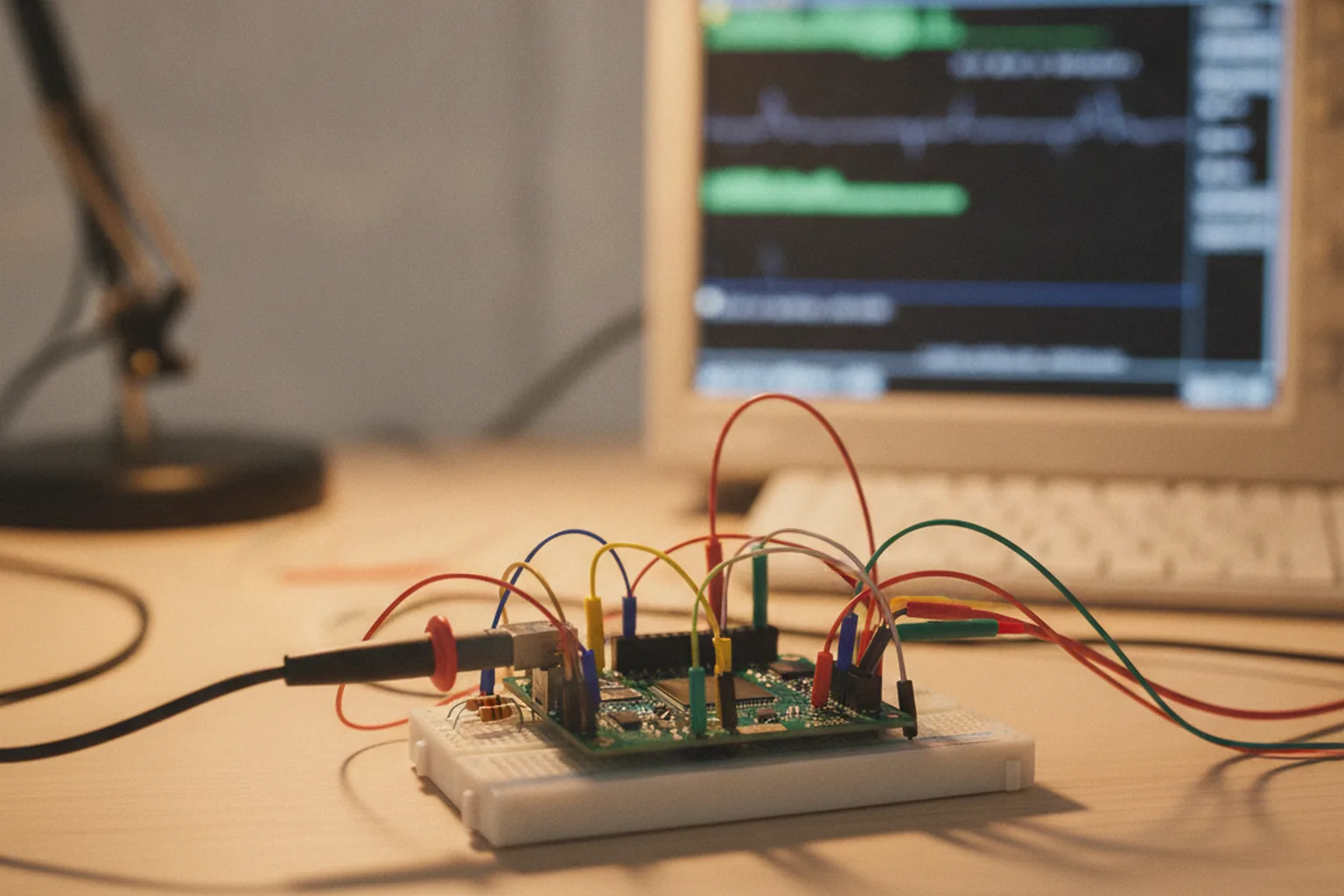
System software is tested in layers: static analysis and unit tests on the developer machine, emulators for fast integration testing, and hardware-in-the-loop rigs and real devices for timing, power and failure behaviour. Skipping the hardware layer is a common reason low-level code passes CI and then fails in the field.
| Technique | What it catches | Typical tools |
|---|---|---|
| Static analysis and coding standards | Undefined behaviour, unsafe patterns, rule violations | MISRA C checkers, Clang static analyzer, Coccinelle, sparse |
| Unit tests on host | Logic errors in isolated modules | Unity, CppUTest, GoogleTest, cargo test |
| Emulation | Boot and integration issues without hardware | QEMU, Renode |
| Hardware-in-the-loop | Timing, interrupts, peripheral behaviour | Custom rigs, programmable power supplies, signal generators |
| On-chip debugging | Crashes, hangs, register state | JTAG and SWD probes, GDB, trace units |
| Fuzzing and sanitizers | Memory corruption, race conditions, input handling bugs | syzkaller, KASAN, AddressSanitizer, libFuzzer |
| Logic and signal analysis | Bus protocol and electrical timing faults | Logic analyzers, oscilloscopes |
Two habits help on nearly every project:
- Crash and log collection: build a collection path into the product early, because field failures are hard to reproduce on the bench.
- Power-cycle and update-interruption tests: automate them, since a device that bricks when power fails mid-update is one of the costliest defects in this field.
What security and compliance rules shape system software in 2026?
In 2026 system software is shaped by three forces: pressure to adopt memory-safe languages, new legal duties for products with digital elements, and the push to move risky code out of the kernel. All three change how you should plan new low-level code.
- Memory-safety roadmaps: the CISA and FBI guidance on Product Security Bad Practices asks manufacturers of software written in memory-unsafe languages to publish a memory-safety roadmap by 1 January 2026. It’s guidance, not law. But enterprise and government buyers now ask for it.
- EU Cyber Resilience Act: Regulation (EU) 2024/2847 requires manufacturers to report actively exploited vulnerabilities from 11 September 2026, and its full requirements apply from 11 December 2027. Firmware and drivers in products sold in the EU fall within its scope.
- Less code in the kernel: after a faulty update to a kernel-mode security driver crashed about 8.5 million Windows devices in July 2024, Microsoft launched the Windows Resiliency Initiative, which includes a platform for running endpoint security outside the kernel. Expect the same principle in driver reviews: keep privileged code as small as possible.
- Supply-chain transparency: software bills of materials (SBOMs, machine-readable lists of every component in a build), signed builds, secure boot and verified updates are becoming standard requirements in procurement checklists.
None of this needs a separate process. Memory-safety, Cyber Resilience Act and supply-chain requirements slot into a secure development process. Our guide to the secure software development life cycle explains how to build threat modelling, code review and vulnerability handling into each phase.
What skills does a system software team need?
A system software team needs engineers who understand both code and hardware: computer architecture, operating system internals, concurrency, low-level debugging and the electrical side of the devices they program. A strong team for a typical hardware product combines the roles below.
| Role | Main responsibility | Key skills |
|---|---|---|
| System architect | Platform choice, layering, interfaces, safety concept | OS internals, processor architectures, standards |
| Kernel and driver engineer | Drivers, kernel patches, BSPs | C, Rust, Linux or RTOS internals, concurrency |
| Firmware engineer | Bootloaders, bare-metal code, power management | C, assembly, microcontrollers, peripherals |
| Build and release engineer | Toolchains, Yocto or Buildroot images, signing, OTA | Build systems, CI, cryptographic signing |
| Test and validation engineer | HIL rigs, fuzzing, regression suites | Test automation, lab equipment, scripting |
| Security engineer | Threat models, secure boot, vulnerability handling | Exploit mitigation, cryptography, SBOM tooling |
Small products don’t need six people; one senior engineer often covers architecture, drivers and firmware. What matters is that someone on the team has shipped low-level code to production hardware before and knows how it fails.
How much does system software development cost?
System software development usually costs more per feature than application work, because it needs senior engineers, lab hardware, longer test cycles and, in regulated sectors, certification evidence. Lines of code tell you little about the budget. These factors tell you much more:
| Cost driver | Why it matters | Impact on budget |
|---|---|---|
| Safety or regulatory level | Standards such as ISO 26262 or IEC 62304 require traceability and test evidence | High |
| Hardware maturity | Unstable prototype boards slow bring-up and debugging | High |
| Number of platforms | Each OS, kernel version or chip variant needs its own build and tests | Medium to high |
| Real-time requirements | Hard deadlines need timing analysis and specialised testing | Medium to high |
| Reuse of open source | Linux, Zephyr or vendor SDKs can remove months of work | Lowers cost |
| Update and security features | Secure boot, signed OTA and rollback add scope but prevent field recalls | Medium |
For connected devices, YuSMP fixed-scope embedded and IoT engagements start at:
- $3,500 for an IoT MVP;
- $5,800 for device management;
- $9,200 for telemetry with a dashboard;
- $11,500 for a full IoT platform.
Driver, BSP and OS porting work beyond those packages is estimated after a short technical discovery, because hardware maturity changes the effort more than any other factor. Plan a yearly maintenance budget too: kernels, toolchains and vulnerability fixes keep moving after launch.
Should you build, buy or use open source?
Most companies should start from open source or a commercial platform and build only the parts that make their product different. Writing an operating system from scratch is rarely justified; writing a custom driver for your own hardware almost always is.
- Use open source (Linux, Zephyr, FreeRTOS, U-Boot) when you need broad hardware support and a large community. Check licences early: the Linux kernel is GPLv2, so kernel modules you distribute generally need source availability, while FreeRTOS is MIT licensed.
- Buy a commercial RTOS or hypervisor when you need pre-certified components for automotive, medical, avionics or industrial safety, where certification evidence is worth more than licence savings.
- Build custom for drivers of your own hardware, product-specific services, power management tuned to your use case and security features that set you apart.
A useful rule: own the code that touches your unique hardware and your customer data path, and reuse everything else.
How do you choose a system software development partner?
Choose a system software partner by evidence of shipped low-level code, not by general software credentials. A vendor with excellent web work may have no one who can read a datasheet or debug a hung interrupt handler. Ask these questions before you sign:
- Which drivers, BSPs or kernel changes have you shipped to production devices, and on which processors?
- Which operating systems and RTOS versions does the team work with today?
- How do you test without final hardware, and what does your hardware-in-the-loop setup look like?
- Which coding standard and static analysis tools run in your CI pipeline?
- Do you write new components in Rust, and how do you handle the C and Rust boundary?
- How do you implement secure boot, signed updates and rollback?
- Can you produce evidence for IEC 62304, ISO 26262 or IEC 61508 if our product needs it?
- How do you handle open source licence compliance, especially GPL code?
- Who owns the source code, build scripts and signing keys at the end of the project?
- How will you support vulnerability fixes and kernel updates after launch?
Red flags include no lab equipment, no answer on update rollback, vague IP terms and estimates given before anyone has looked at the hardware. Good partners ask for schematics and datasheets in the first conversation. For connected products, the cloud and device management side is covered in our guide to IoT software development.
What is next for system software in 2026–2027?
Over the next two years, system software will be shaped by memory-safe languages, smaller trusted kernels and stricter product security law. Plan for five trends:
- More Rust in production kernels and firmware: new Linux drivers, Android components and microcontroller firmware increasingly start in Rust.
- Code moving out of the kernel: security agents, file systems and drivers shift to user space or isolated domains where the platform allows it.
- Mixed-criticality systems on one chip: hypervisors separate real-time safety functions from general-purpose operating systems in cars, robots and industrial controllers.
- Edge AI accelerators: new neural processing units need drivers, runtimes and scheduling support, creating demand for driver and toolchain engineers.
- Compliance as a feature: SBOMs, vulnerability reporting and long-term update commitments become part of the product, driven by the EU Cyber Resilience Act timeline.
Teams that invest now in clean layering, automated hardware testing and a memory-safety plan will meet the 2027 requirements with process changes rather than emergency rewrites.
System software development: FAQ
What is system software development?
System software development is the design, coding, testing and maintenance of low-level software that manages hardware and provides a platform for other programs. It includes operating system kernels, device drivers, firmware and bootloaders, hypervisors, compilers and system utilities. The work is usually done in C, C++, Rust and assembly and is tested on emulators and real hardware.
What is the difference between system software and application software?
System software manages the computer and serves other programs, while application software helps people complete specific tasks. Kernels, drivers and firmware are system software; web apps, mobile apps, CRM and ERP systems are application software. System software usually runs with higher privilege, so its bugs can crash or compromise the whole machine.
Is system development software the same as system software development?
No. System development software usually means the tools used to build software, such as compilers, IDEs, version control and CI servers. System software development is the engineering of operating systems, drivers, firmware and similar platform software. Systems development, a third term, refers to the life cycle for building information systems such as ERP platforms.
Which language is best for system software development?
C is still the most widely used language for system software because every processor and operating system supports it. C++ is common for larger drivers and platforms, and Rust is the strongest choice for new security-critical code because it prevents most memory-safety bugs at compile time. Since December 2025 Rust has been an official core language of the Linux kernel alongside C and assembly.
What are examples of system software?
Common examples are operating systems such as Linux, Windows and macOS, real-time operating systems such as Zephyr and FreeRTOS, device drivers for graphics cards, storage and network adapters, firmware and bootloaders such as UEFI and U-Boot, hypervisors such as KVM and Xen, and compilers such as GCC and LLVM.
How long does system software development take?
A single driver for a well-documented peripheral can take a few weeks, while a board support package and OS port for new hardware typically takes several months. Projects that need safety certification, multiple platforms or a custom real-time system take longer, because test evidence and hardware availability set the pace more than coding does.
Do I need to follow the EU Cyber Resilience Act for firmware?
If you sell a product with digital elements in the EU, its firmware and drivers fall within the scope of Regulation (EU) 2024/2847. Manufacturers must report actively exploited vulnerabilities from 11 September 2026, and the full security requirements apply from 11 December 2027. Plan secure updates, SBOMs and vulnerability handling now and confirm your obligations with counsel.
Sources
- The Linux Kernel documentation, Rust in the Linux kernel; DevClass, Rust boosted by permanent adoption for Linux kernel code (15 December 2025)
- CISA and FBI, Product Security Bad Practices
- EUR-Lex, Regulation (EU) 2024/2847 (Cyber Resilience Act)
- Google Security Blog, Eliminating Memory Safety Vulnerabilities at the Source (September 2024)
- Microsoft, The Windows Resiliency Initiative: building resilience for a future-ready enterprise (26 June 2025)
- Wikipedia, System software