What we build
Custom ERP systems, individual ERP modules, extensions for platform ERPs, integrations, data migration from legacy systems, mobile and terminal apps for the floor, and long-term support.
We build ERP software that runs your operations the way they actually work: finance, inventory, purchasing, production, HR and reporting on one shared set of data. Sometimes that means a custom ERP written from scratch. Often it means new modules and integrations around Dynamics 365, NetSuite or Odoo. It is part of our custom software development practice, so one team owns the data model, the integrations and the apps.
GDPR-aligned · ISO 27001 ready · SOC 2 Type II in progress · HIPAA-capable · CCPA-acknowledged · CET workday with 9 AM–1 PM ET overlap
Custom ERP development is the design and build of enterprise resource planning software around your own products, warehouses, approval rules and reports. A packaged ERP asks you to adopt its standard processes. A custom ERP, or a custom layer on top of a platform, adapts to the processes that make your business different.
Most companies come to us at one of two moments. Either spreadsheets and disconnected tools have stopped scaling, or an ERP is already in place but its gaps are filled with manual exports and workarounds. Our ERP software development guide with costs and pitfalls covers the decision in depth. When the ERP is one of several connected systems, our enterprise software development team plans the wider program.
Custom ERP systems, individual ERP modules, extensions for platform ERPs, integrations, data migration from legacy systems, mobile and terminal apps for the floor, and long-term support.
Custom stacks (Laravel, Node.js, .NET, React, PostgreSQL) and extensions for Microsoft Dynamics 365 Business Central, Oracle NetSuite, Odoo and SAP Business One through their APIs.
Manufacturers, distributors, retail and logistics operators, and service companies whose processes no longer fit a standard ERP or a pile of spreadsheets.
A short paid discovery that maps processes and data and fixes the first-release scope. Then a fixed-price build or a dedicated team, delivered module by module.
Custom ERP development includes process analysis, the data model, the modules themselves, integrations with the systems around them, data migration, rollout and support.
The software is only half of the job. An ERP sits in the middle of the business, so every decision about it is also a decision about who owns which data, which approvals are required and which report management will trust. That is why our projects start with how orders, stock and money really move through your company, not with screens.
There are three ways to reach the result:
Whichever route fits, the project should leave you with outcomes you can check:
Our ERP development services cover the full lifecycle, from the first audit to support years after go-live. You can start with a single module or hand us the whole program.
We map how orders, stock, purchases and payments move today, find where data is entered twice or lost, and review the systems you already pay for. You get a clear recommendation: extend what you have, replace it in stages, or build. You get: process maps, a requirements backlog, an integration map and a roadmap with priorities.
An ERP built from scratch around your data model: products, bills of materials, warehouses, price lists, cost centres and the relationships between them. Web interfaces for office roles, mobile and terminal apps for the floor, one back end and one API. You get: source code, an admin panel, API documentation and deployment scripts you control.
Customized ERP development for one area that your current system handles badly: production planning, a warehouse module, field service, project costing or a supplier portal. The module plugs into your existing ERP and accounting instead of replacing them. You get: a working module, its integration and documentation.
Extensions for Microsoft Dynamics 365 Business Central and Finance and Operations, Oracle NetSuite, Odoo and SAP Business One: custom entities and workflows, reports, approval flows and companion apps built on the platform APIs, so upgrades stay possible. You get: extensions that survive version updates.
Two-way sync between the ERP and your CRM, online store, banks and payment providers, marketplaces, BI and warehouse hardware. We agree which system owns each field, then build connectors with retries, logging and alerts. You get: an integration map and connectors your team can monitor.
Moving products, customers, open orders, balances and history out of an old ERP or spreadsheets. We clean and map the data, run trial migrations and reconcile totals with finance before cut-over. Old systems are replaced module by module through our software modernization practice. You get: reconciled data and a cut-over plan.
Apps for the people who never sit at a desk: warehouse scanning, picking and inventory counts, production reporting, field sales and service. Offline mode, barcode and QR scanning, handheld terminals and scales, built by our mobile development team. You get: apps that write straight into the ERP.
Dashboards and reports on top of clean ERP data: margins by product and customer, stock turnover, production plan versus actual, cash flow. A reporting database keeps heavy queries away from day-to-day transactions. You get: reports management uses instead of exporting to spreadsheets.
Bug fixes, monitoring, security updates, platform version upgrades and new features after go-live, with agreed response times. The same engineers who built the system keep it running. You get: a support plan, a release schedule and a backlog you can see.
An off-the-shelf ERP fits when standard accounting, purchasing and inventory cover most of your work; a custom ERP fits when your operations are the advantage and the platform keeps getting in the way. Many companies end up in between. The table compares the three routes.
| Criterion | Off-the-shelf ERP (NetSuite, Dynamics 365, SAP as configured) | Customized platform ERP (platform + custom modules) | Fully custom ERP |
|---|---|---|---|
| Process fit | Standard processes; the business adapts to the software | Close fit where custom modules are added | Exact fit for every workflow and rule |
| Time to first use | Fastest for standard finance and inventory | Platform first, custom modules follow | Longest; an MVP of core modules can go live first |
| Upfront cost | Lowest, plus implementation partner fees | Medium | Highest |
| Licence cost over 5 years | Grows with users, modules and add-ons | Platform licences plus development | No per-user licence; hosting and support only |
| Integrations | Marketplace connectors; gaps need middleware | Connectors plus custom APIs | Any system, including legacy and hardware |
| Upgrades | Vendor-driven, on the vendor's schedule | Extensions must be tested on every platform update | On your schedule |
| Data and hosting | Vendor cloud, vendor terms | Vendor cloud plus your extensions | Your cloud or your own servers |
| Ownership | You rent the software | You own the extensions, rent the core | You own code, data model and documentation |
| Maintenance | Vendor handles the core | Shared: vendor core, your extensions | Your team, or a support contract with us |
We will tell you during discovery if a platform is the better answer. A longer cost comparison across several years is in our build vs buy guide for enterprise software.
We build the ERP modules that carry your operations, either as one connected system or one module at a time next to software you keep.
General ledger links, accounts payable and receivable, invoicing, cost centres, budgets and multi-currency. Often we connect operations to an accounting system you already use; see our guide to custom accounting software development.
Stock by location and batch, receiving, put-away, picking, transfers, counts, barcode and QR labels, scales and handheld terminals. More in our inventory management software guide.
Purchase requests, approval limits, supplier price lists, purchase orders, goods receipt and three-way matching with invoices.
Bills of materials, routings, production orders, material requirements, shop-floor reporting and order status that partners can check without calling the factory. Background in our manufacturing software development guide.
Quotes, price lists, discounts, orders, shipments and returns. When sales teams need a full pipeline, we connect the ERP to a CRM through our custom CRM development service.
Demand planning, replenishment between warehouses and stores, delivery planning and carrier integration. See our supply chain software development guide.
Employee records, time tracking, leave and the data payroll needs. HRMS work is covered in detail in the section below.
Project budgets and costing, work orders, technician scheduling, checklists with photos, and time and materials billed back to the ERP.
Approval routing, e-signature, a document archive linked to orders and contracts, plus dashboards on a separate reporting database.
HR and HRMS software development covers the people side of an ERP: who works where, when, on what terms and at what cost.
Some clients need an HR module inside a custom ERP so that labour costs land on the right production order or project. Others need a standalone HRMS that syncs with the ERP and payroll provider they already use. In both cases we build the same core pieces:
HR data is personal data, so access is role-based, every change is logged, and sensitive fields are encrypted. For a wider look at HRIS, HRMS and HCM options, read how to build a custom HR system.
Yes. We extend and integrate platform ERPs through their official APIs and extension models, and we help you decide whether to extend a platform or replace parts of it with custom software.
For Dynamics 365 Business Central and Finance and Operations we build extensions, custom entities, reports and approval flows, plus web and mobile companion apps and integrations with Microsoft 365. Document-heavy processes often pair it with our SharePoint development work. The same approach covers Dynamics CRM modules when sales and operations share data.
Integrations through SuiteTalk and REST APIs, custom records and scripts, and external apps for warehouses, portals or field teams that read and write NetSuite data.
Custom Odoo modules in Python, data migration into Odoo, and connectors to online stores, marketplaces and BI. Odoo is open source, so the line between platform and custom is easy to move later.
Integrations and companion apps through the Service Layer and other official interfaces. For older or in-house systems without an API, we build an integration layer that reads and writes data safely.
Our advice on extending a platform versus replacing parts of it is based on your processes and the total cost over several years, not on a preferred vendor.
We integrate an ERP by first deciding which system owns each piece of data, then building monitored connectors around that rule, and we migrate data through repeated trial runs reconciled with finance.
Many ERP problems turn out to be integration problems: two systems both think they own the price list, or a night batch fails and nobody notices until stock is wrong. Our integration work follows a few rules:
For high-volume exchanges we have built a custom enterprise service bus that syncs several databases in parallel. Patterns and trade-offs are in our enterprise system integration guide.
Behind every ERP is a database design that decides how fast it runs and how easily it changes. We design the transactional schema, indexing and partitioning for growing volumes, a separate reporting database or warehouse for analytics, and backup and recovery that has actually been tested. Teams looking for a custom database development company often need exactly this layer, whether or not the ERP itself is custom.
AI fits into a custom ERP where it removes routine work or flags risk early, and a person still approves anything that moves money or stock.
Demand and replenishment forecasts from sales history and seasonality, shown as suggestions buyers can accept or change.
Reading supplier invoices, delivery notes and contracts, matching them to orders and sending exceptions to a person.
Unusual write-offs, duplicate payments, price changes or stock movements flagged for review before month end.
Natural-language questions over ERP data, such as stock for a product or the status of an order, with answers limited by the user's role.
Models run on data you control, with logging of what the model suggested and who approved it. Our AI, ML and data team handles the models and data pipelines.
We deliver ERP projects in six phases, and we roll the system out module by module. Each phase ends with something you can review and approve before the next one starts.
Workshops with finance, operations, warehouse, sales and management; a review of current systems, spreadsheets and reports; a list of integrations and data sources. Deliverable: process maps, a requirements backlog and a recommendation on custom, platform or hybrid.
Entities and relationships, roles and approval rules, the integration map with an owner for every field, hosting and security design. Deliverable: data model, integration design and a fixed first-release scope with estimate.
Clickable screens for the key roles, tested with the people who will use them, designed by our UI/UX design team. We agree which modules go live first. Deliverable: approved prototype and a module-by-module release plan.
Development in two-week sprints with a demo at the end of each, connectors built alongside the modules, and trial data migrations from the first sprints. Deliverable: working modules on a staging environment with real, migrated data.
Automated and manual testing by our QA testing engineers, load tests on realistic volumes, a parallel run against the old system and user acceptance with each team. Deliverable: signed-off release and reconciled numbers.
Cut-over at a quiet moment, role-based training, a hypercare period with the build team on call, then the next module or ongoing support. Deliverable: a live module, trained users and a support plan.
Going live module by module keeps the old system running for what is not replaced yet, which lowers the risk of a single big-bang cut-over.
The cost of custom ERP development depends mostly on the number of modules, integrations and users, the volume and quality of data to migrate, and compliance needs. Timelines follow the same drivers.
| Cost driver | Lower cost | Higher cost |
|---|---|---|
| Scope | One module next to an existing ERP | A full ERP replacing several systems |
| Integrations | A few systems with modern APIs | Many systems, legacy software, hardware on the floor |
| Data migration | Clean master data, little history | Years of history, duplicates, several sources to reconcile |
| Users and locations | One company, one site | Several legal entities, currencies, warehouses or plants |
| Apps and devices | Web interface only | Mobile apps, offline mode, terminals and scales |
| Compliance and hosting | Standard cloud hosting | On-premise deployment, audit and data residency rules |
A focused first release with a few core modules can go live as a fixed-scope MVP, which on our pricing page typically means 8 to 16 weeks. Our enterprise pricing puts an integration or extension of a system you already run from $9,200 (4 to 8 weeks) and an ERP-class, multi-system platform from $68,900 (20 to 32 weeks). A full ERP across several departments is delivered in stages, with each stage useful on its own. For ongoing development and support, our dedicated development teams start with a Mini team from $6,900 per month.
We quote after a short paid discovery, because an ERP estimate without process maps and an integration list is a guess. Market price ranges and a deeper breakdown are in our ERP software development guide.
We build security into an ERP through role-based access, segregation of duties, a complete audit trail and encryption, and we design for the regulations that apply to your data.
For regulated work, our security testing engineers can check the system before go-live.
We build ERP software for companies that move physical goods or schedule people and equipment, where standard ERPs need the most workarounds.
Production orders, bills of materials, shop-floor reporting and order status for partners. See manufacturing software.
Warehouse management, container and batch tracking, terminals and scales on the floor. See logistics software.
Warehouses and stores on shared stock data, replenishment, price lists and chain-wide reporting. See retail software.
Order, stock and price sync between online stores, marketplaces and the back office. See e-commerce development.
Pharmacy chains, clinics and labs that need batch control, warehouse accounting and strict access rules. See healthcare software.
Process control, maintenance and compliance records in plants with closed networks and offline work. See energy software.
These projects cover the core of an ERP: warehouses, production, stock across locations and the integrations between them. Each case describes the problem, what we built and the stack.
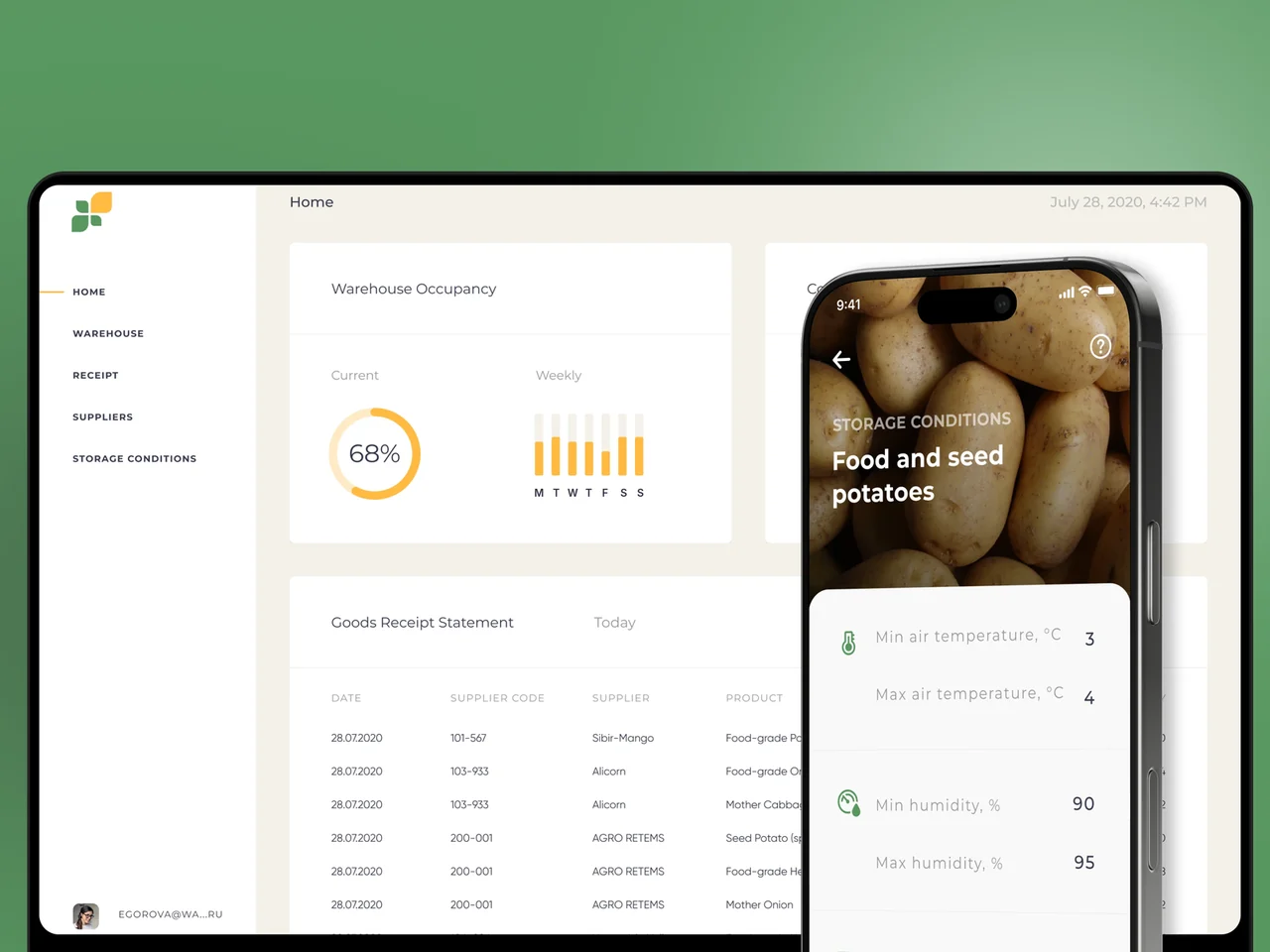
A manager dashboard, operator apps, QR container tags and industrial scales in one synchronized system that works offline on the storage floor.
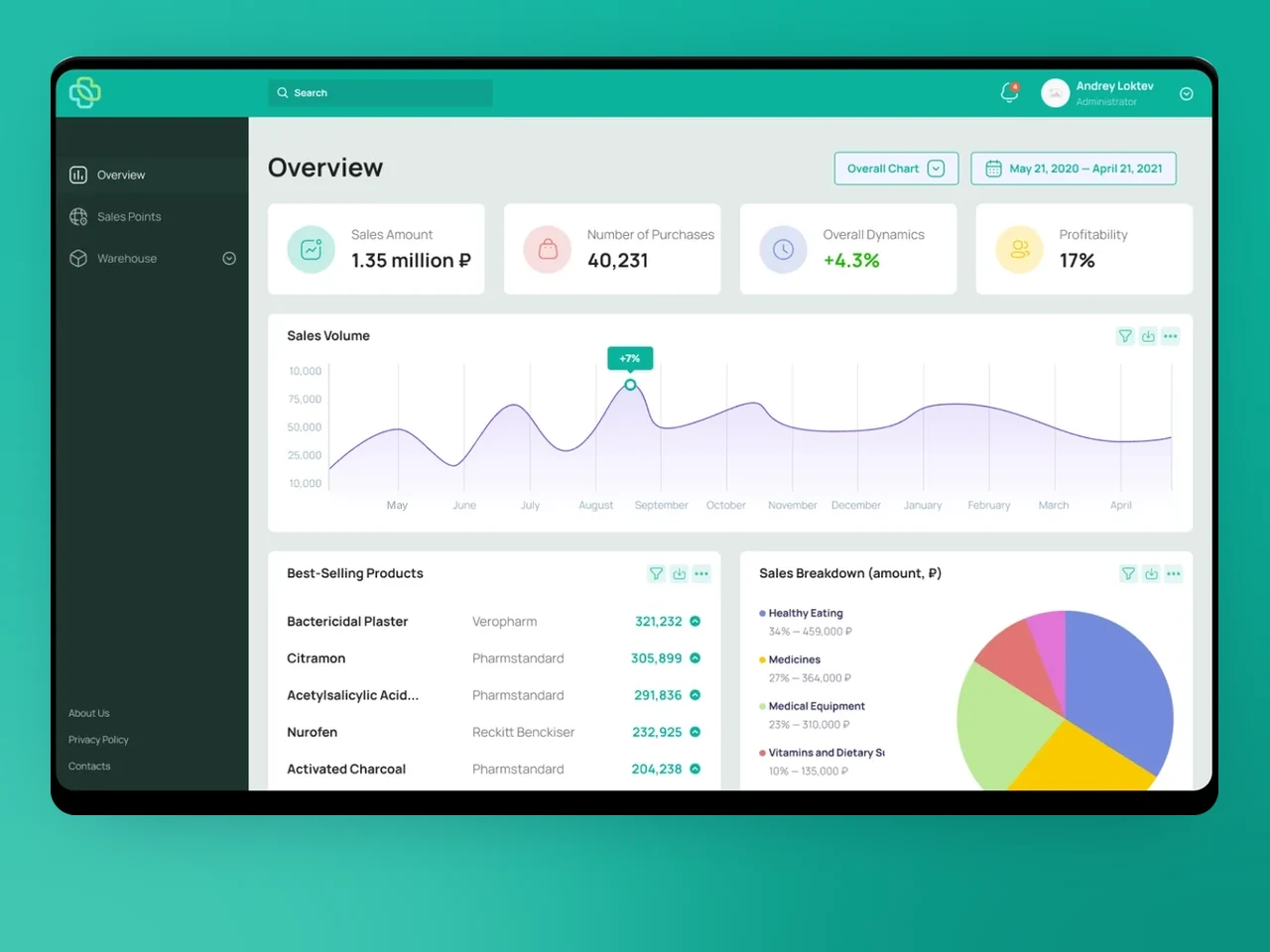
One web app that automates warehouse work, syncs warehouses with points of sale, connects data collection terminals and gives management real-time BI.
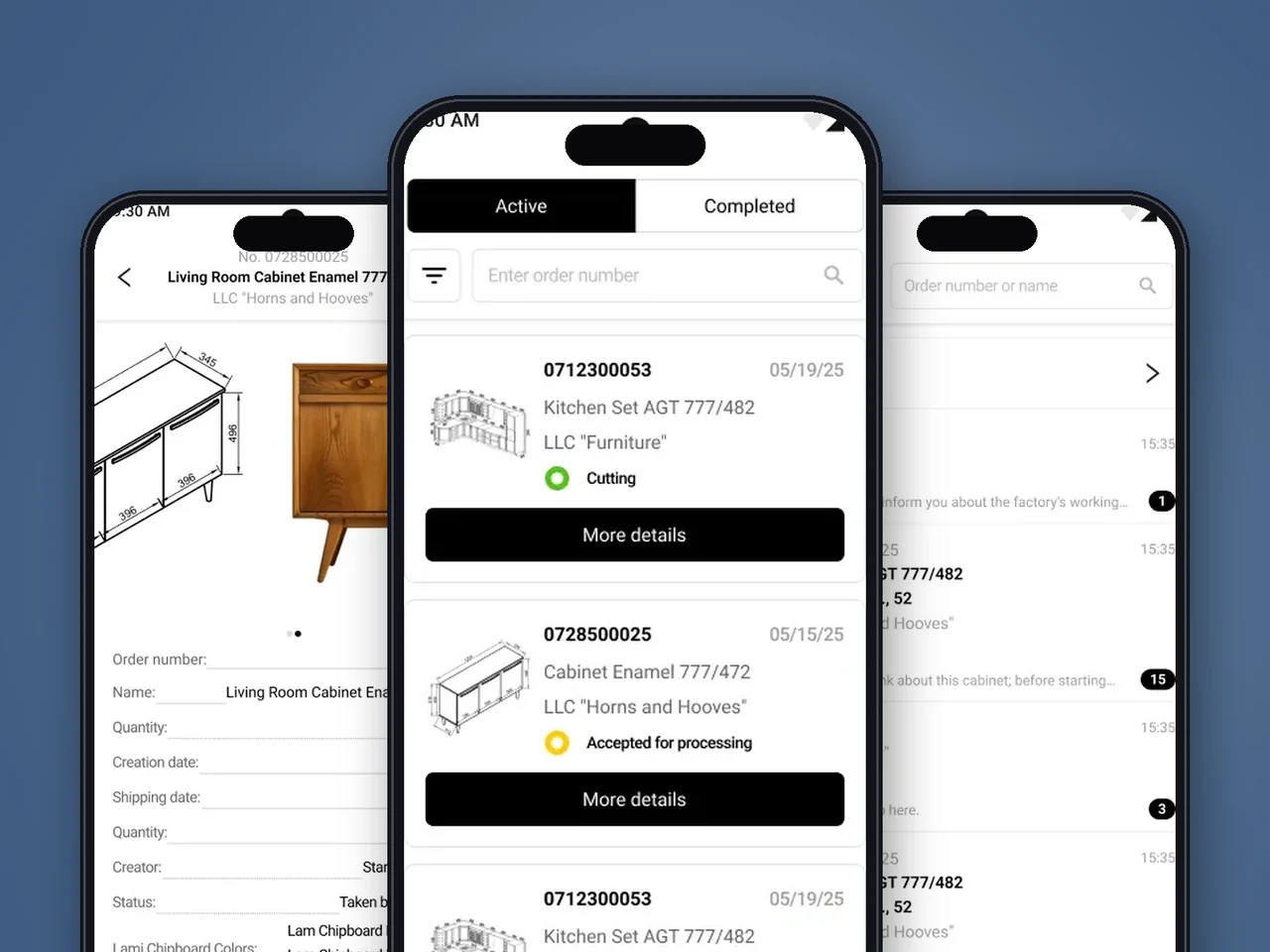
Order tracking through production, partner chats, two-way sync with the accounting system and deployment on the client’s own servers.
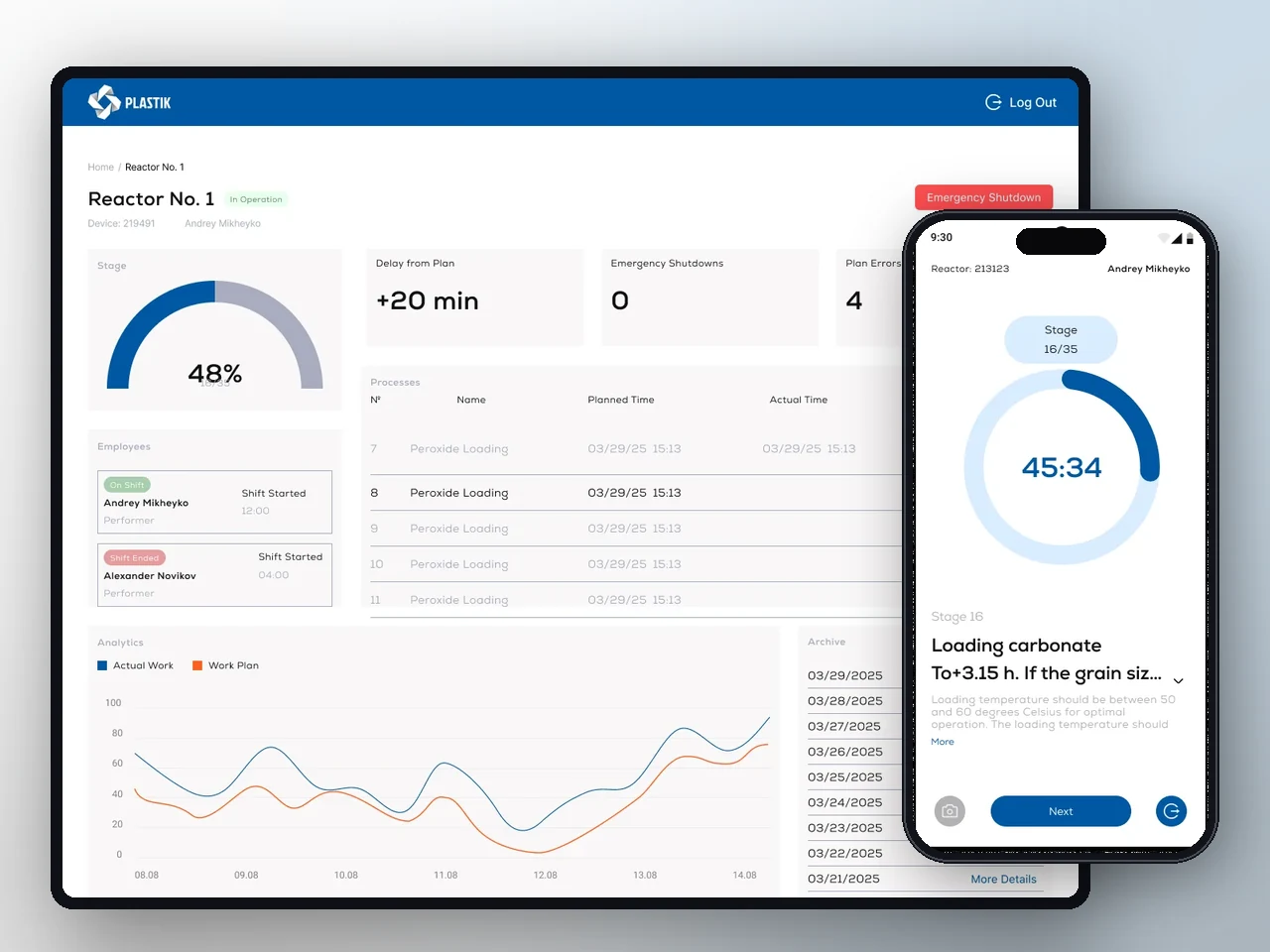
An offline Android app and two web panels that replace paper logs, recording every production stage with a timer and photo on the plant network.
For a vegetable storage company we built a warehouse management system with a manager dashboard, operator apps, QR container tags and industrial scales. A large pharmacy chain got one web app that links warehouses and stores and gives management real-time BI. A nationwide furniture maker tracks every order through production with two-way sync to its accounting system and hosting on its own servers. On the integration side, a custom data bus syncs several databases for a large online store. View all case studies →
You can work with us on an ERP in three ways, depending on how clear the scope is and how long the program will run.
| Model | Best for | How it is billed |
|---|---|---|
| Fixed-scope project | A first release, a single module or a set of integrations with a scope fixed in discovery | Agreed price and timeline, milestone payments |
| Dedicated ERP team | A multi-module ERP delivered in stages, plus long-term development and support | Monthly, per team |
| Staff augmentation | In-house ERP teams that need extra back-end, Dynamics, NetSuite or mobile engineers | Monthly, per engineer, via staff augmentation |
Evaluate an ERP development company by how it handles your processes, your data and the cut-over, not by the number of logos on its site. Lists of top ERP development companies and ERP software development firms make a good shortlist; these questions show who will actually deliver.
Why teams choose YuSMP. The company was founded in 2017, has delivered more than 120 projects for over 80 clients across the US, the EU and Asia, and works with senior-only engineers who overlap with US and European business hours. Warehouse, production and multi-location retail systems are part of that track record, as the cases above show. Read more about YuSMP.
The cost of custom ERP development depends on the number of modules, integrations and users, how much data has to be migrated and cleaned, mobile or terminal apps, and hosting and compliance rules. As a reference, our enterprise pricing starts at $9,200 for an integration or extension of a system you already run and at $68,900 for an ERP-class, multi-system platform. We start with a short paid discovery that fixes the first-release scope, then quote it at a fixed price. Ongoing work can run in a dedicated team from $6,900 per month.
A focused first release with a few core modules is usually delivered as a fixed-scope MVP, which typically takes 8 to 16 weeks. An ERP-class platform spanning several systems typically takes 20 to 32 weeks for its first full scope, and a wider ERP across finance, inventory, production and HR is delivered in further stages. Each stage goes live on its own, so the business starts using the system long before the last module is finished.
Neither is better in general. Off-the-shelf ERP suits companies whose accounting, purchasing and inventory follow standard practice and who want to go live quickly. Custom ERP suits companies whose operations are unusual, who need deep integration with legacy systems or hardware, or whose licence costs keep growing with headcount. Many clients choose a hybrid: a platform for accounting and custom modules for the operations that make them different.
Yes, and it is often the safest route. We build modules and companion apps that connect to Dynamics 365, NetSuite, Odoo, SAP Business One or an in-house system through official APIs, for example production planning, a warehouse floor app or a supplier portal. Your current ERP keeps doing what it does well, and the gaps are filled without a full migration.
Yes. We integrate ERP systems with CRMs, online stores and marketplaces, banks and payment providers, accounting and payroll systems, BI tools and warehouse hardware such as scanners, terminals and scales. Before building connectors we agree which system owns each field, and every connector has retries, logging and alerts so a failed sync is noticed quickly.
We map the old data to the new model, clean duplicates and gaps, and run several trial migrations into a test environment. After each run finance checks balances, open orders and stock against the old system. Only when the numbers match do we schedule the cut-over, usually at a quiet period, with a rollback plan.
You do. With a custom ERP the source code, data model, documentation, infrastructure scripts and admin access are handed over to you, and the data stays in your cloud account or on your own servers. With platform extensions you own the extension code, while the platform itself stays under the vendor's licence.
Yes. After go-live the build team stays on call during a hypercare period, then moves to a support plan with agreed response times: bug fixes, monitoring, security updates, platform upgrades and new features. Many clients keep a dedicated team that continues with the next modules on the roadmap.
Tell us which processes run on spreadsheets or workarounds today and which systems the ERP must connect to. We reply within one business day with questions and a suggested first scope.
Guides from our engineers on ERP modules, HR systems and inventory software.
Share a few details and a senior consultant will reply within one business day.
Email: sales@yusmpgroup.com
Phone: +374 44 871 811
Offices: KAMAR Business Center, Vazgen Sargsyan St. 2, Yerevan, Armenia · Remote — East-Coast US overlap (9 AM–1 PM ET)